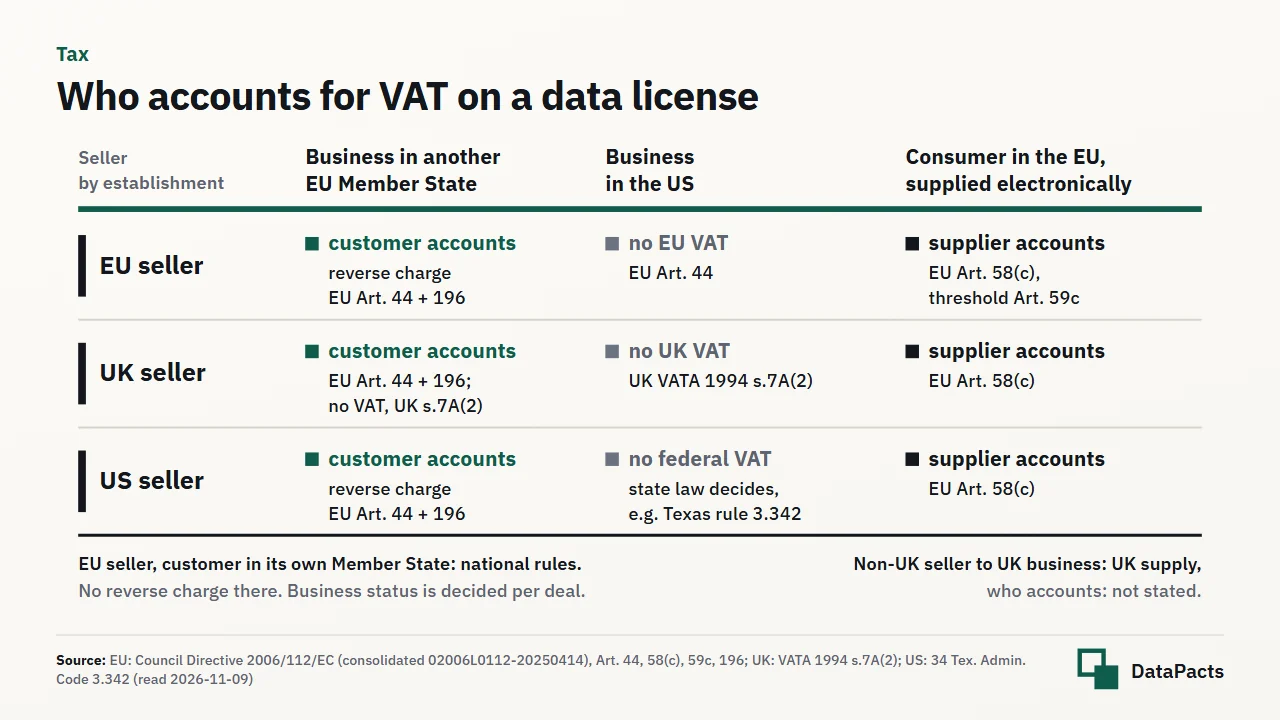
The United States has no federal VAT, and a state taxes a data license only where its own law taxes the service.
This page covers the routes, the EU business and consumer rules, UK section 7A, US state sales tax and the invoice items, using texts read on November 9, 2026. It is one tax question within AI training data licensing, and Texas is the only US state rule recorded here.
DataPacts Editorial Team checked the rules below against the official texts: how we source, date and check every figure.
Where a Data License Is Taxed: Seller and Customer Routes
The VAT on a data license follows two facts, whether the customer is a business or a consumer and where it is established, and the table applies them to the routes data sellers meet most often. EU provisions are cited from Council Directive 2006/112/EC as consolidated in 02006L0112-20250414 on EUR-Lex.
The table compares seven seller and customer routes, as of 2026-11-09, with the rule, the party that accounts for VAT and the source.
| Seller | Customer | Rule | Who accounts for VAT | Source |
|---|---|---|---|---|
| EU seller | business established in the US or elsewhere outside the EU | Art. 44: where the customer is established | no EU VAT on the supply | eur-lex.europa.eu |
| EU seller | business in another Member State | Art. 44 | customer, reverse charge (Art. 196) | eur-lex.europa.eu |
| EU seller | business in the seller's own Member State | Art. 44 | national rules; reverse charge not applicable; rate not stated | eur-lex.europa.eu |
| US, UK or other non-EU seller | business in an EU Member State | Art. 44 | customer, reverse charge (Art. 196) | eur-lex.europa.eu |
| any seller | consumer in the EU, dataset supplied electronically | Art. 58(c); intra-EU threshold Art. 59c(1)(c), EUR 10,000 as of 2026-11-09 | supplier | eur-lex.europa.eu |
| EU seller | consumer outside the EU, licenses or information | Art. 59(a),(c) | no EU VAT on the supply | eur-lex.europa.eu |
| UK seller | business outside the UK | VATA 1994 s.7A(2): where the recipient belongs | no UK VAT on the supply | legislation.gov.uk |
Business status and establishment are decided per deal; a row is not a classification of any specific license. The route of a non-UK seller licensing to a UK business is described in the UK section below.
EU Business Customers: Article 44 and the Reverse Charge Under Article 196
Article 44 of Council Directive 2006/112/EC places a service supplied to a taxable person where that person has established its business, or at the fixed establishment that receives it, and a data license sold to an AI developer is such a service.
The Directive has been in force since 2007-01-01, and the provisions cited here follow the consolidated text 02006L0112-20250414, checked on November 9, 2026.
Article 196 makes the taxable customer liable for the VAT when it receives Article 44 services from a supplier not established in its Member State. For the other EU rules on the subject, see AI training data law in the European Union. Which Member State rate applies is not stated on this page.
Seller and Customer in the Same Member State
When seller and customer are established in the same Member State, Article 44 places the supply there and the Article 196 reverse charge does not apply, because it covers only suppliers not established in that Member State. National VAT rules then govern the charge, and no rate is stated here.
Sellers Outside the EU Licensing to EU AI Developers
A US, UK or other non-EU seller licensing data to an EU business makes a supply in the customer's Member State under Article 44, and the customer accounts for the VAT under Article 196. The seller's own registration duties in that Member State are not stated on this page.
The same sale can still carry US withholding or none, which is a separate tax, as the steps of selling data to AI companies from outside the US show.
Is a Dataset an Electronically Supplied Service?
A dataset made available online can be an electronically supplied service, because Annex II(3) to the VAT Directive lists the supply of images, text and information and the making available of databases.
Implementing Regulation (EU) No 282/2011, Article 7(1), defines such services as delivered over the internet, essentially automated, with minimal human intervention and impossible without information technology. The Regulation applies from 2011-07-01 under Article 65.
Annex I to the Regulation gives examples that include online data warehousing, digitised content of books and online information generated from customer data input. The label matters mainly for consumer sales, because business supplies follow Article 44 either way.
Whether a negotiated license with manual delivery is an electronically supplied service or a transfer of a license under Article 59(a) has no recorded official guidance, so this page states the two lists and classifies no deal.
Consumer Customers Inside and Outside the EU
An electronically supplied service to a consumer is taxed where the consumer is established under Article 58(c), and Article 59c(1)(c) sets a EUR 10,000 threshold, as read on November 9, 2026, for intra-EU consumer supplies of these services. The threshold sits in Article 59c, not Article 58, since Directive (EU) 2017/2455 moved it.
Article 59(a) and (c) cover consumers outside the EU: transfers of copyrights and licenses, data processing and the provision of information are taxed where the customer is, so outside EU VAT.
AI developers buying training data are businesses, so the consumer rules reach a data seller mainly through consumer-facing dataset sales. Registration schemes for those sales are not described here.
UK VAT on a Data License: VATA 1994 Section 7A and HMRC Notice 741A
Under section 7A(2) of the Value Added Tax Act 1994, a service supplied to a relevant business person is supplied in the country where the recipient belongs, so a UK seller licensing data to a US or EU business makes a supply outside UK VAT.
Otherwise the service is supplied where the supplier belongs. HMRC publishes VAT Notice 741A on the place of supply of services on GOV.UK, last updated 2022-09-29, and this page does not summarize it.
A non-UK seller licensing to a UK business makes a supply in the UK under the same subsection. Who accounts for that VAT, the UK consumer rules and HMRC manuals are not stated here. The rules for licensing data for AI training in the United Kingdom cover the wider framework.
US Sales Tax on Data Licenses: State Rules Instead of a Federal VAT
The United States has no federal VAT, so a data license meets consumption tax only where a state taxes the service, and each state defines the taxable service in its own law. Texas is the one state rule recorded on this page.
The table compares the state rules recorded on this page, as of 2026-11-09, with their text and source.
| State | Rule | What it says | Source |
|---|---|---|---|
| Texas | 34 Tex. Admin. Code 3.342(b) | 20 % of the total charge for information services is exempt, from 1999-10-01 | law.cornell.edu (Texas regulations) |
| Other states | not recorded on this page | n/a | n/a |
The Texas rule is an example of a state taxing information services. Whether a given data license is an information service under section 3.342 is not stated, and nexus and marketplace collection rules are not described. Federal and state rules on the data itself are in AI training data law in the United States.
Invoices, VAT Numbers and Reporting on a Cross-Border Data License
The place of supply decides what the invoice for a data license shows, and the customer's VAT status is the first item a seller collects before invoicing. The parties settle these items in the contract:
- The customer's legal status and VAT number.
- The country of establishment or fixed establishment.
- Whether the price is net of VAT.
- The reverse charge treatment where it applies.
- Invoice timing under the contract.
AWS Data Exchange, a marketplace in which the seller stays the licensor, asks non-US providers for a VAT or GST registration number together with the W-8 and bank details (checked November 9, 2026); the W-8 detail sits with withholding. Fees and eligibility of other AI training data marketplaces differ by operator.
Under the Data License Master Terms, section 3, micro1 states that the License Price in the Order Form is the sole consideration, that it invoices only after acceptance and that undisputed amounts are paid within the Order Form period (a buyer's term, checked November 9, 2026). The legal particulars of an invoice are not listed on this page.
For EU reporting, Directive (EU) 2025/516 (VAT in the Digital Age) entered into force on 2025-04-14. Digital Reporting Requirements apply from 2030-07-01, and the package also comprises Regulation (EU) 2025/517 and Implementing Regulation (EU) 2025/518, published by the Commission's DG TAXUD.
Benefits, Risks, Downsides and Alternatives When a Data License Carries VAT, Including Not Licensing
VAT rarely decides whether a data deal is worth doing, but the customer's status and location change who accounts for the tax and what the paperwork looks like.
Benefits
- An EU or UK seller licensing to a business outside the EU or UK makes a supply outside EU or UK VAT (Article 44, section 7A(2)).
- Under the reverse charge in Article 196, the EU business customer accounts for the VAT on a license from a non-EU seller.
- One business-customer rule, Article 44, applies across the Member States.
Risks
- A consumer-facing dataset sale moves to the consumer rules of Articles 58 and 59c.
- The classification of a given deal, electronically supplied service or license transfer, has no recorded official guidance.
- US state rules differ, and only Texas is recorded on this page.
Downsides
- A marketplace such as AWS Data Exchange asks non-US providers for a VAT or GST registration number at onboarding.
- Digital Reporting Requirements apply from 2030-07-01, mainly to cross-border business supplies.
- A buyer's terms can tie invoice timing to acceptance, as micro1's section 3 does.
Alternatives
- Licensing only to business customers, so that Article 44 applies.
- A marketplace that collects tax details, which still asks for a VAT or GST number.
- A buyer in the seller's own country, where domestic VAT applies and no rate is stated here.
- Not licensing at all, which carries no VAT on a license.
All alternatives to selling data to AI labs, including not selling at all are compared on their own page.
Where VAT Sits in the Tax Step of the Seller Process
VAT is settled when the price and the invoice terms are written into the contract, alongside withholding, which is the other tax a cross-border buyer can take before it pays. The full picture of tax on data licensing income sits one level up.
- Withholding tax on data license payments
- AI data licensing agreements
- When and how AI data buyers pay
- Accounting for data licensing revenue
Individuals and AI Training Contributors
People licensing their own data and contributors paid for annotation work meet other rules, which this page does not cover. They are handled in tax on selling your own data for AI training and, separately, taxes for AI training contributors.
GST and Consumption Taxes Outside the EU, the UK and the US
Goods and services taxes in other countries, including Australia, India, Japan and Singapore, are not recorded on this page. Canadian sellers can start from the rules for licensing data for AI training in Canada, which state no GST rule here.
Information, Not Tax Advice
This page is information about VAT and sales tax rules, not tax advice for a specific deal.
Frequently Asked Questions
Do I charge VAT when licensing data from the UK to a US AI company?
No UK VAT is due on a license to a US business, because section 7A(2) of the Value Added Tax Act 1994 places the supply where the business recipient belongs. The customer's status as a business is decided per deal.
Is a dataset a digital service for VAT?
It can be: Annex II(3) to the VAT Directive lists the making available of databases, and Regulation 282/2011 Article 7(1) requires delivery over the internet that is essentially automated. No official guidance on a negotiated license is recorded.
Is data licensing subject to US sales tax?
Only where a state taxes the service: there is no federal VAT, and Texas, for example, taxes information services with 20 % of the charge exempt (34 Tex. Admin. Code 3.342(b)). Other states are not recorded on this page.