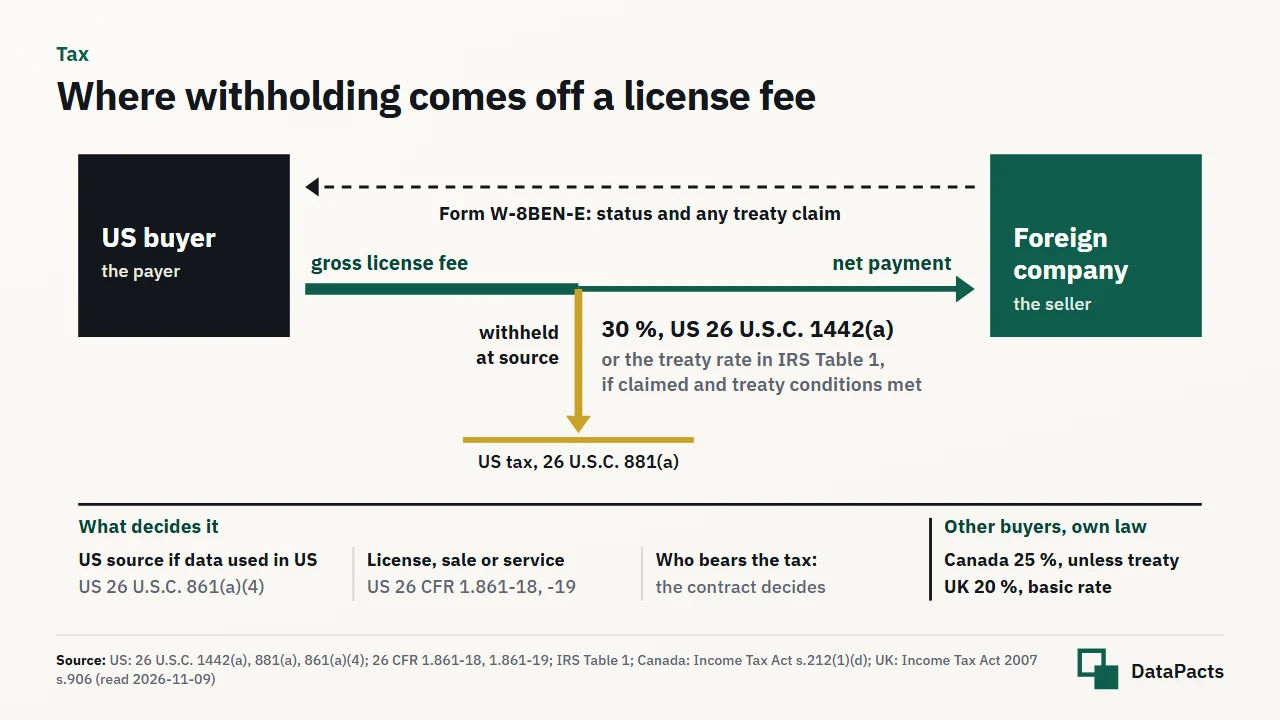
For 45 treaty countries IRS Table 1 lists the reduced rate as of 2026-11-09, and 18 of them carry 0 % under both income codes that matter for data.
This page covers the US rule, the treaty table, the forms behind a reduced rate and the rules of Canadian and UK buyers, as part of AI training data licensing.
Rates come from statutes and IRS Table 1 as read on November 9, 2026, and under their own law a Canadian buyer deducts 25 % unless a treaty reduces it and a UK buyer 20 %.
How Withholding Reaches a Data License Payment
Withholding is deducted by the payer before the money leaves, so the seller receives the license fee net of the tax unless the contract says otherwise. The contract decides who bears the tax; this page records the statutory deduction and no contract wording.
The table compares four payer and seller pairings by who deducts, the rate and what reduces it, as of 2026-11-09.
| Payer and seller | Who deducts | Rate | Reduced by | Source |
|---|---|---|---|---|
| US buyer pays a foreign company a US-source royalty | the US payer, at source | 30 % (26 U.S.C. 1442(a), 881(a)) | treaty rate claimed on Form W-8BEN-E | uscode.house.gov; irs.gov |
| US buyer pays a seller resident in a treaty country | the US payer | IRS Table 1 rate, income code 10 or 12 | treaty conditions, including limitation on benefits | irs.gov (Table 1) |
| Canadian buyer pays a non-resident | the Canadian payer | 25 % Part XIII tax, Income Tax Act s.212(1)(d) | treaty | laws-lois.justice.gc.ca |
| UK buyer pays an owner abroad | the UK payer | basic rate, 20 %, Income Tax Act 2007 s.906 | not stated | legislation.gov.uk |
The US 30% Rule on License Payments to Foreign Companies
Section 1442(a) of the Internal Revenue Code requires the payer to deduct and withhold 30 % at source from US-source royalties and similar income paid to a foreign corporation.
Section 881(a) imposes the underlying 30 % tax on US-source fixed or determinable annual or periodical income of foreign corporations, royalties included, and the withholding under section 1442 collects it.
The 30 % applies to the gross payment and stays in place until a treaty rate is claimed. Individuals and partnerships fall under a different section that this page does not state, and no rate for them is given here. The wider AI training data law in the United States sits on its own page.
Where the Data Is Used Decides Whether the Payment Is US-Source
Royalties for the use of copyrights, secret processes and other like property in the United States are US-source income (26 U.S.C. 861(a)(4)), so the place where the buyer uses the licensed data decides the source. A buyer that trains a model in the US uses the data in the US for this purpose.
A license limited to use outside the United States changes the analysis, because the statute looks at where the property is used and not at where the buyer is incorporated. This is the statute's place-of-use test, stated here as a rule and not as a planning step, and no example rate follows from it.
Royalty, Sale or Service: How the Deal Type Changes Withholding
Since T.D. 10022, published on 2025-01-14, US regulations classify a digital content deal as a copyright license, a sale or lease of a copy, a service or know-how, and that class decides whether the 30 % applies.
Under 26 CFR 1.861-18, a transfer is a sale if the benefits and burdens of ownership pass and otherwise a lease, and an electronic sale is deemed to occur at the purchaser's billing address; the rule applies to taxable years beginning on or after 2025-01-14.
Under 26 CFR 1.861-19, on-demand network access to digital content is a service, and access that lets the buyer keep a copy for storage and use is excluded from that class; early application from 2019-08-14 is permitted.
A sale price is not automatically outside the rule: section 881(a)(4) reaches gains from the sale of copyrights, secret processes and like property to the extent they are contingent on productivity, use or disposition, so a revenue-share sale price can stay inside it.
Which class a given dataset deal falls in is a question of the facts, and AI data monetization models shows how the models differ commercially.
Treaty Rates by Country for Data License Royalties
An income tax treaty can cut the US 30 % to a lower rate, and IRS Table 1 lists the rate per country in two columns that matter for data: income code 10 for know-how and other industrial royalties and income code 12 for copyright royalties.
The table compares 45 treaty countries alphabetically by both codes, with a final row for countries without a treaty, as of 2026-11-09.
| Country of residence | Code 10: know-how and other industrial royalties | Code 12: copyright royalties | Source |
|---|---|---|---|
| Australia | 5 % | 5 % | IRS Table 1 |
| Austria | 0 % | 0 % | IRS Table 1 |
| Belgium | 0 % | 0 % | IRS Table 1 |
| Bulgaria | 5 % | 5 % | IRS Table 1 |
| Canada | 0 % | 0 % | IRS Table 1 |
| Chile | 10 % | 10 % | IRS Table 1 |
| China | 10 % | 10 % | IRS Table 1 |
| Cyprus | 0 % | 0 % | IRS Table 1 |
| Czech Republic | 10 % | 0 % | IRS Table 1 |
| Denmark | 0 % | 0 % | IRS Table 1 |
| Egypt | 30 % | 15 % | IRS Table 1 |
| Estonia | 10 % | 10 % | IRS Table 1 |
| Finland | 0 % | 0 % | IRS Table 1 |
| France | 0 % | 0 % | IRS Table 1 |
| Germany | 0 % | 0 % | IRS Table 1 |
| Iceland | 5 % | 0 % | IRS Table 1 |
| India | 15 % | 15 % | IRS Table 1 |
| Indonesia | 10 % | 10 % | IRS Table 1 |
| Ireland | 0 % | 0 % | IRS Table 1 |
| Israel | 15 % | 10 % | IRS Table 1 |
| Italy | 8 % | 0 % | IRS Table 1 |
| Japan | 0 % | 0 % | IRS Table 1 |
| Latvia | 10 % | 10 % | IRS Table 1 |
| Lithuania | 10 % | 10 % | IRS Table 1 |
| Luxembourg | 0 % | 0 % | IRS Table 1 |
| Malta | 10 % | 10 % | IRS Table 1 |
| Mexico | 10 % | 10 % | IRS Table 1 |
| Netherlands | 0 % | 0 % | IRS Table 1 |
| New Zealand | 5 % | 5 % | IRS Table 1 |
| Norway | 0 % | 0 % | IRS Table 1 |
| Philippines | 15 % | 15 % | IRS Table 1 |
| Poland | 10 % | 10 % | IRS Table 1 |
| Portugal | 10 % | 10 % | IRS Table 1 |
| Romania | 15 % | 10 % | IRS Table 1 |
| Slovak Republic | 10 % | 0 % | IRS Table 1 |
| Slovenia | 5 % | 5 % | IRS Table 1 |
| South Africa | 0 % | 0 % | IRS Table 1 |
| South Korea | 15 % | 10 % | IRS Table 1 |
| Spain | 0 % | 0 % | IRS Table 1 |
| Sweden | 0 % | 0 % | IRS Table 1 |
| Switzerland | 0 % | 0 % | IRS Table 1 |
| Thailand | 15 % | 5 % | IRS Table 1 |
| Turkey | 10 % | 10 % | IRS Table 1 |
| Ukraine | 10 % | 10 % | IRS Table 1 |
| United Kingdom | 0 % | 0 % | IRS Table 1 |
| Countries without a treaty in effect, including Croatia, Hungary and Taiwan | 30 % | 30 % | IRS Table 1; 26 U.S.C. 1442(a) |
Rates assume the seller meets the treaty's limitation-on-benefits article and other conditions, and software follows code 12 unless the treaty provides otherwise. A country not listed here has not been checked, and a missing country is not thereby without a treaty.
Each rate depends on the limitation-on-benefits article and the text of the treaty, and the current Table 1 lists Chile. The other steps of selling data to AI companies from outside the US sit on that page.
Know-How or Copyright: When Income Codes 10 and 12 Give Different Rates
For 36 of the 45 countries in the table both codes carry the same rate, and for nine they differ, so the description of what the buyer pays for can move the rate. The nine countries, shown as code 10 and code 12, are:
- Czech Republic: 10 % and 0 %
- Egypt: 30 % and 15 %
- Iceland: 5 % and 0 %
- Israel: 15 % and 10 %
- Italy: 8 % and 0 %
- Romania: 15 % and 10 %
- Slovak Republic: 10 % and 0 %
- South Korea: 15 % and 10 %
- Thailand: 15 % and 5 %
IRS Table 1 says software follows column 12 unless the treaty provides otherwise, and this page does not state which code a dataset takes.
Sellers With No US Treaty in Effect: Croatia, Hungary and Taiwan
A seller resident in a country with no US income tax treaty in effect faces the full 30 %, and for Croatia, Hungary and Taiwan that status has a dated reason.
A Croatian convention was signed in Washington on 2022-12-07, an amending protocol was signed in Dubrovnik on 2026-04-28, and Treaty Doc. 119-2 was transmitted to the Senate on 2026-09-14; the transmittal says it would be the first bilateral income tax treaty between the United States and Croatia, and it is not in force.
The US-Hungary treaty was terminated effective 2023-01-08 and ceased to have effect for withholding on 2024-01-01, and the current Table 1 omits Hungary.
H.R. 33 on Taiwan passed the House 423-1 on 2025-01-15 and was referred to the Senate Finance Committee on 2025-01-16, with no later action as of 2026-11-09; it is not law, and the 30 % applies unless and until such relief is enacted. A pending item can change, and this page records it as pending.
Form W-8BEN-E and the Paperwork Behind a Reduced Rate
A foreign company documents its status and any treaty claim to the payer on Form W-8BEN-E, and the form stays valid from signing to the last day of the third succeeding calendar year unless circumstances change.
The IRS instructions govern the fields of the form, and this page gives no walkthrough. The payer reports payments to foreign persons on Form 1042-S, and for 2026 those forms are due on 2027-03-15 according to IRS Publication 515, the IRS guide to withholding on foreign persons.
Payment channels ask for the form before they pay. AWS Data Exchange, a marketplace in which the seller stays the licensor, asks non-US providers for a W-8, a VAT or GST registration number and US bank information or a Hyperwallet virtual US account (checked November 9, 2026), and the fees and eligibility of AI training data marketplaces differ by operator.
The 30 % rate is also sometimes confused with backup withholding, which is a separate IRS rule at 24 %.
US Sellers: Form W-9, Form 1099-MISC and Backup Withholding
Section 1442 reaches foreign corporations, so a US seller gives the payer a Form W-9 instead, as AWS Data Exchange asks of US providers (checked November 9, 2026).
Royalties of USD 10 or more are reported in box 2 of Form 1099-MISC according to the IRS instructions (checked November 9, 2026), and backup withholding at 24 % is a separate IRS rule whose triggers this page does not state.
Withholding by Non-US Buyers
Buyers outside the US withhold under their own law, and this reference has verified the rules of two buyer countries, Canada and the United Kingdom. The table compares the two by rule, rate and payments covered, as of 2026-11-09.
| Buyer country | Rule | Rate | Payments covered | Source |
|---|---|---|---|---|
| Canada | Income Tax Act s.212(1)(d), Part XIII | 25 %, unless a treaty reduces it | rent, royalty or similar payment; (d)(ii) information concerning industrial, commercial or scientific experience | laws-lois.justice.gc.ca |
| United Kingdom | Income Tax Act 2007 ss.906 and 907 | basic rate, 20 % | intellectual property royalties to owners abroad; intellectual property includes copyright and information concerning industrial, commercial or scientific experience | legislation.gov.uk |
Canadian Buyers: Part XIII Tax on Royalties and Know-How
A Canadian payer withholds 25 % Part XIII tax on a rent, royalty or similar payment to a non-resident under Income Tax Act s.212(1)(d), unless a treaty reduces it.
Canada's wider rules for licensing data for AI training in Canada cover the rest of the legal frame. Paragraph (d)(ii) reaches payments for information concerning industrial, commercial or scientific experience, which is the wording closest to a data license.
The treaty rate for a Canadian seller paid by a US buyer is in the treaty table above and is 0 % under both codes. No Canadian treaty rate for sellers from other countries is recorded on this page.
UK Buyers: Income Tax Act 2007 Sections 906 and 907
A UK payer deducts income tax at the basic rate, 20 %, from intellectual property royalties paid to an owner whose usual place of abode is abroad, under Income Tax Act 2007 s.906.
Section 907(1) defines intellectual property to include copyright of literary, artistic or scientific work and any information concerning industrial, commercial or scientific experience.
Whether a given dataset fee is a section 907 payment is not stated here, and no UK treaty rates for sellers from other countries are recorded. The rules for licensing data for AI training in the United Kingdom hold the wider position.
Buyers in Other Countries, Including Malaysia and South Africa
For buyers in other countries, including Malaysia and South Africa, this page states no domestic withholding rate, because none has been verified from the country's own statute. A rate for a buyer country is therefore not recorded, and the absence of a figure is not a statement that no tax applies.
The direction that is recorded is the US one: a South African seller paid by a US buyer is at 0 % under both codes in the table above. Public figures on amounts actually withheld in disclosed AI data deals do not exist.
Benefits, Risks, Downsides and Alternatives When a License Fee Is Withheld On, Including Not Licensing
Withholding does not change whether a deal is worth doing, but it changes the cash that arrives and the paperwork that comes with it.
Benefits
- 18 treaty countries carry 0 % under both income codes in IRS Table 1 as of 2026-11-09.
- One Form W-8BEN-E covers several years, until the last day of the third succeeding calendar year.
- The payer collects the tax, and no separate US filing by the seller is stated here.
Risks
- The description of the payment can move the rate in the nine countries where the codes differ.
- Sellers in a country without a treaty in effect face 30 %, and the pending Croatian and Taiwanese items can change.
- The class of the deal under the 2025 regulations (license, sale, lease or service) decides whether the rule applies.
Downsides
- The default is 30 % of the gross payment, and the net amount arrives after it.
- The payer's reporting runs to a fixed deadline, 2027-03-15 for 2026 forms.
- A Canadian or UK buyer brings a second regime with its own rate.
Alternatives
- A buyer in the seller's own country, where domestic tax still applies and is not described here.
- A deal for access rather than a copy, as classified by 26 CFR 1.861-19, which is a question of facts for an adviser.
- A marketplace where the seller stays the licensor, which still asks for a W-8 form.
- Not licensing at all, covered with other outcomes under alternatives to selling data to AI labs, including not selling at all.
Where Withholding Sits in the Tax Step of the Seller Process
Withholding is checked when the price and payment terms are set, because a 30 % deduction changes the net figure a seller compares across offers. The full picture of tax on data licensing income sits on the parent page, and neighbouring steps are:
- When and how AI data buyers pay
- AI data licensing agreements
- Negotiating an AI data licensing deal
- Accounting for data licensing revenue
- VAT and sales tax on data licensing
Individuals and AI Training Contributors
Individuals who license their own data and contributors paid for annotation work file under different forms and rules, which this page does not cover. See tax on selling your own data for AI training for individuals.
The page on taxes for AI training contributors covers annotation work.
Home-Country Rules for Sellers on the Treaty List
Each seller's home-country rules on licensing data, including how it taxes the net fee, sit on its jurisdiction page.
- Ireland's rules for licensing data for AI training
- Japan's rules for licensing data for AI training
- Sellers without a treaty in effect: Croatia, Hungary and Taiwan
- Buyer and seller countries without a recorded rate here: Malaysia and South Africa
Information, Not Tax Advice
This page is information about withholding rules, not tax advice for a specific deal.
Frequently Asked Questions
How can a foreign data seller reduce the 30% US withholding?
By claiming a lower treaty rate on Form W-8BEN-E where its country of residence has a US income tax treaty in effect; 18 of the 45 countries in the table carry 0 % under both income codes. The form stays valid until the last day of the third succeeding calendar year, absent a change in circumstances.
Who pays withholding tax on a data license, the buyer or the seller?
The buyer deducts it from the payment at source, so the seller bears it unless the contract allocates it differently. The deduction is the payer's duty under 26 U.S.C. 1442(a) for US payments.
What are the US withholding rates on royalties by country?
IRS Table 1 lists rates from 0 % to 30 %, separately for know-how (code 10) and copyright (code 12), as shown in the table above as of November 9, 2026. Countries without a treaty in effect face 30 %.