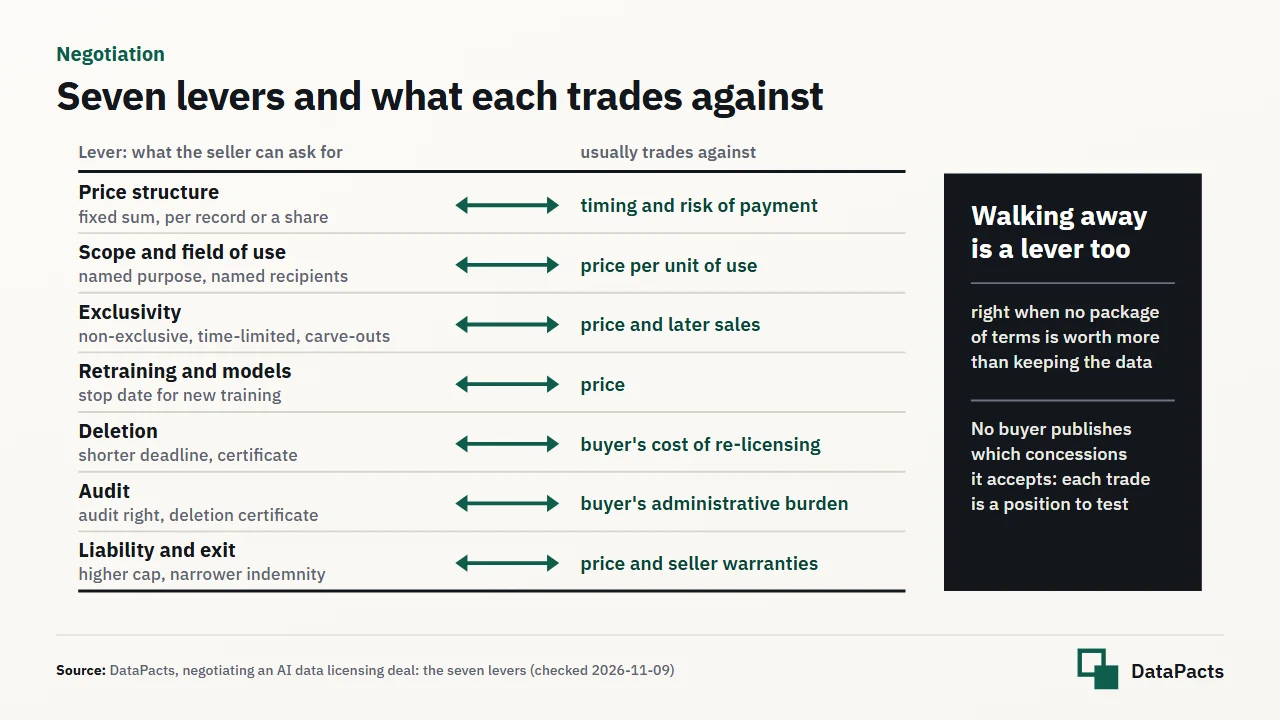
This page works at the level of strategy within AI training data licensing, with one published term per lever as of 2026-11-09. No public record shows how often sellers change a buyer's terms. The DataPacts Editorial Team explains how we source, date and check every figure.
What Can Be Negotiated in an AI Data License, and What Rarely Moves
Buyers that publish license terms put the negotiable points into an order form, so the order form is where a negotiation usually happens. micro1's Data License Master Terms (updated 2026-11-08, checked 2026-11-09) make the License Price in the Order Form the sole consideration (s.3) and refer exclusivity and audit to the Order Form (s.4.2). Handshake AI publishes no license terms on its program pages.
Between EU enterprises, Regulation (EU) 2023/2854 Art. 13(1) makes an unfair data-use or liability term unilaterally imposed by one enterprise on another not binding, and Art. 13(6) treats a term as imposed when the other party could not influence it despite attempting to negotiate.
Art. 13(8) leaves the adequacy of the price outside the test, and Art. 50 applies Chapter IV to contracts concluded after 2025-09-12. The EU Data Act rules on data contract terms have their own page, and whether Art. 13 reaches a given deal is a question for a lawyer.
The Commission's non-binding Recommendation (EU) 2026/2394, adopted 2026-10-29, offers model contractual terms, not terms a buyer must accept.
Preparing Before the First Negotiation Call
Preparation sets a walk-away point, ranks the levers by what they are worth to the company and names the terms it will not give, before any buyer sees the data.
Term length belongs in the ranking: Reddit's S-1 of 2024-02-22 describes terms of two to three years under licenses worth USD 203.0 million in aggregate, counterparties not named, and its 10-Q for the quarter ended 2026-09-30 says substantially all licensing value comes from two counterparties nearing the end of their terms.
- A walk-away point.
- The levers ranked by worth to the company.
- The terms the company will not give.
- The fallback if no deal closes, including keeping the data.
Price expectations are covered in what company data is worth to AI companies.
Seven Levers and What Each One Trades Against Price
Each lever changes what the buyer receives, so each can be traded against price, and the table shows one published term per lever as the starting point a seller meets. None is a market norm.
| Lever | What the seller can ask for | Published starting point | What it usually trades against | As of | Source |
|---|---|---|---|---|---|
| Price structure | fixed sum, per-record fee, upfront fee plus share, or share only | License Price in the Order Form is the sole consideration (micro1); USD 100 per delivered record (Tempus / Pathos Neuro order form); "Nothing upfront" (Turing) | timing and risk of payment | 2026-11-09; 10-Q 2026-10-22 order form | micro1.ai master terms; sec.gov; lazarus.turing.com |
| Scope and field of use | named purpose, named recipients, output limits | sublicensable through multiple tiers (micro1 s.1.2); "sole purpose" foundation model (Tempus 10-K); outputs 200 consecutive words and/or 5 % (HarperCollins, as the Authors Guild states) | price per unit of use | 2026-11-09; 2024-11-19 | micro1.ai; sec.gov; authorsguild.org |
| Exclusivity | non-exclusive, time-limited, or exclusive with carve-outs | exclusive by default, stricter exclusivity priced (Labelbox); 6-month exclusive license to Turing, which may license the record to more than one lab (Turing, checked 2026-11-17); 18 months after the later of delivery and 2027-10-22 (Tempus side letter) | price and the company's later sales | 2026-11-09; 10-Q | prism.labelbox.com/faq; lazarus.turing.com; sec.gov |
| Retraining and models | stop date for new training, notice of new models | no duty to retrain (micro1 s.4.4); "cannot be unlearned" (Labelbox); licensees keep access 12 months (Protege s.7.2) | price | 2026-11-09 | micro1.ai; prism.labelbox.com/faq; withprotege.ai |
| Deletion | shorter deadline, written certificate, backups covered | earlier of 120 days after delivery or termination, backups excluded (micro1); 30 days under a kill clause (Labelbox) | cost to the buyer of re-licensing | 2026-11-09 (micro1 wording re-read 2026-11-10) | micro1.ai; prism.labelbox.com/faq |
| Audit | audit right, records retention, deletion certificate | at most once a year, 15 business days' notice (Defined.ai supplier terms); referred to the Order Form (micro1 s.4.2) | buyer's administrative burden | 2026-11-09 (s.4.2 wording re-read 2026-11-10) | defined.ai/supplier-program; micro1.ai |
| Liability and exit | higher cap, narrower seller indemnity, termination rights | 3 times fees, licensor indemnifies (micro1 s.7.2, s.8.1); 2 times prior 12 months' fees (Protege s.6.2); 30 days' convenience notice (micro1 s.4.1) | price and seller warranties | 2026-11-09 | micro1.ai; withprotege.ai |
Price Structure: One Sum, Per Record or a Share
The structure of the price is itself negotiable, and public filings show fixed fees, per-record fees and payment partly in shares.
Tempus AI, the seller, reported in its 10-K for fiscal 2025 a license to Pathos, the licensee, with fees of USD 200 million over three years including USD 50 million upfront, up to 50 % payable in Series D preferred stock.
Its 10-Q for the quarter ended 2026-09-30 describes a Neuro order form dated 2026-10-22: 500,000 de-identified records at USD 100 per delivered record, plus USD 5.0 million for updates, up to USD 55.0 million. Labelbox states an upfront fee plus a revenue share and Turing "Nothing upfront"; neither publishes the percentage (checked 2026-11-09).
A share moves risk to the seller and a fixed sum moves it to the buyer. Triggers and clawbacks are covered in when and how AI data buyers pay.
Scope and Field of Use: What the Data May Train
A narrower purpose is often the easiest concession to ask for, because it limits what the data may train without changing the price structure.
The Tempus 10-K limits the Pathos license to the sole purpose of a foundation model, the Authors Guild states that HarperCollins's license of 2024-11-19 caps outputs at 200 consecutive words and/or 5 % of a book, and Kopinor's agreement of 2025-12-19 bars specialized media and news models.
The contrast is micro1's grant, sublicensable through multiple tiers (s.1.2).
Exclusivity as a Priced Concession
Exclusivity is a lever several buyers and intermediaries say they pay for, and no published figure says how much more for company data. The parties' own statements, checked 2026-11-09:
- Labelbox: Prism licenses are exclusive by default and buyers pay for stricter exclusivity.
- HUMXN: "exclusive licences pay more up front".
- SuperAnnotate: pricing rests on rarity, depth and exclusivity.
- Mercor listings: "More for large codebases or exclusive terms" and "Depends on history and exclusivity".
The only multiple on record, roughly 4 to 5 times, is for exclusive RL environments, from two founders in an Epoch AI article dated 2026-01-12, and covers no company data.
Exclusivity can also be time-limited: Turing states a license to Turing that is exclusive for the first 6 months after signing (checked 2026-11-17), the Tempus side letter 18 months after the later of delivery and 2027-10-22. Clause detail sits in exclusive vs non-exclusive data licenses.
Retraining and Models Already Trained
The published terms read here let the buyer keep models trained before the license ends, so a seller who wants more must ask for it and expect to give something for it. micro1 s.4.4 imposes no duty to retrain or delete Licensee Materials, Labelbox states that "Models already trained on the data cannot be unlearned", and Protege lets licensees keep access for 12 months after termination (s.7.2; checked 2026-11-09).
The asks are a stop date for new training, no distribution of models after termination and notice of new versions; no buyer publishes whether it accepts them.
Deletion Deadlines and Kill Clauses
Deletion terms decide how long raw data stays with the buyer, and the published deadlines run from 30 to 120 days. Deleting raw data does not remove a trained model; see deletion, return and machine unlearning clauses.
- micro1 s.4.4: raw data is deleted at the earlier of 120 days after delivery or termination, backups excluded.
- Labelbox: a kill clause forces deletion within 30 days after a material breach, a regulatory change or a seller-defined change of control.
- Patronus AI: samples are deleted, with written confirmation, if no deal follows.
Audit and Proof of Compliance
An audit right is how a seller checks the limits it negotiated, and few published programs state one.
The Defined.ai supplier terms allow an audit at most once a year on 15 business days' notice, without naming the auditing party in the sources read here; micro1 refers audit to the Order Form, and Endless states audit rights without detail.
A written deletion confirmation is the lighter substitute, and micro1 gives one on request (s.4.4).
Protections: Liability Cap, Indemnity and Exit
The seller's protections set how much a deal can cost the company after it is paid, and a higher price can come with higher exposure. Published positions, checked 2026-11-09:
- Cap: micro1 caps liability at 3 times total fees (s.7.2); Protege at 2 times fees of the prior 12 months (s.6.2).
- Indemnity: the licensor indemnifies the buyer for IP, privacy and data protection claims under micro1 s.8.1; under Protege s.4.1 the provider indemnifies.
- Exit: micro1 allows 30 days' notice for convenience (s.4.1).
See also liability caps in AI data licenses.
Trading One Lever Against Another
Levers are traded in pairs, and a concession is worth asking for only when the other side values it more than the company does.
- Exclusivity against price and term: the Tempus side letter limits third-party licensing for 18 months after the later of delivery and 2027-10-22.
- A narrower field of use against a perpetual grant like micro1's.
- A revenue share against an upfront fee: Turing's "Nothing upfront" is one end, the Tempus upfront payment (10-K, fiscal 2025) the other.
- A shorter deletion deadline against accepted model retention.
No buyer publishes which concessions it accepts, so each trade is a position to test.
When an Intermediary Negotiates for the Company
Some sell-side intermediaries negotiate the license on the company's behalf while being paid by the AI side, which the company should know before relying on them.
Marin Data, a broker, states that it is paid by AI labs and charges companies nothing; Regulr, also a broker, states that the buyer pays it a fee when a license closes (checked 2026-11-09).
Neither acquires the data, and fees and conflicts are weighed in selling direct or through a broker.
Pushing Back or Signing as Offered: Benefits, Risks, Downsides and Alternatives
Negotiating, signing as offered and walking away are all valid outcomes, and walking away is right when no package of terms is worth more to the company than keeping the data. Pushing back is not promised to work.
Benefits
- A narrower grant keeps rights the company can license again.
- A shorter term brings repricing sooner, relevant because Reddit's licensing value rests on two counterparties near the end of their terms.
Risks
- A buyer may treat its published terms as fixed.
- Demand moves: Shutterstock's Data, Distribution, and Services revenue was USD 15.8 million in Q3 2026 against USD 65.7 million in Q3 2025, down 76 % (10-Q, quarter ended 2026-09-30).
- Added asks can slow a fast program, such as Labelbox's stated under 21 days to first wire.
Downsides
- Signing as offered can grant a perpetual, irrevocable, sublicensable license, as micro1's s.1.2 reads.
- A concession on one lever can be paid for on another.
Alternatives
- Sign after reviewing the order form against the table above.
- License a narrower set of data or a shorter term.
- Ask other buyers for terms first.
- Do not license at all: alternatives to selling data to AI labs, including not selling.
Where Negotiation Sits in the Process to Sell or License Company Data
Negotiation follows the offer, the NDA and the buyer's diligence, and it ends in a term sheet or order form and the signed contract. The guide to how to sell or license company data to AI companies sets out the path.
- Should you sell or license your data
- Evaluating an offer for your data
- Running several AI data buyers in parallel
- NDAs before sharing data with an AI buyer
- Samples, clean rooms and proving data quality
- Due diligence in an AI data deal
- Term sheets, order forms and LOIs
- Board and shareholder approval for a data licensing deal
- AI data licensing agreements, every clause explained
Clause detail for the levers:
- Retraining and model retention rights
- Field of use and scope limits
- Audit rights in AI data licenses
- Indemnities and warranties in AI data licenses
- License term and perpetual licenses
Negotiation in a Court-Supervised Data Sale
When an estate sells data under court supervision, bidders compete on price and the court order replaces most negotiation of terms. In the Spirit Airlines case (Bankr.
S.D.N.Y. 25-11897 (SHL)) the bill of sale is an 11 U.S.C. 363 sale, as is; the successful bid is Google LLC at USD 10,000,000, not approved as of 2026-11-09, with a hearing on 2026-11-17. See data assets in insolvency.
Information, Not Legal Advice
This page explains negotiation positions and published terms; it is not legal advice. Unfair terms between enterprises are the subject of Data Act Article 13 on unfair terms in B2B data licenses.
Terms, Programs and Deals Cited on This Page
The terms above come from these programs' own pages and from public filings, each checked on the date shown (2026-11-09 unless a filing date is given).
- Data Licensing Advisors, Defined.ai, Endless, HarperCollins (Authors Guild, 2024-11-19), HUMXN, Kopinor (2025-12-19), Mode, Patronus AI, Protege, Regulr and SuperAnnotate
- Labelbox Prism profile
- Marin Data broker profile
- micro1 data buyer profile
- Reddit's AI data licensing deals
- Tempus AI clinical data licensing deals
- Turing Project Lazarus profile
- AI data licensing brokers and sell-side advisers, license clause matrix, AI data partnership payouts and program terms compared and the AI data licensing deals tracker
Frequently Asked Questions
Can a company negotiate an AI buyer's standard data license terms?
Yes, usually through the order form, which under published master terms carries the price and can carry exclusivity and audit terms. No public record shows how often sellers change a buyer's terms.
Which terms matter most besides the price?
Exclusivity, the field of use, what happens to trained models and the deletion deadline change what the price buys more than other terms. Labelbox states that trained models cannot be unlearned.
How long does negotiating an AI data licensing deal take?
Published schedules put term negotiation in weeks: Marin Data states weeks 3 to 6, and Labelbox states under 21 days from first call to first wire. Neither figure is a market norm. The full schedule is in how long an AI data licensing deal takes.