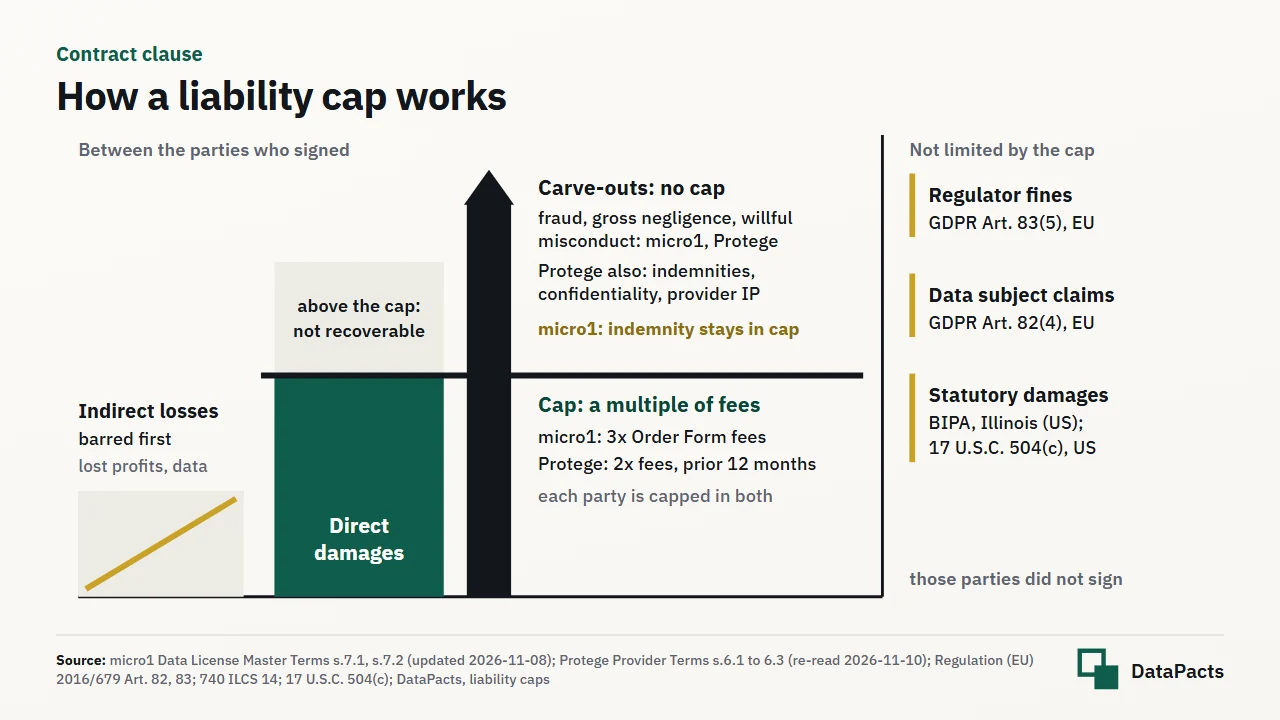
micro1's Data License Master Terms (last updated November 8, 2026, re-read November 10, 2026) cap each party at 3x the Order Form fees (s.7.2), and Protege's Provider Terms cap each party at 2x the fees of the prior 12 months (s.6.2).
Neither cap limits a regulator's fine or a statutory damages award, because those parties did not sign. The cap is one term in any decision about AI training data licensing, and declining a license with an unacceptable cap is a valid outcome.
Each term below names its source and date; see how DataPacts sources, dates and checks every figure.
What a Liability Cap Limits in an AI Data License
A liability cap limits damages between the parties to the license, together with a list of excluded losses and a list of carve-outs. Four parts decide its reach:
- The cap: an aggregate limit tied to fees (micro1 s.7.2, Protege s.6.2).
- The exclusion: indirect losses are barred first (micro1 s.7.1, Protege s.6.1).
- The carve-outs: claims the cap does not reach (micro1 s.7.2, Protege s.6.3).
- The direction: micro1, Protege and Proximal cap each party, while Defined.ai's Data License Agreement (7(b)) caps only the licensor.
A cap binds only the signatories. Under GDPR Art. 82(4) and (5), each responsible controller or processor is liable for the entire damage to a data subject, with recourse against the others.
Liability Caps in Published AI Data Contracts
Five published AI data documents state a liability cap, and they differ in amount, lookback, direction and carve-outs. The table compares them as of 2026-11-10, in alphabetical order.
| Party (role) | Document | Cap amount and lookback | Who is capped | Carve-outs from the cap | Consequential-loss exclusion | Source and check date |
|---|---|---|---|---|---|---|
| Defined.ai (licensor of its own datasets) | Data License Agreement, effective 2022-11-30 | total amounts paid to the licensor, proven direct damages only (7(b)) | licensor only | none stated | yes, including lost profits, data loss or security breaches (7(a)) | defined.ai/data-license-agreement, re-read 2026-11-10 |
| Defined.ai (acquirer of supplier data) | Supplier Program General Terms | 2x total value of business conducted, on the supplier's indemnity (s.3.4) | supplier's indemnity | none stated | none found | defined.ai/supplier-program, re-read 2026-11-10 |
| micro1 (buyer) | Data License Master Terms, updated 2026-11-08 | 3x total fees paid or payable under the Order Form under which the claim arose (s.7.2) | each party | fraud, gross negligence, willful misconduct; indemnities not carved out | yes, except fraud, gross negligence, willful misconduct and indemnification obligations (s.7.1) | micro1.ai, re-read 2026-11-10 |
| Protege (licenses provider data on to its licensees) | Provider Terms (no update date shown) | 2x fees paid and payable for the Data in the 12 months before the event (s.6.2) | each party | gross negligence, willful misconduct, fraud; defense and indemnification obligations; confidentiality breach; provider's IP infringement (s.6.3) | yes (s.6.1), except gross negligence, willful misconduct, fraud | withprotege.ai/provider-terms, re-read 2026-11-10 |
| Proximal (service provider; its customer pays Proximal) | Master Development Services Agreement, updated 2026-07-06 | fees paid or payable under the applicable Order Form in the 12 months before the event (s.11.1) | each party | fees payable, gross negligence, willful misconduct, IP infringement, confidentiality breach | yes, same exceptions (s.11.1) | proximal.ai/msa, re-read 2026-11-10 |
Each term is the stating party's own wording, and the signed order form can change it. Proximal's agreement is a services contract, shown for comparison.
Handshake AI, Mercor and Scale AI publish no liability terms on their program pages, and Magma's and Mode's USD 100 caps sit in website terms, not the data license (checked 2026-11-09). The license clause matrix sets the cap beside every other published clause.
How the Cap Amount Is Measured: Fee Multiples and Lookback Periods
Every published cap is a function of what the buyer pays, so the cap moves with the price of the license. Five measures appear in the documents read on November 10, 2026:
- 3x the total fees under the Order Form of the claim (micro1 s.7.2).
- 2x the fees for the Data in the 12 months before the event (Protege s.6.2).
- The fees under the applicable Order Form in the prior 12 months (Proximal s.11.1).
- The total amounts paid to the licensor, for proven direct damages (Defined.ai 7(b)).
- 2x the total value of business conducted, on the supplier's indemnity only (Defined.ai Supplier Program s.3.4).
A 12-month lookback shrinks once payments stop, and a per-Order-Form cap does not pool fees across orders. No published survey of typical multiples exists.
Carve-outs: Which Claims the Cap Does Not Reach
A carve-out removes a type of claim from the cap, and the published contracts agree only on fraud, gross negligence and willful misconduct. The documents diverge on the rest:
- Fraud, gross negligence, willful misconduct: carved out by micro1, Protege and, without fraud, Proximal.
- Indemnification obligations: uncapped under Protege, while micro1 does not carve them out, so its licensor indemnity (s.8.1) stays within 3x.
- Confidentiality breach: carved out by Protege and Proximal.
- IP infringement: uncapped for the provider (Protege) and either party (Proximal).
- Data protection claims: no published cap cited here carves them out.
Pangea.ai states that its ownership warranty is "uncapped because buyers rely on the same ownership assurance" (agency page, re-read November 10, 2026). Defined.ai's licensor cap has no carve-out. Who defends which claim is covered under indemnities and warranties in AI data licenses.
Consequential-Loss Exclusions and What They Remove
A consequential-loss exclusion bars recovery of indirect losses such as lost profits altogether, before the cap is even reached. micro1's s.7.1 excludes indirect, consequential, special, punitive and exemplary damages, including loss of revenue, profits, data or goodwill, except fraud, gross negligence, willful misconduct and indemnification obligations. Protege's s.6.1 and Proximal's s.11.1 exclude the same type of loss.
Defined.ai's licensor-side agreement (7(a)) also excludes loss of any data and breach of data or system security, so a loss from a breach falls outside recovery against the licensor. By the words alone, "loss of data" in a mutual exclusion can reach the seller's own claim after a buyer breach.
Fines and Statutory Damages Against a Fee-Based Cap
A cap tied to fees has no relation to how many people or works are in the data, while fines and statutory damages are counted per turnover, per person or per work.
As of 2026-11-10, GDPR fines reach EUR 20,000,000 or 4 % of total worldwide annual turnover, whichever is higher (Regulation (EU) 2016/679, Art. 83(5)), and the authority imposes them on the infringer. See GDPR and AI training data.
As of 2026-11-10, the Illinois Biometric Information Privacy Act (740 ILCS 14) gives liquidated damages of USD 1,000 per negligent and USD 5,000 per intentional or reckless violation. Public Act 103-0769, effective 2024-08-02, counts repeated collection from one person by one method as one violation, and section 15(c) bars selling biometric identifiers.
| Exposure | Instrument | Amount | Counted per | Source |
|---|---|---|---|---|
| GDPR administrative fine (higher tier) | Regulation (EU) 2016/679, Art. 83(5), as of 2026-11-10 | up to EUR 20,000,000 or 4 % of total worldwide annual turnover, whichever is higher | infringer | legislation.gov.uk (Art. 83 as adopted) |
| GDPR compensation to data subjects | Art. 82(4) and (5) | entire damage, recourse among controllers and processors | data subject | publications.europa.eu, CELEX 32016R0679 |
| BIPA liquidated damages | 740 ILCS 14 (P.A. 103-0769 single-violation rule from 2024-08-02) | USD 1,000 negligent; USD 5,000 intentional or reckless | violation (one per person and method) | Clay v. Union Pacific, 7th Cir. No. 25-2762, 2026-04-01 |
| US copyright statutory damages | 17 U.S.C. 504(c), as of 2026-11-10 | USD 750 to 30,000; up to 150,000 if wilful; down to 200 if innocent | work | govinfo.gov |
| Removal of copyright management information | 17 U.S.C. 1203(c)(3)(B), as of 2026-11-10 | USD 2,500 to 25,000 | violation | govinfo.gov |
| Contract cap, for comparison | micro1 s.7.2; Protege s.6.2 | 3x Order Form fees; 2x prior 12 months' fees | contract | micro1.ai; withprotege.ai |
The table compares exposure amounts with the contract caps. As of 2026-11-10, 17 U.S.C. 504(c) sets USD 750 to 30,000 per work, and section 1203(c)(3)(B) sets USD 2,500 to 25,000 per removal of copyright management information.
As of 2026-11-10, Bartz v. Anthropic (N.D. Cal. 3:24-cv-05417-AMO) is settled for USD 1.5 billion on a Works List of 482,460 works, approximately USD 3,000 gross per work (final approval 2026-07-20, Dkt. 680). That settlement is the buyer's exposure, shown only as scale.
The cap decides only what seller and buyer can recover from each other for such a fine or award. Whether a GDPR fine can be passed on by contract is not answered by the published terms cited here.
Imposed Liability Limits Under the EU Data Act
Between enterprises, a term limiting liability for intentional acts or gross negligence that one side imposes on the other is always unfair and not binding (Regulation (EU) 2023/2854, Art. 13(1) and 13(4)).
Chapter IV applies to contracts concluded after 2025-09-12 (Art. 50). micro1, Protege and Proximal already carve out gross negligence and willful misconduct, so the rule bites mainly on caps without carve-outs; see EU Data Act and AI training data.
What Sellers Ask For and What Published Caps Already Give
Sellers ask for caps that protect them as much as the buyer, and the table separates asks with a published precedent from asks that none grants, as of 2026-11-10.
| Seller ask | Published precedent | Source |
|---|---|---|
| mutual cap, not one-sided | yes: micro1 ("each party"), Protege ("neither Protege's nor Provider's") | micro1 s.7.2; Protege s.6.2, re-read 2026-11-10 |
| indemnity inside the cap | yes: micro1 (not carved out) | micro1 s.7.2 and s.8.1, re-read 2026-11-10 |
| no uncapped IP or ownership liability for the seller | none: Protege provider IP uncapped; Pangea.ai warranty uncapped | Protege s.6.3; Pangea.ai agency page, re-read 2026-11-10 |
| consequential-loss exclusion for both sides | yes: micro1, Proximal | micro1 s.7.1; Proximal s.11.1, re-read 2026-11-10 |
| carve-out for the buyer's use outside the license | partial: micro1 licensee indemnity (s.8.2), within the cap | micro1 s.8.2 and s.7.2, re-read 2026-11-10 |
| cap floor in currency regardless of fees | none published | none in the published terms cited here |
| separate cap for data protection claims | none in the published terms cited here | none in the published terms cited here |
Such asks are negotiated in the order form, with no public figure for their price. See negotiating an AI data licensing deal.
Accepting a Liability Cap: Benefits, Risks, Downsides and Alternatives
Accepting a published cap limits what the seller can lose to a known multiple of the price, and what the cap leaves out is the cost of that certainty. The wider choice is covered in should you sell or license your data.
Benefits
- A known ceiling on the seller's liability where the cap is mutual.
- Consequential losses excluded on both sides.
- The seller's indemnity inside the cap at micro1.
Risks
- Uncapped IP or confidentiality liability for the provider (Protege) and an uncapped ownership warranty (Pangea.ai).
- Statutory exposure counted per person or work.
- A one-sided cap that protects only the licensor (Defined.ai's Data License Agreement).
Downsides
- The seller's recovery for a buyer breach is limited to the same multiple.
- "Loss of data" is excluded in micro1's terms.
- A 12-month lookback shrinks after payments stop.
Alternatives
- Negotiate the asks in the table above.
- License only de-identified or less sensitive subsets.
- Insurance cover (no product named here).
- Not licensing at all: alternatives to selling data to AI labs.
How the Liability Cap Works With the Other Clauses of the License
The cap is read with the indemnity, the warranties, the grant and the deletion clause, because each creates claims it limits. The parent page explains every clause of an AI data licensing agreement.
- Who defends claims: indemnities and warranties
- Deletion, return and machine unlearning clauses
- Exclusive vs non-exclusive data licenses
- Field of use and scope limits
- Acceptance and rejection of delivered data
- Governing law, arbitration and disputes
- Run a rights audit before licensing.
- Prepare for due diligence in an AI data deal.
- Compare terms when evaluating an offer for your data.
Information, Not Legal Advice
This page explains published terms and public rules for information and is not legal advice for a specific agreement.
Terms, Laws and Records Cited on This Page
The terms above come from each party's own documents, re-read on November 10, 2026, unless another date is shown.
- Defined.ai: licensor of its own datasets, and acquirer of supplier data
- Magma: intermediary that packages data for labs (site terms, checked 2026-11-09)
- micro1, with the micro1 Data License Master Terms clause by clause
- Mode: buyer of a filtered copy (site terms, checked 2026-11-09)
- Pangea.ai: code licensing platform
- Protege: licenses provider data on to its licensees
- Proximal: service provider paid by its customer
- Programs: company data partnership programs
- Laws: Illinois BIPA and AI training data; fair use and AI training in US law; Data Act Article 13 unfair terms
- Record: Bartz v. Anthropic settlement
Frequently Asked Questions
What is a liability cap in an AI data license?
It is the most one party can recover from the other under the license, set in published terms as a multiple of fees. micro1 states 3x the Order Form fees, Protege 2x the prior 12 months' fees, and Defined.ai the amounts paid to the licensor.
Does a liability cap cover the seller's indemnity?
It depends on the carve-outs. micro1's 3x cap does not exclude indemnities, so the seller's indemnity is capped there, while Protege takes indemnities out of its cap.
Does a liability cap protect against GDPR fines?
No, because no contract binds the authority. As of 2026-11-10, Art. 83(5) fines reach EUR 20,000,000 or 4 % of total worldwide annual turnover, and the cap only limits what the parties recover from each other afterwards.
What are consequential damages in a data license?
They are indirect losses such as lost profits, revenue, goodwill or data. micro1, Protege, Proximal and Defined.ai exclude them, and micro1 excepts fraud, gross negligence, willful misconduct and indemnities.