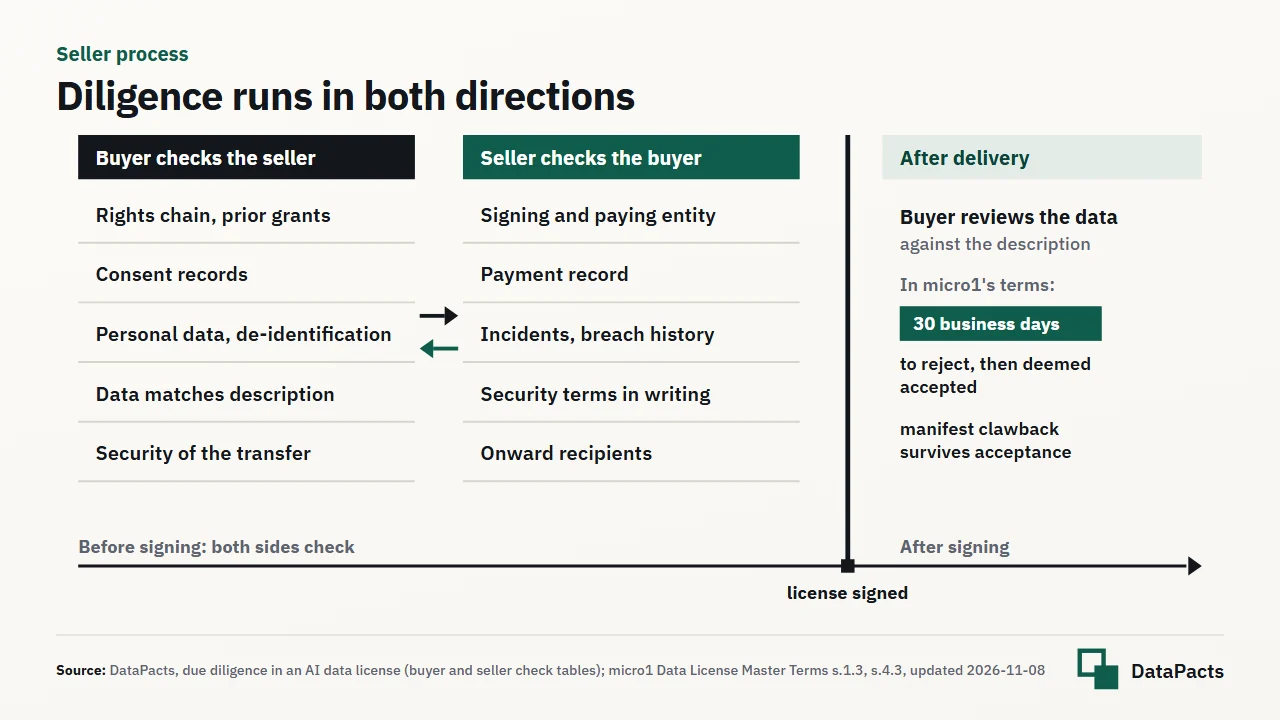
Buyers check five things (rights chain, consent records, personal data, provenance, security), and a seller should check five about the buyer (signing entity, payment record, incidents, written security commitments, onward recipients).
Diligence continues after signing: micro1 states a 30 business day rejection window with deemed acceptance. This page covers AI training data licensing diligence from both directions.
What Due Diligence Covers in a Data License, and Who Checks Whom
Diligence in a data license is narrower than in a company sale: it covers one dataset, the rights in it and the two parties to the license, not the whole business.
In micro1's master terms, last updated 2026-11-08, the Order Form's Data Manifest (s.1.1) is the measure for the delivered data. Mercor states that no AI lab buyer or third-party vendor ever sees raw data (checked 2026-11-09), so a seller there checks the program itself.
An acquirer's diligence on a company that holds a data license belongs to a company sale, not here. Selection of a counterparty is covered in choosing a buyer for your data; this page starts after that choice.
Five Things AI Buyers Check Before Licensing Company Data
AI buyers check five things before they license company data: the rights chain, consent records, personal data, provenance against the description, and the seller's security. The table compares each check with a published example, as of 2026-11-09.
| What the buyer checks | What it asks the seller | Published example | Source |
|---|---|---|---|
| Rights chain and prior grants | Does the company own the data, and has anyone else received the same rights? | micro1 s.5.1 no-prior-grant warranty and s.8.1 indemnity; Pangea uncapped ownership warranty | micro1.ai/legal (updated 2026-11-08); pangea.ai, checked 2026-11-09 |
| Consent records | How were the people in the records told, and where is the record? | micro1: consent and release records kept 7 years; Defined.ai: sourced with consent and documentation | micro1.ai/legal; defined.ai/partnerships, checked 2026-11-09 |
| Personal data and de-identification | What was removed, by whom, and does the copy resist re-identification? | AfterQuery: re-identification test before delivery; Spirit: Cal. Civ. Code 1798.140(m) standard | afterquery.com/data-partnerships, checked 2026-11-09; Bankr. S.D.N.Y. 25-11897, Dkt. 1463 |
| Provenance, quality and volume | Does the data match the description in volume, quality and metadata? | Defined.ai data expertise review; micro1 manifest clawback s.4.3 | defined.ai/partnerships; micro1.ai/legal |
| Security | How will the data leave the company's systems? | Defined.ai cybersecurity check; micro1 s.2.4 encryption in transit and at rest | defined.ai/partnerships; micro1.ai/legal |
Rights Chain and Prior Grants in the Buyer's Review
Buyers check that the company owns what it licenses and has not already granted the same rights to someone else. micro1's master terms contain a no-prior-grant warranty (s.5.1) and make the licensor indemnify the licensee for intellectual property, privacy, publicity and data protection claims (s.8.1).
Pangea states an uncapped ownership warranty (checked 2026-11-09). The preparation steps are in the rights audit.
Consent Records and Personal Data Under Review
Buyers ask how the people in the records were told and what was removed, and some test the de-identified copy themselves. micro1 requires the licensor to keep consent and release records for 7 years after the agreement ends.
AfterQuery states that payroll, privileged legal material and credentials are never used and that it runs a re-identification test (checked 2026-11-09).
In the Spirit Airlines sale the Bill of Sale sets the de-identification standard as Cal. Civ. Code 1798.140(m), with 45 CFR 164.514 added for health data (Dkt. 1463).
Provenance, Quality and Volume Against the Description
Buyers compare what arrives with what the seller described, and the description becomes the measure for rejection and refund.
Defined.ai states that a data expertise review covers quality, volume and metadata, and Turing asks for rough volumes per system (both checked 2026-11-09). Under micro1 s.4.3, a materially inaccurate manifest allows a clawback with refund. See training data provenance for the documentation.
Security Questions Put to the Seller
Buyers check how the data will leave the company's systems, and at least one program lists cybersecurity among its compliance checks.
Defined.ai names cybersecurity next to licensing rights (checked 2026-11-09), and micro1 requires encryption in transit and at rest (s.2.4). Mercor states SOC 2 Type II, which is a claim on its page, not a license term (checked 2026-11-09).
How Buyer Diligence Runs: Questionnaire, Sample Review, Acceptance Window
Published processes run diligence in three stages: an NDA and questionnaire, a sample review, and an acceptance window after full delivery. The table compares six programs' stated steps and times, as of 2026-11-09, with intermediaries kept apart.
| Program | Role | Published diligence steps | Stated time (party's claim) | Checked | Source |
|---|---|---|---|---|---|
| AfterQuery Data Partnerships | buyer | mutual NDA and questionnaire; sample review; re-identification test before delivery | questionnaire reply within three business days | 2026-11-09 | afterquery.com/data-partnerships |
| Centific Enterprise Data | buyer | mutual NDA; read-only connection; anonymize and sign off on a sample pack; payment after acceptance with audit trail | not stated for review | 2026-11-09 | centific.com/enterprise-data |
| Marin Data (Marin Foundry Company, LLC) | intermediary, paid by AI labs | records map and ownership check; mutual NDA and de-identified sample | ownership check within a week; sample in weeks 2 to 3 | 2026-11-09 | marindata.ai |
| micro1 Data License Master Terms | buyer | Order Form with Data Manifest; review after transfer; rejection window | 30 business days to reject, then deemed accepted (s.1.3); program page says 30 days | updated 2026-11-08; checked 2026-11-09 | micro1.ai/legal/data-license-master-terms |
| Patronus AI | buyer | sample under NDA; written offer; full delivery and review | sample 5 business days; full review up to 30 days | 2026-11-09 | data.patronus.ai |
| Turing Project Lazarus | sells records on the company's behalf | online mutual NDA; rough volumes per system; a small sample slice; QA review | 5 business days | 2026-11-09 | lazarus.turing.com |
micro1's master terms say 30 business days (s.1.3) and its program page says 30 days; both are kept as written, and times are never added up here.
A limited sample comes before any full export; see proving data quality without sharing the data.
What Happens When Diligence Finds a Problem After Signing
In the published terms, diligence does not end at signing: the buyer keeps a review window after delivery and, in micro1's terms, a refund right that outlives acceptance. The master terms, last updated 2026-11-08, set four remedies:
- Rejection window: 30 business days after delivery, then deemed accepted (s.1.3).
- Latent defects: 60 days after acceptance.
- Manifest clawback: a refund for a materially inaccurate manifest, surviving acceptance (s.4.3).
- Indemnity: the licensor indemnifies intellectual property, privacy, publicity and data protection claims (s.8.1).
Handshake AI states that payouts depend on "the outcome of our due diligence process and your acceptance of our data licensing terms and conditions" (checked 2026-11-09). Buyers check carefully partly because an FTC Office of Technology staff post of 2024-01-09 says the FTC has required deletion of models developed with unlawfully obtained data.
The clauses are explained in representations, indemnity and clawback clauses of an AI data licensing agreement.
Five Things a Seller Should Check About the Buyer
A seller should check five things about the buyer before signing: the legal entity, its payment record, its incidents and breach history, its written security commitments, and who will receive the data. The table compares the question and the evidence on record for each, as of 2026-11-09.
| What the seller checks | Question to put to the buyer | Evidence on record | Source |
|---|---|---|---|
| Signing and paying entity | Which legal entity signs, pays and holds the data? | Mercor.io Corporation, Stryder Corp. d/b/a Handshake, micro1 Inc., Turing Enterprises, Inc.; Labelbox and AfterQuery: not stated on the program pages | Dkt. 1463; joinhandshake.com terms; micro1.ai/legal; lazarus.turing.com |
| Payment record | Which licenses have been completed and paid, and on what trigger? | no seller-confirmed amounts public; Regulr states it has not yet closed a data deal | regulr.ai, checked 2026-11-09 |
| Incidents and breach history | Which incidents, complaints or suits are on record, and their status? | Mercor breach litigation, stay pending mediation stipulated; noyb complaints against Scale AI, no decision | oag.ca.gov; N.D. Cal. 3:26-cv-02821-WHO Dkt. 44; noyb.eu |
| Security commitments in the license | What notice period, encryption and deletion terms will the buyer sign? | micro1: notice within 2 business days, deletion within 120 days | micro1.ai/legal (updated 2026-11-08) |
| Onward recipients | Who receives the data, and in which countries? | micro1: labs and enterprises in the U.S. and allied countries; 28 CFR Part 202 bars countries of concern | micro1.ai/data-partnerships; ecfr.gov |
Which Legal Entity Signs, Pays and Receives the Data
The entity named in the license is the one that owes payment and holds the data, so it is the first thing to confirm.
Court and program pages name Mercor.io Corporation (Dkt. 1463), Stryder Corp. d/b/a Handshake, micro1 Inc. and Turing Enterprises, Inc.; the Labelbox and AfterQuery program pages do not state a legal entity (checked 2026-11-09).
Under micro1 s.9.1 either party, the buyer included, may assign the agreement without consent in a merger, acquisition or sale of substantially all assets, with written notice, though not to a competitor of the other party (re-read 2026-11-16), so the signing entity can change.
A mismatch between the entity that offers and the entity that signs is one of the scam checks.
Payment Record: What Can and Cannot Be Verified
No seller-confirmed payment amount under any company data program is public, so a payment record is something to ask for, not to look up. Regulr AI, Inc., a sell-side adviser paid by the buyer when a license closes, states it has not yet closed a data deal (checked 2026-11-09).
Centific states payment after acceptance with an audit trail. A seller can ask for completed licenses and the payment trigger.
Incidents, Breach History and Court Records
A buyer's incidents are on public record only where they reached a regulator or a court, and each record can be put to the buyer as a diligence question.
Mercor reported to the California Attorney General unauthorized access through compromised LiteLLM versions, with breach dates of 2026-03-24 and 2026-03-30. In In re Mercor.io Corporation Data Breach Litigation, N.D. Cal. 3:26-cv-02821-WHO, the parties stipulated on 2026-07-21 to stay the case pending mediation (Dkt. 44), with no ruling on the merits as of 2026-11-09.
On 2026-10-27 noyb filed five GDPR complaints about contributor data at Scale AI's Outlier, with no decision published as of 2026-11-09. All records are in the register of data buyer incidents.
Security Commitments the Buyer Puts in Writing
A buyer's security promises count in diligence only when they appear in the license, because marketing claims carry no remedy. micro1's master terms, last updated 2026-11-08, are specific on three points:
- Notice period: breach notice within 2 business days (s.2.5).
- Encryption: in transit and at rest (s.2.4).
- Deletion: raw data deleted at the earlier of 120 days after delivery or termination, with written confirmation on request (s.4.4).
GDPR Art. 33(1) sets 72 hours for a controller to notify the supervisory authority where feasible (applies from 2018-05-25).
Onward Recipients and Foreign Buyers
A seller of US personal data also checks where the data ends up, because a federal rule bars some recipients outright. 28 CFR Part 202, effective 2025-04-08, prohibits selling or licensing bulk US sensitive personal data, even anonymized or de-identified, to buyers in or linked to China, Cuba, Iran, North Korea, Russia or Venezuela.
Section 202.302 requires a contractual bar on onward transfer to those countries for data brokerage with any foreign person. micro1 states that it licenses data to labs and enterprises based in the U.S. and allied countries (checked 2026-11-09).
A Court's Diligence on Bidders: The Spirit Airlines Privacy Review
The Spirit Airlines chapter 11 case shows seller-side diligence done by a court-appointed reviewer: the privacy report examined the bidders, not only the data. The consumer privacy ombudsman's supplemental report of 2026-10-05 (Bankr.
S.D.N.Y. 25-11897, Dkt. 1684) asks for further research into Mercor's security incident and whether Mercor.io Corporation is an appropriate, qualified buyer, and asks for review of micro1's proposal to de-identify the data itself.
The report says approval would be appropriate from a privacy perspective after passenger databases were excluded. As of 2026-11-09 the sale is not approved: the successful bid on 2026-08-14 is Google LLC's at USD 10,000,000 (Dkt. 1463), and a hearing is set for 2026-11-17 (Dkt. 1779).
Personal Data Shared During Diligence: Where Regulators Draw a Line
Diligence itself can move personal data, and German regulators hold that customer, supplier and employee data should in principle not reach a prospective counterparty before signing without consent.
The Datenschutzkonferenz resolution of 2024-09-11 calls such transfer in due diligence "grundsätzlich unzulässig" without consent, with a possible legitimate interest for key persons in advanced negotiations and special-category data only with explicit consent (GDPR Art. 9(2)(a), Art. 7).
It is written for asset deals and applied here by analogy, not as a ruling on data licenses.
The practical consequence is diligence on de-identified samples, counts and descriptions. The legal basis is covered in GDPR and AI training data; this page is information, not legal advice.
Benefits, Risks, Downsides and Alternatives of Two-Sided Diligence, Including Not Licensing
Diligence on both sides costs time and exposes some information early, and it is what lets a seller sign knowing who holds the data and what can be clawed back.
Benefits
- Problems are found before a clawback under terms such as micro1 s.4.3.
- A record of who receives the data exists.
- The buyer's incident record is checked before signing.
Risks
- Information leaves the company before any payment.
- Data can be rejected after delivery, as in micro1's 30 business day window.
- Deals conditioned on diligence can fall through.
Downsides
- No public payment records exist to check a buyer against.
- A review can run up to 30 days on Patronus AI's stated terms.
- Legal and preparation cost falls on the seller.
Alternatives
- An intermediary that checks buyers, with its own fee and conflicts.
- A narrower, de-identified subset licensed first.
- Waiting for published terms.
- Not licensing at all.
The question of whether to sell or license your data at all has its own page.
Where Due Diligence Sits in the Process to Sell or License Company Data
Due diligence follows the choice of buyer, the NDA and the data manifest, and comes before negotiation and the contract. In the process to sell or license company data to AI companies, it is a late check.
- NDAs before sharing data with an AI buyer, the previous step.
- The data manifest, the previous step.
- Due diligence, this page.
- Negotiating an AI data licensing deal, the next step.
Related pages: customer consent and confidentiality clauses, PII removal and de-identification, how long an AI data licensing deal takes, setting up a data room, security during an AI data sale, the DOJ bulk sensitive data rule and data licenses in an M&A sale.
Diligence in an Insolvency or Defunct-Company Sale
When a trustee or administrator sells the data, the officeholder runs the seller-side diligence, and a court can add its own review of bidders, as in Spirit (Dkt. 1684). See data assets in insolvency and selling data from a defunct company.
Buyer Pages Cited on This Page
The program terms above come from each party's own pages, checked November 9, 2026, with micro1's master terms last updated November 8, 2026.
- Handshake AI data buyer profile
- Mercor data buyer profile
- micro1 data buyer profile
- Turing Project Lazarus profile
- AI data partnership payouts and program terms compared
AfterQuery, Centific, Defined.ai and Patronus AI are cited from their own pages; Marin Data and Regulr are intermediaries.
Frequently Asked Questions
What do AI buyers check before buying data?
AI buyers check that the company owns the data and has not licensed it elsewhere, how consent and personal data were handled, whether the data matches its description, and how it will be transferred.
Can a buyer reject licensed data after signing?
Yes, under some published terms: micro1's master terms give it 30 business days after delivery to reject, and silence counts as acceptance.
Should a seller share personal data during due diligence?
As a rule no; buyers can review de-identified samples, counts and descriptions, and German regulators treat passing customer and employee data before signing as in principle not permitted without consent.