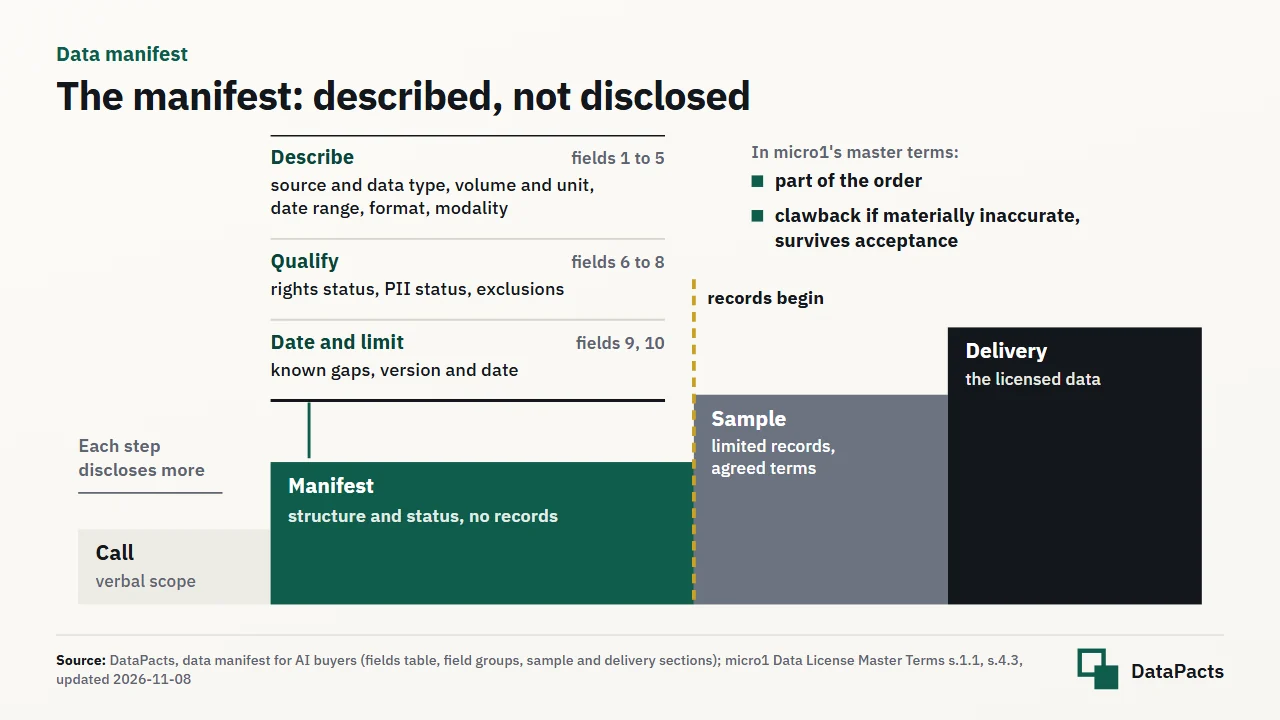
The manifest is the first outward document in AI training data licensing for a company holding data. It never contains records, and a seller can stop at this step.
Fact-check note: every figure on this page is dated and sourced as described in how we source, date and check every figure.
What a Data Manifest Tells an AI Buyer, and What It Leaves Out
A manifest answers the buyer's first three questions, whether the data fits, roughly what it is worth to them, and what delivery would involve, without giving them anything they could train on.
It leaves out the records, the names of customers and staff, and the company's own identity where the program allows it: Troveo states that the company is never named publicly, and Ooak Data that buyers receive the dataset under a code name (both checked 2026-11-09).
The inventory is complete and private, and the manifest is a selective, outward extract of it. The record it draws from is the data inventory for an AI data sale.
The Fields of a Data Manifest
Ten fields per source cover what published buyer and intermediary pages ask for before a sample. The table lists each with the level of detail that describes without disclosing (as of 2026-11-10; each source checked 2026-11-09).
| # | Field | What to state | Detail level that describes without disclosing | Where buyers ask for it | Source |
|---|---|---|---|---|---|
| 1 | Source and data type | system or archive and record family per row | product name and record family, no workspace or customer names | Turing states rough volumes per system; Sureform states systems and record types | lazarus.turing.com; sureformhq.com |
| 2 | Volume and unit | count in the buyer's unit, estimate flag | band (for example 1M to 5M messages) and the basis of the count | Turing; Mercor sets volume floors by unit | lazarus.turing.com; Mercor listings |
| 3 | Date range | earliest and latest record held | years or quarters; gaps named | Ooak Data and Sureform state date ranges | ooakdata.com/partner; sureformhq.com |
| 4 | Format and structure | file types, export format, field names, languages | field names and types, no values | Mercor states original Word, PowerPoint, Excel or PDF files and each speaker on a separate channel | Mercor listings |
| 5 | Modality | text, image, video, audio, other | modality only | AI Act training summary template, Section 2.2.1 | ec.europa.eu |
| 6 | Rights status | cleared, cleared with conditions, under review, excluded, with basis | basis category (company-created, customer contract reviewed, releases held) | Mercor states release and consent rules | Mercor listings |
| 7 | PII and sensitive-data status | categories of people, sensitive categories, standard and party | categories and counts, never names | micro1 master terms s.5.7 list excluded categories | micro1.ai/legal/data-license-master-terms |
| 8 | Exclusions | sub-sources and categories kept out | category names (HR channels, payroll) | Ooak Data annexes exclusions; Endless lets the seller define them | ooakdata.com/partner; endless-data.com |
| 9 | Known gaps and quality notes | missing periods, duplicates, retention losses | period and cause | Slack deletes history older than one year in Free workspaces from 2024-08-26 | slack.com help |
| 10 | Manifest version and date | version number, date, who approved | always stated | Endless states a manifest the seller approves; micro1 puts it in the Order Form | endless-data.com; micro1.ai |
Fields 1 to 5 describe the data, fields 6 to 8 qualify it, and fields 9 and 10 date it and state its limits.
A Sample Data Manifest for a Company Archive
The table below is an illustrative manifest for a fictional 120-person software and services company, with volumes in bands and every status stated. It is a format example, not a buyer's template (as of 2026-11-10); the bands and statuses are invented.
| Source | Data type | Volume band | Date range | Format | Rights status | PII status | Status | Source |
|---|---|---|---|---|---|---|---|---|
| Team chat workspace | chat messages, public and private channels | 5M to 10M messages | 2018 to 2025 | JSON export per channel | company-created; customer channels under review | staff names and emails; to be pseudonymized before delivery, standard named in the order | included (customer channels held) | illustrative |
| Ticket system | support tickets with replies | 200,000 to 500,000 tickets | 2019 to 2025 | CSV plus attachments | customer terms reviewed; reuse clause present | customer names and contact details; to be removed before delivery | included | illustrative |
| Code repositories | private repositories, commits, pull requests | 100 to 200 repos | 2017 to 2025 | Git history | company-owned; vendored third-party code listed separately | committer names; to be replaced | included | illustrative |
| Document store | proposals, specifications, SOPs | 50,000 to 100,000 files | 2016 to 2025 | DOCX, PDF, XLSX originals | client deliverables under review | client names in text; to be removed | under review | illustrative |
| HR and payroll | employee records | not counted | n/a | n/a | excluded | sensitive | excluded | illustrative |
The excluded row stays visible on purpose: the Spirit Airlines asset schedule filed in bankruptcy court does the same, with "Not Included" lines beside the included ones. Rows under review are flagged rather than dropped.
Describing Without Disclosing: Detail Levels for Each Field
Each field can be stated at a level that lets a buyer price and plan while revealing nothing a competitor or a model could use. The levels are:
- Volumes in bands, with the unit and the basis of the count, rather than exact counts.
- Dates in years or quarters, with gaps named.
- Structure as field names and file types, never values.
- Exclusions as categories, not as the items inside them.
- People as categories and counts, never names.
Public precedent exists for describing licensed data without naming it. The European Commission's training content summary template (Communication C(2025) 8311 final of 2025-12-05) asks a model provider only for a Yes or No on commercial licensing agreements with rightsholders, plus the modality (text, image, video, audio or other), in Section 2.2.1, and lists private datasets from other third parties, such as data intermediaries, only if publicly known (Section 2.2.2).
SpaceXAI's public summary for Grok 4.7 (2026-09-21) states sizes as bands: text more than 10 trillion tokens, images more than 1 billion, audio and video more than 1 million hours each. Its commercial licenses line reads Yes for text and image only.
The obligations behind the template are set out under EU AI Act Article 53 training data summary.
How Programs Use the Manifest: Pricing, Bidding, Approval and Acceptance
Programs that name a manifest use it at four moments: to invite bids, to fix a price, to approve scope, and to test the delivery.
The table lists eight parties alphabetically, each cell the party's own statement (as of 2026-11-09, checked 2026-11-09). Intermediaries place data with buyers and do not acquire it themselves; Endless takes a license and licenses on to labs.
| Party | Role | When the manifest is used | What the party states | Source |
|---|---|---|---|---|
| DataSupply.ai | intermediary (broker; buyer pays the seller directly) | before bids | discovery call, metadata-only manifest, labs bid; first offers within 7 days, usually 3 | datasupply.ai/owners |
| Endless | aggregator that takes a license and licenses on to labs | before price | 20-minute call; data manifest the seller approves; fixed payment agreed before anything is shared | endless-data.com |
| McCarthy's AI (Verta Ventures Inc.) | intermediary (broker) | scope approval | business chooses systems and date ranges, exports a de-identified copy, keeps its originals and never shares passwords | mccarthys.ai |
| micro1 | buyer | order and acceptance | Order Form with Data Manifest; 30 business days to reject; clawback if materially inaccurate | micro1.ai/legal/data-license-master-terms |
| Ooak Data | buyer program | scope approval | seller chooses systems and date ranges; exclusions annexed; buyers receive the dataset under a code name | ooakdata.com/partner |
| Sureform | identifies buyers and manages licensing (intermediary role) | before valuation and scope | private valuation from high-level questions, no file uploads; seller approves systems, folders, record types, date ranges and exclusions | sureformhq.com |
| Troveo | licenses on the seller's behalf (intermediary role) | packaging | scope, agree, package (anonymized, manifest), get paid; company never named publicly | troveo.ai/business-data |
| Turing Project Lazarus | reseller to labs | intake | rough volumes per system, then a small sample slice on a sampling request | lazarus.turing.com |
Two programs skip the seller's own manifest by design. Mercor states a route of scope, connection, automated extraction and de-identification, and payout, and that no AI lab buyer or third-party vendor ever sees the raw data (checked 2026-11-09). micro1 states that it de-identifies sensitive information itself, and Scale AI that it anonymizes inside the company's environment (both checked 2026-11-09). The seller still needs its own written scope on these routes.
When the Manifest Becomes a Contract Term: Rejection, Accuracy and Clawback
Under micro1's Data License Master Terms, the manifest is part of the Order Form, so its accuracy is a contractual promise that outlives delivery. The terms (last updated 2026-11-08, checked 2026-11-09) provide for an Order Form with a Data Manifest (s.1.1).
The licensee has 30 business days to reject delivered data, after which the data is deemed accepted (s.1.3). The data-partnerships page of the same company says "30 days", and both statements stay visible here because the page and the terms do not match.
Section 4.3 allows a clawback with refund if the Data Manifest is materially inaccurate, and the clawback survives acceptance.
Section 5.7 excludes, among other material and unless the Order Form allows them: protected health information, biometric identifiers, payment card or financial account data, data of children under 18 and export-controlled information, so the PII field must answer each category.
The licensor indemnifies the licensee against intellectual property, privacy, publicity and data protection claims from the data (s.8.1), and the grant is nonexclusive (s.1.2).
A seller therefore describes conservatively, dates every version and keeps the signed copy. The manifest clause sits among the others in AI data licensing agreements.
Rights Status and PII Status: Stating Them Without Overclaiming
Rights status and PII status are the two fields a buyer relies on most and can check least before delivery, so each states its basis rather than a conclusion.
Rights status takes one of four values:
- Cleared: the basis is named.
- Cleared with conditions: the condition is named.
- Under review: the open question is named.
- Excluded: the reason is named.
PII status takes one of three values:
- None expected: the basis is named.
- Present and to be removed: the standard and the party are named.
- Removed: the method and date are named.
Buyer rules shape both fields. Mercor states that call recordings need consent covering reuse, video needs appearance releases, photography needs model and usage releases, law firm files need client consent or full anonymization, and semiconductor data owned by a customer or foundry partner is not a fit (all checked 2026-11-09).
The Spirit Airlines sale shows a named standard. Its Bill of Sale form names the CCPA de-identification standard, Cal. Civ.
Code 1798.140(m), plus 45 CFR 164.514 for consumer health data (Dkt. 1463), and the ombudsman report names Tonic.ai as the de-identification agent (Dkt. 1684, 2026-10-05); the sale is not approved as of November 9, 2026. The method behind a PII status is covered under PII removal and de-identification.
What a Manifest Cannot Prove on Its Own
A manifest states what the seller believes the data contains; buyers verify quality, density and fit only by looking at records. Polyshares states that it reads a sample to price, in its words "We do not pay for a record we have not seen" (checked 2026-11-09).
Turing states a quality review within 5 business days, and Patronus AI 5 business days for a sample under NDA and up to 30 days for a full review (both checked 2026-11-09).
The manifest therefore ends where records begin. Sample size, clean rooms and how a buyer tests quality without taking the data belong to samples, clean rooms and proving data quality without sharing the data.
Sending a Manifest: Benefits, Risks, Downsides and Alternatives, Including Not Selling
A manifest discloses less than a sample and more than a phone call, and sending one commits the seller to its own description.
Benefits:
- One document answers the intake of several programs.
- Pricing or bidding can begin before any record moves.
- Scope and exclusions are fixed in writing.
Risks:
- Detail can reach parties who are not buyers.
- An overstated manifest becomes a refund claim where the terms bind it, as in micro1's s.4.3.
- The first number in a manifest can anchor the first offer.
Downsides:
- Preparing it takes unpaid staff time.
- It ages after a new export or a rights change.
Alternatives:
- Not selling or licensing at all, which is a valid outcome.
- A verbal scope call.
- A connection-based program such as Mercor's.
- Offering one source first.
The full range is laid out under alternatives to selling data to AI labs.
Where the Manifest Sits in the Process to Sell or License Company Data
The manifest sits after the choice of a buyer and before samples, due diligence and the contract. The whole sequence is in sell or license company data to AI companies.
- Data inventory (the record this manifest draws from).
- Rights audit.
- Customer consent and confidentiality clauses.
- How much company data is worth to AI companies.
- Choosing a buyer for your data.
- The data manifest (this page).
- NDAs before sharing data with an AI buyer.
- Due diligence in an AI data deal.
- Setting up a data room.
- Negotiating an AI data licensing deal.
- Delivering licensed data to an AI buyer.
How a Manifest Differs From Research Documentation and Public Summaries
A research datasheet documents a finished dataset for its users, a training content summary tells the public what a model was trained on, and a manifest tells one prospective buyer what is on offer.
Datasheets for Datasets first appeared on arXiv on 2018-03-23. The documents are covered under dataset documentation: datasheets, data cards and training data summaries, and the wider record of origin under training data provenance.
A Manifest for a Closed or Insolvent Company
In a court-supervised sale the asset schedule does the manifest's job in public, and the person who signs is a trustee or debtor representative rather than a manager.
The Spirit Airlines schedule (Dkt. 1463, filed 2026-08-14) lists a status per source, and the Google LLC successful bid of USD 10,000,000 is not approved as of November 9, 2026, with a hearing on November 17, 2026 (Dkt. 1779).
The route for closed companies is in selling data from a shut-down or defunct company, and the sale in Spirit Airlines' data archive sale.
Program Pages Cited on This Page
The manifest steps, contract terms and sample rules above come from these programs' own pages, each checked November 9, 2026.
- Company data partnership programs
- Endless
- McCarthy's AI
- Mercor data buyer profile
- micro1 data buyer profile
- Ooak Data
- Patronus AI
- Polyshares
- Scale AI
- Troveo
- Turing Project Lazarus profile
- AI data buyer match by published acceptance criteria
- Who buys AI training data
Frequently Asked Questions
What is a data manifest?
A data manifest is a written description of a dataset sent to a prospective buyer before any data moves, listing sources, volumes, date ranges, formats, rights status and personal-data status, with exclusions. The same word also names a software file that lists other files for loading.
Is a data manifest the same as a datasheet for a dataset?
No; a datasheet documents a finished dataset for its users, while a manifest describes data on offer to one buyer and can become part of the order. Under micro1's master terms the manifest is part of the Order Form.
Should a data manifest include sample records?
No; the manifest describes structure and status, and records go only into a sample under agreed confidentiality terms. Patronus AI, for example, states that it reviews a sample under NDA.
Can a buyer reject data that does not match the manifest?
Under micro1's master terms the licensee has 30 business days to reject, and a materially inaccurate manifest allows a clawback that survives acceptance.
Other buyers set their own terms, covered under acceptance, rejection and deemed acceptance of delivered data.
What does a data manifest look like?
A table with one row per source and columns for type, volume band, date range, format, rights status, PII status and exclusions, dated and versioned, as in the sample above.