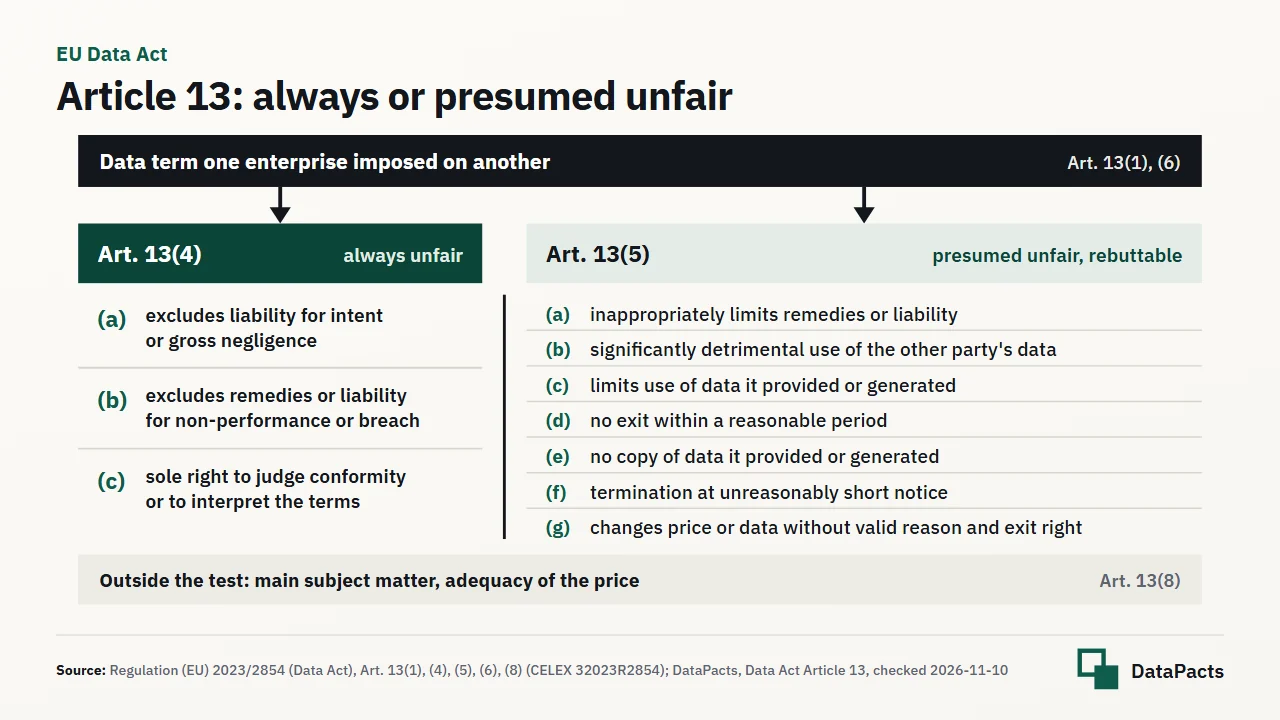
The regulation is OJ L, 2023/2854, 22.12.2023, CELEX 32023R2854, and its Chapter IV is titled "Unfair contractual terms related to data access and use between enterprises". Chapter IV applies to contracts concluded after September 12, 2025.
The Commission's non-binding model terms, Recommendation (EU) 2026/2394 of October 29, 2026 (OJ of November 6, 2026), give a reference text. This page sets out the two lists, the dates and the model terms as of November 10, 2026, and what they mean for the contract layer of AI training data licensing in the EU.
Which Data License Terms Article 13 Reaches
Article 13 reaches terms in a contract between two enterprises that concern access to and use of data, or liability and remedies for breach or termination of data-related obligations, and Chapter IV covers any private-sector data used under such a contract (Art. 1(2)(c)), not only data from connected products.
- In scope: the two term types of Art. 13(1), when one enterprise imposed the term on another.
- Not unfair by definition: a term that reflects mandatory Union law, or the Union rule that would apply if the contract were silent (Art. 13(2)).
- Outside the test: terms defining the main subject matter and the adequacy of the price against the data supplied (Art. 13(8)); recital 60 adds contract parts unrelated to making data available.
The rule is two-sided. It protects whichever enterprise had the term imposed, whether a seller facing an AI buyer's standard terms or an AI buyer facing a large holder's terms. Consumers fall under Union consumer law instead (recital 28, Directive 93/13/EEC), and individual contributors are not addressed here.
When a Term Counts as Unilaterally Imposed
A term is unilaterally imposed when one party supplied it and the other could not influence its content despite an attempt to negotiate it (Art. 13(6)), so a license signed without any attempt to negotiate gives weaker grounds than one where changes were requested and refused.
Under recital 59, a term simply provided and accepted, or negotiated and agreed in amended form, is not imposed.
The party that supplied the term bears the burden of proving it was not imposed, and may not itself argue that the term is unfair (Art. 13(6)).
The parties cannot exclude Art. 13, derogate from it or vary its effects (Art. 13(9)). Written change requests and the buyer's refusals are the evidence Art. 13(6) turns on. An attempt to negotiate is part of negotiating an AI data licensing deal.
Terms That Are Always Unfair Under Article 13(4)
Article 13(4) lists three terms that are unfair whenever they were unilaterally imposed, with no room for the imposing party to show otherwise. The table gives them as of 2026-11-10, with where each can show up in an AI data license.
| Point | A unilaterally imposed term is always unfair if its object or effect is to | Where it shows up in an AI data license | Source |
|---|---|---|---|
| 13(4)(a) | exclude or limit the imposing party's liability for intentional acts or gross negligence | liability cap without a carve-out for intent or gross negligence | eur-lex.europa.eu |
| 13(4)(b) | exclude the other party's remedies for non-performance, or the imposing party's liability for breach | "no remedy" or "sole remedy is termination" wording | eur-lex.europa.eu |
| 13(4)(c) | give the imposing party the exclusive right to determine whether supplied data conform to the contract, or to interpret any term | buyer alone decides acceptance or interprets the license | eur-lex.europa.eu |
The third column is an illustration, never a finding that any buyer's clause is unfair. An unfair term drops out and the rest of the contract stays binding where the term is severable (Art. 13(7)).
Terms Presumed Unfair Under Article 13(5) and the General Test
Article 13(5) lists seven terms presumed unfair, which the imposing party can keep only by showing the term is not unfair in the specific case (recital 62). The table gives them as of 2026-11-10.
| Point | Presumed unfair if its object or effect is to | Where it shows up in an AI data license | Source |
|---|---|---|---|
| 13(5)(a) | inappropriately limit remedies or liability, or extend the liability of the party the term was imposed on | seller's uncapped indemnity beside a capped buyer | eur-lex.europa.eu |
| 13(5)(b) | let the imposing party access and use the other party's data in a significantly detrimental way, in particular commercially sensitive, trade-secret or IP-protected data | use beyond the licensed purpose | eur-lex.europa.eu |
| 13(5)(c) | prevent the other party using data it provided or generated during the contract, or limit that use so it cannot use, capture, access, control or exploit the value of the data adequately | exclusivity that stops the seller using its own data | eur-lex.europa.eu |
| 13(5)(d) | prevent the other party terminating within a reasonable period | lock-in with no exit for the seller | eur-lex.europa.eu |
| 13(5)(e) | prevent the other party obtaining a copy of data it provided or generated during the contract or within a reasonable period after termination | no copy of the seller's own data or derived records | eur-lex.europa.eu |
| 13(5)(f) | let the imposing party terminate at unreasonably short notice, considering the other party's ability to switch and its financial detriment, unless there are serious grounds | buyer termination for convenience on very short notice | eur-lex.europa.eu |
| 13(5)(g) | let the imposing party substantially change the price or the nature, format, quality or quantity of the data without a valid reason and a right to terminate (proviso for indefinite contracts) | buyer may rewrite the data specification unilaterally | eur-lex.europa.eu |
The point (g) proviso lets a party reserve unilateral changes in a contract of indeterminate duration where the contract states a valid reason, reasonable notice is given and the other party may terminate at no cost.
A term on neither list is judged by the general test of Art. 13(3): a gross deviation from good commercial practice in data access and use, contrary to good faith and fair dealing.
Recital 61 limits this to excessive terms where a stronger bargaining position was abused, so a term merely more favorable to one side remains normal contractual freedom, and recital 62 makes the lists the yardstick.
Which Contracts Article 13 Covers, by Date of Signature
Chapter IV applies to data contracts concluded after September 12, 2025, and from September 12, 2027 also to older contracts that run indefinitely or are due to expire at least 10 years from January 11, 2024 (Art. 50). The table gives the dates in order, as of 2026-11-10.
| Date | What happens | Provision | Status as of 2026-11-10 | Source |
|---|---|---|---|---|
| 2024-01-11 | Data Act enters into force | Art. 50 | done | eur-lex.europa.eu |
| 2025-09-12 | Regulation applies; Chapter IV applies to contracts concluded after this date; Art. 41 deadline for the model terms | Art. 50, Art. 41 | in effect | eur-lex.europa.eu |
| 2026-10-29 | Commission adopts Recommendation (EU) 2026/2394 (non-binding) | Art. 41 | adopted | eur-lex.europa.eu (CELEX 32026H2394) |
| 2026-11-06 | Recommendation published in the Official Journal (OJ L, 2026/2394) | Art. 41 | published | eur-lex.europa.eu |
| 2027-09-12 | Chapter IV reaches contracts concluded on or before 2025-09-12 that are of indefinite duration or due to expire at least 10 years from 2024-01-11 | Art. 50 | ahead | eur-lex.europa.eu |
A three-year license signed on 2025-06-01 stays outside Chapter IV; a license signed on 2025-06-01 with no end date falls under it from 2027-09-12. Whether a "perpetual" grant counts as indefinite duration is not settled here. The full timeline of the Act sits on the page for the EU Data Act and AI training data.
The Commission's Non-Binding Model Terms and Cloud Clauses: Recommendation (EU) 2026/2394
Article 41 required the Commission to recommend non-binding model contractual terms on data access and use and standard contractual clauses for cloud computing contracts before September 12, 2025, and it adopted them on October 29, 2026 as Recommendation (EU) 2026/2394, published in the Official Journal on November 6, 2026.
The table lists its twelve annexes as of 2026-11-10; point 1 recommends the model terms of Annexes I to V, point 2 the cloud clauses of Annexes I and VI to XII, and point 3 asks Member States to promote them.
| Annex | Type | Parties or subject | Data Act link | Source |
|---|---|---|---|---|
| I | general introduction | how to choose and adapt the MCTs and SCCs; legal value | Art. 41 | eur-lex.europa.eu |
| II | MCT | data holder and user of a connected product or related service | Art. 4 | eur-lex.europa.eu |
| III | MCT | user and data recipient | Art. 5 | eur-lex.europa.eu |
| IV | MCT | data holder and data recipient (mandatory sharing at the user's request) | Art. 5 | eur-lex.europa.eu |
| V | MCT | data sharer and data recipient (voluntary sharing) | Chapter IV | eur-lex.europa.eu |
| VI | SCC | switching and exit | Chapter VI | eur-lex.europa.eu |
| VII | SCC | termination | Chapter VI | eur-lex.europa.eu |
| VIII | SCC | security and business continuity | Chapter VI | eur-lex.europa.eu |
| IX | SCC | non-dispersion | Chapter VI | eur-lex.europa.eu |
| X | SCC | liability | Chapter VI | eur-lex.europa.eu |
| XI | SCC | non-amendment | Chapter VI | eur-lex.europa.eu |
| XII | SCC | definitions | Chapter VI | eur-lex.europa.eu |
Annex I states that the terms are non-binding and can be adapted, that their use is "at the complete discretion of the parties", and that they do not affect GDPR duties.
Dispute settlement bodies under Art. 10 should take them into account. The Commission page on the Recommendation (publication date November 19, 2025, checked 2026-11-10) describes four sets of model terms, the fourth drafted to comply with Chapter IV.
The cloud clauses are not the GDPR standard contractual clauses for transfers to third countries (Implementing Decision (EU) 2021/914), and Annex I says the Data Act clauses do not incorporate GDPR requirements. The GDPR clauses have their own page on transferring training data to US buyers with SCCs.
Annex V: The Model Contract for Voluntary Data Sharing, Read for an AI Deal
Annex V is the model contract that fits a company licensing data to an AI developer of its own choice, because it covers voluntary sharing between a data sharer and a data recipient and names sharing data for the training, improvement or development of AI systems among its examples.
It describes itself as usable "as a benchmark for assessing the fairness of clauses in existing contracts". Most clauses below offer options, and none is recommended over another.
- 5.1.1 Purposes: a restrictive list of authorized purposes, or a broad option for non-personal data only.
- 5.1.4 Duration of use: a right to use the data in perpetuity, for the contract term or for a set period.
- 5.1.5 Deletion: deletion of the data and copies, with written certification on request.
- 5.2.1 Onward sharing: none, "whether in identified, anonymised or pseudonymised or aggregate form", unless an option is filled.
- 7.2 Results: intellectual property in results owned by the recipient, held jointly, or assigned to the sharer.
- 8 Remuneration: agreed by the parties, with no amount given.
- 9.2 Termination: the recipient may end the contract for convenience on notice, with optional compensation of the sharer's costs.
- 4.4.4 Security: a breach is reported within 24 hours of discovery.
Reading an AI Buyer's Standard License Terms Against Article 13
Most published AI data license terms are drafted by the buyer, so a seller that tried and failed to change them can test each data-related clause against the two lists, while price and the description of the licensed data stay outside the test. The mapping is a reading aid, not a verdict.
Liability limits map to Art. 13(4)(a), the buyer's sole right to decide conformity to 13(4)(c), limits on the seller's own use of its data to 13(5)(c), termination at unreasonably short notice to 13(5)(f), and unilateral change of data conditions to 13(5)(g).
For example, the micro1 Data License Master Terms cap liability at 3x the total fees paid or payable under the order form and exclude fraud, gross negligence and willful misconduct from the cap (s.7.2, terms updated 2026-11-08, checked 2026-11-09), which is the carve-out 13(4)(a) looks for.
Whether Chapter IV reaches a contract with a recipient outside the Union, or one under a non-EU governing law, is not settled here. Art. 1(3) applies the Regulation to data holders making data available to recipients in the Union. How published buyer contracts differ clause by clause is shown in the license clause matrix.
Relying on Article 13 as a Data Seller: Benefits, Risks, Downsides and Alternatives, Including Not Licensing
Article 13 gives a seller a fallback against imposed one-sided data terms, not a right to a fair price or to any deal, and licensing on negotiated terms or not licensing at all remain valid choices.
Benefits
- The black-list terms are not binding whatever the contract says (Art. 13(4), 13(9)).
- The grey list shifts the burden to the imposing party (Art. 13(5), 13(6)).
- Annex V gives a published reference text since 2026-11-06.
Risks
- A term the seller accepted without trying to negotiate may not count as imposed (Art. 13(6)).
- Price and main subject matter are excluded (Art. 13(8)), so a low fee is not unfair under Art. 13, and a seller may need to negotiate the clauses of an AI data licensing agreement instead.
- Reach against non-EU buyers is not settled.
Downsides
- Older long contracts are covered only from 2027-09-12.
- The model terms are non-binding and a buyer may decline them.
- The Digital Omnibus proposal COM(2025) 837 would amend the Data Act and is listed on the European Parliament's procedure page as "Awaiting committee decision" as of 2026-11-10.
Alternatives
- Negotiate and record each change request.
- Propose Annex V wording as the starting draft.
- License only under terms the seller drafts.
- Not licensing at all.
Every alternative to selling data to AI labs, including not selling stays open.
Beyond Article 13: The Parent Act, Contract Clauses and Seller Steps
Article 13 is one chapter of the Data Act, and each contract clause has its own page. The parent page on the EU Data Act covers the product-data rule, cloud switching and every date; wider context sits in the EU rules for AI training data and in AI training data law by jurisdiction.
- Liability: liability caps in AI data licenses (Art. 13(4)(a))
- Acceptance: acceptance and deemed acceptance of delivered data (Art. 13(4)(c))
- Exclusivity: exclusive vs non-exclusive data licenses (Art. 13(5)(c))
- Term: license term and perpetual licenses (Art. 13(5)(d), (f))
- Indemnity: indemnities and warranties in AI data licenses (Art. 13(5)(a))
- Scope: field of use and scope limits (Art. 13(5)(b), Annex V 5.1.1)
- Deletion: deletion, return and machine unlearning clauses
- Retraining: retraining and model retention rights
- Derivatives: ownership of derivatives and models trained on licensed data
- Onward transfer: sublicensing and onward transfer
- Audit: audit rights in AI data licenses
- Disputes: governing law, arbitration and disputes
- Confidentiality: trade secrets and licensed datasets
How This Page Is Sourced and Dated
Every rule here cites the Official Journal text of Regulation (EU) 2023/2854 or Recommendation (EU) 2026/2394, or the Commission page, with the date it was checked.
The method is described under how we source, date and check every figure, and this page is general information about Article 13 of the Data Act, not legal advice on any specific contract or term.
Frequently Asked Questions
Are the Data Act model contractual terms binding?
No: the model contractual terms and the cloud clauses in Recommendation (EU) 2026/2394 are non-binding, and parties may adapt them or not use them at all. Dispute settlement bodies under Art. 10 should take them into account.
Does Article 13 apply to a data license signed before September 12, 2025?
Only from September 12, 2027, and only if the contract runs indefinitely or is due to expire at least 10 years from January 11, 2024.
Can an AI company's take-it-or-leave-it license terms be unfair under the Data Act?
Yes, if a data-related term was supplied by the AI company, the seller tried and failed to change it, and the term is on the lists or fails the general test. Price and the main subject matter of the contract stay outside the test (Art. 13(8)).