It states a round of USD 15 million at a USD 300 million valuation, dated September 29, 2026, and claims USD 200 million in annualized revenue; neither figure is confirmed by a filing in the record.
Proximal is paid by its customers, so it is profiled as a builder of environments and data, and every figure below is Proximal's own statement with its date. The profile sits within AI training data licensing, where RL environments are one form of data acquired for AI training.
Each value names its source and check date, and how DataPacts sources and dates every figure is set out in the methodology.
What Proximal Builds: Post-Training Data and Long-Horizon Coding Tasks
Proximal builds two things for AI developers: post-training data and long-horizon coding RL environments, the multi-step software tasks with tests that coding agents train and are scored against.
Its home page, checked 2026-11-10, calls Proximal a research lab for coding data, and its funding post of September 29, 2026 says it works with frontier labs and enterprises and generates targeted post-training data for coding agents.
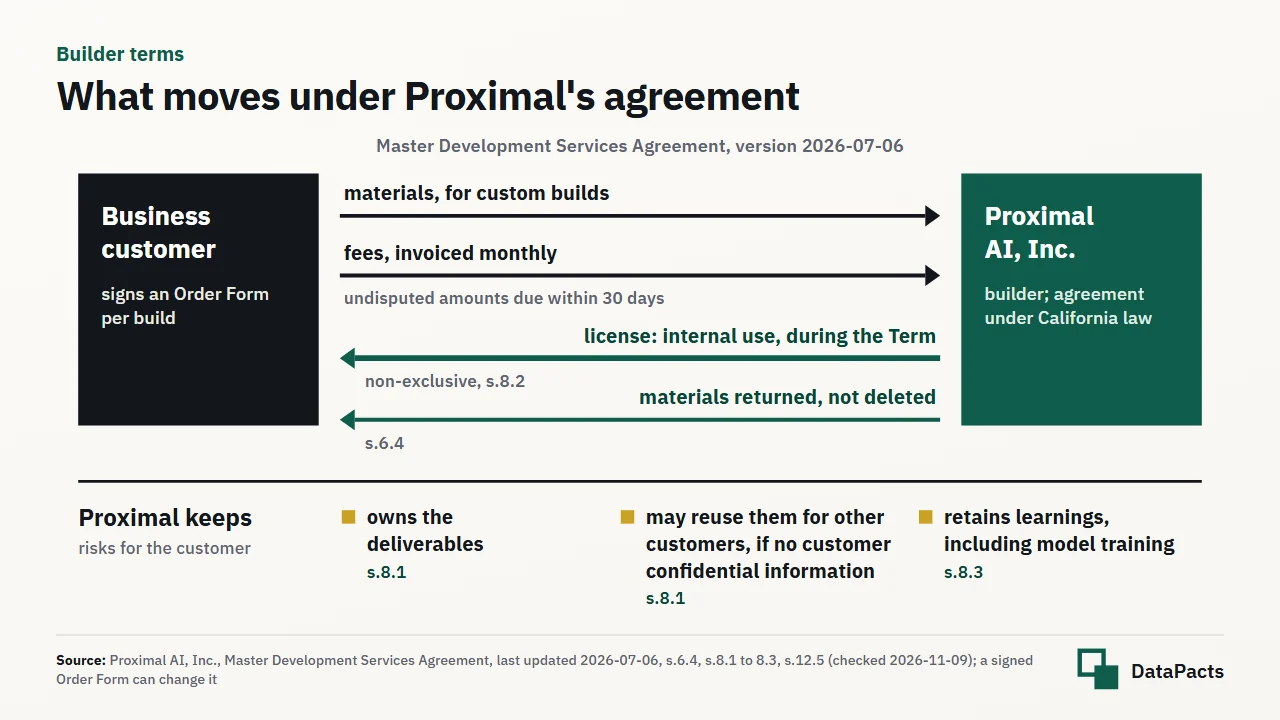
A customer's own materials enter a build only when the work is custom: the agreement lists customer materials for custom post-training data and environment builds as the input. Each build is set out in an Order Form under the agreement, which is signed by business customers.
The agreement is the only Proximal document in the record that sets commercial terms: no contributor program, task bounty or marketplace listing of Proximal is on record as of 2026-11-09, so the relationship it describes runs between Proximal and a paying business, not between Proximal and an individual contributor.
Proximal also publishes FrontierSWE, which its site presents as its own benchmark. Its home page, checked 2026-11-16, presents FrontierSWE v2 as "34 tasks, 13 frontier models, 20-hour budgets" with a leaderboard; these are Proximal's statements, and no launch date is on record.
Other builders' benchmarks are listed with the wider set of RL environments for coding agents.
Proximal Company Identity
Proximal's legal name is Proximal AI, Inc., as its Master Development Services Agreement gives it, and the agreement is governed by California law. The table lists each attribute with its source, as of 2026-11-09.
| Attribute | Value | Source |
|---|---|---|
| Legal name | Proximal AI, Inc. | proximal.ai/msa |
| Website | https://www.proximal.ai/ | proximal.ai |
| Registry number | none found on primary pages, checked 2026-11-09 | n/a |
| Country | United States | proximal.ai/msa |
| City | San Francisco, CA (site footer), checked 2026-11-10 | proximal.ai/msa |
| Founded | not stated in the sources checked | n/a |
| Type | RL environment builder, post-training data | proximal.ai |
| Governing law of its agreement | California (s.12.5) | proximal.ai/msa |
| Benchmark | FrontierSWE | proximal.ai |
| Officers | not named in the sources checked | n/a |
Three attributes are not public in the sources checked: a state registry number, a founding year and the names of officers. Each is added when a Proximal page or a filing states it.
Other companies with similar names exist, so the legal name and the website in the table are the identifiers this page relies on, and a figure is attributed to Proximal only when it comes from those pages.
Proximal's Round and Revenue, as Proximal States Them
Proximal states that it raised USD 15 million at a USD 300 million valuation in a round led by General Catalyst, in a post dated September 29, 2026.
The same post names SV Angel, Diede van Lamoen of Go Global Ventures and Chemistry as investors, and the angels Liam Fedus, Kevin Weil and Erik Bernhardsson. The post's own summary line, checked 2026-11-10, calls it a "Seed Fundraise", while the post body gives no round type.
| Date | Item | Value | Named parties | Stated by | Source |
|---|---|---|---|---|---|
| 2026-09-29 | Round ("Seed Fundraise" in the post's summary line) | USD 15,000,000 | Led by General Catalyst; SV Angel, Diede van Lamoen (Go Global Ventures), Chemistry; angels Liam Fedus, Kevin Weil, Erik Bernhardsson | Proximal | proximal.ai/blog/new-frontiers |
| 2026-09-29 | Valuation | USD 300,000,000 | n/a | Proximal | proximal.ai/blog/new-frontiers |
| 2026-09-29 | Annualized revenue (self-reported) | USD 200,000,000 | n/a | Proximal | proximal.ai/blog/new-frontiers |
Proximal's own statements as of 2026-11-09; no filing in the record confirms them.
The same post claims USD 200 million in annualized revenue, which is self-reported and not independently verified. The post is the only source for all three figures, and they share one date, so none of them can be read as a change over time.
Funding is what investors paid for shares, not a price for an environment, and it says nothing about what any single customer pays. The page is updated when Proximal announces another round or a filing states one. Rounds across companies are compared under funding and valuations of AI data companies.
Proximal's Master Development Services Agreement
Proximal sells its work under a Master Development Services Agreement, last updated July 6, 2026, which business customers sign before each project is set out in an Order Form.
The agreement is a services contract in which the customer pays Proximal, and the table reads it as Proximal's published template, checked 2026-11-09; a signed Order Form can change it.
| Term | What the agreement says | Section | Source |
|---|---|---|---|
| Who signs | Business customers | n/a | proximal.ai/msa |
| How work is ordered | An Order Form under the agreement | n/a | proximal.ai/msa |
| Who pays | The customer pays Proximal; monthly invoices; undisputed amounts due within 30 days | n/a | proximal.ai/msa |
| Ownership of deliverables | Proximal | s.8.1 | proximal.ai/msa |
| Customer's license | Non-exclusive, non-transferable, non-sublicensable, worldwide, royalty-free, internal business use, during the Term | s.8.2 | proximal.ai/msa |
| Reuse | For other customers, absent customer confidential information | s.8.1 | proximal.ai/msa |
| Retained learnings | "learnings, improvements, optimizations, or model training" | s.8.3 | proximal.ai/msa |
| Customer materials | Returned, not deleted | s.6.4 | proximal.ai/msa |
| Liability cap | 12 months' fees, with carve-outs | s.11.1 | proximal.ai/msa |
| IP indemnity | By Proximal | s.10.1 | proximal.ai/msa |
| Governing law | California | s.12.5 | proximal.ai/msa |
Proximal's published template; a signed Order Form can change it.
The version date matters because terms change: the agreement checked on 2026-11-09 still carries its July 6 update, 85 days before the funding post of September 29, 2026, so the funding post did not come with a new version of the terms.
The liability cap is 12 months' fees with carve-outs (s.11.1), and Proximal gives an IP indemnity to the customer (s.10.1). How those carve-outs sit beside other published caps is set out under liability caps in AI data licenses.
Who Keeps the Work Under Proximal's Agreement
Under Proximal's agreement Proximal owns the deliverables, and the customer receives a non-exclusive, non-transferable, non-sublicensable, worldwide, royalty-free license to use them for internal business purposes during the Term (s.8.1, s.8.2). Proximal may also reuse deliverables for other customers when they contain no customer confidential information (s.8.1).
Proximal retains "learnings, improvements, optimizations, or model training" (s.8.3), and it returns customer materials rather than deleting them (s.6.4). For a company that supplies materials, this means its data can shape work that Proximal keeps and reuses, while the copies it handed over come back to it.
Whether supplied materials count as customer confidential information is decided by the agreement's definitions and the Order Form, so a company reads both before it hands anything over, and a signed Order Form can move any of these points.
Other published contracts set ownership, reuse and deletion differently, and the license clause matrix shows how, clause by clause, without repeating them here.
Does Proximal Pay for Data? What the Record Shows
No program on record shows Proximal paying a company or contributor for data, code or expert work, as of November 9, 2026: under its published agreement, money flows from the customer to Proximal. The only input on record is customer materials supplied for the customer's own build.
No Proximal transaction is in the deal tracker, and no customer is named in the sources checked. The page is updated when Proximal publishes a program or terms for acquiring codebases or paying experts.
Until then, a company asking whether Proximal acquires its materials has no published term to point to, and the only documented route into a Proximal project is a paid build under the agreement.
A holder of a codebase who wants to license it is better served by the page on licensing source code to AI companies, which sets out who acquires code and on what terms.
Working With Proximal: Benefits, Risks, Downsides and Alternatives
For a company that would commission work from Proximal or supply it materials, Proximal is a builder with a public agreement: its terms can be read before talks, and they keep the deliverables with Proximal.
Benefits
- A published agreement with a dated version (last updated 2026-07-06).
- Plain payment terms: monthly invoicing, undisputed amounts due within 30 days.
- An IP indemnity from Proximal (s.10.1).
- A stated focus on coding and post-training work.
Risks
- Proximal owns the deliverables and may reuse them for other customers (s.8.1).
- Retained learnings include model training (s.8.3).
- Customer materials are returned, not deleted (s.6.4).
- Liability is capped at 12 months' fees, with carve-outs (s.11.1).
- No registry number found on primary pages, checked 2026-11-09.
Downsides
- The customer's license is for internal use only and runs during the Term (s.8.2).
- No named customer or officer is on record.
- Revenue and valuation are Proximal's own figures, dated 2026-09-29.
Alternatives
- Other builders on the company list below, each with its own terms.
- A marketplace where the seller lists its own codebase or task set: DataVendor states that a sale licenses the assets rather than transferring them and keeps 20 % of vendor earnings at withdrawal (DataVendor's claim, checked 2026-11-09).
- Building and licensing an environment directly: the guide to how to sell an RL environment or task set compares the routes.
- Not commissioning, supplying or licensing at all, which is a valid outcome.
Proximal's terms are its own and can change, so the current agreement and the Order Form are the reference before relying on any of this.
Proximal Among RL Environment Builders
Proximal is one of the custom environment builders for labs on DataPacts' list of RL environment companies, which sets each builder's legal entity and stated funding side by side.
Within that list, Proximal's distinguishing record is a public agreement with ownership, reuse and payment terms, and a stated round dated September 29, 2026. The list of RL environment companies holds the full set. Related pages:
- Other builder profiles: Mechanize, Fleet AI and Datacurve.
- The environment type and its prices: RL environments and the public price points for RL environments.
- Who owns what inside an environment, and other agreements: rights in an RL environment and program terms compared.
- Post-training suppliers and the decision: RLHF data and whether to sell or license data at all.
More About Proximal
Frequently Asked Questions About Proximal
What does Proximal AI do?
Proximal AI builds post-training data and long-horizon coding RL environments for frontier labs and enterprises. It sells under a public services agreement and publishes the FrontierSWE benchmark, as its site states, checked 2026-11-10.
Is Proximal AI a real company?
Yes, on the record: Proximal AI, Inc. has its own website, a dated agreement and a dated funding post. No registry number was found on its primary pages, checked 2026-11-09.
How much funding has Proximal raised?
Proximal states USD 15 million at a USD 300 million valuation, led by General Catalyst, in a post dated September 29, 2026. The post's summary line calls it a seed fundraise, and no filing confirms the figures.
Who owns the work Proximal delivers?
Proximal owns the deliverables under s.8.1 of its agreement. The customer receives a non-exclusive license for internal business use during the Term (s.8.2), per the version last updated 2026-07-06.
Where is Proximal based?
Proximal is based in San Francisco, California, as the footer of its own site states, checked 2026-11-10. Its agreement also sends disputes to the courts of San Francisco County (s.12.5).
Does Proximal buy company data or code?
No such program is on record as of November 9, 2026. Customers pay Proximal for builds, and holders of code find the licensing routes on the source-code page above.