Epoch AI's interviewees put a task at USD 200 to 2,000 in the same article (2026-01-12), and Mechanize states about USD 500 per task as a minimum efficient spend (2025-08-18).
Every figure on this page is a claim with its stating party and date, and figures are never averaged, rounded or combined across units. Where two statements conflict, both are shown, and compute cost, revenue and funding are kept apart from price. The page sits within AI training data licensing.
What an RL Environment Price Is Quoted Per: Task, Replica, Contract or Bounty
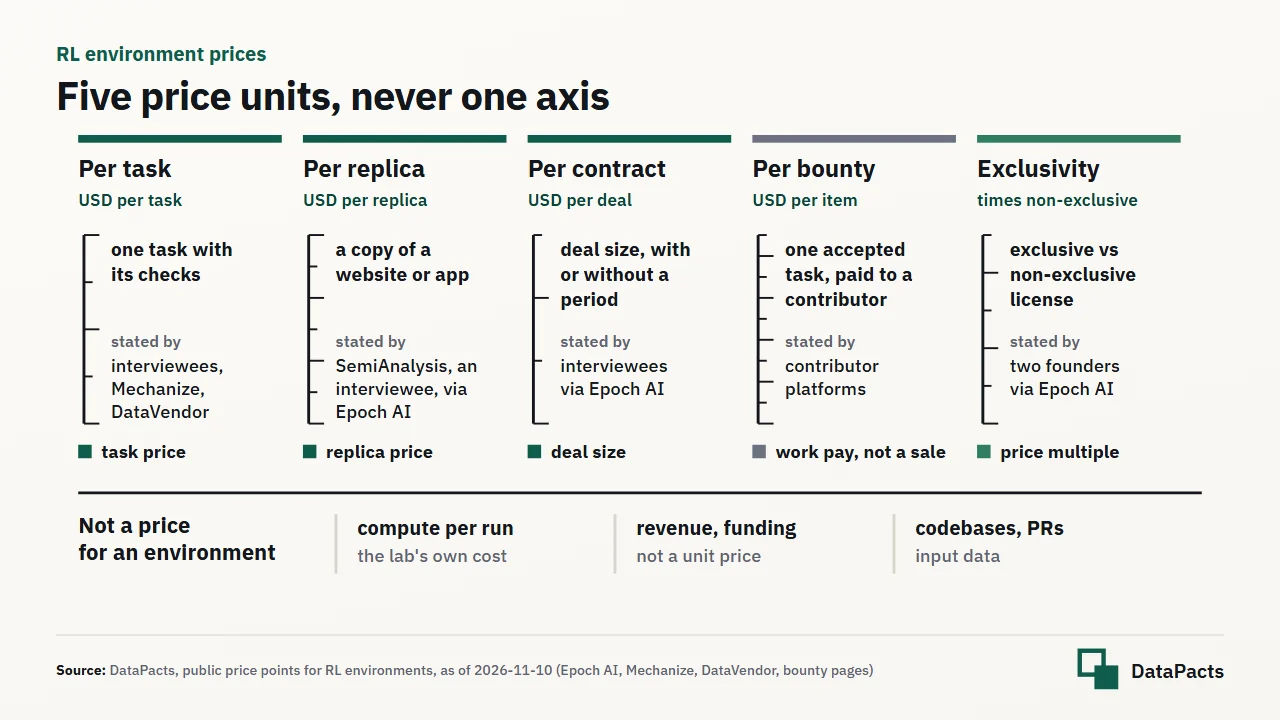
Public RL environment prices come in five units: per task, per environment or software replica, per contract or quarter, per contributor bounty item, and as a multiple for exclusivity.
The units answer different questions, so a per-task figure cannot be set against a per-replica one, and a contract figure says nothing about how many tasks it covers unless the source says so.
One neolab researcher quoted by Epoch AI notes that contract size varies a lot depending on the number of tasks (article of 2026-01-12).
- Per task: one task with its checks, stated by interviewees, Mechanize and DataVendor.
- Per environment or replica: a copy of a website or a software product, stated through Epoch AI.
- Per contract or quarter: the size of a deal, with or without a period.
- Per bounty item: pay to a contributor for one accepted task, which is work pay rather than a sale of an environment.
- Exclusivity multiple: how much more an exclusive license is said to cost than a non-exclusive one.
Inputs such as a codebase carry their own prices (DataVendor's codebase floor, Turing's price per pull request), and they are input data, not environments. For what an environment contains and who builds and buys it, see the parent page on what RL environments are, who builds them and who buys them.
Every Public Price Point, With Stating Party and Date
Fifteen public price points exist on the record as of November 10, 2026, from a research publisher's interviews, one builder, a marketplace and three contributor platforms, plus one company's codebase price list.
Epoch AI's article draws on 18 people (9 calls and 9 written replies) and 4 sanity checks without input, and its date of 2026-01-12 is the article date, not the date of any interview.
Dates in the table are either the document date or the check date, and rows from the same source share its limits: the interviewees are named only by role, and Epoch AI states the figures as ballparks.
The table lists each price point as stated, as of 2026-11-10 for rows checked that day and 2026-11-09 where the date says so.
| Unit | Figure | Wording in the source | Stated by | Date | Kind | Source |
|---|---|---|---|---|---|---|
| per task | USD 200 to 2,000 | "a ballpark of $200-$2,000 per task" | Epoch AI interviewees (several) | article 2026-01-12 | claim | epoch.ai |
| per task, upper case | USD 20,000 | "$20k per task would be rare but possible" | one RL environment founder via Epoch AI | article 2026-01-12 | claim | epoch.ai |
| per task, minimum efficient spend | about USD 500, projected a few thousand within a year | Mechanize essay | Mechanize | 2025-08-18 | claim (spend floor) | mechanize.work |
| per task, buyer opportunity | around USD 500 to 1,500; hundreds to thousands of tasks per request | "around $500 to $1,500 a task" | DataVendor | checked 2026-11-10 | claim | docs.datavendor.ai |
| per website replica (UI gym) | about USD 20,000 each | "cost around $20k each" | SemiAnalysis via Epoch AI | article 2026-01-12 | claim | epoch.ai |
| per high-fidelity replica (example: Slack) | around USD 300,000 | "figures around $300k" | one interviewee via Epoch AI | article 2026-01-12 | claim | epoch.ai |
| per contract, per quarter | often six to seven figures | "often six to seven figures per quarter" | Epoch AI article (interviewees) | article 2026-01-12 | claim | epoch.ai |
| per contract, per quarter | seven figures or more | "seven figures per quarter or more" | one RL environment founder via Epoch AI | article 2026-01-12 | claim | epoch.ai |
| per contract, no period stated | USD 300,000 to 500,000 | "in the $300k-$500k range" | one neolab researcher via Epoch AI | article 2026-01-12 | claim | epoch.ai |
| exclusive vs non-exclusive | roughly 4 to 5 times | "roughly 4-5x more expensive" | two founders via Epoch AI | article 2026-01-12 | claim | epoch.ai |
| per bounty, Open Access | USD 100 to 500 | "in the $100-500 range" | Prime Intellect | 2025-10-27 | claim (contributor bounty) | primeintellect.ai |
| per bounty item, coding | USD 80 to 220 | bounties shown on the page | Datacurve (Shipd) | checked 2026-11-09 | claim (contributor bounty) | shipd.ai |
| per task, video and animation editing | USD 30 to 60, 35 to 65, 45 to 75 by role | "Price agreed upfront; paid on approval" | Refresh | checked 2026-11-09 | claim (contributor task) | refresh.dev |
| per pull request, codebase for task building | USD 1,000, up to USD 10,000 per modern codebase; legacy USD 10,000 to 100,000+; USD 50 per bundled org artifact | newsletter 57 | Turing | 2026-03-25 | claim (input data) | turing.com |
| per codebase license | about USD 30,000 floor; some single-codebase deals above USD 10 million | "About $30,000 per license is the floor for a good codebase" | DataVendor | checked 2026-11-10 | claim (input data) | docs.datavendor.ai |
The Kind column separates environment and task prices from contributor pay and input data, and units are never summed. Figures that appear only in press reports or secondary directories, including lab spending budgets, deal values and funding rounds, are left out of the table until a party to them states them on the record.
Where the Stated Prices Disagree
The public statements disagree in three places, and both sides of each are shown rather than reconciled. The table compares the statements as of 2026-11-10.
| Point | Statement A | Statement B | Why they differ | Sources |
|---|---|---|---|---|
| Low end per task | USD 200 per task (Epoch AI interviewees, 2026-01-12) | about USD 500 minimum efficient spend (Mechanize, 2025-08-18); around USD 500 to 1,500 (DataVendor, checked 2026-11-10) | Mechanize argues a spend floor from compute; DataVendor states buyer opportunity prices | epoch.ai; mechanize.work; docs.datavendor.ai |
| Contract size | often six to seven figures per quarter (Epoch AI article) | USD 300,000 to 500,000 per contract, no period (one neolab researcher) | different periods; "varies a lot depending on the number of tasks" | epoch.ai |
| Turing pricing | USD 1,000 per PR, up to USD 10,000 per codebase (newsletter 57, 2026-03-25) | revenue share, "Nothing upfront" (Lazarus page, checked 2026-11-09) | different documents and dates; not reconciled by Turing | turing.com; lazarus.turing.com |
Mechanize's figure is a spend floor argued from compute, not a quote, which explains part of the first gap, and DataVendor's range describes what buyers post on a marketplace, not what a builder invoiced. The second gap comes from period: a quarterly figure and a per-contract figure with no stated period cannot be compared.
The third gap is two documents of one company from different dates, which Turing does not reconcile. The USD 20,000 per task figure is one founder's "rare but possible" case, not a typical one (article of 2026-01-12).
Coding-specific bounties and codebase figures sit on the page about RL environments for coding agents.
Compute Spent per Task Is Not a Sale Price
Mechanize estimates that RL training spends about USD 480 of compute per run on one task and about USD 2,400 over five reuses, a cost to the lab that trains, not a price paid to the builder (essay of 2025-08-18). Epoch AI cites the same USD 2,400. The basis of the estimate:
- 500,000 tokens per run, which is Mechanize's projection, while current frontier RL transcripts average around 100,000 tokens per task in Mechanize's own experience.
- USD 15 per 1M output tokens, the price Mechanize assumes (2025-08-18).
- A group size of 64.
Mechanize uses the compute figure to argue for spending at least about USD 500 per task (essay of 2025-08-18), which is the minimum efficient spend in the table.
The argument is that a task cheaper than the compute spent on it wastes the run, so the figure is a floor set by cost and not an offer from any builder.
Data prices for other data types exclude compute costs in the same way, and they sit on the page about AI training data prices, which exclude compute costs.
Terms Around the Number: Who Sets It, Fees, Invoicing and Exclusivity
A stated price means little without the terms around it: who sets it, what the venue keeps, when invoices fall due and whether the license is exclusive. These are the documented terms, each as the party states it, and none of them states a total price for an environment.
- DataVendor (checked 2026-11-09): vendors set the price, 20 % of earnings is kept at withdrawal and never on referral fees, the minimum withdrawal is USD 1,000 before fees, and a sale licenses rather than transfers.
- Proximal's master services agreement (last updated 2026-07-06): monthly invoicing, undisputed amounts due within 30 days, liability capped at 12 months' fees, and Proximal owns the deliverables.
- Bounties (checked 2026-11-09): paid on approval or completion; Refresh states "Price agreed upfront" and "Larger scopes quoted separately".
- Turing (checked 2026-11-09): a revenue share, with the holder also paid when Turing builds RL environments on the record; the split is not published.
Two founders put exclusivity at roughly 4 to 5 times the non-exclusive price (Epoch AI article of 2026-01-12). The multiple comes from two founders and is not a published rate card. Lock-in and carve-outs are covered on the page about exclusive vs non-exclusive data licenses.
Builders, Platforms and Labs With No Published Price
Most builders publish no price at all, and the two acquisitions of RL environment builders on record carry no disclosed value. The table lists them as of 2026-11-09.
| Company or filing | What is on record | Price | Source |
|---|---|---|---|
| Abundant (Foundry) | builds custom environments from a customer's sessions, tools and golden test cases | not published | abundant.ai |
| Anthropic, PBC (S-1, 2026-10-26) | training data includes datasets licensed or commissioned from third parties | not stated | sec.gov |
| BenchFlow (PostTrain Arena) | "Contribute an environment"; no compensation stated | none stated | benchflow.ai |
| Deeptune, Inc. | Mercor announced it will acquire Deeptune (2026-07-09); closing not confirmed | not disclosed | mercor.com |
| General Reasoning (OpenReward) | environments hosted; no payment to creators stated | none stated | gr.inc |
| Halluminate (Data Partnerships) | company data and workflows; contact form | not published | halluminate.ai |
| Plato ("Partner with Plato") | real-world software and data turned into environments | not published | plato.so |
| Scale AI (RL Environments) | 2,000+ tasks, 4 enterprise environments (Scale AI's claim) | not on record | scale.com |
| Sepal AI, Inc. | acquired by Mercor.io Corporation (2026-02-06) | undisclosed | orrick.com |
No lab has published what it pays for an environment, and the Anthropic S-1 (2026-10-26) places datasets licensed or commissioned from third parties among its training sources without stating any price.
Revenue and Funding Statements Are Not Prices
Builders' revenue statements show that money moves, not what one environment costs: Proximal states annualized revenue of USD 200,000,000 (self-reported, 2026-09-29), Halluminate a mid-eight-figure run rate reached in 10 months (2026-10-01), and Prime Intellect annualized revenue of over USD 100,000,000 (company-wide claim, 2026-07-08).
Halluminate also states four of the five leading closed-source US AI labs as customers, without naming them. Funding, valuations and acquisitions of every builder are on the list of RL environment companies with funding and acquisitions.
Revenue divided by an assumed task count is never a price, and this page computes none. Funding rounds and valuations show what investors paid for a company, which is a different transaction from a lab licensing an environment.
Using These Figures, and Their Limits
The figures bound a negotiation; they do not price a given environment, because each comes from one party, one unit and one date. The Epoch AI figures rest on interviews and carry the article date, and most builders stay silent on price.
A figure from one source is a reference point for a conversation, not a quote that a lab or a builder has agreed to.
Routes, buyer checks and the decision whether to sell at all are on the page about how to sell an RL environment or task set to AI labs.
Not selling remains a valid outcome.
Where Environment Prices Meet Data Prices, Payouts, Pay and Rights
Environment prices border four neighbors: advertised payouts to data sellers, payment structures, contributor pay and the rights inside an environment.
- Reported payouts to data sellers and when and how AI data buyers pay.
- Pay for AI training work and licensing source code and codebases.
- RL environments for computer-use agents and Mechanize, an RL coding environment builder.
- Turing Project Lazarus and AI data licensing deals.
- Not yet published: rights in an RL environment, verifiers, graders and rubrics, DataVendor (HUD), Prime Intellect and Proximal.
Frequently Asked Questions
How much does an RL environment cost?
Stated figures for whole environments are about USD 20,000 for a website replica (SemiAnalysis via Epoch AI) and around USD 300,000 for a high-fidelity replica such as Slack (one interviewee), both published 2026-01-12. They are claims, not market prices.
How much does a single RL task cost?
Epoch AI's interviewees put a task at USD 200 to 2,000 (2026-01-12), and DataVendor states around USD 500 to 1,500 per task for buyer opportunities (checked 2026-11-10). The two ranges are not reconciled.
Are exclusive RL environments more expensive?
Two founders told Epoch AI that exclusive deals cost roughly 4 to 5 times non-exclusive ones, a claim published 2026-01-12, not a market figure. No builder publishes its own multiple.
Can a company price its own data from these figures?
No: these are prices for built environments and tasks, while company records are valued by rights, volume, history and buyer demand. A built environment is a product with its own unit, while a records license is priced on other grounds. The page on what company data is worth to AI companies covers valuation methods for company records.