Anthropic's S-1 of 2026-10-26 lists datasets licensed or commissioned from third parties among its training data sources. Builders, marketplaces and bounty platforms supply them, and every figure on this page is the stating party's claim with its date.
Seven companies state that they build coding environments or supply coding tasks (checked 2026-11-09). Public per-task payment figures run from USD 80 per bounty item (Datacurve's Shipd page, checked 2026-11-09) to USD 1,500 per marketplace task (DataVendor, checked 2026-11-09), and no lab publishes what it pays.
A company holding private code can license it, turn it into tasks, or leave it out of AI training; this page sets the coding facts within AI training data licensing and leaves general terms to the parent page.
What a Coding RL Environment Contains: Repository, Task, Build and Tests
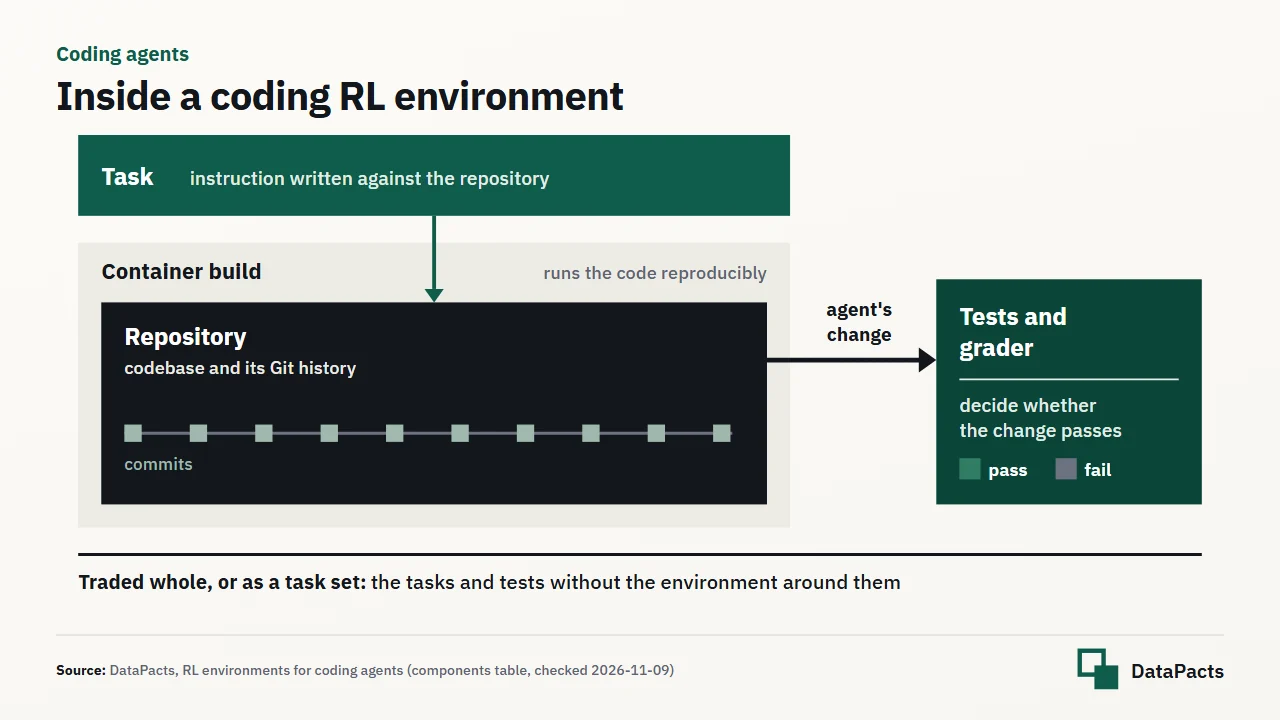
A coding environment has four parts: a repository with its history, a task written against it, a build that runs the code in a container, and tests or a grader that decide whether the agent's change passes.
The published checks and formats of a marketplace, a hub and a builder show each part in practice. Environments are traded either whole or as a task set, which is the batch of tasks and tests without the full environment around it.
The table compares the four components with an example on the record for each, as of 2026-11-09.
| Component | What it is | Example on the record | Source |
|---|---|---|---|
| Repository | the codebase and its Git history the agent works in | DataVendor requires a readable repo with Git history; pre.dev supplies private codebases with full git history | docs.datavendor.ai; pre.dev |
| Task | an instruction written against the repository | pre.dev: RL coding tasks built from real commits; DataVendor: tasks must be present | pre.dev; docs.datavendor.ai |
| Build | a container that runs the code reproducibly | OpenReward: deploy with a Dockerfile and a GitHub repository; DataVendor: environment must build | gr.inc; docs.datavendor.ai |
| Tests and grader | checks that score the change made | Abundant: golden test cases and a stress test of at least five runs across at least three agents; the MIT-licensed Prime Intellect library for building graders | abundant.ai; github.com |
General terms such as reward and rollout are defined on the page about what RL environments are and who builds and buys them, and grader design is covered on its own page.
Where Coding Tasks Come From: Real Commits, Bounties and Open Task Sets
Coding tasks come from three sources on the record: commits in private company codebases, tasks written by paid contributors, and open task sets assembled by environment hubs.
- Real commits. pre.dev (Pre Dev Corp.) states that it builds RL coding tasks from real commits in private production codebases, and as of 2026-09-27 it states 10,000+ private codebases, 50B+ tokens and 2.5M+ commits, rounded down (checked 2026-11-09).
- Contributor bounties. Shipd, operated by Datacurve AI, Inc., shows bounties of USD 80 to 220 per item (checked 2026-11-09); its quest categories on 2026-11-16 are software engineering, machine learning and data science. Prime Intellect's Open Access bounties are "in the $100-500 range" (blog of 2025-10-27), awarded on successful completion.
- Open task sets. Prime Intellect counts about 365,000 tasks in 23 tasksets, 198,000 of them SWE (blog of 2026-07-22). The post title says "365,000+ Environments" while the body counts tasks, so this page uses "tasks".
The source decides who holds rights in a task. Shipd's Contributor Terms s.3.1 irrevocably assign all work product to Shipd, while pre.dev licenses codebases non-exclusively by default (checked 2026-11-09); these rights questions sit with the page on rights in an RL environment, linked in the border section below.
Companies That Build Coding Environments, With Legal Entity
Seven companies state on their own pages that they build coding environments or supply coding tasks, listed alphabetically with the legal entity on record, checked November 9, 2026. The table compares entity, coding work stated and source for each, as of 2026-11-09.
| Company | Entity on record | Coding work stated | Source |
|---|---|---|---|
| Bespoke Labs | BespokeLabs.AI, Inc. (SEC CIK 2025407) | RL environments and infrastructure; Terminal-Bench co-created | bespokelabs.ai; sec.gov |
| Datacurve | Datacurve AI, Inc. (privacy policy: Datacurve, Inc.) | RL environments, long-horizon tasks, DeepSWE; Shipd contributor bounties | datacurve.ai; shipd.ai |
| Huzzle Labs | Huzzle Ltd. (Companies House 13245967) | coding, computer-use and enterprise-workflow environments | labs.huzzle.com |
| Mechanize | Mechanize, Inc. | "environments and evals for frontier coding agents" | mechanize.work |
| pre.dev | Pre Dev Corp. | private codebases with git history; RL coding tasks from real commits | pre.dev |
| Prime Intellect | Prime Intellect, Inc. (SEC CIK 2103990) | open environment hub; about 198,000 SWE tasks counted | primeintellect.ai |
| Proximal | Proximal AI, Inc. | long-horizon coding RL environments; FrontierSWE | proximal.ai |
Datacurve's two entity names come from its own documents: the Contributor Terms use "Datacurve AI, Inc." and the privacy policy of 2026-06-01 assigns Work Product to "Datacurve, Inc.". Funding, acquisitions and entities for every builder sit on the full list of RL environment companies.
Coding Benchmarks and Task Sets Named by Builders
Builders name their own coding benchmarks and task sets, and each figure about them is the builder's statement: Bespoke Labs co-created Terminal-Bench, Datacurve publishes DeepSWE, Proximal publishes FrontierSWE, Huzzle Labs reports pass@8 scores on its coding tasks, and Prime Intellect counts about 198,000 SWE tasks. The table lists each name alphabetically with who stated it, as of 2026-11-09.
| Name | Published or named by | What the record says | Stated by | Date | Source |
|---|---|---|---|---|---|
| DeepSWE | Datacurve | listed among Datacurve's benchmarks | Datacurve | checked 2026-11-09 | datacurve.ai/products |
| FrontierSWE | Proximal | Proximal's benchmark | Proximal | checked 2026-11-09 | proximal.ai |
| Huzzle coding tasks | Huzzle Labs | pass@8: a Claude 4.8 model 31.4 %, GPT 5.5 27.2 % | Huzzle Labs | checked 2026-11-09 | labs.huzzle.com/rl-environments |
| Prime Intellect SWE tasksets | Prime Intellect | about 198,000 SWE tasks of about 365,000 in 23 tasksets; title says "365,000+ Environments" | Prime Intellect | 2026-07-22 | primeintellect.ai/blog/scaling-agentic-rl |
| Terminal-Bench | Bespoke Labs (co-created) | co-created by Bespoke Labs | Bespoke Labs | checked 2026-11-09 | bespokelabs.ai |
A benchmark measures and an environment trains, and the same task set can serve both, which is why labs ask for tasks they have not seen.
One startup employee told Epoch AI (article of 2026-01-12) that requests for RL environments outnumber benchmarking requests by 10 to 20 times. Other public coding benchmarks are outside this table because the record holds no builder statement about them.
Payments for Coding Tasks and Codebases, as Dated Claims
No builder or lab publishes a price list for coding environments; the public figures are per-task bounties, marketplace ranges, interviewee statements and codebase prices, each stated by one party on one date. The table lists eight figures by unit, as of 2026-11-09.
| Unit | Figure | Stated by | Date | Source |
|---|---|---|---|---|
| per bounty item (contributor) | USD 80 to 220 | Datacurve (Shipd page) | checked 2026-11-09 | shipd.ai |
| per bounty (Open Access) | USD 100 to 500 | Prime Intellect | 2025-10-27 | primeintellect.ai |
| per RL task (general, not coding only) | USD 200 to 2,000 | Epoch AI interviewees | article 2026-01-12 | epoch.ai |
| per task, minimum efficient spend | about USD 500, projected a few thousand within a year | Mechanize | 2025-08-18 | mechanize.work |
| per task, marketplace opportunity | about USD 500 to 1,500, hundreds to thousands of tasks per request | DataVendor | checked 2026-11-09 | docs.datavendor.ai |
| per pull request, modern codebase | USD 1,000, up to USD 10,000 per codebase; legacy USD 10,000 to 100,000+ | Turing (newsletter 57) | 2026-03-25 | turing.com |
| per codebase license | about USD 30,000 floor; some single-codebase deals above USD 10 million | DataVendor | checked 2026-11-09 | docs.datavendor.ai |
| per company deal, software company | USD 50,000 to 500,000 | Mercor (listing) | checked 2026-11-09 | api.data.mercor.com |
Per-task figures and codebase figures are different units and are never added or averaged. Mechanize's essay of 2025-08-18 also puts compute at USD 480 per run and USD 2,400 over five reuses, on a projected 500,000 tokens per run against about 100,000 for current tasks; Epoch's range is the article date of 2026-01-12, not an interview date, and none of these is a market price. Wider comparisons are planned on the page with public price points for RL environments.
Turing's figures conflict. Its newsletter 57 of 2026-03-25 prices pull requests, while its Lazarus page, checked 2026-11-09, describes a revenue share with "Nothing upfront". Both are shown as stated, and neither is resolved here.
A Company With Code: Licensing It, Turning It Into Tasks, or Neither
A company that holds private code can license the codebase to an acquirer that builds coding tasks from it, build and sell tasks itself, or keep the code out of AI training altogether. pre.dev builds tasks from licensed codebases, Collinear AI, Inc. acquires private repositories with pull requests and tickets and leaves ownership with the seller, and Patronus AI takes production codebases with history on a non-exclusive basis and does not resell code (all checked 2026-11-09).
Eligibility, rates and clearing steps for a codebase are set out on the page about licensing source code and codebases to AI companies, so only the coding-specific points follow.
Benefits
- A license keeps ownership: pre.dev licenses non-exclusively by default, DataVendor says a sale "licenses your assets for a commercial use rather than transferring them", and Collinear leaves ownership with the seller (checked 2026-11-09).
- Dormant code can earn: Turing states USD 10,000 to 100,000+ for legacy codebases (newsletter 57, 2026-03-25), which is Turing's claim.
Risks
- A builder's contract may let it keep and reuse what it builds: Proximal's MSA (updated 2026-07-06) gives Proximal ownership of the deliverables and lets it reuse them absent customer confidential information (s.8.1) and the customer a non-exclusive internal-use license (s.8.2).
- Contributors on bounty platforms assign everything to the platform, so tasks a company commissions must carry the same assignment (Shipd Contributor Terms s.3.1).
- Reference solutions generated with commercial models can breach their terms; Anthropic's Commercial Terms (effective 2025-06-17) bar customers from using the services to "train competing AI models" (s. D.4).
Downsides
- On DataVendor, sales are final and the buyer's entitlement survives unpublishing, with a fee of 20 % of earnings at withdrawal (checked 2026-11-09).
- pre.dev does not publish seller payouts (checked 2026-11-09).
Alternatives
- License records other than code, such as plain-text records.
- List on a marketplace such as DataVendor.
- Do not license or build at all.
The sale routes, buyer checks and preparation steps for finished tasks are covered in how to sell an RL environment or task set to AI labs, and the license scope question is the same one that governs exclusive vs non-exclusive data licenses.
What the Record Shows About Labs and Coding Environments
No lab has published what it pays for coding environments; the clearest primary statement is Anthropic's S-1 of October 26, 2026, which names datasets licensed or commissioned from third parties among its training data. The same filing states that Anthropic suspended higher-risk RL environments after 2026 incidents in pre-release cybersecurity evaluations.
No party announces a deal between Mechanize and any lab, and this page states no value for one. Mechanize's own page says "We build environments and evals for frontier coding agents" (checked 2026-11-09).
The 2026-04-19 agreement between SpaceX (including xAI) and Anysphere (Cursor) concerns developer interaction data such as coding prompts and iteration cycles, not environments; see the Cursor developer interaction data agreement.
Where Coding Environments Meet Computer Use, Code Licensing and Contributor Rights
Coding is one of seven environment types; the neighboring pages cover computer-use environments, trajectories, code ownership and the rights inside a task set.
- RL environments for computer-use agents and agent trajectory data.
- Who owns the code you want to sell and GitHub repositories.
- Mechanize, an RL coding environment builder.
- Verifiers, graders and rubrics, rights in an RL environment, enterprise workflow RL environments and open-source license contamination
Frequently Asked Questions
Which companies build RL environments for coding?
Bespoke Labs, Datacurve, Huzzle Labs, Mechanize and Proximal state that they build coding environments, Prime Intellect hosts open coding task sets, and pre.dev supplies RL coding tasks built from real commits. Entities and sources are in the table above (checked 2026-11-09).
What is a coding task set?
A coding task set is a batch of tasks written against one or more repositories, each with the tests or grader that score it, sold or shared without the full environment around it. DataVendor lists RL environments only together with a taskset (checked 2026-11-09), and Prime Intellect counts its open tasks in tasksets.
How much does a coding RL task cost?
Stated figures run from USD 80 per bounty item to USD 1,500 per marketplace task, each a single party's claim with its date. The items are Datacurve's Shipd page and DataVendor (both checked 2026-11-09), and Epoch AI's interviewees give USD 200 to 2,000 for RL tasks in general (article of 2026-01-12). The page on public price points for RL environments compares more.
Can developers get paid to write coding tasks?
Yes, as contributor work: bounty platforms pay per accepted task and take an assignment of the work, which is a job, not a data license. Shipd shows USD 80 to 220 per item (checked 2026-11-09) and Prime Intellect pays on completion. Contributor jobs are covered in AI training jobs and platforms compared.