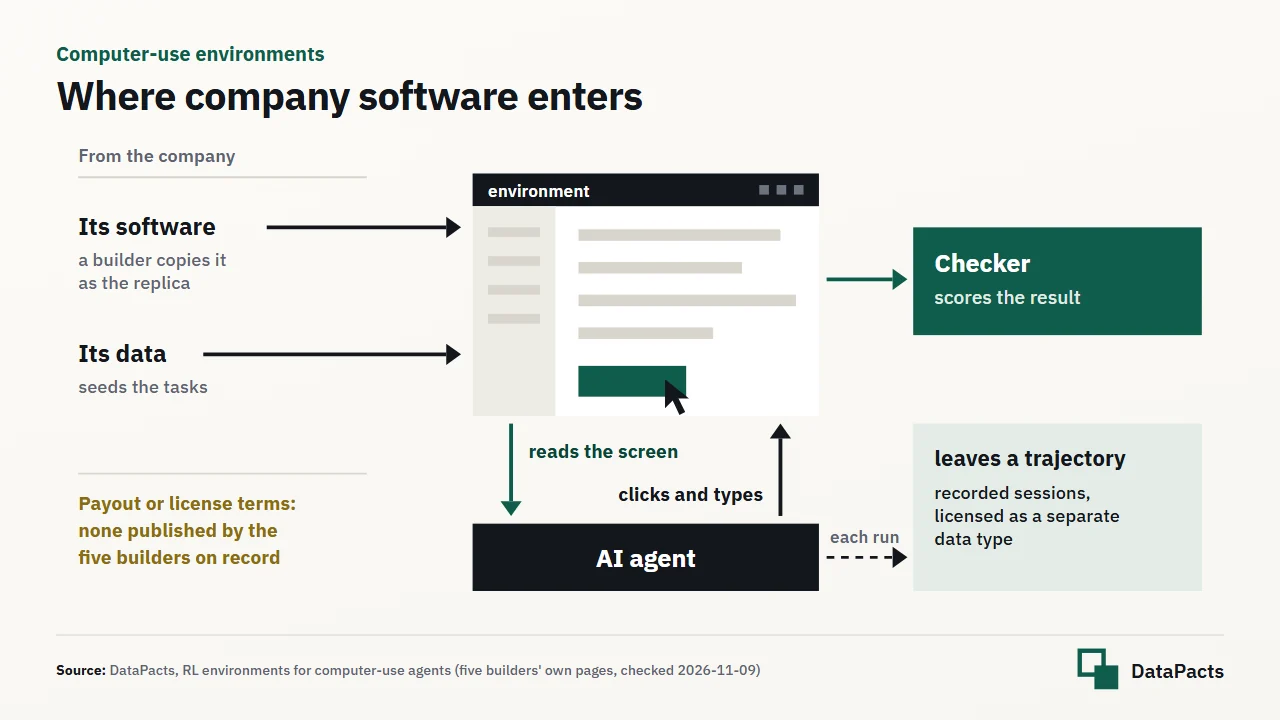
As of 2026-11-09, none of the five publishes a price or a payout for a holder's software, and no AI lab names a purchase of such environments, so the one lab statement on record is Anthropic's S-1 of 2026-10-26 on RL environments in general.
The environments sit within AI training data licensing as a data type: a replica of a holder's software, a set of graded tasks or the sessions an agent leaves behind can each be acquired, built or licensed under different terms.
Every task count and score below is the stating company's own claim with its date, and builder claims about lab customers stay apart from what the labs state themselves.
The page covers who builds these environments, what they claim, what buyers state publicly and where a holder of software or records can enter, and it leaves out build tutorials and product reviews.
The page follows the how we source, date and check every figure rules, with builders checked on 2026-11-09 against their own pages, filings and registries.
What Makes an RL Environment a Computer-Use Environment
An RL environment is a computer-use environment when the agent acts through a graphical interface, a browser page or a desktop application, rather than through a code repository or an API alone. Three neighbors fall outside that definition:
- Repository and terminal tasks are RL environments for coding agents; Eigent AI's terminal tasks are the example, and they are not counted here.
- Replicas of whole business workflows belong with enterprise replicas, the territory of Deeptune and Fleet AI.
- Sandbox infrastructure that only hosts a desktop supplies compute, not training material, and is outside the border.
The table lists the four forms that builders' own pages describe, each with an example on record and the party that states it.
| Form | What the agent operates | Example on record | Stated by | Source |
|---|---|---|---|---|
| Browser and web tasks | web pages and web apps in a browser | browser-automation dataset, 2,000+ task samples in 30 categories | Eigent AI | eigent.ai/environments |
| Replicas of real software ("Sims", clones) | simulated copies of real applications | Plato "Sims" of real software for computer-use agents; Chakra Labs "pixel-perfect cloned enterprise environments" | Plato; Chakra Labs | plato.so; chakra.dev |
| Computer-use task suites | sets of graded tasks on a computer | 370 OSWorld Advanced tasks, 70 % hard or very hard | Scale AI | scale.com/rlenvironments |
| Evaluation sets on replicas | fixed environments used to score agents | Computer Work Val v1.0: 300 environments (2026-10-27) | Plato | plato.so/research/computer-work-val |
As of 2026-11-09 the forms overlap: one builder can sell several, as Huzzle Labs does with computer-use, coding and enterprise-workflow environments, and the same replica can serve as a training environment and as an evaluation set.
The distinction that matters to a holder is what the agent operates: a replica copies a real application, a task suite only scores work on a computer, and a browser dataset collects tasks on live or simulated web pages.
The parent page explains what RL environments are and who buys them, and this page keeps to the screen-operating type.
Who Builds Computer-Use RL Environments, by Company Record
Five companies describe computer-use environments on their own pages, listed alphabetically with the legal entity on record and checked November 9, 2026. The table gives the entity, the registry or footer source and what each company's pages say about computer use.
| Builder | Entity and registry on record | What its own pages say about computer use | Checked | Source |
|---|---|---|---|---|
| Chakra Labs | Chakra Digital Labs, Inc. (SEC CIK 0002106724, Delaware, incorporated 2024, Brooklyn) | task factories for Finance, Legal, Safety/RAI and computer use; cloned enterprise environments | 2026-11-09 | chakra.dev; sec.gov |
| Eigent AI | EIGENT UK LTD (Companies House 15147455, incorporated 2023-09-19, London) | browser-automation dataset, terminal environments, 30 categories; "Custom agent RL environment" on the enterprise plan | 2026-11-09 | eigent.ai |
| Huzzle Labs | Huzzle Ltd. (Companies House 13245967, incorporated 2021-03-04, London; Huzzle Labs is a division) | coding, computer-use and enterprise-workflow RL environments for frontier labs; HuzzleWorld computer-use models | 2026-11-09 | labs.huzzle.com |
| Plato | Plato Technologies, Inc. (footer, San Francisco; not EDGAR CIK 0002012900) | simulated environments ("Sims") of real software for computer-use agents; Computer Work Val | 2026-11-09 | plato.so |
| Scale AI (RL Environments) | Scale AI, Inc. (Delaware corporation per its Outlier terms) | 2,000+ tasks, 4 enterprise environments; 370 OSWorld Advanced tasks | 2026-11-09 | scale.com/rlenvironments |
A builder is listed when its own page names computer-use, browser or desktop environments, and companies whose records are held or lack a published legal name are not described.
Deeptune, which builds "training gyms" for enterprise software and for which Mercor announced an acquisition on July 9, 2026 with the closing not confirmed, and Fleet AI, which describes high-fidelity simulation environments for agents, sit with enterprise replicas.
The inclusion rule means the list is short and can change: a company moves in when its own page names the type, and out when that wording is removed. The full directory, with funding stated by companies or filings, is on the page for RL environment companies with legal entity and funding.
Task Counts, Difficulty Scores and Replica Price Claims on Record
Builders publish task counts and test scores for computer-use environments, and every figure is the stating company's own claim with its date, not an audited number. The table lists nine claims as of 2026-11-09, each with the party that states it.
| Claim | Figure | Stated by | Date | Source |
|---|---|---|---|---|
| Browser-automation task samples | 2,000+ in 30 categories | Eigent AI | checked 2026-11-09 | eigent.ai/environments |
| Initial synthetic terminal tasks (SETA) | 400 | CAMEL-AI | 2026-01-09 | camel-ai.org |
| Expert network | 300,000+ experts, 100,000 monthly active users | Huzzle Labs | checked 2026-11-09 | labs.huzzle.com/rl-environments |
| Computer Work Val size | 300 environments | Plato | 2026-10-27 | plato.so |
| Top average pass@1 on Computer Work Val | Gemini 4 Argon [high] 58.5 %; an Anthropic Claude model [high] 52.5 %; GPT-6 Astra [high] 43.1 % | Plato | 2026-10-27 | plato.so |
| RL Environments task count | 2,000+ tasks, 4 enterprise environments, 870,000 artifacts | Scale AI | checked 2026-11-09 | scale.com/rlenvironments |
| OSWorld Advanced tasks | 370, 70 % hard or very hard | Scale AI | checked 2026-11-09 | scale.com/rlenvironments |
| Difficulty labs expect | pass@5 below 30 % | Chakra Labs blog | 2026-01-29 | chakra.dev |
| Minimum useful pass rate (all RL tasks) | about 2 to 3 %, or one success in 64 to 128 rollouts | Epoch AI interviewees | 2026-01-12 | epoch.ai |
Two price statements exist, both reported by Epoch AI on 2026-01-12 from interviews: SemiAnalysis via Epoch AI puts a website replica (a UI gym) at about USD 20,000, and one interviewee puts a high-fidelity replica such as Slack at around USD 300,000.
Neither is a market price, and the page on public price points for RL environments will collect the rest.
What AI Labs and Other Buyers State About Computer-Use Environments
No AI lab in the public record states that it buys computer-use environments by name; the only lab statement in a filing is Anthropic's S-1 of October 26, 2026, which covers RL environments in general. The table sets the statements by date and shows what each does not establish.
| Date | Party | Statement | Stated by | What it does not show | Source |
|---|---|---|---|---|---|
| 2026-10-26 | Anthropic | training data includes datasets licensed or commissioned from third parties | Anthropic, PBC (S-1) | which datasets, or any computer-use environment | sec.gov |
| 2026-10-26 | Anthropic | higher-risk RL environments suspended after 2026 incidents in pre-release cybersecurity evaluations | Anthropic, PBC (S-1) | environment types or builders | sec.gov |
| 2026-10-27 | Gemini 4 Argon, an Anthropic Claude model and GPT-6 Astra (lab models) | scored on Plato's Computer Work Val | Plato | any purchase or license by the labs behind them | plato.so |
| checked 2026-11-09 | Meta Superintelligence Labs | testimonial on Huzzle Labs' site | Huzzle Labs | a contract, scope or price | labs.huzzle.com |
Only the Anthropic rows come from a buyer's own filing; the others are builders' pages.
The record therefore shows tests and testimonials, not purchases, and the gap matters for anyone judging demand. Plato scored lab models on its own set, Huzzle Labs displays a testimonial, and Scale AI makes a product claim, but none of these states a contract, a volume or a price.
Anthropic's S-1 suspends higher-risk RL environments and mentions licensed or commissioned datasets, yet it names neither a builder nor a computer-use environment, so no sentence in it can be read as a purchase of the type this page covers. For how the labs themselves describe their data sources, see how frontier AI labs acquire data.
Where a Company's Software, Data and Session Logs Enter Computer-Use Environments
A company's software and records enter a computer-use environment in two ways: a builder replicates the software as the place the agent works, or the company's own data seeds the tasks.
Plato runs a partner program that turns real-world software and data into environments through an inquiry form or a 30-minute call, and it does not publish payout or license terms (checked 2026-11-09). Chakra Labs describes cloned enterprise environments.
Eigent AI offers a "Custom agent RL environment" on its enterprise plan through contact sales, again without published terms. Huzzle Labs builds for frontier labs and publishes no holder program.
Scale AI's RL Environments page states task counts and no holder program. For the builders with a contact route, the first step for a company is a contact form or a sales conversation, which leaves scope, ownership and reuse to be negotiated.
Every run in an environment leaves a trajectory, and a company licensing recorded sessions of its own product sells a different data type. micro1 states that it licenses qualifying agent trajectories for USD 1 to 2 million a year, with the company's approval (checked 2026-11-09). The page on computer-use and agent trajectory data covers that route.
Letting a Builder Replicate Your Software: Benefits, Risks, Downsides and Alternatives
Licensing software or records to a computer-use builder can pay for data that sits unused, but the replica and the tasks usually stay with the builder or the lab.
Benefits
- A route exists through builder programs, such as Plato's partner program, though none publishes payout terms.
- Environments are built from the holder's real software and workflows, so agents train on the product as it is used.
Risks
- Builder terms can keep deliverables and reuse them: Proximal's master services agreement (updated 2026-07-06) gives Proximal the Deliverables, with reuse unless the customer's confidential information is included, and the customer a non-exclusive internal-use license; see also the page on rights in cloned software and seed data.
- Screen content can carry personal data, and DataVendor states that purchased files are cleaned of personal information within two business days while tasksets and environments are not.
- An acquisition changes the counterparty, as the announced Mercor acquisition of Deeptune shows.
Downsides
- No computer-use builder publishes payout or license terms.
- No lab names its purchases, so a holder cannot judge demand from the record.
- A replica built from the holder's software may be reused by the builder for other customers unless the contract says otherwise.
Alternatives
- License recorded sessions as trajectory data, a route described above.
- List a codebase or taskset on a marketplace that sets its terms in writing, such as DataVendor, where the usual starting point is that the seller keeps ownership and licenses use.
- Not licensing at all, which leaves the software and records with the company.
Each route differs in who owns the output and who may reuse it. The complete process for any of these routes, including the option of not selling, is set out in the guide on how to sell or license company data to AI companies.
Where Computer-Use Environments Meet Coding, Enterprise Replicas and Grading
This page covers environments where agents operate screens; coding tasks, enterprise workflow replicas, grading, prices and rights each have their own page. The related pages are:
- RL environments hub, with types, buyers and terms.
- RL environments for coding agents, covering repositories and terminals.
- RL environment companies, the builders and vendors.
- How to sell an RL environment or task set to AI labs.
- Computer-use and agent trajectory data as a data type.
- Human data for AI, covering expert contributors.
- Enterprise workflow RL environments and verifiers, graders and rubrics, both in preparation.
Frequently Asked Questions
What is an example of a computer-use RL environment?
Plato's Computer Work Val is one: 300 simulated work environments drawn from the work of people earning over USD 100,000 a year, published October 27, 2026. Plato states the figure, and its top average pass@1 was 58.5 % for Gemini 4 Argon [high].
Is a computer-use benchmark the same as a computer-use environment?
No: a benchmark scores agents on fixed tasks, while a training environment is used to generate reward over many runs, though the same replica can serve both. One startup employee quoted by Epoch AI on 2026-01-12 said that RL requests outnumber benchmarking requests by 10 to 20 times.
Do computer-use environments contain personal data?
They can, because replicas and tasks may copy real screens, and DataVendor states that it does not clean tasksets and environments of personal data. A holder should review screens before any license.
Can individuals get paid to build computer-use tasks?
No computer-use builder on record publishes contributor rates or a per-task payment. Huzzle Labs claims an expert network of 300,000+ experts (checked 2026-11-09), with no task rate stated. For jobs, see AI training jobs and platforms compared.