Mercor states that forks or copies of open-source projects are not a fit for its Software Company listing, pre.dev states that it strips vendored dependencies, binaries and build output, and SimpleClosure's CEO states that roughly 37 % of raw code offered through AssetHub is removed in cleaning (all checked 2026-11-09).
This page covers how such code gets in, what a seller can license, what acquirers accept, how to find outside code and whether to license at all. Outside code is a recurring check in AI training data licensing, where DataPacts is independent.
Fact-check note: program terms are read from each program's own page with the check date, court records from the court's own documents; see how we source, date and check every figure.
What License Contamination Means When a Codebase Is Licensed for AI Training
In a license for AI training, contamination is not about publishing the code: it is about granting an acquirer rights in files whose copyright belongs to outside authors under their own license terms.
The grant reaches every delivered file. micro1's Data License Master Terms (updated 2026-11-08) describe a worldwide, royalty-free, nonexclusive, irrevocable, perpetual and sublicensable license (s.1.2) and give the licensee ownership of derivatives, models and weights (s.2.2), so an outside file inside the delivery would be covered by a grant the seller cannot make.
GitHub's Terms of Service, effective 2026-04-27, state in section D.3 "You own Your Content", which covers what the company wrote, not code it copied in. Whether delivering a copy to an acquirer counts under any particular license's own terms is a question for the license text and counsel, and this page does not decide it.
Acquirers, rates and eligibility sit under selling or licensing source code and codebases to AI companies, and this page covers only the outside-code layer.
How Open-Source Code Ends Up Inside Proprietary Repositories
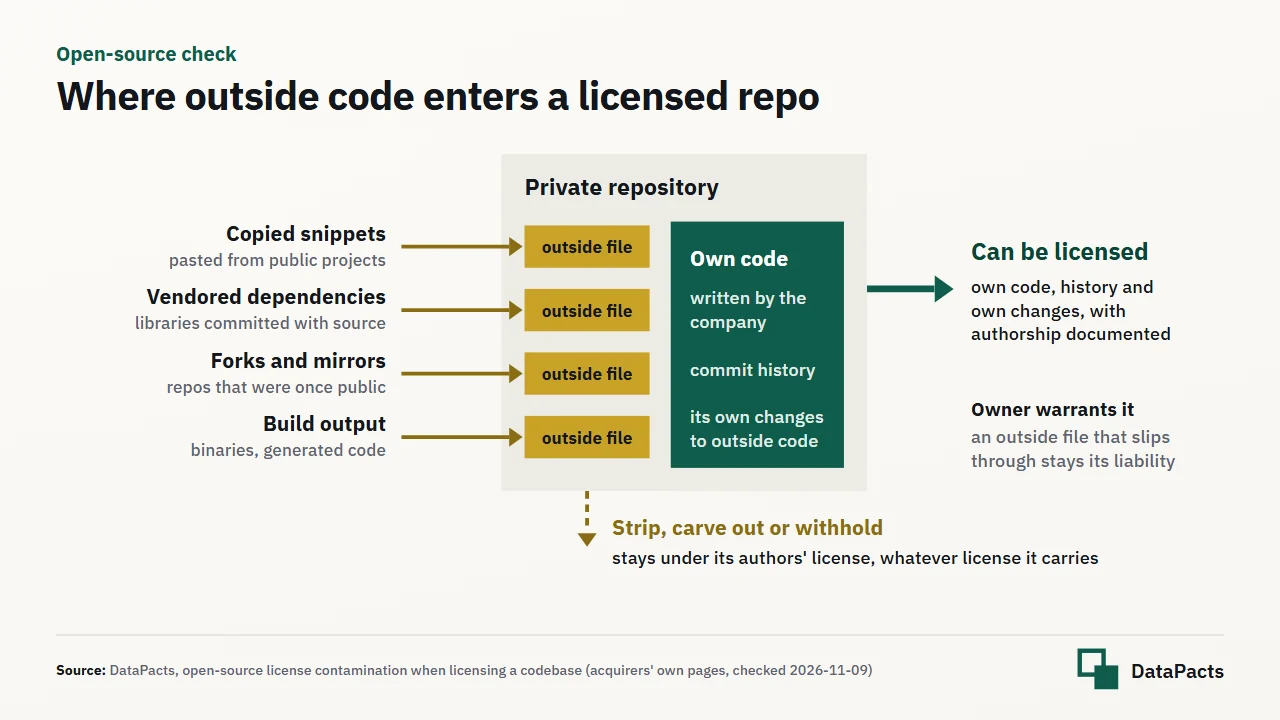
Outside code enters private repositories in four common ways, and each leaves files the company did not write next to files it did.
- Copied snippets and files pasted from public projects.
- Vendored dependencies and bundled libraries committed with the source.
- Forks, mirrors and repositories that were once public.
- Build output, binaries and generated code committed with the source.
Acquirers name the same categories. pre.dev strips vendored dependencies, binaries and build output and checks that a repository is not public, not a fork, not archived and not a published package, while Mercor wants repositories that have never been public, mirrored or open-sourced (both checked 2026-11-09).
The scale on record is one company's claim. SimpleClosure's CEO states that roughly 37 % of raw code offered through AssetHub is removed in cleaning (blog of 2026-09-03), and the reasons recorded are third-party and generated code and duplication. No industry-wide share is stated here.
Ownership Versus License: What a Seller Can and Cannot License
A seller can license only code it holds the rights to, so open-source components stay under their authors' licenses and fall outside what the company can grant, whatever license they carry.
Acquirers set the bar at ownership. Mercor asks for 50,000+ lines of code "the company owns outright" for its Software Company listing, and Pangea.ai takes owned private code only (both checked 2026-11-09).
The seller can license its own authored code, its commit history and the modifications it wrote, as long as authorship is documented. It cannot license the third-party files themselves, or rights that a license never gave it.
Authorship by employees, contractors, agencies and founders is a separate question, answered under who owns the code you want to sell.
Copyleft and Permissive Licenses in a Licensed Codebase
Open-source components carry licenses usually grouped as copyleft, such as GPL-3.0, AGPL-3.0, LGPL-3.0 and MPL-2.0, or permissive, such as MIT and Apache-2.0, and each license's own text sets what a holder of a copy may do.
The seller records, per component, the license name and version, the file paths, and the license and notice files shipped with it. That record is what an acquirer's ownership questions are answered from.
The family matters less here than in software distribution, because acquirers reject or strip outside code regardless of license: Mercor, Pangea.ai and pre.dev publish exclusions by origin (forks, public, vendored), not by license name. No acquirer on record publishes a rule by license name, and the license texts themselves are not summarized on this page.
What Acquirers of Code Accept, Strip or Reject
Acquirers and intermediaries of code publish what they do with outside code on their own pages: some reject a repository that is a fork or was once public, others strip third-party parts before delivery.
The table compares five programs as of 2026-11-10, each the party's own statement checked 2026-11-09, and keeps intermediaries apart from buyers in the role column.
| Program | Role | Rejects | Strips or removes | Ownership condition | Checked | Source |
|---|---|---|---|---|---|---|
| Mercor, Design & Web Agency listing | buyer program | open-source design systems such as Material; template sites or sites written by AI tools | not stated | right to license the work, own or cleared with clients | 2026-11-09 | api.data.mercor.com |
| Mercor, Software Company listing | buyer program | forks or copies of open-source projects; repositories ever public, mirrored or open-sourced | not stated | 50,000+ lines the company owns outright | 2026-11-09 | api.data.mercor.com |
| Pangea.ai code licensing | marketplace (intermediary) | public or forked code; client-owned code | grading and scrubbing before batches go to buyers | owned private code only; uncapped ownership warranty | 2026-11-09 | pangea.ai |
| pre.dev Labs | buyer (RL-environment builder) | public, forked, archived or published-package repositories | vendored dependencies, binaries and build output | licensed directly from the teams that built the code | 2026-11-09 | pre.dev/labs |
| SimpleClosure AssetHub | wind-down service (intermediary) | not stated | roughly 37 % of raw code removed in cleaning (CEO's blog, 2026-09-03) | license or outright sale | 2026-11-09 | simpleclosure.com |
Stripping by an acquirer does not shift responsibility. Pangea.ai calls its ownership warranty uncapped, and micro1's terms make the licensor indemnify IP claims arising from the Data (s.8.1) and allow a clawback with refund for a materially inaccurate Data Manifest that survives acceptance (s.4.3), with liability capped at 3x the Order Form fees except for fraud, gross negligence and wilful misconduct (s.7.2). Clause-level drafting sits under indemnities and warranties in AI data licenses.
Finding Open-Source Components Before Licensing
A seller finds outside code before an acquirer does by listing every component and its license, then deciding per repository whether to strip, carve out or withhold it.
- List the repositories that were ever public, mirrored, forked or published as a package.
- Run a license scanner or software composition analysis tool over the source and the history; any tool that reports licenses per file and per dependency serves.
- Record each dependency, vendored directory and copied file with its license name, version and path.
- Remove build output, binaries and generated code from the scope.
- Strip or carve out the third-party files, or withhold repositories that are mostly outside code.
- Keep the inventory with the Data Manifest that the license describes.
Step 6 matters because micro1's terms attach the clawback to the Data Manifest (s.4.3). The component list is one layer of a rights audit for data you want to license.
Licensing a Codebase With Open-Source Components: Benefits, Risks, Downsides and Alternatives
A codebase with its outside code identified and removed can still be licensed while the company keeps it, but any third-party file that slips through stays the seller's liability after payment, because a trained model cannot give the code back.
Benefits
- Owned code remains licensable non-exclusively while ownership stays with the company, as Pangea.ai and pre.dev describe.
- A component inventory answers acquirers' eligibility checks before delivery.
Risks
- Pangea.ai's ownership warranty is uncapped.
- micro1's licensor IP indemnity (s.8.1) and manifest clawback (s.4.3) apply to what the Data contains.
- A perpetual, irrevocable, sublicensable grant (s.1.2) cannot be recalled.
Downsides
- Stripping shrinks the licensable code (SimpleClosure's roughly 37 % claim) and can drop a repository below a threshold such as Mercor's 50,000 owned lines.
- Scanning and review cost time, and no figure for it is stated here.
Alternatives
- License only repositories written in-house.
- Withhold repositories built on forks.
- Do not license the code at all, which is a valid outcome.
The wider decision, including not selling, is covered under should you sell or license your data.
Where Open-Source Checks Sit Among Code Pages and Seller Steps
The open-source check is one step on the code seller path: the parent page covers acquirers and rates, the sibling covers authorship, and the system and contract pages cover export and promises. Every step is set out in the guide to sell or license company data to AI companies.
- Source code and codebases: the parent, with acquirers, rates and eligibility.
- GitHub repositories: export rights and licenses: terms, export and commit history.
- Software companies licensing code to AI: the sector view.
- Dataset licenses for AI training: licenses on public datasets, such as CC BY and ODC-BY, are covered there.
- Training data provenance and chain of rights: documentation of origin.
- The data manifest: describing a dataset without handing it over.
- Due diligence in an AI data deal: what buyers check and what sellers should check.
The Copilot Attribution Case and Licensed Private Code
The best-known code lawsuit concerns AI tools reproducing public code, not companies licensing private repositories. In Doe 1 et al. v. GitHub, Inc. et al. (N.D. Cal. 4:22-cv-06823-JST; 9th Cir.
No. 24-7700), anonymous programmers sued GitHub, Microsoft and OpenAI entities over Copilot and Codex reproducing code without attribution, and on 2026-09-16 the Ninth Circuit affirmed dismissal of the DMCA 1202(b) claim, with the mandate issued 2026-10-08 (Dkt. 297) and the remaining contract claims back in the district court, as of 2026-11-09. Other claims sit in the tracker of AI copyright lawsuits over training data, and the case has its own Doe v. GitHub (Copilot) case page.
The EU AI Act Open-Source Exemption Covers Models, Not Licensed Code
The open-source exemption in Regulation (EU) 2024/1689 Art. 53(2) concerns AI models released under free and open-source licenses with public weights, not code a company licenses for training.
It exempts only Art. 53(1)(a) and (b), the copyright policy (c) and the training content summary (d) still apply, systemic-risk models are excluded, and the general-purpose model obligations apply from 2025-08-02. The duties themselves are set out under EU AI Act Article 53.
What This Page Does Not Cover
This page covers third-party open-source code inside a codebase licensed for AI training; it does not cover choosing a license for publishing software, or who owns code produced by AI tools. This page is general information, not legal advice, and it does not answer whether a trained model is bound by a code license.
Program Pages Named on This Page
The terms above come from these programs' own pages, each checked November 9, 2026.
- Mercor data buyer profile
- micro1 data buyer profile
- Pangea.ai code licensing profile
- pre.dev profile
- SimpleClosure AssetHub profile
- AI data partnership payouts and program terms compared
Frequently Asked Questions
Can a company license a codebase that contains open-source code?
Yes, the parts it owns. Acquirers ask for code the company owns outright, and they strip or reject third-party parts (Mercor, Pangea.ai and pre.dev, checked November 9, 2026).
Do AI data buyers accept forks of open-source projects?
Not the ones that publish rules. Mercor lists forks or copies of open-source projects as not a fit, and Pangea.ai and pre.dev exclude forked code (checked November 9, 2026).
Does the Copilot lawsuit decide whether open-source code can be licensed?
No. Doe v. GitHub concerns Copilot and Codex output; the Ninth Circuit affirmed dismissal of the DMCA 1202(b) claim on September 16, 2026, and the case is back in district court.
Does the EU AI Act exempt open-source code from licensing rules?
No. Art. 53(2) exempts certain open-source models from two documentation duties only, and says nothing about code licenses.