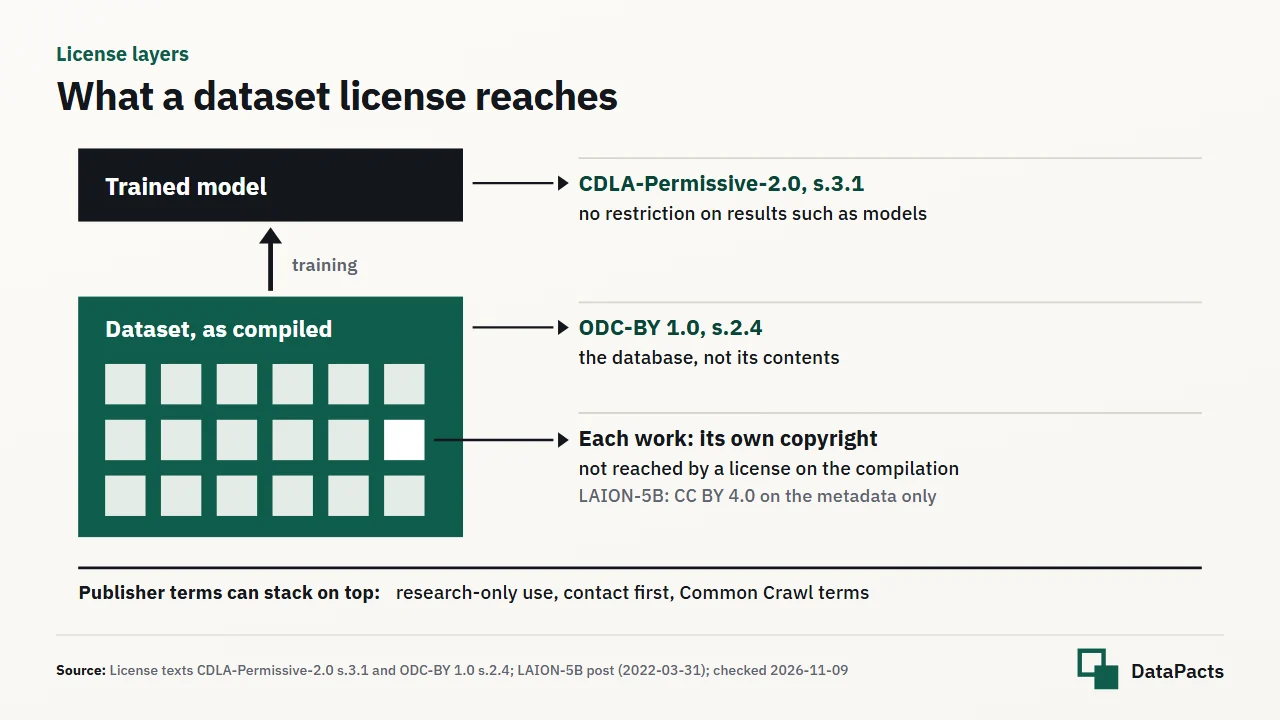
Creative Commons states that its licenses apply only when copyright permission is required (creativecommons.org, checked 2026-11-09), and ODC-BY 1.0 covers the database, not the contents.
A dataset license often covers the compilation, not the works inside it, so it answers only part of whether training is allowed.
The page sets out which license a dataset carries and what that license does and does not reach, for the developer using a dataset and for the holder whose content sits in one or who licenses its own, as the open-license layer of AI training data licensing.
Seven License Types Found on AI Training Datasets
Seven license types appear on the AI training datasets on record, from Creative Commons and Open Data Commons licenses to Apache-2.0 and research-only terms, and they differ most in whether they reach the works inside a dataset and the models trained on it.
The table compares the licenses, with the as-of date of each row and its source, and lists only licenses with a dated source on record.
| License | What it covers or says about AI training | Datasets on record using it | As of | Source |
|---|---|---|---|---|
| Apache-2.0 (applied to data) | Applied by some publishers to datasets; its scope on data is not recorded | Re-LAION-5B; Egocentric-10K (Build AI states); ABC-130K (XDOF states) | 2024-08-30; 2025-08; 2026-06-17 | laion.ai; huggingface.co; xdof.ai |
| CC BY 4.0 | CC licenses apply only when copyright permission is required | LAION-5B metadata (images under their own copyright); DCLM-Baseline, research purposes only | 2026-11-09 | creativecommons.org; laion.ai; huggingface.co |
| CC licenses with NoDerivatives or NonCommercial terms | ND: under a cautious reading not used as training data (Creative Commons); NC and ND content is not a fit for Mercor's video listing (Mercor states) | none on record | 2026-11-09 | creativecommons.org; api.data.mercor.com |
| CC0 | Named with CC BY 4.0 as acceptable terms for EU high-value public datasets | OpenWebText packaging; Common Voice (community playbook: CC0; Mozilla Data Collective v27 post: "a permissive licence") | 2026-11-09 | skylion007.github.io; common-voice.github.io; publications.europa.eu |
| CDLA-Permissive-2.0 | No restriction on results such as trained models (s. 3.1) | none on record | 2021-06-17 | cdla.dev |
| ODC-BY 1.0 | Governs rights over the database, not individual contents (s. 2.4) | C4 (allenai), with Common Crawl terms of use; Dolma since 2024-04-15; Dolma 3 Mix, research and educational use (Ai2 states) | 2026-11-09 | opendatacommons.org; huggingface.co |
| Research-only and custom terms | The publisher's own conditions; in the EU contract limits may bind on databases protected by neither copyright nor the database right (C-30/14) | Institutional Books (contact IDI for commercial use including AI training; noncommercial Early-Access terms); Common Crawl terms of use, last updated 2024-03-07 | 2026-11-09 | huggingface.co; commoncrawl.org; publications.europa.eu |
A dataset can carry two layers at once: C4 is under ODC-BY and also subject to Common Crawl's terms of use. The datasets and the terms each carries are listed on the page for major AI training datasets, which groups them by corpus where this page groups them by license.
Creative Commons Licenses and What Creative Commons Says About Training Use
Creative Commons states that its licenses apply only when copyright permission is required, so where training needs no permission, the license terms do not come into play (creativecommons.org, checked 2026-11-09). Where an exception covers the copying, the license is not what decides.
In the EU, Directive (EU) 2019/790 Art. 4 allows text and data mining unless the rightholder reserves the right, and for online content the reservation must be machine-readable under Art. 4(3).
On NoDerivatives, Creative Commons says that under a cautious reading, content under an ND license is not to be used as training data (creativecommons.org, checked 2026-11-09).
The positions of Creative Commons on attribution, ShareAlike and NonCommercial duties in training are not recorded on this page, so the page makes no statement about them and the license text itself has to be read.
Creative Commons licenses show up on datasets in different ways. LAION-5B carries CC BY 4.0 on its metadata while the linked images stay under their own copyright (LAION, 2022-03-31). DCLM-Baseline pairs CC BY 4.0 with research purposes only (dataset card, 2026-11-09).
OpenWebText's packaging is CC0, and Common Voice is CC0 in its community playbook while the Mozilla Data Collective post on version 27 says "a permissive licence", so both wordings stay visible.
The EU high-value datasets rule, Implementing Regulation (EU) 2023/138 in force since 2023-02-09, requires listed public datasets to carry CC0, CC BY 4.0 or less restrictive terms.
A holder choosing a Creative Commons license for its own material should weigh the same point from the other side, since a license that applies only where permission is required gives the holder no control over uses that need none.
Whether a given use needs permission at all is the question of copyright and AI training across jurisdictions.
Open Data Commons and CDLA: Licenses Written for Databases
Open Data Commons and CDLA licenses were written for data rather than creative works, and the two on record split on the point that matters for training: ODC-BY covers only the database, while CDLA-Permissive-2.0 places no restriction on results such as trained models.
ODC-BY 1.0 s.2.4 governs rights over the database and not its individual contents (opendatacommons.org, checked 2026-11-09). The C4 dataset from Ai2 (Allen Institute for AI) carries ODC-BY plus Common Crawl's terms of use. Dolma moved to ODC-BY on 2024-04-15, and Ai2 describes Dolma 3 Mix as ODC-BY for research and educational use.
CDLA-Permissive-2.0, dated 2021-06-17, states in s.3.1 that it places no restriction on results, and the license text applies this to trained models (cdla.dev). No dataset on record uses it. A license that leaves the model free still does not say anything about the works inside the data, which is the layer ODC-BY leaves out.
A developer reading both licenses together therefore reads them as answers to different questions: one about the database, one about what comes out of training on it, with the rights in each work a third question that neither text settles.
In the EU, what an ODC license grants is partly a database right. Directive 96/9/EC Art. 7(1) lets a maker who has made a substantial investment prevent extraction or re-utilisation of a substantial part of a database, Art. 7(3) allows the right to be licensed and Art. 10(1) sets a term of 15 years from 1 January after completion.
The EU database right and licensing datasets page covers the sui generis right in full.
Apache-2.0, Research-Only Terms and Custom Access Conditions
Apart from the open-content licenses, datasets carry Apache-2.0 or terms the publisher writes itself, such as research-only use or contact before commercial use.
Re-LAION-5B, released on 2024-08-30, carries Apache-2.0, where LAION-5B carried CC BY 4.0, and the two are never interchangeable. Build AI states Apache-2.0 for its Egocentric-10K dataset (dataset card, 2025-08), and XDOF states Apache-2.0 for ABC-130K (2026-06-17).
Custom terms are written by the publisher. The Institutional Books dataset requires contacting IDI for commercial use including AI model training and otherwise offers noncommercial Early-Access terms (dataset card, checked 2026-11-09). Common Crawl publishes terms of use, last updated 2024-03-07, which are not a license.
Custom terms can bind where no copyright applies. In Ryanair v PR Aviation (CJEU C-30/14, 2015-01-15), the Court held that the Database Directive does not stop the maker of a database protected by neither copyright nor the database right from setting contractual limits on its use.
Licenses for code held in repositories follow different rules, set out for open-source license contamination when licensing a codebase.
Attribution, NonCommercial and NoDerivatives Terms in Commercial Training
For commercial training, NonCommercial and NoDerivatives terms are where open licenses most often stop a deal, and at least one buyer excludes such content in its own listing criteria.
Mercor states that its video production listing does not fit content under non-commercial or no-derivatives licenses, and that its publisher listing does not fit content distributed under someone else's license or already open access (Mercor listings, checked 2026-11-09).
These are one buyer's criteria, not a rule of law, but they show where a holder of NonCommercial or NoDerivatives content finds that a commercial license of the same material is hard to place, and why a holder reviews the license on its own material before approaching any buyer.
The same logic applies to data that is already public. Mercor's trading-firm listing excludes data that is already public (Mercor states, checked 2026-11-09), and openly released data competes with any paid license of the same records.
Attribution works as a license term too. The RSL Collective's attribution license permits AI training and AI input in exchange for attribution, and its paid license permits training (rslcollective.org, checked 2026-11-09), which shows attribution used as the price of access.
How attribution and ShareAlike duties attach to a trained model is not recorded on this page. No court decision on record holds that a dataset license makes training lawful.
Finding and Checking the License of a Specific Dataset
The license of a specific dataset is stated by its publisher on the dataset card, paper or website, and hosting-site labels are not reliable on their own.
The Data Provenance Initiative audit of 1,800+ text datasets (arXiv 2310.16787, 2023-10-25) found license omission above 70 % and errors above 50 % on hosting sites. The sources to read, in order:
- The publisher's own dataset card or paper.
- The license text and its version.
- Added terms on top, such as research-only use or contact first.
- Takedown records on the host.
Sources can disagree: Common Voice is CC0 in the community playbook and "a permissive licence" in the version 27 post. Terms can also stack, as C4's ODC-BY does with Common Crawl's terms of use. This method applies to every named dataset, such as COCO, MNIST or Waymo Open, whose license this page does not state.
A license on a host does not settle rights in the contents. Hugging Face's public notice files include a University of Denver DMCA notice over AffectNet redistribution in 3 repositories (2026-09-28) and a notice from The New York Times Company over a dataset containing the NYT Annotated Corpus (2026-05-19). Recording the chain of rights is the subject of training data provenance.
Licensing Your Own Dataset: Benefits, Risks, Downsides and Alternatives
A holder that publishes its own dataset can release it under an open license, license it for payment, share it under research-only terms or not license it at all, and each route trades reach against control and income.
Benefits
- An open license with a stated scope tells developers what is allowed, as CDLA-Permissive-2.0 s.3.1 does for models.
- Public bodies meet the EU high-value datasets rule with CC0 or CC BY 4.0.
Risks
- An open release cannot be recalled once copied.
- A license covers only what needs permission, as Creative Commons states (checked 2026-11-09).
- Hosting labels get lost or changed, as the 2023-10-25 audit found.
Downsides
- Mercor lists content that is already open access, or under non-commercial or no-derivatives licenses, as not a fit for some listings (Mercor states, checked 2026-11-09).
- Research-only terms limit income to whoever contacts the holder.
Alternatives
- A paid license on a platform where the provider sets price and license, which the Mozilla Data Collective states (checked 2026-11-09).
- A direct sale or license, set out under how to sell a dataset.
- Research-only access with a contact route for commercial use.
- Not licensing at all and keeping the data private.
The license text is only one layer, and a contract governs a paid deal.
Contracts, Exceptions and Dataset Pages Beyond the License Text
This page covers the license families; the datasets that carry them, the text and data mining exception, public domain material and collective licenses each have their own page.
- Common Crawl's contents, license and legal status: terms of use, not a license, with a USD 100 liability cap (checked 2026-11-09).
- LAION-5B and Re-LAION-5B: CC BY 4.0 versus Apache-2.0.
- EU text and data mining exception: Art. 4 and the machine-readable opt-out.
- Licensed vs scraped training data: paid licenses against open crawls.
- Public domain and openly licensed material in AI training: material with no rights to clear.
- Collective licensing for AI training: licenses issued by collectives.
- Alternatives to selling data, including not selling at all: not licensing at all.
This page is information, not legal advice.
Frequently Asked Questions About Dataset Licenses
Is CC BY 4.0 free for commercial AI training?
Not always on a dataset, because publishers add terms. DCLM-Baseline pairs CC BY 4.0 with research purposes only (dataset card, 2026-11-09). Creative Commons states that its licenses apply only when copyright permission is required (checked 2026-11-09).
What is the difference between a dataset license and a data license agreement?
A dataset license is standard public terms for anyone; a data license agreement is a negotiated contract with one buyer. The contract sets price, scope and duration for that buyer. The clauses are set out in data licensing agreements, clause by clause.
Does a dataset license cover the images or texts inside the dataset?
Often not. ODC-BY 1.0 s.2.4 covers the database only. LAION-5B's CC BY 4.0 covers the metadata, and the images stay under their own copyright (LAION, 2022-03-31).
Can a dataset license forbid AI training?
Within limits. Creative Commons licenses apply only where permission is needed. In the EU an Art. 4 reservation must be machine-readable, and Art. 7(1) protects only Art. 3 research against contract override. Singapore voids a contract exclusion of the s.244 exception under s.187(1)(c). For EU databases protected by neither copyright nor the database right, contract terms may bind (C-30/14).
Agents and advisers can use the introducer form.