The Copyright Licensing Agency (CLA) in the UK covers training, fine-tuning and retrieval-augmented generation (RAG); STIM in Sweden covers only works its members opted in.
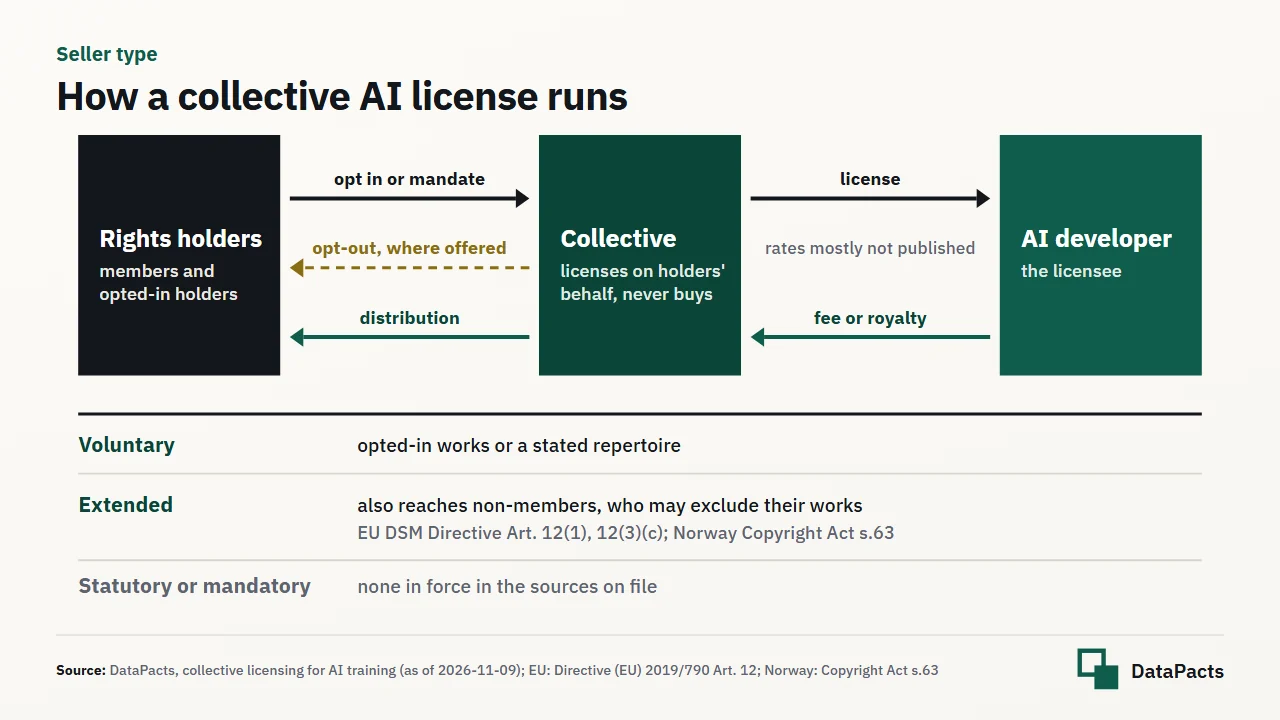
Collectives license on their members' behalf and are never buyers; the AI developer is the licensee. Of seven collective AI licenses on record as of November 2026, only Kopinor's agreement with the National Library of Norway publishes a price, NOK 45,000,000 for 2026. The licenses sit within the wider market for AI training data licensing.
Fact-check note: every term on this page is stated as the collective's own, checked on its public pages on 2026-11-09 unless a row says otherwise; see how we source, date and check every figure.
Voluntary, Opt-in and Extended: The Models of Collective AI Licensing
Collective AI licenses on record follow two models: a voluntary license covering opted-in works or a stated repertoire, and an extended collective license that also reaches non-members unless they exclude their works. Three arrangements exist:
- Voluntary license: CLA, STIM, GEMA and the RSL Collective on an opt-in basis, and Copyright Clearance Center (CCC) for its repertoire.
- Extended collective license: a collective's agreement also covers non-members, who may exclude their works (Directive (EU) 2019/790 Art. 12(1) and 12(3)(c); Norway Copyright Act s.63).
- Statutory or mandatory scheme: none in force in the sources on file.
Extended collective licensing is defined with its safeguards in the AI training data glossary.
Collective Licenses Offered to AI Developers as of November 2026
Six collectives publish seven AI licenses or agreements as of November 2026, and only one of them, Kopinor's agreement with the National Library of Norway, states a price. The table compares uses granted, coverage and payment terms as the collectives state them on their own pages, alphabetical by collective.
| Collective (country) | License | Uses granted, as stated | Who is covered | Payment terms stated | Source |
|---|---|---|---|---|---|
| Copyright Clearance Center (US) | AI Systems Training License | training AI systems for uses external to the licensee; voluntary, non-exclusive | CCC repertoire | not published | copyright.com |
| Copyright Clearance Center (US) | Annual Copyright License, internal AI re-use rights (since July 2024, per CCC) | internal-only AI re-use | CCC repertoire, Annual Copyright License holders as licensees | not published | copyright.com |
| Copyright Licensing Agency (UK) | Generative AI Solution | generative AI training, fine-tuning and RAG; "indemnity protection" | content opted in by publishers via PLS and authors via ALCS | not published | cla.co.uk; pls.org.uk |
| GEMA (Germany) | PLAI by GEMA | training on ca. 57,000 works, ca. 178,000 audio files; composition and master rights; delivered exclusively to each customer, per GEMA | contributing rights holders | contributors paid "anteilig und angemessen"; no figures | gema.de |
| Kopinor (Norway) | agreement with the National Library of Norway (signed 2025-12-19) | building corpora and training Norwegian and Sami language models; no specialised news-service models | press publications "up to one year from the date of publication" (s.2) | NOK 45,000,000 for 2026, index-adjusted from 2027 (s.17) | agreement PDF, kopinor.no |
| RSL Collective (US) | Collective License: AI Training, paid and attribution | paid: ai-train; attribution: ai-train and ai-input | web content of publishers declaring the license | paid: royalties per AI result; rates not published | rslcollective.org |
| STIM (Sweden) | collective AI license for music (from September 2025) | training plus AI service use; attribution technology required | works whose creators opted in | fixed fee plus a share of the AI service's income; no rates | stim.se |
As of 2026-11-09. Not published means the collective's public page states no amount; licensees are AI developers, never the collective.
UK: CLA's Generative AI Solution, With PLS for Publishers and ALCS for Authors
The Copyright Licensing Agency licenses AI developers to use published content that publishers opt in through Publishers' Licensing Services (PLS) and authors opt in through ALCS.
CLA states that the license is voluntary, covers generative AI training, fine-tuning and RAG, includes "indemnity protection" and is "designed to work in harmony with any direct deals publishers have or want to pursue"; no payout is published.
PLS invites publishers to opt in to an "industry-led collective licensing initiative", with terms in a publisher login and no fees or dates on its public page (re-read 2026-11-10).
The UK government's report of March 2026 describes CLA developing the license. Readers can see where the license fits among the UK copyright rules for AI training.
US: CCC's AI Systems Training License and Internal AI Re-use Rights
Copyright Clearance Center offers two voluntary, non-exclusive collective licenses for AI: one for training AI systems used outside the licensee's organization, and internal AI re-use rights inside its Annual Copyright License.
CCC publishes no payout for either license. CCC states that the internal re-use rights launched in July 2024; no licensee of either license is on record.
Music Societies: STIM's Opt-in License and GEMA's PLAI Catalog
Two music societies license AI developers on their members' behalf: STIM through an opt-in collective AI license from September 2025, and GEMA through its PLAI training catalog. The label deals and society terms are detailed among the labels, publishers and societies licensing music for AI training.
GEMA also went to court where no license was agreed: the Munich Regional Court I (42 O 14139/24) ruled on 2025-11-11 on lyrics memorized in a model, and as of 2026-11-09 the judgment is not final.
A Priced Collective Agreement: Kopinor's Press License for Norwegian Language Models
Kopinor, the Norwegian reproduction rights organization, signed an agreement on 2025-12-19 licensing Norwegian press publications to the National Library of Norway for training Norwegian and Sami language models.
The license is non-exclusive, covers press publications "up to one year from the date of publication" (s.2), excludes specialized news-service models, and sets remuneration at NOK 45,000,000 for 2026, index-adjusted from 2027 (s.17). The library is a public institution, so the sum is not a commercial developer's payment.
Rights holders may opt out for future training (s.16), and the agreement extends to non-represented holders only if Kopinor is approved under Copyright Act s.63 (s.3). Termination, first effective 2028-01-01, does not affect trained models; see Kopinor's agreement with the National Library of Norway.
RSL Collective: A License Declared in robots.txt
The RSL Collective, a nonprofit rights organization by its own description, licenses web content of publishers who add a License line pointing to its terms in their robots.txt file. It lists two licenses:
- A paid license permitting ai-train, with royalties "whenever an AI application uses your content to generate a result".
- An attribution license permitting ai-train and ai-input, with attribution links instead of payment.
Rates and distribution terms are not published (checked 2026-11-09). The crawler-side mechanics are covered under pay-per-crawl and crawler licensing.
Opt-in, Opt-out and Extended Effect: Whose Works a Collective License Covers
Most collective AI licenses on record cover only opted-in works; CCC names its repertoire, and Kopinor's agreement runs on member mandates with an opt-out and could extend to non-members. The table shows how works get in and out.
| Collective | How works get in | How holders get out | Reaches non-members | Source |
|---|---|---|---|---|
| CCC | CCC repertoire | not stated on the page | no statement | copyright.com |
| CLA | publishers opt in via PLS, authors via ALCS | not stated on the public page | no, opted-in content only | cla.co.uk; pls.org.uk |
| GEMA PLAI | contributing rights holders; more can be added | not stated | no | gema.de |
| Kopinor | member organizations' mandates, including Mediebedriftenes Landsforening | opt-out for future training (s.16) | only if approved under Copyright Act s.63 (s.3) | agreement PDF |
| RSL Collective | License line in robots.txt or an RSL file | not stated | no | rslcollective.org |
| STIM | explicit opt-in; from 2026-06-01 approval work by work | exclude the AI rights category from STIM's administration | no | stim.se |
As of 2026-11-09.
Joining a license and reserving works are different acts. An EU rights holder who does not join can still reserve text and data mining in machine-readable form under Directive (EU) 2019/790 Art. 4(3), and neither step undoes copies already made, as the EU text and data mining exception explains.
How Revenue Reaches Rights Holders Under a Collective License
Collectives pass AI license income to rights holders in four published ways, and none of them publishes rates or a distribution formula. As stated by the collectives:
- STIM: a fixed fee plus a percentage of the AI service's income, with royalties at training, use and output, traced by attribution technology.
- GEMA: contributing rights holders are paid "anteilig und angemessen" (proportionately and appropriately), with no formula.
- RSL Collective: a paid license with per-output royalties, rates not published.
- Kopinor: an annual remuneration, due no earlier than 30 June each year.
- CLA and CCC: payout terms not published.
No per-member payout from any collective AI license is on record. The Authors Guild recommends 75 to 85 percent to the author between publisher and author, its own view and not a rule; other figures are collected under reported payouts to data sellers.
Platforms Acting for Many Rights Holders That Are Not CMOs
Some licensing platforms gather many rights holders' works without being collective management organizations, and their terms are their own claims rather than a society's rules. Each is an intermediary or marketplace, never a buyer:
- Created by Humans: authors or their agents sign up and opt in per use for training, reference and transformative rights; the payout is not published.
- Credtent: states 85 percent to rights holders under its standard terms, paid quarterly, with an annual training fee plus a revenue share (checked 2026-11-09), a claim and not a market price.
- Mozilla Data Collective: the provider sets the price and license, and the platform states that uploaders "keep 100% of revenue"; the name is a brand and the platform is not a collecting society.
Individual sellers are covered under creators selling content for AI training.
Where Governments Stand on Collective and Extended Licensing
No government on record has imposed a collective or extended license for AI training, and the UK, EU and US positions as of 2026 lean toward letting voluntary licensing develop.
The UK government's report of March 2026 proposes not to intervene in the licensing market at this stage (Section G, para. 63), and the opt-out exception is no longer its preferred way forward.
The European Parliament's non-binding resolution of 2026-03-10 (2025/2058(INI)) calls for sectoral voluntary collective licensing, remuneration for past uses and a rebuttable presumption of use; para. 10 names the EUIPO as a trusted intermediary for exclusion tools.
The US Copyright Office's pre-publication report of 2025-05-09 says on p. 106 that the licensing market should develop without government intervention, with targeted extended licensing considered where market failures are shown; its final version is not listed as of 2026-11-09, per the US Copyright Office report on generative AI training.
Benefits, Risks and Downsides of a Collective License, and the Options Besides It
A collective license reaches AI developers a single rights holder could not negotiate with, but rates are unpublished, the collective sets the terms, and not licensing remains a valid outcome.
Benefits
- One route to many licensees under a single license.
- CLA's license works alongside direct deals and includes indemnity protection.
- STIM states it pays at training, use and output.
Risks
- No published rates or distribution formula.
- Attribution-based distribution depends on technology that STIM's license page calls relatively new and untested.
- Public funding can lapse: Kopinor states that the 2027 state budget proposal has no funding for its books agreement with the National Library (2026-10-26).
Downsides
- The collective sets the uses granted; CLA's license covers RAG as well as training and fine-tuning.
- GEMA delivers the catalog exclusively to each customer and publishes no figures.
- Under Kopinor's agreement, models already trained survive termination.
Alternatives
- A direct license negotiated by the rights holder.
- Machine-readable reservation of text and data mining rights.
- A licensing platform.
- Litigation, including through a collective such as GEMA or the Danish press collective DPCMO.
- Not licensing at all, as set out in the alternatives to selling data to AI labs.
Steps to Join a Collective AI License
A rights holder joins a collective AI license in six steps, and the first decides whether it can opt anything in at all.
- List the works the holder controls and check publishing or recording contracts.
- Find the collective for the sector and country.
- Read the license's uses, opt-in mechanics and exclusion route.
- Opt works in, or work by work where the collective offers it.
- Keep a record of opted-in works and reserve the rest in machine-readable form.
- Review statements and exclusion rights yearly.
Before step 4, a holder can compare a collective's terms with the clauses of direct AI data licensing agreements.
Where Collective Licensing Meets Copyright Law, Contracts and Other Sellers
Whether an AI developer needs any license, collective or direct, depends on copyright exceptions that differ by country. Norway's Copyright Act (LOV-2018-06-15-40) has no text and data mining exception, while the EU allows one with a reservation; see copyright and AI training across jurisdictions.
The parent page covers every type of seller, and sector pages cover the rights holders a collective represents: news publishers and media and academic and scientific publishers.
Book publishers and authors who weigh CLA against a direct deal find the per-title deals on record on the book publishers and authors page. This page is information, not legal advice.
- Rights audit
- Exclusive vs non-exclusive data licenses
- Indemnities and warranties in AI data licenses
- Retraining and model retention rights
- Ethics and risk of selling data for AI training
- Norway's rules for licensing data for AI training
- Sweden's rules for licensing data for AI training
- Consent and compensation for creators
- Training data attribution and per-use payment
- Visual artists and illustrators
Deal, Law and Profile Pages Named on This Page
Each deal, case and platform named above has or will have its own page with parties, dates and sources.
- AI data licensing deals
- GEMA v. OpenAI
- HarperCollins book licensing for AI
- Mozilla Data Collective
- Created by Humans
Frequently Asked Questions
Is a collecting society a buyer of my works?
No: a collecting society licenses members' works to AI developers on their behalf and passes income on; the AI developer is the licensee.
How much does a collective AI license pay rights holders?
No collective publishes rates; the only priced collective agreement is Kopinor's NOK 45,000,000 for 2026 from a public library, paid to Kopinor on behalf of its member organizations. Collective rates are therefore a negotiation outcome. The valuation guide explains what data is worth to AI companies.
Can I leave a collective AI license after joining?
STIM members can exclude the AI rights category, Kopinor's agreement allows opt-out for future training, and EU law lets holders exclude works from extended licenses; under Kopinor's agreement, models already trained stay.