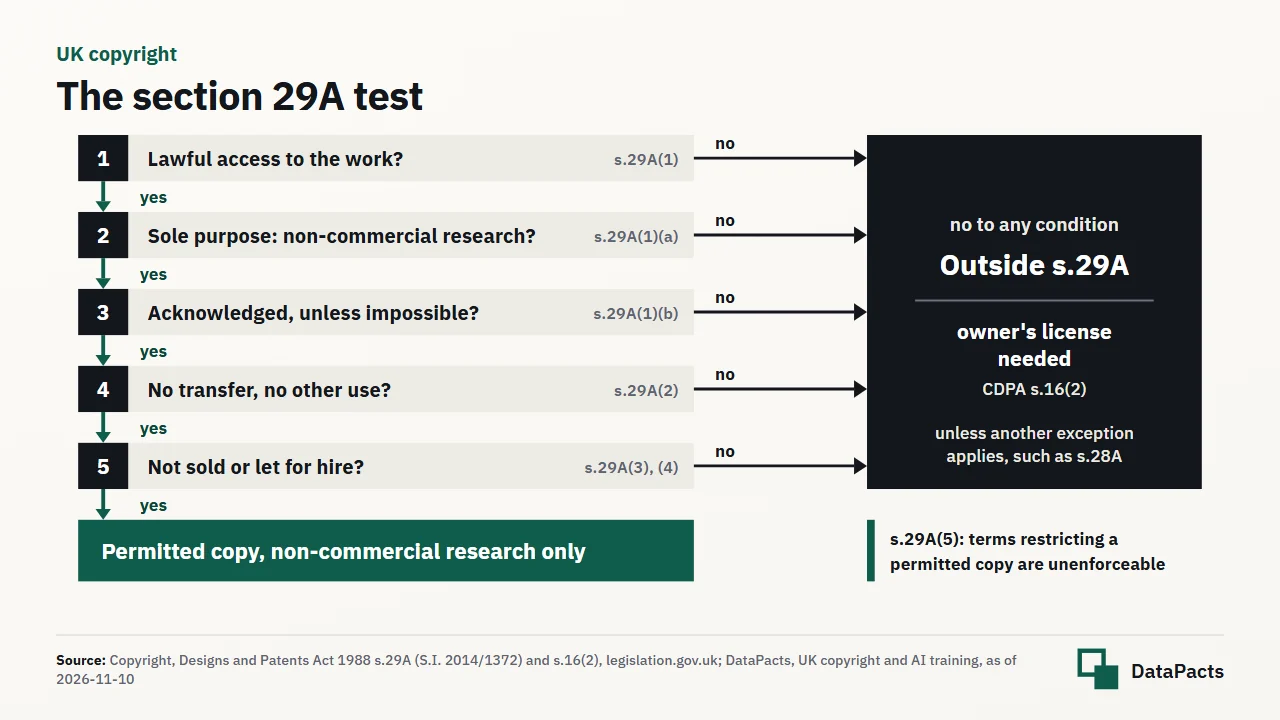
Section 29A has been in force since 2014-06-01. The government's Report on Copyright and Artificial Intelligence, published on 2026-03-18, says a broad exception with an opt-out is no longer its preferred way forward and proposes no intervention in the licensing market at this stage.
This page covers the exception, the 2024 consultation, the report, the Getty appeal and licensing practice as of 2026-11-10, within the wider field of AI training data licensing.
Why Commercial AI Training in the UK Needs a License
Making a copy of a protected work without the owner's license infringes copyright under CDPA s.16(2) unless an exception applies, and the report (para. 54) names two exceptions relevant to AI training: temporary copies (s.28A) and non-commercial research mining (s.29A).
Section 28A covers transient or incidental copies with no independent economic significance. The report (para. 94) records that developers cite both exceptions, but each applies only when its conditions are met.
A commercial training copy made in the UK therefore falls back on the owner's exclusive right, and permission "is commonly granted through a licence" (report para. 55).
Who can grant it depends on ownership: under CDPA s.11(2) an employer is the first owner of works made by an employee in the course of employment, subject to agreement.
What Section 29A Allows: Mining for Non-Commercial Research Only
Section 29A lets a person with lawful access copy a work for computational analysis only when every condition in the table holds. The table lists the conditions of CDPA 1988 s.29A as of 2026-11-10, from legislation.gov.uk; the section was inserted by S.I. 2014/1372 and has been in force since 2014-06-01.
| Condition | What it requires | Subsection | Source |
|---|---|---|---|
| Lawful access | the person making the copy, and the person analysing, have lawful access to the work | s.29A(1) | legislation.gov.uk |
| Purpose | the copy is made for a computational analysis of anything recorded in the work, for the sole purpose of research for a non-commercial purpose | s.29A(1)(a) | legislation.gov.uk |
| Acknowledgement | the copy is accompanied by a sufficient acknowledgement, unless impossible for reasons of practicality or otherwise | s.29A(1)(b) | legislation.gov.uk |
| No transfer, no other use | transferring the copy to anyone else, or using it for another purpose, infringes unless the owner authorises it | s.29A(2) | legislation.gov.uk |
| No dealing | a copy sold, let for hire or offered for sale or hire is treated as an infringing copy | s.29A(3)-(4) | legislation.gov.uk |
| Contract override | a contract term preventing or restricting a permitted copy is unenforceable | s.29A(5) | legislation.gov.uk |
A copy that fails one condition, or that is later sold or let for hire, is an infringing copy. Section 29A(5) makes contract terms that prevent or restrict a permitted copy unenforceable, so a license or website terms cannot switch off research mining, unlike Article 4 of the EU Directive.
The 2024 Consultation: Four Options and 11,520 Responses
The government launched its copyright and AI consultation (CP1205) in December 2024 and put four options to respondents, from leaving the law unchanged to a broad exception with no opt-out. The table gives the options and the share of respondents preferring each, as the report gave them on 2026-03-18.
| Option | What it proposed | Share of respondents preferring it | Source |
|---|---|---|---|
| 0 | keep the law unchanged (status quo) | 10 % | Report para. 123 |
| 1 | strengthen copyright so licensing is required for copies made during AI development in all cases | 81 % | Report para. 71 |
| 2 | a broad data mining exception with no opt-out | "a very low number" (no percentage given) | Report para. 108 |
| 3 | a data mining exception with a rightholder opt-out | no share recorded here | Report paras. 70, 176 |
The report counts 11,520 responses in total, 10,110 through Citizen Space and 1,410 by email. The December 2025 progress update counted Citizen Space responses only, so shares quoted from that update differ from the report's and are not repeated here.
What the March 2026 Report Concludes and What It Leaves Unchanged
The Report on Copyright and Artificial Intelligence, published on GOV.UK on 2026-03-18 by the Department for Science, Innovation and Technology, the Department for Culture, Media and Sport and the Intellectual Property Office, concludes that a broad copyright exception with opt-out "is no longer the government's preferred way forward".
It was presented under s.136 of the Data (Use and Access) Act 2025 (Royal Assent 2025-06-19), which required the report and the s.135 economic impact assessment within nine months; ss.135 to 137 have been in force since 2025-08-20. The impact assessment was published alongside the report.
Instead of an exception, the report proposes to gather further evidence on how copyright affects AI development, to engage stakeholders on other approaches, and to monitor technology, litigation, international approaches and the licensing market (para. 176).
On licensing, Section G (para. 63) says: "We propose not to intervene in the licensing market at this stage", because the government does not consider there to be sufficient evidence to justify intervention.
The report proposes no bill and no amendment to s.29A, and s.29A stands unchanged on legislation.gov.uk as of 2026-11-10. The report does not adopt an opt-out and does not create a licensing regime.
Training Outside the UK and Imported Models: The 2025 Judgment and the Appeal
The only UK judgment on an AI model and training data so far did not decide whether training in the UK infringes, because Getty Images abandoned its training claim for lack of evidence that training took place in the UK. In Getty Images v.
Stability AI ([2025] EWHC 2863 (Ch), claim IL-2023-000007, judgment 2025-11-04, Joanna Smith J), the High Court dismissed secondary infringement because a model that does not store or reproduce the works is not an "infringing copy" under CDPA ss.22, 23 and 27(3), and found trade mark infringement in part.
The report adds that the applicable law for training will often be that of the USA or another country (para. 109). The claims and rulings are in the tracker of AI copyright lawsuits over training data.
Getty received permission to appeal on secondary infringement on 2025-12-16 ([2025] EWHC 3343 (Ch)). The Court of Appeal case CA-2026-000007 was part heard on 2026-11-11 in London, and judgment was reserved on 2026-11-12 (Court of Appeal case tracker, checked 2026-11-16). This page states no outcome.
How UK Content Is Licensed for AI Training in Practice
UK publishers license content to AI developers through direct bilateral deals, and a collective route for published text is being built, but most deals state display in AI answers rather than model training.
The table lists UK licensors by date as of 2026-11-10; each value is as stated by the named party, and training is marked only where the party's own text says so.
| Licensor (UK) | Counterparty | Date | What the license covers | Value | Stated by | Page |
|---|---|---|---|---|---|---|
| The Financial Times Limited | OpenAI | 2024-04-29 | attributed summaries, quotes and links in ChatGPT; to "improve its models' usefulness by incorporating FT journalism" (training stated) | not disclosed | FT press release | Financial Times AI licensing deals |
| News Corp (The Times, The Sunday Times, The Sun among its titles) | OpenAI | 2024-05-22 | current and archived news; display in answers and to "enhance its products" | not disclosed by the parties | News Corp | News Corp AI licensing deals |
| Taylor & Francis (Informa PLC) | buyers not named by Informa | 2024 | academic content and data access | AI-related revenues USD 75m+ in 2024, "non-recurring" (Informa states) | Informa RNS | Taylor & Francis AI licensing deals |
| Guardian Media Group plc | OpenAI | 2025-02-14 | reporting and archive journalism as attributed summaries and extracts in ChatGPT (training not stated) | not disclosed | Guardian press office | The Guardian AI licensing deals |
| Creative Content Exchange (government pilot) | not applicable | 2026-01-26 | pilot marketplace for licensing digitised cultural and creative assets, 12 cultural institutions | not applicable | Report para. 39 | none |
| Reach plc | Amazon Web Services | disclosed 2026-07-22 | AI licensing (Reach: "secured deals with large tech firms such as AWS") | not disclosed | Reach H1 2026 report | Reach plc AI licensing deals |
| Reach plc | 2026-10-12 | enhanced content rights across the UK and Ireland portfolio (Google News AI pilot) | not disclosed; Google: "we pay for enhanced content rights" | Reach | same page | |
| CLA (with PLS and ALCS) | AI developers as licensees | page checked 2026-11-09 | generative AI training, fine-tuning and RAG over opted-in published content | not published | CLA, PLS | collective licensing for AI training |
The CLA Generative AI Solution is voluntary. CLA states that it covers generative AI training, fine-tuning and RAG over content opted in by publishers (through PLS) and authors (through ALCS), carries "indemnity protection" and is "designed to work in harmony with any direct deals"; payout terms are not published (checked 2026-11-09).
In March 2026 the report recorded no collective license for generative-AI training in the UK apart from MERLIN's partnership activity, with CLA, PLS and ALCS "developing" one (para. 34). Its launch date and fees are not stated here.
The Creative Content Exchange pilot was announced on 2026-01-26 with 12 cultural institutions as a marketplace for licensing digitised cultural and creative assets, and the report aimed for an operational pilot platform by summer 2026 (para. 66). Its status after summer 2026 is not recorded.
UK parties rarely disclose values. Informa's aggregate is the one figure in the table that the licensor itself states, and it names no buyer. Press-reported values are not stated on this page. Every dated UK deal is in the AI data licensing deal tracker.
License, Rely on Section 29A's Limits or Do Nothing: Benefits, Risks, Downsides and Alternatives
For a UK rightholder, the absence of a commercial exception makes a license the lawful route to commercial training on its works, but licensing carries costs and limits, and leaving content unlicensed or not licensing at all remain valid choices.
Benefits
- Commercial training in the UK needs a license, so the owner sets scope and price (CDPA s.16(2)).
- Section 29A covers only non-commercial research, with no transfer of the copies (s.29A(2)).
- The government proposes no intervention in the licensing market, so terms stay contractual (report para. 63).
Risks
- A model trained abroad and imported was held not an infringing copy in the 2025 judgment, and the appeal was heard in November 2026 with judgment reserved on 2026-11-12.
- Government policy is not settled: the report proposes more evidence-gathering rather than a rule.
- Ownership of company content depends on employment and contracts (s.11(2)), which decides whether to sell or license your data to AI companies at all.
Downsides
- Most disclosed UK deals cover display, not training, and few disclose values.
- A collective route for published text has no published fees or launch date.
Alternatives
- License directly to a developer.
- Opt works into a collective scheme where one exists (CLA through PLS or ALCS).
- Leave content unlicensed and rely on existing rights.
- Do not sell or license the content at all.
What Is Still Open in UK Copyright and AI as of November 2026
Four dated items can change how UK copyright applies to AI training, and the table gives each one's next step and source as of 2026-11-10.
| Item | Body | Status | Next step | Source | Page |
|---|---|---|---|---|---|
| Getty Images v. Stability AI, CA-2026-000007 | Court of Appeal (Civil Division) | permission granted 2025-12-16 on secondary infringement | part heard 2026-11-11, London; judgment reserved 2026-11-12 (checked 2026-11-16) | casetracker.justice.gov.uk | Getty Images v. Stability AI (UK) |
| CMA investigation of Meta's commercial terms | Competition and Markets Authority | opened 2026-10-30 under Competition Act 1998 Chapter II; concerns terms for collecting business and publisher website content for AI features | investigation, no decision date recorded | gov.uk | none |
| Further evidence on copyright and AI | government (report of 2026-03-18) | opt-out no longer preferred; evidence-gathering proposed | no bill or further publication recorded | gov.uk | none |
| Creative Content Exchange and CLA collective license | government pilot; CLA | CCE operational pilot aimed for summer 2026; CLA terms page live, fees and launch date not published | status after summer 2026 not recorded | gov.uk; cla.co.uk | none |
None of the rows changes s.29A. Any later bill or ruling is a trigger to refresh this page.
Beyond UK Copyright: Personal Data, Other Jurisdictions and the Seller Process
Copyright is one of several UK rules on a training-data deal: personal data in the same content falls under the UK GDPR as amended by the Data (Use and Access) Act 2025, and outside the UK the EU allows commercial mining unless the rightholder reserves it (Directive (EU) 2019/790 Art. 4(3)) while US law decides training copies under fair use (17 U.S.C. 107).
The UK rules for licensing data for AI training cover the UK overview with personal data and insolvency rules.
- AI training data law by jurisdiction: the overview of every country page.
- Copyright and AI training across jurisdictions: how the UK compares with fair use and opt-out models.
- EU text and data mining exception: the EU exception and its opt-out.
- Fair use and AI training: the US approach.
- UK GDPR after the Data (Use and Access) Act 2025: personal data in UK training-data deals.
- Rights audit: checking who owns the content before any license.
- AI data licensing agreements: training and scope clauses.
- UK administration and liquidation: selling data out of an insolvent UK company.
What This Page Does Not Cover
This page covers UK copyright as it applies to content acquired for AI training, not who owns outputs made by AI systems or the protection of computer-generated works.
Digital replicas of voice and likeness, also treated in the same report, are outside this page, and licenses that let professionals paste content into AI tools as prompts are not training licenses.
How This Page Is Sourced and Dated
Every rule cites legislation.gov.uk, the government's own report or the court's record, with the date it was checked. The method is in how we source and date every rule. This page is general information about UK copyright law, not legal advice for any specific deal.
Frequently Asked Questions
Does the UK have a text and data mining exception for AI training?
Yes, but only for non-commercial research. Section 29A lets a person with lawful access copy a work for computational analysis, with acknowledgement, and the copy may not be passed on.
Did the UK adopt an opt-out for AI training?
No. The March 2026 report says a broad exception with opt-out is no longer the government's preferred way forward, and s.29A is unchanged.
Can a license or website terms exclude section 29A?
No for research copies. Section 29A(5) makes a term that prevents or restricts a permitted research copy unenforceable, though commercial training needs a license anyway.
Does the EU opt-out apply to UK content?
Not in UK law. Directive (EU) 2019/790 is EU law, so a reservation under its Art. 4(3) matters only where EU law applies.