The government's March 2026 report on copyright and AI calls an opt-out exception "no longer the government's preferred way forward", so the exception stays limited to non-commercial research as of 2026-11-09.
This page sets out the UK instruments, dated changes and programs that name the UK as of 2026-11-09, for the data holder and for the AI developer. It is a free-to-read part of the wider reference on AI training data licensing, and every rule cites legislation.gov.uk, a court judgment or a GOV.UK publication.
Each figure is dated and checked against the official text, as described in the method for sourcing and dating every figure.
What UK Law Decides Before a Company Licenses Data for Training
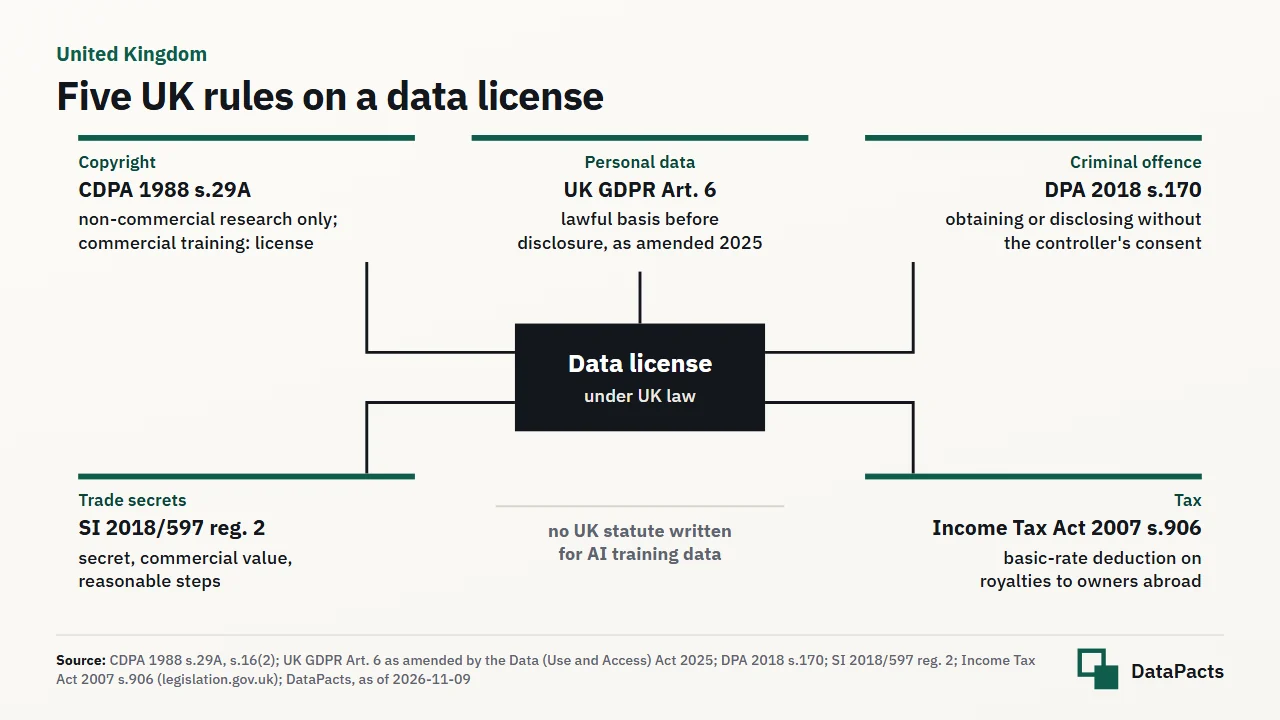
UK law decides five things before a data license: whether protected works may be copied without permission, whether personal data may be disclosed and on which lawful basis, whether staff who move data commit an offence, whether confidential records keep trade-secret protection, and how cross-border payments are taxed.
- Copyright: CDPA 1988 (c. 48), section 29A.
- Personal data: UK GDPR Article 6, as amended by the Data (Use and Access) Act 2025.
- Offence: Data Protection Act 2018 (c. 12), section 170.
- Trade secrets: Trade Secrets (Enforcement, etc.) Regulations 2018 (SI 2018/597), regulation 2.
- Tax: Income Tax Act 2007 (c. 3), section 906.
The 2025 act is the Data (Use and Access) Act, never the "Data Protection and Digital Information Act". No UK statute written for AI is recorded on this page.
UK Instruments That Apply to a Training Data Deal
Eleven UK instruments and record gaps shape a training-data license, and the table gives each citation, its date and whether it is final or open. Rows with a page of their own link to it, and "open" rows mean no primary source was verified on 2026-11-09, not that no rule exists.
| Instrument | Citation | Dates | What it decides in a data deal | Final, pending or open | Source |
|---|---|---|---|---|---|
| CDPA 1988, s.29A | 1988 c. 48, s.29A (S.I. 2014/1372) | in force 2014-06-01 | text and data analysis copies only for non-commercial research; s.29A(5) contract override unenforceable | final | legislation.gov.uk |
| UK GDPR | Regulation (EU) 2016/679 as it forms part of UK law | in force; amended in stages | lawful basis for disclosing personal data | final | legislation.gov.uk |
| Data (Use and Access) Act 2025 | 2025 c. 18 | Royal Assent 2025-06-19; ss.67, 70, 71 from 2026-02-05 | research definition, Art. 6(1)(ea), purpose limitation; Part 7 copyright reports | final (staged) | legislation.gov.uk |
| DPA 2018, s.170 | 2018 c. 12, s.170 | in force 2018-05-25 | offence: obtaining or disclosing personal data without the controller's consent | final | legislation.gov.uk |
| Trade Secrets Regulations 2018 | SI 2018/597, reg. 2 | in force 2018-06-09; words substituted 2026-10-01 | definition: secret, commercial value, reasonable steps | final | legislation.gov.uk |
| Insolvency Act 1986 | 1986 c. 45, Sch. B1 paras 59, 60, 69; Sch. 1 para. 2; Sch. 4 para. 6 | in force 1986-12-29; Sch. B1 from 2003-09-15 | office-holder power to sell company property, data included | final | legislation.gov.uk |
| Companies Act 2006, ss.1012, 1024, 1030 | 2006 c. 46 | in force | dissolved company's property is bona vacantia; restoration within 6 years | final | legislation.gov.uk |
| Income Tax Act 2007, ss.906-907 | 2007 c. 3 | in force | basic-rate deduction on IP royalties to owners abroad | final | legislation.gov.uk |
| VAT Act 1994, s.7A | 1994 c. 23, s.7A(2) | in force | business-to-business services supplied where the recipient belongs | final | legislation.gov.uk |
| Workplace monitoring rules | not stated | not stated | not stated | open | n/a |
| Call recording and interception rules | not stated | not stated | not stated | open | n/a |
How Each UK Rule Reaches the Seller and the Buyer
The table lists each instrument; the sections below show what each one asks of the data holder and of the AI developer.
Commercial Training Needs a License: Section 29A Covers Only Non-commercial Research
The exception in CDPA section 29A, in force since 2014-06-01 (S.I. 2014/1372), lets a person with lawful access copy works for computational analysis only for the sole purpose of non-commercial research, so commercial training on protected works needs a license under section 16(2).
Section 29A(5) makes contract terms restricting such copying unenforceable, which protects research copies, not commercial ones.
The government's March 2026 report calls an opt-out exception "no longer the government's preferred way forward". The consultation figures, the Creative Content Exchange and licensing detail sit on the page on UK copyright and AI training.
Personal Data in the Set: Lawful Basis Under the UK GDPR as Amended in 2025
The UK GDPR, Regulation (EU) 2016/679 as it forms part of UK law and as amended by the Data (Use and Access) Act 2025 (c. 18), requires a lawful basis before personal data in a dataset is disclosed to an AI buyer.
The Information Commissioner's Office (ICO) is the UK data protection regulator, and its guidance on AI and anonymisation is not summarized here.
- Do customer records identify individuals, and which lawful basis covers disclosure to a third party?
- Do staff communications such as emails or chats carry names or contact details?
- Do call recordings capture voices of individuals who spoke for a service purpose only?
The recognised legitimate interests basis in Article 6(1)(ea), in force since 2026-02-05, applies only where an Annex 1 condition is met, and the Annex 1 headings (disclosure for public-task purposes, national security, emergencies, crime, safeguarding) do not name commercial data licensing. Article-level rules sit on the page on the UK GDPR after the 2025 act.
Commercial Research and Purpose Limitation After the 2025 Reforms
Since 2026-02-05, under S.I. 2026/82, the UK GDPR counts commercial research and technological development as scientific research and rewrites purpose limitation, but neither change makes a sale of personal data lawful by itself.
- Section 67 (Article 4(2)-(3)) covers research "whether publicly or privately funded and whether carried out as a commercial or non-commercial activity".
- Section 71 (Article 5(1)(b), 5(3)) provides that compatible processing is not lawful by that fact alone.
The changes are dated by commencement, not by Royal Assent on 2025-06-19.
The Criminal Offence for Taking Personal Data to Sell It
Section 170(1) of the Data Protection Act 2018, in force since 2018-05-25, makes it an offence to knowingly or recklessly obtain or disclose personal data without the consent of the controller, to procure its disclosure, or to retain it after obtaining it.
Directors or staff who copy customer or staff data from a failing or closed company to sell it, without the controller's consent, risk this offence. The controller's own decision to license, on a lawful basis, is the route the section leaves open, and penalties are not stated here.
Confidential Company Records as Trade Secrets
The Trade Secrets (Enforcement, etc.) Regulations 2018 (SI 2018/597), in force since 2018-06-09, protect information that is secret, has commercial value because it is secret, and has been subject to reasonable steps to keep it secret (regulation 2).
A seller that shares samples without a confidentiality agreement weakens the third limb, and a non-disclosure agreement before samples is the usual step. Words in regulation 2 were substituted from 2026-10-01 (SI 2026/723), and the definition is unchanged as read on 2026-11-09.
Staff Data, Monitoring and Call Recordings: What Is Recorded and What Is Open
Staff data and call recordings fall under the UK GDPR like any personal data, and no UK employee-specific statute or recording-consent rule is recorded on this page.
Section 170 applies to staff data too. UK workplace-monitoring and interception rules are open, so they are not filled from memory, and the comparison pages in the final section cover other countries.
Insolvent and Dissolved Companies
A UK administrator may sell company property, which includes data assets, under the Insolvency Act 1986 (Schedule B1 paragraph 60 and Schedule 1 paragraph 2), and acts as the company's agent (paragraph 69), so the company stays the data controller.
Once a company is dissolved, its property vests in the Crown as bona vacantia (Companies Act 2006 section 1012), with restoration possible within 6 years (sections 1024 and 1030). The table rows link to the pages with the depth.
Tax on Cross-Border License Payments to and From the UK
A UK payer deducts income tax at the basic rate, 20 % as of 2026-11-09 per GOV.UK, from intellectual property royalties paid to an owner abroad (Income Tax Act 2007 section 906(5)), and section 907(1) counts information concerning industrial, commercial or scientific experience as intellectual property.
The IRS treaty table (Table 1, revised May 2023) lists 0 % US withholding on industrial and copyright royalties (income codes 10 and 12) paid to UK residents, subject to the treaty's limitation-on-benefits test.
A UK seller's license to a business abroad is supplied where the recipient belongs (VAT Act 1994 section 7A(2)), and whether a given dataset fee is a section 907 payment is not stated.
Enacted, Pending and Proposed: UK Changes as of November 2026
Nine dated items changed or may change UK rules for training data, and the table keeps what is in force apart from what is under appeal or only planned.
| Date | Item | Citation | Status as of 2026-11-09 | Source |
|---|---|---|---|---|
| 2026-11-09 | Getty v Stability AI appeal | Court of Appeal CA-2026-000007 | pending; no merits judgment | caselaw.nationalarchives.gov.uk |
| 2026-10-01 | Trade secret definition: words substituted | SI 2026/723, Sch. 2 para. 20 | in force; definition unchanged | legislation.gov.uk |
| 2026-03 | Report on Copyright and AI | DUAA 2025 s.136 report | published; opt-out no longer preferred; no licensing-market intervention at this stage | assets.publishing.service.gov.uk |
| 2026-02-05 | UK GDPR research definition, Art. 6(1)(ea), purpose limitation | DUAA ss.67, 70, 71; S.I. 2026/82 reg. 2 | in force | legislation.gov.uk |
| 2026-01-26 | Creative Content Exchange pilot announced | Report para. 39 | operational pilot planned by summer 2026; later status not stated | assets.publishing.service.gov.uk |
| 2025-12-16 | Permission to appeal granted to Getty | [2025] EWHC 3343 (Ch) | granted on secondary infringement; Stability refused on trade marks | caselaw.nationalarchives.gov.uk |
| 2025-11-04 | Getty v Stability AI judgment | [2025] EWHC 2863 (Ch), IL-2023-000007 | training claim abandoned; model not an infringing copy; trade mark infringement in part | judiciary.uk |
| 2025-08-20 | Copyright and AI reporting duties commence | DUAA ss.135-137; S.I. 2025/904 | in force | legislation.gov.uk |
| 2025-06-19 | Data (Use and Access) Act 2025 Royal Assent | 2025 c. 18 | enacted; staged commencement | legislation.gov.uk |
The Getty appeal has no merits judgment as of 2026-11-09, and the report is a government position, not law. The Creative Content Exchange pilot was planned for summer 2026 and its later status is not stated.
The 2025-11-04 judgment dismissed the secondary infringement claim, which is the issue on appeal, and the other court rulings on training data are tracked in the AI copyright lawsuits over training data tracker.
Selling Company Data to AI Companies From the UK: Programs That Name the UK
Eight programs, intermediaries and licensors name the UK on their own pages, each as a claim checked 2026-11-09, and none of them changes what UK law requires of the seller.
| Program, intermediary or licensor | Role | What it acquires or handles | What its own pages say about the UK (checked 2026-11-09) | Source |
|---|---|---|---|---|
| CLA Generative AI Solution (The Copyright Licensing Agency Limited) | collective licensor (UK rightholders opt in) | licenses opted-in published content for generative AI training, fine-tuning and RAG | publishers opt in via PLS, authors via ALCS; payout terms not published | cla.co.uk |
| Collinear AI, paid data licensing | buyer program | repositories with PRs and tickets, Slack, Gmail, Jira and similar records | English data; US, CA, UK, EU, AU, NZ; teams of about 50+ | collinear.ai |
| Endless (Seldon Ventures, L.L.C.) | aggregator (licenses non-exclusively, places data with AI labs) | company records for licensing | "US, UK, Canada prioritised"; roughly 30+ employees, English documentation | endless-data.com |
| Human Native (HUMAN NATIVE LTD) | marketplace (intermediary) | connects rights holders and AI developers | UK company, Companies House 15609120; acquired by Cloudflare (announced 2026-01-15) | find-and-update.company-information.service.gov.uk; blog.cloudflare.com |
| McCarthy's AI (Verta Ventures Inc., Ontario) | intermediary | arranges licensing of de-identified business work records through unnamed data partners | consulting serves firms of 10 to 500 staff in the US, Canada and UK; no published data-partnership eligibility | mccarthys.ai |
| micro1, Company Data Partnerships | buyer program | company data | FAQ: demand strongest in the US, UK and Canada; main page prioritizes US companies | micro1.ai |
| Mode, data partnership program | buyer program | company data | referral page: US, Canada, UK, Australia; agreement: US, EU, Canada, Australia; home page: US strongest fit | data.mode.inc |
| Turing, Project Lazarus | buyer program | records of active and shut-down companies | strongest demand US, UK, Canada, EU | lazarus.turing.com |
Mode's three pages list different countries, with the UK on the referral page and not in the agreement, and micro1's FAQ names the UK while its main page prioritizes US companies. Endless licenses data non-exclusively and places it with AI labs, while McCarthy's AI and Human Native arrange or connect and do not buy data.
UK publishers also license directly, as in Reach plc's statement of 2026-10-12 on enhanced content rights for Google, which states no amount. Terms across the buyer programs are compared in the company data partnership programs page.
Benefits, Risks, Downsides and Alternatives of Licensing Data Under UK Law, Including Not Selling
UK law lets a company license data it holds the rights to, and the absence of a commercial exception gives that content license value, but lawful basis, the section 170 offence and confidentiality add conditions, and not licensing remains a valid choice.
Benefits
- No commercial exception gives protected works away, so owned content carries license value.
- Trade-secret status survives a license that carries confidentiality terms.
- The US treaty lists 0 % withholding on royalties to UK residents, as of the May 2023 table.
Risks
- Disclosure of personal data without a lawful basis breaches the UK GDPR.
- Data taken without the controller's consent risks the section 170 offence.
- The Getty appeal can change how a model is treated under copyright law.
Downsides
- Lawful-basis analysis and written agreements cost time.
- A UK payer licensing from an owner abroad deducts 20 % as of 2026-11-09.
Alternatives
- License only content that carries no personal data.
- License de-identified data.
- License through a collective scheme such as the CLA's.
- Not selling or licensing at all, among the alternatives to selling data to AI labs.
Beyond the UK Layer: EU Rules, Topic Comparisons and the Sale
UK law stops at the UK border and at the contract; the pages below cover the EU layer next door, compare topics across jurisdictions and apply the rules to a sale.
- AI training data law in every jurisdiction, the parent overview.
- The EU layer next door, a separate regime.
- How copyright exceptions compare across jurisdictions.
- Privacy rules compared by jurisdiction.
- Employee data rules by jurisdiction.
- Recording consent compared across countries.
- Canada, another common-law jurisdiction.
- The seller path for non-US holders.
- The steps to sell or license company data to AI companies.
How This Page Is Sourced and Dated
Every rule here cites legislation.gov.uk, a commencement instrument, a judgment on judiciary.uk or the National Archives, or a GOV.UK publication, with the date it was checked.
The rules for dating are set out in how we source and date every rule. This page is general information about UK law, not legal advice for any specific deal.
Frequently Asked Questions
Does the UK have a text and data mining exception for commercial AI training?
No, the only exception is CDPA section 29A, which covers non-commercial research. It has been in force since 2014-06-01, and commercial training on protected works needs a license.
Which lawful basis can cover personal data in a UK training data license?
A UK GDPR Article 6 basis must apply. Article 6(1)(ea), in force since 2026-02-05, applies only where an Annex 1 condition is met.
Is it a crime to take a company's personal data and sell it to an AI buyer in the UK?
It can be, under section 170 of the Data Protection Act 2018. Obtaining or disclosing personal data without the controller's consent is an offence.
Did the UK adopt an opt-out for AI training?
No, the UK did not adopt an opt-out. The March 2026 report says an opt-out is no longer the government's preferred way forward.