The Authors Guild states that HarperCollins offers USD 5,000 per title, split 50-50 between publisher and opted-in author (2024-11-19), and the Guild holds that standard trade contracts grant no AI training right.
This page covers the seller side: who can sign, the deal structures used, how consent works, the split as each party states it, the clauses on record and the options besides licensing. Books are among the oldest sources in AI training data licensing, and not licensing is a valid outcome.
Publisher, Author, Agent or Collective: Who Can Sign a Book License
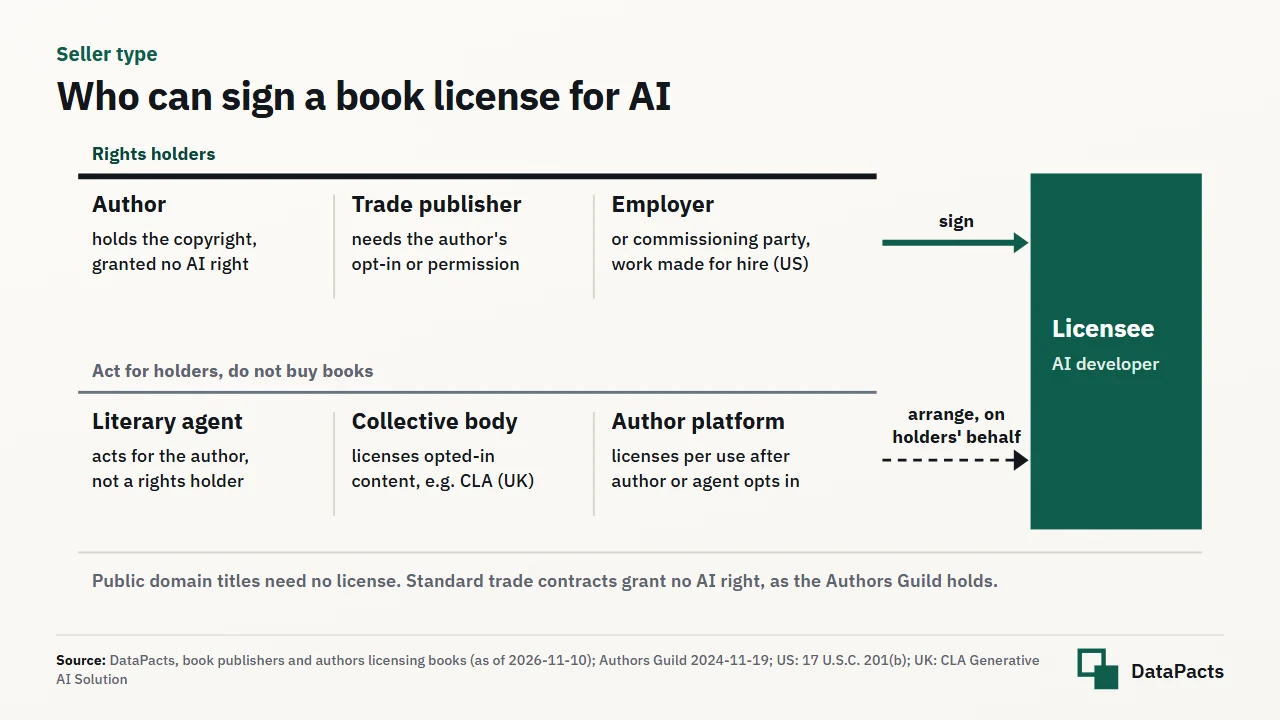
Six kinds of seller can sign or arrange a book license for AI training, and each one's authority comes from a different source: the publishing contract, the copyright itself, an agency mandate or an opt-in. The table lists them from rights holder to intermediary (as of 2026-11-10).
| Seller | Authority to license | Basis on record | Source |
|---|---|---|---|
| Author holding the copyright, granted no AI right | the copyright itself | Authors Guild: standard trade contracts grant no AI training rights | authorsguild.org |
| Trade publisher | the author's opt-in or permission | HarperCollins separate opt-in addendum, nonfiction backlist | authorsguild.org |
| Employer or commissioning party (work made for hire) | owns all rights unless a signed instrument says otherwise | 17 U.S.C. 201(b), 101 | govinfo.gov |
| Literary agent | acts for the author, not a rights holder | Created by Humans accepts authors and agents | createdbyhumans.ai |
| Collective licensing body (intermediary) | licenses opted-in content on holders' behalf | CLA Generative AI Solution: publishers via PLS, authors via ALCS | cla.co.uk; pls.org.uk |
| Author platform (intermediary) | licenses on authors' behalf per use | Created by Humans, author or agent opts in per use | createdbyhumans.ai |
Intermediaries license on rights holders' behalf and do not buy books. Titles in the public domain need no license, and in the EU a work enters it 70 years after the author's death, counted from 1 January of the following year (Directive 2006/116/EC, Arts. 1(1) and 8). A rights audit sorts titles by who holds the AI right.
Trade Books: The Publishing Contract and the Author's AI Right
In trade publishing the Authors Guild holds that a standard publishing contract grants no AI training right, so a trade publisher that wants to license a backlist asks each author first. In the HarperCollins license, the Guild states, the publisher uses a separate opt-in addendum for nonfiction backlist titles (2024-11-19).
The Guild also commends Cambridge University Press for seeking author permission before AI licensing (2024-11-19).
Academic, Educational and Work-for-Hire Books
Books written as works made for hire belong to the employer or commissioning party in the United States, which can then sign alone. Under 17 U.S.C. 201(b) the employer or the person for whom the work was prepared is the author and owns all rights unless both parties sign a written instrument saying otherwise.
In the UK the employer is first owner of an employee's work made in the course of employment, subject to agreement (CDPA 1988 s.11(2)). Bartz default splits applied to non-education works only, and education works went by contract (Dkt. 680, 2026-07-20).
Journals, textbooks and the Wiley and Taylor & Francis filings sit on the page for academic and scientific publishers. This page keeps to the trade and author side.
Deal Structures Book Sellers Have Used
Book sellers have licensed through six structures: a per-title opt-in run by the publisher, a one-time project license of a catalog, recurring or non-recurring data access, a collective license, an author platform and a company data program.
The table orders them by the date of the first statement, each value being the stating party's own (as of 2026-11-10).
| Structure | Example on record | Who consents | Stated pay | Buyer named? | Source |
|---|---|---|---|---|---|
| One-time project license of a catalog | Wiley first GenAI content rights project, disclosed 2024-06-13 | publisher | USD 23 million (Wiley) | no ("large tech company") | sec.gov |
| One-time project license | Wiley second project, disclosed 2024-09-05 | publisher | USD 21 million; Q1 FY2025 USD 16 million (release) vs 17 million (presentation) | no | sec.gov |
| Data access agreements | Taylor & Francis (Informa), first May 2024, second H1 2024 | publisher | AI-related revenues USD 75m+ in 2024, "non-recurring" (Informa) | no | investegate.co.uk |
| Per-title opt-in run by the publisher | HarperCollins nonfiction backlist | each author, separate addendum | USD 5,000 per title, split 50-50 (Authors Guild, 2024-11-19) | no ("an unknown AI company") | authorsguild.org |
| Collective license | CLA Generative AI Solution | publisher via PLS, author via ALCS | not published, checked 2026-11-09 | n/a (licensees are AI developers) | cla.co.uk |
| Author platform | Created by Humans, Author AI rights licensing | author or agent, per use | not published (dashboard), checked 2026-11-09 | not stated | createdbyhumans.ai |
| Company data program listing | Mercor "Publisher or Education Company" listing, published 2026-10-17 | the company holding the rights | Mercor states USD 35,000 to 370,000 per company, checked 2026-11-09 | Mercor is the acquirer | Mercor listings API |
Wiley's six-month AI license revenue to 2025-10-31 of USD 34.9 million includes USD 15.7 million related to content licensed from other publishers (10-Q), so a publisher can relicense content it licensed in. The deals for HarperCollins, Wiley and Taylor & Francis (Informa) name no buyer.
The figures are not comparable, because they are per title, per project or per company. The full figures and dispute list sit with books as AI training data.
How an Author Opts In, Gives Permission or Declines
An author's consent to AI training reaches the licensee in one of four ways on record, and in each the author can also decline.
- An opt-in addendum with the publisher, as in the HarperCollins license (Authors Guild, 2024-11-19).
- Permission sought before licensing, which the Guild commends Cambridge University Press for doing.
- Opt-in through ALCS for the CLA Generative AI Solution, while publishers opt in through PLS (checked 2026-11-09).
- Per-use opt-in on an author platform: Created by Humans states that the author or agent signs up or delegates, opts in per use, and that the platform negotiates for author approval (checked 2026-11-09).
The CLA launch date and fees are not stated in the sources used here. The routes for collective licensing for AI training have their own page.
Splitting a License Fee Between Publisher and Author
The only fee split on record for a book AI license is 50-50 between HarperCollins and the opted-in author, as the Authors Guild states, and the Guild itself recommends that authors receive most of the income.
The Guild calls the 50-50 split "far too much to the publisher" and states that the payments are not set against advances (2024-11-19). It recommends 75 to 85 % for authors (2024-12-12), which is advocacy, not a rule.
| Basis | Author share | Publisher share | Stated by, date | Nature | Source |
|---|---|---|---|---|---|
| HarperCollins opt-in license | 50 % of USD 5,000 per title | 50 % | Authors Guild, 2024-11-19 | license term as reported by an authors' body | authorsguild.org |
| Authors Guild recommendation | 75 to 85 % | remainder, by the publisher's role | Authors Guild, 2024-12-12 | advocacy position | authorsguild.org |
| Bartz settlement allocation | by elected default split (non-education works) or by contract or publishing agreement | same | Dkt. 680, 2026-07-20 | court allocation of past-claims money, not a license | court PDF |
The Bartz row divides settlement money for past conduct and says nothing about a future license fee. No other book route states a split.
Clauses Book Sellers Negotiate: Output Caps, Piracy Pledges, Advances and Scope
Four clauses appear in the one book license with stated terms, and the collective and platform routes add two scope definitions: the uses granted and who carries the indemnity. The table sets out what each record shows (as of 2026-11-10).
| Clause | What the record shows | Stated by | Source |
|---|---|---|---|
| Separate consent instrument | opt-in addendum per author | Authors Guild on HarperCollins | authorsguild.org |
| Payment and the advance | payments not set against advances | Authors Guild on HarperCollins | authorsguild.org |
| Output cap | no more than 200 consecutive words and/or 5 % of a book's text | Authors Guild on HarperCollins | authorsguild.org |
| Source of copies | licensee pledges not to scrape piracy sites | Authors Guild on HarperCollins | authorsguild.org |
| Uses granted | training, fine-tuning and RAG (CLA); training, reference and transformative rights (Created by Humans) | CLA; Created by Humans | cla.co.uk; createdbyhumans.ai |
| Indemnity | "indemnity protection" in the CLA license | CLA | cla.co.uk |
Term, exclusivity and deletion are not stated in any book route on record, and they are the points to compare in AI data licensing agreements.
Past Use Settled in Court Versus a License for Future Training
Suing or claiming in a class settlement compensates for past copying, while a license sets terms for future use, and a book seller may do both. In Bartz v.
Anthropic, training and scanning purchased print books were fair use on that record while pirated library copies were not excused (Dkt. 231, 2025-06-23), and the same record shows Anthropic approaching major publishers about licensing in spring 2024.
In Kadrey v. Meta, the court found the plaintiffs not entitled to the market for licensing their works as AI training data on that record, and added that the ruling does not stand for the proposition that Meta's use is lawful (Dkt. 598, 2025-06-25).
Other book cases are open as of 2026-11-09. Elsevier, Cengage, Hachette Book Group, Macmillan, McGraw Hill and Scott Turow sued Meta (N.D. Cal. 3:26-cv-11415-VC, transferred 2026-09-25), three publishers filed separate suits against SpaceX Super Intelligence Corp. (f/k/a X.AI Corp.) on 2026-11-04, none a class action, and the summary-judgment motions in Authors Guild v.
OpenAI have no ruling. Those pages are Authors v. OpenAI, Kadrey v. Meta and Authors and publishers v. xAI.
The Bartz settlement of USD 1.5 billion received final approval on 2026-07-20 (Dkt. 680) for 482,460 works, and it releases conduct before 2025-08-25 only, with no release of output claims. The co-claimant review window was extended from 30 to 60 days. Payments and status are on the page for the Bartz v. Anthropic settlement.
Benefits, Risks and Downsides of a Book License, and the Options Besides It
A book license pays for backlist titles under written limits, but it can split publisher and author, rarely names the buyer, and has not produced recurring income on record, and not licensing is a valid outcome.
Benefits
- A per-title fee for backlist titles, with an output cap and a piracy pledge, in the HarperCollins license.
- One license through a collective, with indemnity protection, alongside direct deals.
- A catalog can earn project revenue, as Wiley's filings show.
Risks
- The publisher may lack the right if the contract grants none.
- The split between publisher and author can be disputed, as the 50-50 criticism shows.
- The buyer is unnamed in the deals on record.
- A court may treat the licensing market as not the rightsholders' to claim, as in Kadrey.
Downsides
- Project revenue swings: Wiley's AI license revenue was USD 13.7 million in the quarter to 2026-07-31 against USD 28.9 million a year earlier (10-Q).
- Informa calls its data access revenue non-recurring.
- Collective fees are unpublished.
Alternatives
- Opt in title by title, as in the HarperCollins license.
- License through a collective.
- Reserve rights through machine-readable TDM reservations, since in the EU a printed or natural-language notice may not count for online copies (Directive (EU) 2019/790 Art. 4(3); OLG Hamburg 5 U 104/24, 2025-12-10, as summarized in the BGH notice for I ZR 281/25).
- Not license at all.
Steps From Contract Review to a Signed Book License
A publisher or author reaches a signed book license in six steps, and the first three decide which titles can be offered at all.
- List titles and editions and check public-domain status.
- Read each publishing contract for the AI right.
- Ask authors or estates for opt-in or permission and record declines.
- Agree the split in writing, paid outside the advance.
- Collect written terms from more than one route and compare grant, output cap, term, deletion, indemnity and payment.
- Sign and keep the opt-in records.
Each step can end in a decision not to proceed; the alternatives to selling data, including not selling are set out on their own page.
Where Book Licensing Meets Book Data, Other Sellers and Copyright Law
This page covers the book seller's decision; books as a data type, other sellers and the law that decides whether a license is needed each have their own page. Book sellers are one entry among every type of seller, and archives and live reporting belong to news publishers and media.
Whether a license is needed turns on copyright, and in the EU on the machine-readable reservation. This page is information, not legal advice.
- Creators selling content: self-published writing.
- Pirated books and shadow libraries: how pirated books entered training sets.
- Copyright and AI training across jurisdictions: whether a license is needed.
- Fair use and AI training: the US defense.
- Retraining and model retention rights: what happens after the term.
- AI copyright lawsuits over training data: every book case in the tracker.
Deal, Case and Program Pages Named on This Page
Each deal, case and program above has or will have its own page with parties, dates and sources.
- Buyers and programs: Created by Humans, Mercor data buyer profile.
Frequently Asked Questions
Can I sell my books to AI companies?
Yes, if you hold the AI training right in them: an author who granted no AI right keeps it, while a publisher needs it in the contract or the author's opt-in.
What share of a book license fee goes to the author?
In the one deal with a stated split, half: the Authors Guild states HarperCollins pays USD 5,000 per title split 50-50 with the opted-in author (2024-11-19), and it recommends 75 to 85 % for authors.
See what data is worth to AI companies.
Does a publisher need the author's permission to license a book for AI training?
Under a standard trade contract the Authors Guild says yes, because the contract grants no AI right; for works made for hire the employer owns the right.