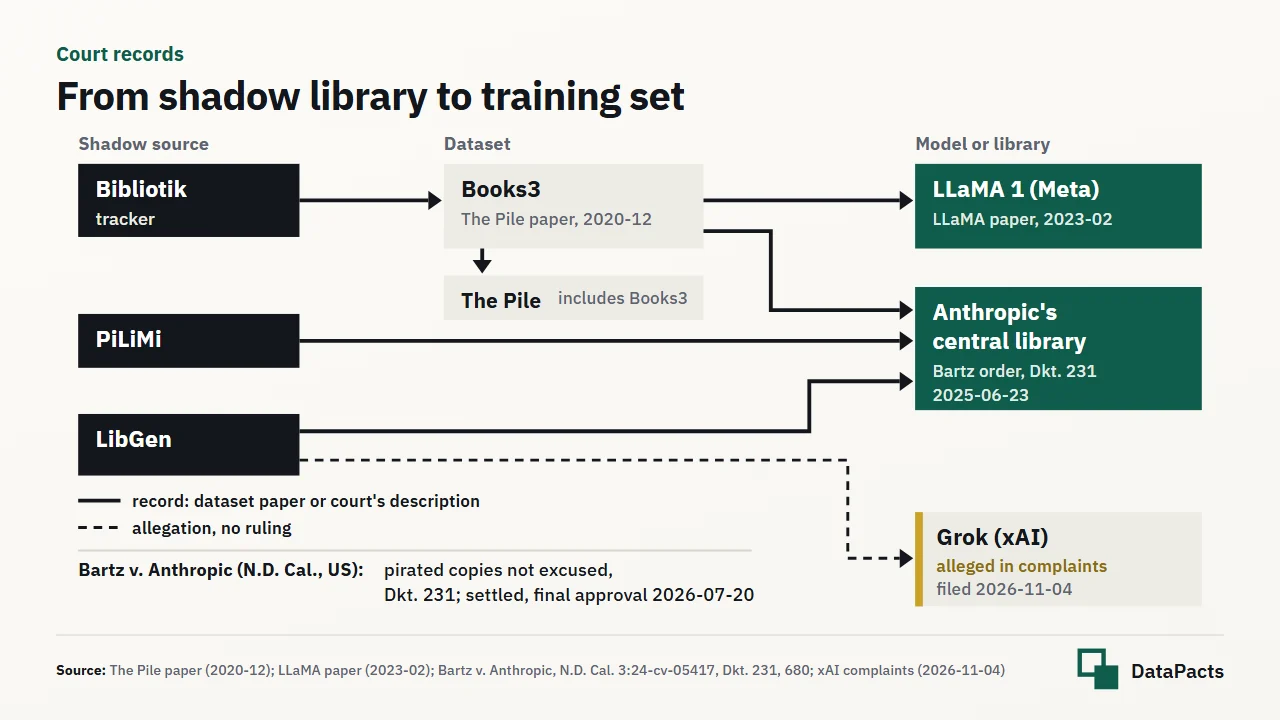
Court records show that AI developers built training libraries from pirated books, and that the copies came from shadow libraries such as Books3, LibGen and PiLiMi.
For AI training data licensing, the point is that one court has ruled on such copies and one class settlement has received final approval: in Bartz v. Anthropic the order of 2025-06-23 did not excuse the pirated library copies, and the case settled for USD 1.5 billion with final approval on 2026-07-20.
This page states claims as claims and findings as findings, each with a docket and a date. It never links to or locates a shadow library. DataPacts is independent.
The fact-check note: every count, docket entry and date below is taken from the court order, dataset paper or agency document named in the sentence, and how we source, date and check every figure is described on the methodology page.
What is a shadow library, and which ones appear in AI training records?
A shadow library is a collection that distributes copies of books and articles without the rights holders' permission, and a US court order on AI training names three such sources with counts: Books3, LibGen and PiLiMi. In Bartz v.
Anthropic, the Order on Fair Use (Dkt. 231, 2025-06-23) describes Books3 at 196,640 books, LibGen at least five million copies and PiLiMi at least two million copies. Books3 is a dataset built from a shadow library rather than a library itself: The Pile paper (December 2020) says it derives from the Bibliotik tracker.
Z-Library and Anna's Archive appear in press coverage and in reporting on complaints. This reference has not read a primary filing that records their use for AI training, so it lists them as not recorded. The dataset itself has its own page, the Books3 dataset profile, which covers its contents.
Shadow library sources named in court records and dataset papers
The table lists each source as the record that names it describes it, with the date of the record and whether a court found or only a party alleged its use.
In the finding column, "court's description of the record" is the court stating what the evidence showed in an order, and "allegation" is a party's claim in a pleading.
Books3 counts differ by record. The figure of 196,640 is Anthropic's copy as described in Dkt. 231, and about 200,000 is the figure of RettighedsAlliancen, the Danish rights group. Other counts come from secondary sources and are not used.
Table: shadow library sources named in primary records, as of 2026-11-10, ordered alphabetically by source.
| Source | What it is per the record | Record that names it | Date of record | Finding or allegation | Source |
|---|---|---|---|---|---|
| Anna's Archive | not recorded from a primary filing here | n/a | n/a | not recorded | n/a |
| Books3 | book set derived from the Bibliotik tracker; 100.96 GiB and 12.07 % of The Pile | The Pile paper | 2020-12 | dataset paper | arxiv.org/pdf/2101.00027v1 |
| Books3 | 196,640 books downloaded by Anthropic, January or February 2021 | Bartz v. Anthropic, Dkt. 231 | 2025-06-23 | court's description of the record | archive.org (court PDF) |
| Books3 | about 200,000 books; removed from its host mid-July 2023 | RettighedsAlliancen notice | 2023-08-14 | rights body's own figure | rettighedsalliancen.dk |
| Books3 | named in claims against Bloomberg, NVIDIA and Salesforce | Huckabee Dkt. 98; Nazemian and Tanzer complaints | 2023 to 2025 | allegation (Huckabee: plausibly pleaded) | court PDFs |
| LibGen | at least five million copies downloaded by Anthropic, June 2021 | Bartz v. Anthropic, Dkt. 231 | 2025-06-23 | court's description of the record | archive.org (court PDF) |
| LibGen | alleged acquisition for Grok | publisher complaints v. xAI | 2026-11-04 | allegation | archive.org (complaint) |
| PiLiMi | at least two million copies downloaded by Anthropic, July 2022 | Bartz v. Anthropic, Dkt. 231 | 2025-06-23 | court's description of the record | archive.org (court PDF) |
| Unnamed shadow libraries | sources of books for Llama; torrenting | Kadrey v. Meta claims | 2023-07-07 onward | allegation | courtlistener.com (court PDF) |
| Z-Library | not recorded from a primary filing here | n/a | n/a | not recorded | n/a |
"Not recorded" means that no primary filing naming the source was read for this reference by the check date.
How pirated books moved into open training sets
Books3 reached many models through public datasets: it was a component of The Pile, and Meta's first LLaMA paper lists it among its book sources.
The Pile paper (December 2020) gives Books3 as 100.96 GiB raw, with a 12.07 % weight and 1.5 epochs, derived from the Bibliotik tracker. The LLaMA paper (February 2023) puts books from Gutenberg and Books3 at 4.5 % of the sampling mix, 85 GB.
The RedPajama-Data-1T dataset card marks its book configuration as "defunct due to reported copyright infringement for Books3" (checked 2026-11-09). RettighedsAlliancen says it had Books3 removed from its host in mid-July 2023 and announced this on 2023-08-14. The wider list of major AI training datasets and their legal status sits on the datasets page.
Removal from a host does not remove copies already downloaded or models already trained. The original Huckabee complaint also named Meta, Microsoft and EleutherAI as defendants. No dataset maintainer's legal name is stated here.
Developers accused of training on pirated sources
Seven case entries on record name pirated sources in their claims, and only one, Bartz, has a court finding on the pirated copies themselves. The three publisher suits against xAI count as one entry.
Table: case entries whose claims name a pirated source, as of 2026-11-10 (case status as of 2026-11-09), ordered by filing date.
| Case | Court and docket | Developer | Pirated source in the claims | Stage and date | Case page | Source |
|---|---|---|---|---|---|---|
| Kadrey v. Meta | N.D. Cal. 3:23-cv-03417-VC | Meta | shadow-library books; torrenting | training: summary judgment for Meta on that record (Dkt. 598, 2025-06-25); related trial 2027-05-03 (Dkt. 879) | Kadrey v. Meta | courtlistener.com |
| Huckabee v. Bloomberg | S.D.N.Y. 1:23-cv-09152-MMG | Bloomberg | Books3 | motion to dismiss denied 2025-11-24 (Dkt. 98) | Huckabee v. Bloomberg | court opinion PDF |
| Nazemian v. NVIDIA | N.D. Cal. 4:24-cv-01454-JST | NVIDIA | Books3; alleged shadow-library sources | discovery; fact discovery closes 2027-02-12 | Nazemian v. NVIDIA | archive.org (complaint) |
| Bartz v. Anthropic | N.D. Cal. 3:24-cv-05417-AMO | Anthropic | Books3, LibGen, PiLiMi | settled; final approval and judgment 2026-07-20 (Dkt. 680) | linked below | archive.org (court PDF) |
| Strike 3 Holdings v. Meta (video, for contrast) | N.D. Cal. 5:25-cv-06213-EKL | Meta | at least 2,396 adult films allegedly downloaded by BitTorrent | complaint filed 2025-07-23; pending | Strike 3 Holdings v. Meta | complaint PDF |
| Tanzer v. Salesforce | N.D. Cal. 3:25-cv-08862-CRB | Salesforce | The Pile, RedPajama, Books3 | pending | Tanzer v. Salesforce | complaint PDF |
| Cognella, Chicken Soup for the Soul and Cambronne v. SpaceX Super Intelligence Corp. et al. | N.D. Cal. 3:26-cv-13189, 3:26-cv-13188, 5:26-cv-13187-SVK | xAI | pirate libraries such as LibGen | complaints filed 2026-11-04; no ruling | authors and publishers v. xAI | archive.org (complaint) |
The full tracker of training-data suits is kept elsewhere, and this table holds only suits whose claims name a pirated source.
What courts have found about pirated copies so far
One court has ruled on pirated copies, one court has ruled on training in a case with torrenting claims, four more developers face undecided claims, and two agencies have stated positions.
Anthropic: acquisition judged apart from training
In Bartz v. Anthropic the court separated how the books were obtained from how they were used, and the pirated copies did not share the fair use finding.
The Order on Fair Use (Dkt. 231, 2025-06-23) held training "exceedingly transformative" and fair use, held the scanning of purchased print books fair use, and did not excuse the over seven million pirated library copies, which it set for trial.
The case then settled. Counts by library are in the table above, and the payments and claims are set out in Bartz v. Anthropic and its settlement.
Meta: a training ruling that left the torrenting claims open
In Kadrey v. Meta, thirteen authors claimed that Meta trained Llama on books from shadow libraries and that it downloaded and uploaded them by torrent. The case is not a class action.
Dkt. 598 (2025-06-25) granted summary judgment for Meta on training on that record. The court said the plaintiffs were "not entitled to the market for licensing their works as AI training data", and that the ruling "does not stand for the proposition that Meta's use ... is lawful".
A joint case management statement (Dkt. 879, 2026-10-27) records disputes over a torrenting expert and Books3 testimony, and sets the first related trial, Entrepreneur Media, for 2027-05-03. The other suits are tracked with AI copyright lawsuits over training data.
Bloomberg, NVIDIA, Salesforce and xAI: claims not yet decided
Four more developers face claims that name Books3 or pirate libraries, and none of those claims has been decided on the merits. In Huckabee v.
Bloomberg the court denied the motion to dismiss on 2025-11-24 (Dkt. 98), finding it plausible that the works were in Books3 and that BloombergGPT was trained on it, and left fair use unresolved at the pleading stage. In Nazemian v. NVIDIA the claims concern Books3 and alleged shadow-library sources, and fact discovery closes on 2027-02-12.
In Tanzer v. Salesforce the complaint alleges training on The Pile, RedPajama and Books3, and the case is pending. Three publisher suits against xAI, filed 2026-11-04, allege acquisition from pirate libraries such as LibGen, and no court has ruled on them.
Agency positions on pirated sources
Two government bodies have addressed pirated sources directly, and both treat knowing use as a factor against the developer rather than a fixed rule.
The US Copyright Office, in its Part 3 pre-publication report (2025-05-09, p. 52), says knowing use of a dataset of pirated or illegally accessed works should weigh against fair use without being determinative. It is a report, not a ruling.
Japan's Agency for Cultural Affairs, in the English overview of its General Understanding on AI and Copyright (May 2024, p. 11, not legally binding), says collecting training data from websites known to distribute pirated content "should be strictly avoided".
For the wider statute, see Japan's rules for licensing data for AI training. The EU position on pirate sources is not stated here.
Settlement terms on record for pirated copies
The only final settlement over pirated book copies on record is the Bartz class settlement: a USD 1.5 billion non-reversionary fund, approved on 2026-07-20. The final approval order of 2026-07-20 (Dkt. 680) counts the Works List at 482,460 works, sets payment in four instalments of USD 300 million, 300 million, 450 million and 450 million, and puts the gross amount at approximately USD 3,000 per work before fees and costs.
The release covers conduct before 2025-08-25 only and does not release claims over outputs. It is a settlement, not a license, and it sets no price for future training. The case page carries the payments, the claims and the status.
Why the source of a copy matters to buyers and rights holders
The source of a copy matters because US courts have so far judged acquisition separately from training, and statutory damages are counted per work.
Under 17 U.S.C. 504(c), as of 2026-11-10, statutory damages run from USD 750 to 30,000 per work, up to USD 150,000 if the infringement is willful. The Bartz order and the Copyright Office both looked at how copies were obtained.
For buyers, a documented chain of rights for each source is the record a court looks at; the method is set out under training data provenance and the chain of rights. Dataset papers and cards, as the section on open training sets shows, record origin in different degrees of detail.
For book rights holders, the records show three positions:
- License titles on documented terms (no figures here).
- Wait for the pending cases, where a ruling has not yet been reached.
- Do nothing, and neither license nor sue.
Lawful routes to book data, and where each topic is covered
Pirated copies are one route among several, and the pages below cover the licensed routes, the book market and the law in full. This page is information, not legal advice.
- How AI companies get training data covers all acquisition routes, and licensed vs scraped training data compares the licensed route with scraping.
- Books as AI training data covers prices and disputes, and book publishers and authors licensing books for AI training covers the seller side.
- Fair use and AI training in US law and copyright and AI training across jurisdictions cover the law.
- Anthropic as a data buyer and Meta as a data buyer cover the two developers most often named here.
- Public domain and openly licensed material in AI training and the US Copyright Office report on generative AI training cover two further topics.
Frequently asked questions
Did Meta use pirated books to train Llama?
The Kadrey plaintiffs claim that Meta trained Llama on books from shadow libraries; no court has made that finding. Dkt. 598 (2025-06-25) granted Meta summary judgment on training on that record and says it does not hold Meta's use lawful. The torrenting claims continue in the related cases.
Were Z-Library or Anna's Archive used for AI training?
No primary filing read for this reference records their use for AI training. Press coverage names them, but this page states only what court records, dataset papers and agency documents show.
Is it illegal to train AI on pirated books?
No US court has decided that question generally. Bartz did not excuse the pirated library copies (Dkt. 231), the Kadrey training ruling is limited to its record (Dkt. 598), and the Copyright Office says knowing use of pirated works weighs against fair use (Part 3, p. 52).
Can authors still claim from the Anthropic settlement?
The claim deadline of 2026-03-30 has passed.
The settlement website expects first payments on or before 2026-11-15; see the Bartz settlement payments and status.