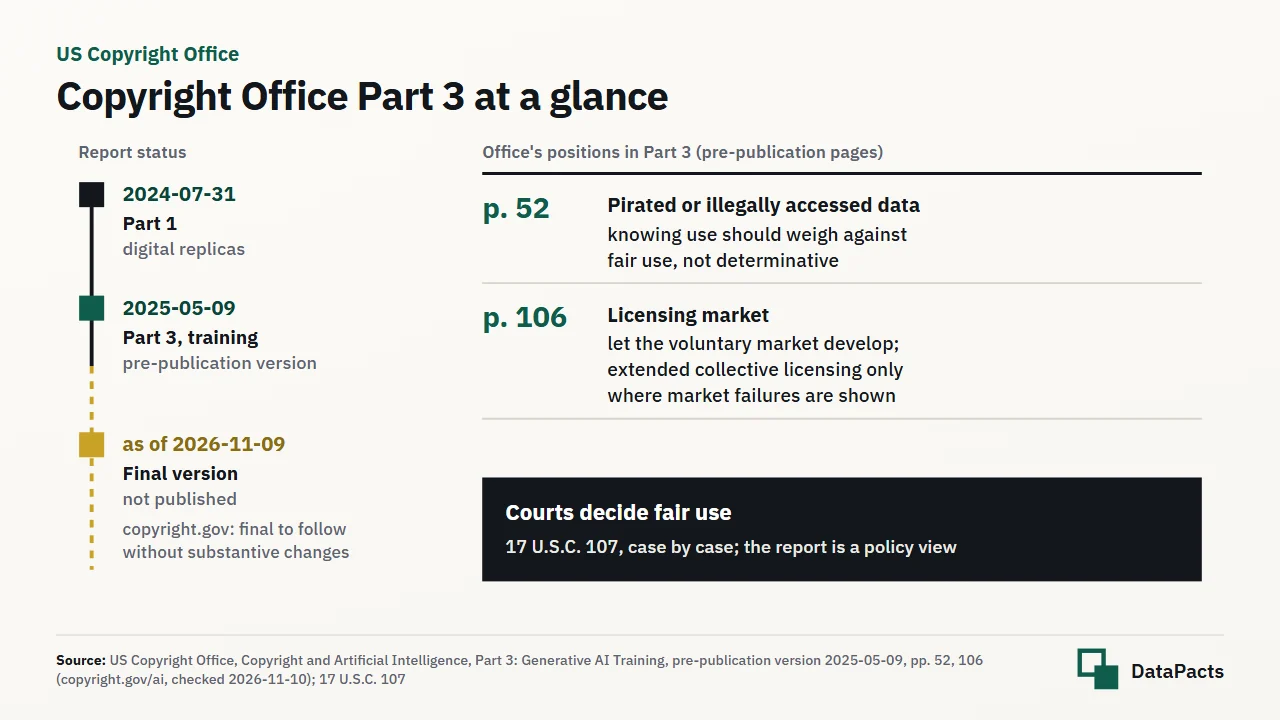
The page sets out the report's record and status, two positions it takes on training data, its view of the licensing market and the court record of the dispute over the Register of Copyrights. The report is the Office's policy view of AI training data licensing, while courts decide fair use.
The figures and citations here come from copyright.gov and court records, as described on the page on how we source, date and check every figure.
Part 3 of the Copyright and AI Report: Record and Pre-publication Status
Part 3: Generative AI Training is a report of the United States Copyright Office, an agency within the Library of Congress, and it exists only as a pre-publication version dated 2025-05-09. The table lists the record as of 2026-11-09, re-checked 2026-11-10.
| Field | Value | Source |
|---|---|---|
| Title | Copyright and Artificial Intelligence, Part 3: Generative AI Training | copyright.gov/ai |
| Issuer | United States Copyright Office, an agency within the Library of Congress | copyright.gov |
| Version and date | pre-publication version, 2025-05-09 | copyright.gov/ai |
| Final version | not published as of 2026-11-09; copyright.gov states a final will follow without substantive changes | copyright.gov/ai |
| Document | PDF, 113 pages | copyright.gov PDF |
| Other parts | Part 1 on digital replicas, 2024-07-31; Part 2 on output copyrightability, not covered here | copyright.gov/ai |
Copyright.gov still described the report as a pre-publication version on 2026-11-10, so every page number cited on this page refers to the 2025-05-09 text and could shift in a final version, even though the Office expects no substantive changes.
Part 1 appeared on 2024-07-31, and Part 2 concerns whether AI outputs are copyrightable, a question this page does not answer because it sits outside the topic of training data.
The Report's Fair Use Positions on Training Data
The report analyzes training under the four fair use factors of 17 U.S.C. 107, and the positions recorded here are the Office's own claims with page numbers from the pre-publication version.
The table lists only positions this page can cite with a page number, as of the 2025-05-09 version, checked 2026-11-09, and it does not summarize the report's overall conclusion.
| Topic | Office's position | Page | Status | Source |
|---|---|---|---|---|
| Pirated or illegally accessed datasets | knowing use should weigh against fair use, not determinative | p. 52 | pre-publication | copyright.gov PDF |
| Licensing market | let the voluntary market develop without government intervention; targeted extended collective licensing only where market failures are shown | p. 106 | pre-publication | copyright.gov PDF |
Pirated or Illegally Accessed Datasets (Page 52)
The Office states that knowing use of a dataset of pirated or illegally accessed works should weigh against fair use without being determinative (Part 3, p. 52).
For a seller, this makes documented, lawful acquisition a point a buyer can cite, and it does not make training on such data infringing by itself. The sources themselves are covered on the page about pirated books and shadow libraries in AI training.
Market Harm and Market Dilution in the Report
This page does not yet summarize the report's fourth-factor analysis, including market dilution, because those passages have not been checked against the report text for this page.
One court has addressed the theory: in Kadrey v. Meta (N.D. Cal. 3:23-cv-03417-VC, Dkt. 598, 2025-06-25), the court called market dilution the "potentially winning argument" but found it undeveloped on that record.
Licensing Markets and Extended Collective Licensing in Part 3
The Office recommends letting the voluntary licensing market for training data develop without government intervention and considering targeted extended collective licensing only where market failures are shown (Part 3, p. 106).
Extended collective licensing lets a collective license extend to rightholders the collective does not represent. Norway's Copyright Act s.63 (LOV-2018-06-15-40) allowed it for the agreement of 2025-12-19 between Kopinor and the National Library of Norway, worth NOK 45,000,000 for 2026, a public institution and not a commercial AI developer.
The EU model in Article 12 of Directive (EU) 2019/790 lets rightholders exclude their works at any time.
The UK government's report of March 2026 likewise proposes no intervention in the licensing market at this stage (Section G, para. 63).
For a seller, the recommendation means direct and collective licenses stay private contracts with no statutory rate in the US, and the routes a rightholder can join are described under collective licensing for AI training.
Where the Report Sits Beside Courts and the United States' Own Filing
The report states the Office's policy view, while whether a training use is fair use is decided by courts applying 17 U.S.C. 107 case by case.
A second federal position exists. The United States' Statement of Interest of 2026-09-01 in In re OpenAI Copyright Infringement Litigation (S.D.N.Y. No. 1:25-md-03143), as cited in footnote 7 of the Third Circuit's ROSS opinion, argued that training that can generate original responses is transformative and causes no substitutive competition.
The two federal positions come from different bodies and address different questions, and neither binds a court. The Office's report predates the filing by more than a year, and the filing is a position in one case.
The four factors, the June 2025 rulings and the Third Circuit decision of 2026-09-29 are set out on the page about fair use and AI training in US law, and this page does not repeat them.
The Register of Copyrights Dispute in the Court Record
The leadership of the Copyright Office is in litigation, and the Supreme Court record in Blanche v. Perlmutter, No. 25A478, shows Shira Perlmutter remaining in office as Register of Copyrights pending that litigation. The table lists the entries as of 2026-06-30, checked 2026-11-09.
| Date | Court and docket | Entry | Source |
|---|---|---|---|
| 2025-11-26 | Supreme Court, Blanche v. Perlmutter, No. 25A478 | stay application deferred pending Trump v. Slaughter and Trump v. Cook | supremecourt.gov docket |
| 2026-06-30 | Supreme Court, No. 25A478 | stay denied, "not a ruling on the merits"; Perlmutter remains in office pending litigation | supremecourt.gov docket |
| n/a | D.C. Cir. No. 25-5285 | lower-court case; no D.C. Circuit decision recorded on the Supreme Court docket | supremecourt.gov docket |
The order of 2026-06-30 is, in the Court's own words, not a ruling on the merits, and the Supreme Court docket records no decision of the D.C. Circuit in No. 25-5285. This page states no link between the dispute and the content of the report.
What Part 3 Means for Licensing Data: Benefits, Risks, Downsides and Alternatives, Including Not Licensing
Part 3 does not change what a license may contain, but its two positions on training data give sellers and buyers arguments to weigh, and not licensing remains a valid choice.
Benefits
- A license documents lawful acquisition, which p. 52 treats as relevant to fair use.
- The Office favors a voluntary market over a statutory scheme, leaving price and scope to contract (p. 106).
- A rights audit before licensing data shows what the holder owns before relying on p. 52.
Risks
- The report is a pre-publication version and not law.
- Courts decide fair use, and the United States' filing states a separate federal position.
Downsides
- No US statutory license or rate exists to fall back on.
- Collective schemes may extend to works of non-members only where a law provides it, as in Norway.
Alternatives
- License directly to a buyer.
- Join a collective route.
- Wait for the final version and for court rulings.
- Not license at all, as set out in alternatives to selling data to AI labs.
Beyond the Report: US Rules, Other Jurisdictions and Licensing Pages
Part 3 is one federal document, and other US rules and other jurisdictions reach a training data deal as well.
The page on United States AI training data law places it beside the statutes, rules and state laws that apply to such a deal, and the list below points to the pages that cover the rest.
- AI training data law by jurisdiction: rules outside the US.
- Copyright and AI training across jurisdictions: how other countries treat training copies.
- UK copyright and AI training: the UK report's licensing position.
- AI copyright lawsuits over training data: where courts test the report's positions.
- In re OpenAI Copyright Infringement Litigation: the MDL with the United States' filing.
- Licensed vs scraped training data: how licensed sources differ from scraped ones.
- Should you sell or license your data to AI companies: the decision before any license.
- Kopinor and the National Library of Norway: an extended collective license in practice.
- Norway rules for licensing data for AI training: the s.63 extended collective license.
- Federal AI training data bills: bills, not law.
How This Page Is Sourced and Dated
Every position here cites the pre-publication PDF on copyright.gov with its page number, and the status and court entries carry the date they were checked. The method is described under how we source, date and check every figure. This page is general information about a government report, not legal advice for any specific license.
Frequently Asked Questions
Is the Copyright Office report on AI training final?
No. The Office released a pre-publication version on 2025-05-09, and as of 2026-11-09 copyright.gov states a final version will follow without substantive changes.
Does the Copyright Office report decide whether AI training is fair use?
No. It states the Office's view, courts decide fair use under 17 U.S.C. 107, and the United States filed its own position in MDL 3143 on 2026-09-01.
What does Part 3 say about licensing training data?
Let the voluntary market develop without intervention. The Office would consider targeted extended collective licensing only where market failures are shown (p. 106).
What does the report say about pirated training data?
Knowing use should weigh against fair use. Knowing use of pirated or illegally accessed works is not determinative (p. 52).