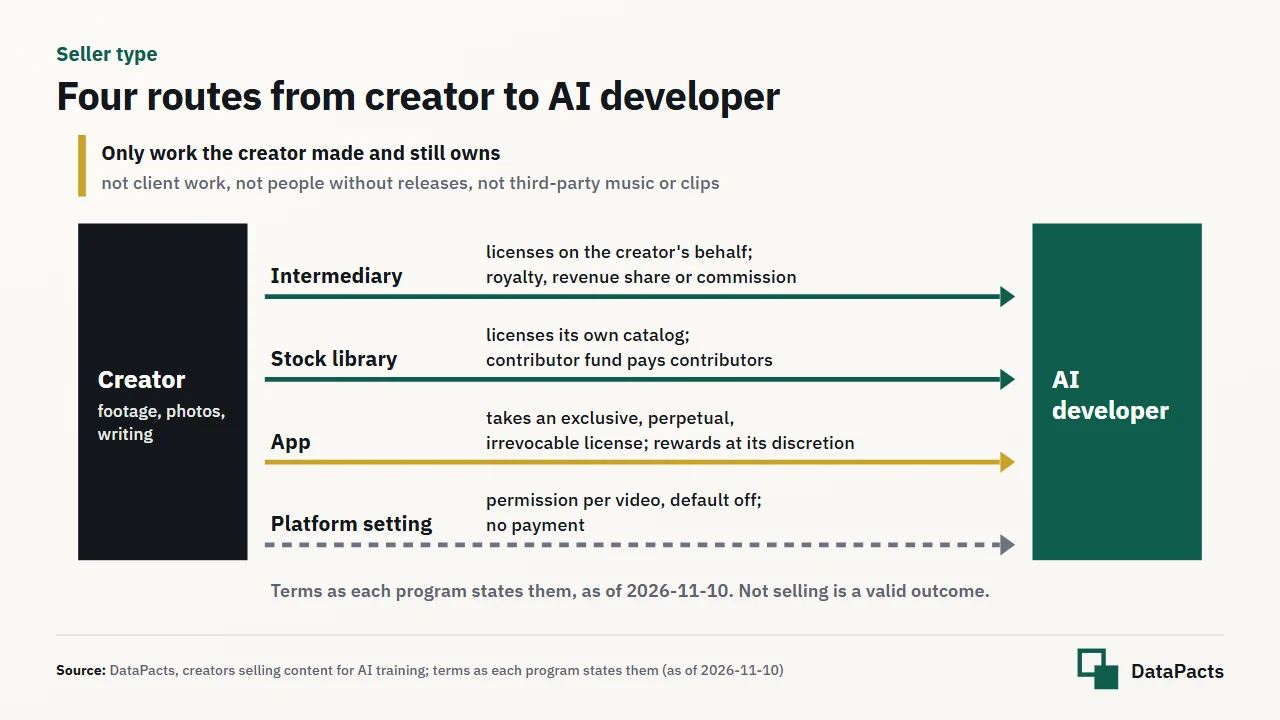
Troveo states a royalty each time video is used, and Wirestock states a 50 % commission per license (both checked 2026-11-09). No program publishes an average payout, and Troveo's own pages give two different paid-out totals, USD 50 million and USD 20 million (checked 2026-11-09).
A creator can license only work the creator made and still owns, which leaves out client work, other people's music and people without releases. Not selling is a valid outcome within the wider field of AI training data licensing.
What a Creator Can License: Footage, Photos and Writing They Own
A creator can license only work they made and still hold the rights to, which for most creators means original footage, photos and illustrations, and long-form writing. Three kinds of asset appear in program terms:
- Footage: raw, edited, aerial and interview video; Troveo prefers 1080p or 4K.
- Photos and illustrations: including vector and 3D.
- Writing: long-form text, books and courses, not short articles alone.
Programs ask for volume: Mercor's listings of 2026-10-17 ask a video studio for 100+ hours. Image catalogs are covered under selling photos and images for AI training.
Programs That License Creators' Work, and the Terms Each States
Most programs that take creators' work are intermediaries that license it to AI developers on the creator's behalf, while stock libraries license their own catalogs and pay contributors from the proceeds. The table compares eleven programs and settings as of 2026-11-10, alphabetical, with each term the program's own statement checked 2026-11-09 unless noted.
| Program | Role | Work it takes | Pay as stated | License as stated | Source |
|---|---|---|---|---|---|
| Created by Humans author AI rights licensing | rights platform, intermediary | books, opt in per use | not published; dashboard tracking | training, reference and transformative rights | createdbyhumans.ai |
| Credtent content licensing | licensing platform, intermediary | catalogs of rights holders | 85 % to creatives and rights holders under standard terms, quarterly | annual training fee plus revenue share; free opt-out notice | credtent.org |
| Getty Images contributor compensation | library licensing its own catalog | contributor images and video | "compensate creators on a recurring basis"; no rate published | not published | Getty 10-K FY2025 |
| Kled app | app, licensee (Nitrility, Inc.) | photos, video, music, transcriptions | rewards in fiat at its discretion or tokens, no guaranteed value | exclusive for AI, perpetual, irrevocable; re-read 2026-11-10 | kled.ai terms |
| Mercor publisher and video studio listings | company data program, licensee | long-form text, courses, video; owned footage with releases | USD 35,000 to 370,000 (publisher); USD 95,000 to 870,000 (video studio) per company | not stated in the listings | Mercor listings API |
| Newsflare AI Licensing | intermediary (NEWSFLARE LIMITED) | uploaders' video | 50:50 revenue share, monthly cycle | exclusive for AI licensing; 90-day minimum; deletion 30 days after request | learn.newsflare.com |
| ProRata attribution | attribution platform, intermediary | content for AI answers | "depends on the relevant rights, licenses, and commercial agreements" | "never used for model training" | prorata.ai |
| Shutterstock Contributor Fund | library licensing its own catalog | contributor images, video, metadata | compensation where contributor IP was used; first data-deal earnings Q4 2022 | not stated on the page | submit.shutterstock.com |
| Troveo content owner licensing | intermediary | video catalogs and libraries | royalty each time content is used; no public price sheet | owner keeps ownership; private licensing under NDAs; exclusivity not stated on the page | troveo.ai |
| Wirestock projects | intermediary (WIRESTOCK INC.) | photos, video, illustrations, vector, 3D | 50 % commission per license; fixed payment per approved asset | not described on the page | wirestock.io |
| YouTube third-party training setting | platform setting, no license fee | public videos | none: YouTube "isn't facilitating payments" | permission per video; default off; all applicable rights holders must allow | support.google.com |
Eleven programs and settings, as each states its terms; no row is a recommendation.
Video Creators: Royalties per Use and Revenue Shares
Video creators license footage mainly through Troveo, which states a royalty each time content is used, and Newsflare, which states a 50:50 revenue share on AI licensing. Troveo publishes no price sheet and licenses to labs under NDAs; Newsflare pays the creator's portion within 30 days from AI clients' usage reports.
Mercor lists a video studio program for companies of 5 to 500 employees at USD 95,000 to 870,000, which "depends on hours and rights" (checked 2026-11-09). Footage types, pricing structures and deals are owned by selling video for AI training.
Photo and Illustration Creators: Commissions and Contributor Funds
Photographers and illustrators reach AI developers through commission platforms such as Wirestock or through the contributor funds of the stock libraries that hold their work. Two library funds are on record:
- Getty Images: compensates creators "on a recurring basis" per its annual report, with no rate published.
- Shutterstock Contributor Fund: compensates contributors whose IP was used, announced 2022-10-25.
Adobe's contributor terms are not stated here. Contributor funds are owned by stock photo and footage libraries licensing to AI.
Writers and Authors: Opt-in Rights Platforms and Company Listings
Writers license mainly through rights platforms where the author opts in per use, while company listings ask for catalogs of long-form text that individual writers rarely hold. Created by Humans offers training, reference and transformative rights with payout not published, and Credtent states 85 % under standard terms, paid quarterly (checked 2026-11-09).
Mercor's publisher listing states USD 35,000 to 370,000 for companies of 10 to 500 employees (checked 2026-11-09), and ProRata says attribution content is "never used for model training".
What Creators Are Paid: Dated Claims and a Contradiction
No program publishes an average or median payout to creators, so every figure is the program's own claim on the date it was checked (2026-11-09). The claims on record, alphabetical:
- Getty Images: over USD 220 million in royalties to contributors in 2025 across all products, not AI alone, to more than 600,000 contributors (10-K for FY2025).
- Kled: rewards at its discretion with no guaranteed value; Kled states its highest earner at USD 7,400 a month, one account (checked 2026-11-09).
- Newsflare: 50:50 revenue share on AI licensing.
- Troveo: USD 50 million+ "to creators globally" on one page and USD 20 million+ "Paid to Licensors" on another (checked 2026-11-09); neither total is merged.
- Wirestock: 50 % commission per license, and fixed payments per approved asset.
A claimed total is not a per-creator payout. See reported payouts to data sellers for how advertised and confirmed amounts differ.
Rights a Creator Must Hold Before Licensing
A creator can grant only the rights they hold, and three kinds of material break that chain: work made for clients, identifiable people, and anything licensed in from others.
Client Work, Commissions and Work Made for Hire
Work a creator made as an employee, or under a signed work-for-hire agreement in a listed category, belongs to the employer or client in the United States, so the creator cannot license it.
Under 17 U.S.C. 201(b), the employer or commissioning party is the author unless a signed instrument says otherwise, and 17 U.S.C. 101 covers employee work and nine commissioned categories. In the United Kingdom, section 11(2) of the Copyright, Designs and Patents Act 1988 makes the employer first owner of employee work, subject to agreement.
Troveo excludes client-owned work, and Mercor asks for "original footage the company owns". A rights audit sorts owned from client work.
People on Camera: Likeness, Releases and Biometrics
Footage and photos of identifiable people need the people's permission as well as the creator's, so programs ask for appearance or model releases and exclude talent-restricted clips. Mercor's video listing asks for appearance releases and its photo listing for model and usage releases. Three instruments apply:
- Tennessee ELVIS Act: Public Chapter No. 588, in force 2024-07-01, covers likeness, voice and image.
- Illinois BIPA: 740 ILCS 14/15(b) requires written notice and a written release before biometric identifiers are collected, and 14/15(c) bars selling them.
- NO FAKES Act of 2026: S. 4591, placed on the Senate Legislative Calendar on 2026-06-24, with no later action as of 2026-11-09; a bill, not law.
The detail sits under voice and likeness rights in AI training data.
Music, Stock Clips and Other Third-Party Material
A soundtrack, a stock clip or an image licensed from someone else stays that person's property, so programs exclude unlicensed music and third-party clips from what a creator can submit. Mercor's listings name downloaded or third-party clips, non-commercial or no-derivatives licenses, stock or licensed imagery and images without usage rights as not a fit.
Whether a stock or music license bought for a video also covers AI training depends on the license text, and no general rule is stated here; the license should be read, or the music removed, before footage is offered.
Exclusivity, Duration and Withdrawal in Creator Licenses
Creator programs range from an exclusive, perpetual and irrevocable license to arrangements where the creator keeps ownership, and several do not publish their scope at all. Four programs show the range:
- Kled: a transferable, fully sublicensable, perpetual and irrevocable license, exclusive for training third-party AI; Kled "may, but is not obligated to" delete content on account deletion.
- Newsflare: exclusive to Newsflare for AI licensing, 90 days minimum after upload, deletion 30 days after a request.
- Troveo: the owner keeps ownership and exclusivity is not stated on the program page, while a Troveo article of 2026-07-25 says 95 % of licensors signed exclusively.
- Wirestock: license scope is not described.
Where a program states no exclusivity or term, the written agreement decides. See exclusive vs non-exclusive data licenses for price, lock-in and carve-outs.
When a Creator Does Not Sell: Platform Settings and Lawsuits
Not selling leaves a creator's published work exposed to platform settings and to scraping, and creators have answered with opt-out settings and lawsuits rather than licenses. YouTube's third-party training setting shows the limits (checked 2026-11-09):
- It is off by default.
- All applicable rights holders on the video must allow it, and the video must be public.
- YouTube "isn't facilitating payments between third-party companies and creators or other rights holders at this time".
Other switches are covered under opting out of AI training through platform settings. Creators have also sued in two cases:
- Kneschke v. LAION: a photographer sued over a photograph copied to build LAION-5B; LG Hamburg 310 O 227/23 gave judgment on 2024-09-27, OLG Hamburg 5 U 104/24 dismissed the appeal on 2025-12-10, and the Federal Court of Justice (I ZR 281/25) heard the case on 2026-09-03 with pronouncement scheduled for 2026-12-17 (as of 2026-11-09).
- Millette v. OpenAI: N.D. Cal. 5:24-cv-04710, a putative class of YouTube creators over the use of video transcripts, a member of MDL No. 3143 and pending as of 2026-11-09.
The full tracker is AI copyright lawsuits over training data.
Benefits, Risks, Downsides and Alternatives for Creators, Including Not Selling
Licensing a catalog can earn from work that already sits unused, but it can give away rights for good, and not selling is a valid outcome.
Benefits
- Existing work can earn without new production.
- Some programs let the owner keep ownership (Troveo) or share revenue (Newsflare).
- A royalty per use ties pay to use.
Risks
- An exclusive, perpetual, irrevocable grant such as Kled's cannot be undone.
- An intermediary or library can fail: Getty Images filed Chapter 11 on 2026-10-21 (Bankr. D. Del. 26-11643) with contributors paid in the ordinary course per its first-day motions, as of 2026-11-09.
- Client work, third-party material or people without releases in a submission break the rights chain.
Downsides
- No average payout is published, so earnings cannot be forecast.
- Shutterstock's data, distribution and services revenue fell 76 % in Q3 2026 against Q3 2025, which its release ties to deal timing volatility in data licensing.
- Settings such as YouTube's carry no payment.
Alternatives
- Not selling at all.
- Keeping platform training settings off.
- Attribution-only licensing, as ProRata states.
- A collective license for AI training.
- A revenue share instead of a one-off fee.
Steps From Catalog Check to a Signed Creator License
A creator reaches a signed license in six steps, and the first three decide how much of the catalog can be offered.
- List what was made and for whom.
- Remove client work and anything under someone else's license.
- Check releases for every identifiable person, and clear or strip music.
- Decide exclusive or non-exclusive, and for how long.
- Compare written terms from more than one program on pay basis, exclusivity, deletion and refund clauses.
- Sign, keep a dated copy of the terms, and track usage reports.
If no terms suit, the alternatives to selling data to AI labs include not selling.
Where Creator Licensing Meets Stock Libraries, Artists, Books, Music and Tax
Creators sit beside individuals selling their own files, stock libraries, visual artists, authors and musicians, and each of those sellers has its own page. A comparison of every type of seller sits in one place.
Own files and device data belong under individuals selling their own data, authors with whole books under book publishers and authors licensing books, and illustration and fine art under visual artists and illustrators.
License income is taxable. For US payers, the information return threshold is USD 2,000 a year for payments after 2025-12-31 under 26 U.S.C. 6041(a) as amended, and income below it stays taxable. See tax on data licensing income and tax on selling your own data.
- Musicians, labels and publishers licensing music
- Copyright and AI training across jurisdictions
- AI data licensing agreements
- AI training data marketplaces
- AI training jobs and platforms
This page is information, not legal or tax advice.
Program, Deal and Case Pages Named on This Page
Each program, deal and case above has or will have its own page with terms, dates and sources.
- Programs: Getty Images data licensing profile, Kled, Mercor data buyer profile, Newsflare, ProRata, Shutterstock data licensing profile, Troveo, Wirestock, Troveo vs Protege
- Deals and topics: Getty Images AI licensing deals, consent and compensation for creators, video and photo production studios
- Cases: Getty Images v. Stability AI (UK), Kneschke v. LAION, In re OpenAI Copyright Infringement Litigation
Frequently Asked Questions
How much do AI companies pay creators for content?
No program publishes an average payout; the figures on record are each program's own rates and totals. Examples are Wirestock's 50 % commission and Troveo's two different paid-out totals. See what data is worth to AI companies.
Does YouTube pay creators who allow AI training?
No: YouTube's third-party training setting is off by default, and YouTube states it is not facilitating payments between third-party companies and creators. The setting is a permission, not a license fee.
Is selling content for AI training the same as an AI training job?
No: a creator licenses work already made, while AI training jobs pay for tasks such as rating, writing or recording to a brief. The two differ in what is paid for. Job platforms are covered under human data for AI.