Mercor states a deal range of USD 30,000 to 800,000 for brands and studios, and Wirestock a 50 % commission per license (both checked November 9, 2026).
This page sets out, for photos in AI training data licensing, who acquires images, who only handles them, the stated terms, the filings on record and the rights to clear first. Not licensing is a valid outcome.
The DataPacts Editorial Team explains how we source, date and check every figure.
Can You Sell Photos and Images for AI Training?
Yes, if the seller owns the images or holds the rights to license them, and the people, property and other works in them are cleared; most programs take a license, not ownership. Holders range from brands and studios to libraries and photographers.
Demand is large: SpaceXAI's Grok 4.7 training content summary (September 21, 2026) states more than 1 billion images in training data. Marketing photos only are not a fit for Mercor's construction listing (checked November 9, 2026).
The full list of data types AI companies buy shows where images sit among the others.
What Image Collections AI Developers Ask For
AI developers ask for original, high-resolution images grouped in a way that explains them, such as product and campaign shoots, project site photos and curated catalogs, with releases and usage rights attached.
The table compares the images each acquirer lists and what it requires or excludes, as of November 10, 2026 (terms checked November 9, 2026).
| Acquirer (role) | Images it asks for | Stated requirement or exclusion | Source |
|---|---|---|---|
| Bria AI (developer) | licensed visual assets | identifier per asset: source, creator, license | bria.ai |
| Defined.ai (marketplace) | image datasets among other types | no exclusivity, no minimums | defined.ai |
| HUMXN (marketplace) | technician and construction site photos, with company records | company must own the data | humxn.io |
| Kled (app) | individuals' photos and media | exclusive license to Kled for AI uses | kled.ai |
| Mercor, photo studio listing (program) | owned high-resolution images grouped by product or campaign; thousands | model and usage releases; not a fit: stock or licensed imagery, images without usage rights | Mercor listing feed |
| Mercor, construction listing (program) | site photos, video or drone imagery tied to projects | 50+ employees; not a fit: marketing photos only | Mercor listing feed |
| Shutterstock (library) | contributor images, video and metadata | its own contributors | submit.shutterstock.com |
| Wirestock (creator platform) | photos, illustrations, vector, 3D, video | creators upload once | wirestock.io |
The two listings differ in scope, and both are set out in the Mercor data buyer profile.
Who Acquires Images, and Who Only Handles Them
Images reach AI developers through four kinds of companies: developers licensing for their own models, company data programs, marketplaces and creator platforms that license on the holder's behalf, and libraries that license their own catalogs.
Defined.ai, HUMXN, PIXTA AI and Wirestock handle images and license them on the holder's behalf; they do not buy them.
The table lists each company's role for images as of November 10, 2026.
| Company | Role for images | What it acquires or handles |
|---|---|---|
| Bria AI | developer licensing for its own models | states it trains only on licensed data from partners including Getty Images, Alamy and Envato |
| Mercor (Mercor.io Corporation) | company data program | owned brand, studio and site photos |
| Defined.ai (DefinedCrowd Corporation) | marketplace, licenses on suppliers' behalf | image datasets |
| HUMXN | marketplace, licenses on companies' behalf | company records including photos |
| Kled AI (Nitrility, Inc.) | app, takes an exclusive license and licenses on | individuals' photos and media |
| PIXTA AI (PIXTA Inc.) | data vendor and marketplace | datasets from third-party providers |
| Wirestock (WIRESTOCK INC.) | creator platform, licenses creators' assets | photos, illustrations, 3D, video |
| Getty Images (Getty Images Holdings, Inc.) | library, licenses its own catalog | data access and licensing |
| Shutterstock, Inc. | library, licenses its own catalog | contributor images and metadata |
Photographers and illustrators have their own routes, set out for creators selling content for AI training.
Image Licensing Terms by Program: Pay, Exclusivity and Withdrawal
Image programs differ most on three terms: how the holder is paid, whether the license is exclusive, and whether images can be withdrawn once delivered.
Kled states an exclusive, perpetual, irrevocable license and no duty to delete (checked November 9, 2026). Defined.ai's FAQ calls its customer license perpetual, while its data license agreement s.8(a) says until terminated; both are stated.
The table compares pay, scope and withdrawal terms for nine programs as of November 10, 2026. Other data types are in the program terms compared, dated.
| Program | Pay basis (stated by the program) | License scope and exclusivity | Withdrawal or deletion | Source |
|---|---|---|---|---|
| Bria data partner program | ongoing compensation for works above relevance thresholds, tied to influence; no rate | not published | not published | bria.ai |
| Defined.ai Supplier Program | no revenue share published | no exclusivity, no minimums (s.3.5) | FAQ "perpetual" vs DLA s.8(a) "until terminated" | defined.ai |
| Getty Images contributor compensation | "on a recurring basis" for training use; no rate | contributor agreements, not published | not published | Getty 10-K FY2025 |
| HUMXN company data licensing | per license; exclusive pays more up front | non-exclusive or exclusive; company never named | not stated | humxn.io |
| Kled app | fiat at Kled's discretion or tokens such as SOL; refund if grant invalidated | worldwide, perpetual, irrevocable, sublicensable; exclusive for training third-party AI | "may but is not obligated to" delete | kled.ai/terms-of-service |
| Mercor photo studio listing | deal range, depends on archive size and rights | owned images with releases | not stated | Mercor listing feed |
| PIXTA AI | listing, referral and other fees per separate form; no rate | per the form | not stated | pixta.ai/term |
| Shutterstock Contributor Fund | compensation where contributor IP was used; first earnings Q4 2022 | not stated | not stated | submit.shutterstock.com |
| Wirestock | 50 % commission per license; fixed payments per approved asset | not described | not described | wirestock.io |
How Image Deals Are Priced: Deal Ranges, Commissions and Per-Image Rates
No public rate card exists for licensed photos; the figures on record are a few acquirers' stated ranges, splits and list prices, each tied to one structure.
Four structures appear, each as stated by the program on November 9, 2026:
- Deal range: Mercor states USD 30,000 to 800,000, depending on archive size and rights.
- Commission: Wirestock states 50 % per license.
- Pay tied to use: Bria and Getty state recurring compensation to creators, without a rate.
- List price: Bee Maps lists USD 0.005 per street-level image, a vendor's own price (checked November 9, 2026).
HUMXN states that single-company deals start at USD 250,000, across all data types (checked November 9, 2026). Price points for every other data type are collected on the page of AI training data prices per work, hour, image.
The figures are not averaged or converted to a per-image rate, because the units differ.
Image Deals, Filings and Training Summaries on Record
Few image deals publish terms: Getty's two AI licenses on record are display licenses with no value disclosed, and the listed libraries report AI licensing inside wider revenue lines.
Shutterstock's 10-K reports Data, Distribution, and Services revenue of USD 203.264 million for fiscal 2025, with no AI-only line.
Its 10-Q for the quarter ended September 30, 2026 reports USD 15.823 million against USD 65.668 million a year earlier, and USD 33.2 million of unsatisfied obligations, primarily data deals; the quarter is not a full-year figure.
SpaceXAI's Grok 4.7 summary declares commercial licenses with rightsholders for text and image only. The template, set out on the AI Act training data summary page, asks only for Yes or No plus the modality.
Getty's 10-K for fiscal 2025 reports "Other" revenue, which includes data access and licensing among other lines, at 5.6 % of revenue (4.3 % in 2024); it is not an AI-only figure. Its Perplexity and OpenAI licenses are display licenses whose training use is not stated.
The table compares six records as of November 10, 2026.
| Parties or filer | Date | What was licensed or reported | Value on record | Source |
|---|---|---|---|---|
| Getty Images Holdings, Inc. and Perplexity, see Getty Images AI licensing deals | 2025-10-31 | multi-year display license for AI search | not disclosed | Getty newsroom |
| Getty Images Holdings, Inc. and OpenAI | 2026-06-21 | multi-year display license, ChatGPT search; training not stated | not disclosed | Getty 8-K Ex. 99.1 |
| Shutterstock, Inc. and OpenAI, see Shutterstock AI licensing deals | 2022-10-25 (expansion announced) | images and metadata for training datasets | not disclosed | Shutterstock FAQ |
| Shutterstock 10-K, see AI data licensing revenue | FY2025 | DD&S revenue, includes metadata licensing for AI training | USD 203.264 million; no AI-only line | SEC |
| Shutterstock 10-Q | Q3 2026 | DD&S revenue; unsatisfied obligations primarily data deals | USD 15.823 million vs 65.668 million; USD 33.2 million unsatisfied | SEC |
| Getty 10-K | FY2025 | "Other" revenue incl. data access and licensing | 5.6 % of revenue (4.3 % in 2024) | SEC |
Captions, Metadata and Provenance: What Makes an Image Archive Worth More
An image teaches a model little without text that says what it shows, so acquirers license images together with captions, keywords and records of where each image came from.
Shutterstock's contributor FAQ lists images, video and metadata among the content its data deals cover.
Bria states that each asset carries an identifier linking it to its source, creator and license (checked November 9, 2026).
LAION-5B, published March 31, 2022, shows the other extreme: 5.85 billion image-text pairs that are links, captions and metadata, not the images, which stay under their own copyright. Contents and legal status are on the page for LAION-5B and Re-LAION-5B.
No filing or license on record states a per-image rate or a caption premium.
Clearing Images Before You License Them
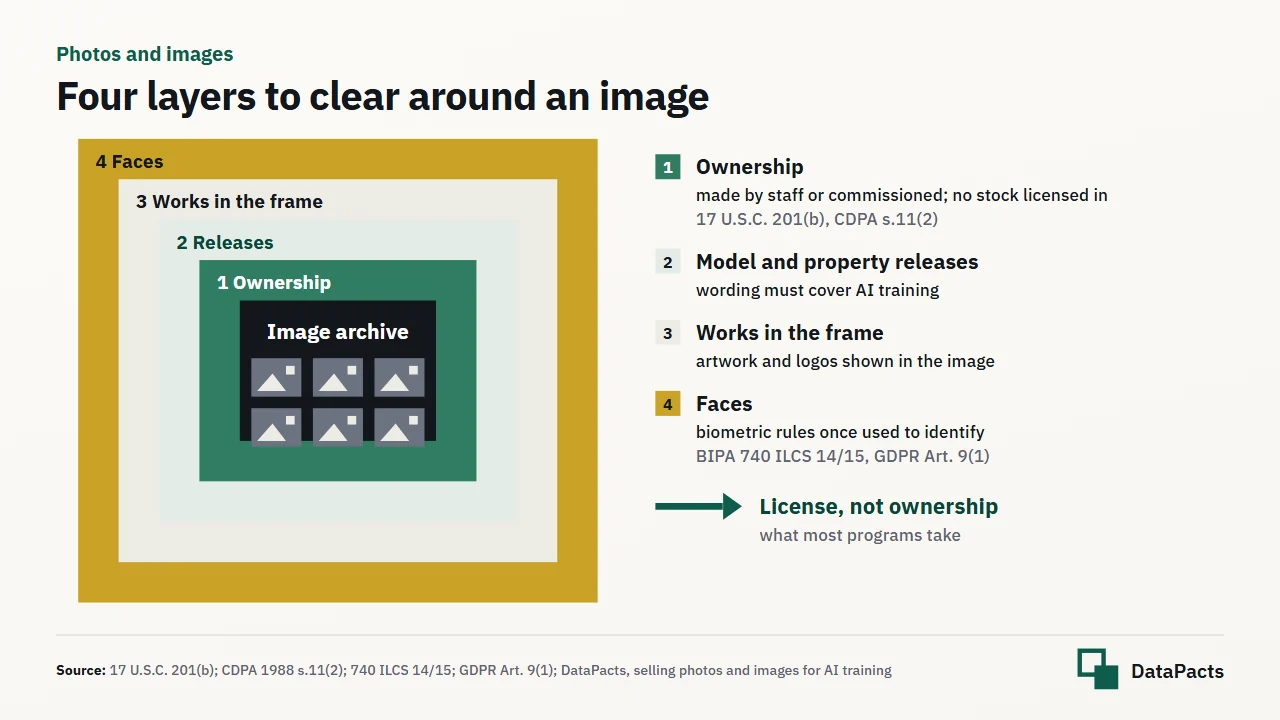
Images are cleared on three fronts before an acquirer sees a sample: ownership, the people and works in the frame, and biometric rules for faces. This section is information, not legal advice.
Ownership: Staff Photos, Commissioned Shoots and Images Licensed In
Only images the seller made or holds licensing rights to can be licensed, which excludes stock licensed in for marketing and images without usage rights. Mercor lists both as not a fit.
Under 17 U.S.C. 201(b), the employer or commissioning party is the author of a work made for hire unless a signed instrument says otherwise. Under CDPA 1988 s.11(2) in the UK, the employer is first owner of an artistic work or film made by an employee in the course of employment, subject to agreement.
Each image is checked in a rights audit of the image archive before licensing, recording who made it and under what contract.
Model Releases, Property Releases and Works Shown in the Frame
Images of identifiable people call for model releases that cover AI training, and acquirers say so: Mercor states it wants original images with model and usage releases (checked November 9, 2026).
Whether an older release covers AI training depends on its wording, so the seller checks it against the intended use. The same check applies to property releases and to works shown in the frame, such as artwork and logos.
A person's likeness is also covered under voice and likeness rights in AI training data.
Faces in Photos: Biometric Rules in Illinois, the EU, Virginia and Texas
A face in a photo becomes regulated biometric data once it is used to identify someone, and the rules differ by state and country:
- Illinois: BIPA, 740 ILCS 14/15(b), requires written notice and release before collecting, purchasing or receiving biometric identifiers, and 15(c) bars selling or profiting from them; liquidated damages are USD 1,000 (negligent) or USD 5,000 (intentional or reckless) per violation, and since August 2, 2024 (Public Act 103-0769) repeated collection from one person by one method counts as one violation.
- EU: GDPR Art. 9(1) (applies from May 25, 2018) makes biometric data used to identify a person special-category data, needing an Art. 9(2) exception and an Art. 6 basis.
- Virginia: Va. Code 59.1-575 excludes a physical or digital photograph, a video or audio recording "or data generated therefrom" from biometric data, as well as HIPAA treatment, payment or operations data (in force January 1, 2023; checked 2026-11-16).
- Texas: CUBI as amended by HB 149 (in force January 1, 2026) exempts biometric identifiers used to train AI unless the system identifies a specific individual.
The release and sale rules are set out in Illinois BIPA and AI training data; the cases below include BIPA claims over scraped faces.
Under 28 CFR Part 202 (effective April 8, 2025), biometric identifiers of more than 1,000 US persons are bulk sensitive data, and sales to countries of concern are prohibited.
What Lawsuits Over Scraped and Unlicensed Images Allege
The image cases on record turn on three questions: whether training copies infringe, whether a trained model is itself an infringing copy, and whether faces may be collected without consent.
The table compares eight matters as of November 9, 2026. Pending cases are stated as allegations.
| Case | Court and docket | Alleged or decided | Status | Source |
|---|---|---|---|---|
| Andersen v. Stability AI | N.D. Cal. 3:23-cv-00201-WHO | artists allege infringement via LAION-based training; copyright claims survived 2024-08-12 | discovery | Dkt. 223 |
| EVOX v. Stanford | N.D. Cal. 5:24-cv-09521-NW | vehicle images in a research dataset | past pleadings | Dkt. 90 |
| Everalbum (FTC) | File No. 192-3172 | delete models built from users' photos | final 2021-05-07 | FTC |
| Getty v. Stability AI (UK) | IL-2023-000007; CA-2026-000007 | training claim abandoned; model not an infringing copy; trade mark infringement in part | appeal part heard 2026-11-11, judgment reserved 2026-11-12 (Court of Appeal case tracker, checked 2026-11-16) | [2025] EWHC 2863 (Ch) |
| Getty v. Stability AI (US) | N.D. Cal. 3:25-cv-06891-TLT | copyright and trade mark claims over training on Getty images | stayed until 2027-01-13 (checked 2026-11-16); trial had been set for 2028-01-18 | Dkt. 81; Dkt. 74 |
| In re Clearview AI | N.D. Ill. 1:21-cv-00135; 7th Cir. 25-1673 | BIPA claims over scraped face images | approval vacated, remanded 2026-07-13 | 7th Cir. Doc. 69 |
| Kneschke v. LAION | LG/OLG Hamburg; BGH I ZR 281/25 | photographer v. dataset builder; appeal dismissed 2025-12-10 | BGH ruling scheduled 2026-12-17 | bundesgerichtshof.de |
| Vance v. IBM | N.D. Ill. 1:20-cv-00577 | BIPA claims over a face dataset from Flickr photos; dismissal largely denied 2020-09-15 | later status not recorded | govinfo.gov |
In the UK case the training claim was abandoned for lack of evidence of UK training, and the appeal was heard in November 2026 with judgment reserved on 2026-11-12.
Licensing Images: Benefits, Risks, Downsides and Alternatives, Including Not Licensing
Licensing an image archive can earn from shoots that already sit unused, but delivered images usually cannot be recalled and a trained model cannot be untrained.
Benefits:
- Unused shoots can earn a fee, as in Mercor's stated deal range.
- A commission continues with use, as in Wirestock's 50 % per license.
- Getty's 10-K describes recurring compensation to creators.
Risks:
- Delivered images usually cannot be recalled; Kled may but is not obligated to delete, so the deletion, return and machine unlearning clauses matter.
- Faces bring biometric exposure, including BIPA's liquidated damages.
- Library data revenue moves with deal timing, as Shutterstock's third quarter shows.
Downsides:
- Kled's exclusive license keeps the images from other AI licensing.
- No rate card is on record, so the price is negotiated without a public benchmark.
Alternatives:
- Grant a non-exclusive license, as Defined.ai and HUMXN allow.
- License a sample or a share of the archive.
- Seek attribution-based pay, as Bria describes.
- Not license at all, as set out in the decision page on whether to sell or license your data.
Neighboring Image Types, Creator and Stock Routes, and the Seller Steps for Images
Images on this page means still photos and illustrations a company or library already holds; video, aerial imagery, medical scans and design files have their own pages.
Neighboring pages:
- Selling video for AI training
- Geospatial and drone imagery: Bee Maps lists USD 0.005 per street-level image (checked November 9, 2026)
- Medical imaging data
- Design files as AI training data
- Stock photo libraries licensing to AI
- Visual artists and illustrators
- Photo production studios
- Biometric data in AI training
How intermediaries charge and pay is compared on AI training data marketplaces. See licensed vs scraped training data and the tracker of AI copyright lawsuits over training data.
Images of people in the EU fall under GDPR and AI training data, face data sold abroad under the DOJ bulk sensitive data rule, and other countries under AI training data law by jurisdiction.
Seller steps for images:
- Read how to sell or license company data for the whole process.
- Describe the archive in a data manifest.
- Blur or remove faces where needed, covered under de-identification before licensing.
- Agree the license, clause by clause, using AI data licensing agreements.
- Check how payment works, covered under when AI data buyers pay.
Frequently Asked Questions
How much do AI companies pay for photos?
No public rate card exists, and the stated figures cover different structures. Mercor states a deal range of USD 30,000 to 800,000 for brands and studios and Wirestock a 50 % commission per license (checked November 9, 2026). See what company data is worth to AI companies.
Can an individual sell their own photos for AI training?
Yes, through apps and creator platforms, under their terms. Kled, for example, takes an exclusive, perpetual, irrevocable license (checked November 9, 2026). See individuals selling their own data.
Do I need model releases to license photos for AI training?
Programs that state a requirement ask for model and usage releases, and faces add biometric rules. Mercor states the releases requirement (checked November 9, 2026), and Illinois BIPA, 740 ILCS 14/15(b), requires written notice and release before biometric identifiers are collected.
Can I keep my published photos out of AI training without selling them?
Settings and opt-outs exist but pay nothing. LAION-5B was built from links to public images. The limits are covered in opting out of AI training.
Advisers and agents can use the introducer form.