Universal Music Group and Warner Music Group settled with Udio, Warner settled with Suno, and no label has disclosed what any AI company pays.
Music is one of the most litigated corners of AI training data licensing, and the deal terms on file are thinner than the court record.
Which Music Rights an AI License Covers: Recordings, Compositions and Artist Identity
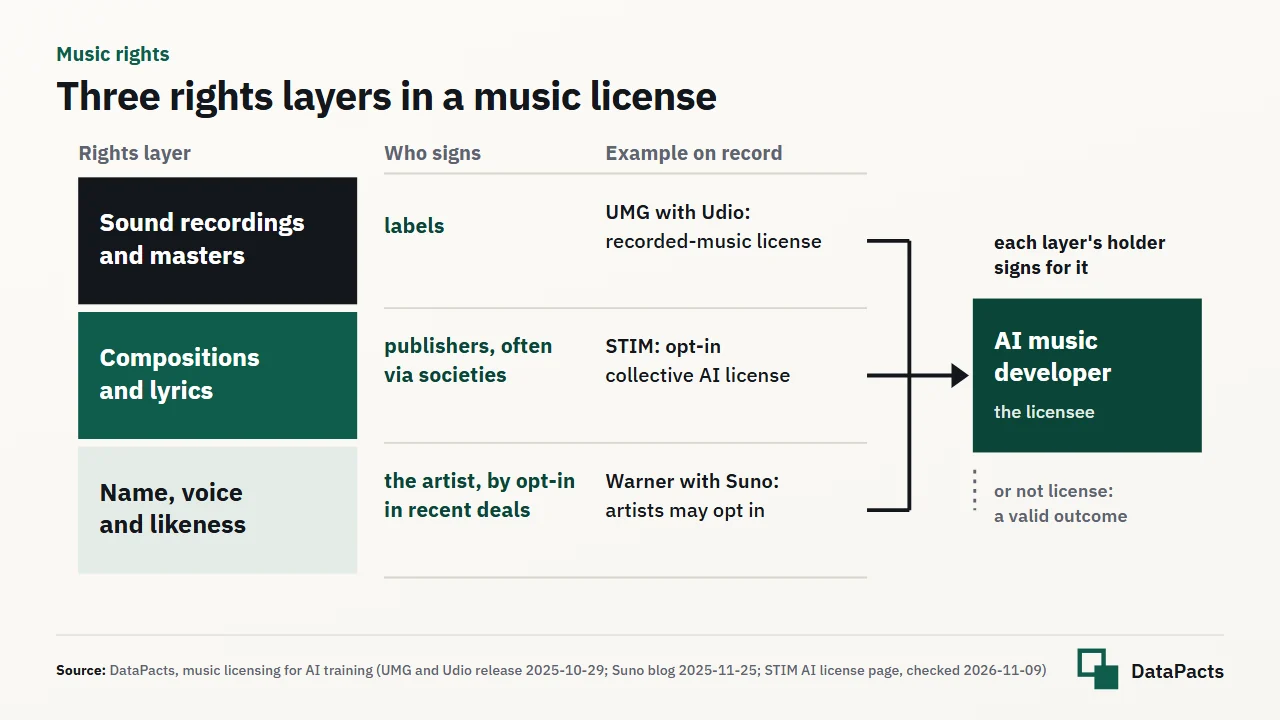
An AI music license can cover three separate layers of rights, and each layer has a different holder who must sign. The layers are:
- Sound recordings and masters, held by labels.
- Compositions and lyrics, held by publishers and often administered by societies.
- Artist names, voices and likenesses, which recent deals make subject to the artist's opt-in.
Universal's Udio release describes recorded-music and publishing licenses as two grants. The data-type view of the same material is covered under music as AI training data.
How Labels Moved From Suing AI Music Companies to Licensing Them
Seven label agreements with AI music companies are on record from October 2025 to September 2026, and none discloses a value.
| Date | Label | AI company | What the parties state | Use | Source |
|---|---|---|---|---|---|
| 2025-10-29 | Universal Music Group | Udio (Uncharted Labs, Inc.) | Settlement of copyright litigation plus recorded-music and publishing licenses; platform trained on authorized and licensed music | T | UMG release |
| 2025-10-30 | Universal Music Group | Stability AI | Strategic alliance to co-develop professional AI creation tools | P | Stability AI newsroom |
| 2025-11 | Warner Music Group | Klay Vision Inc. | Agreement on variable economics | P | WMG 8-K exhibit |
| 2025-11-19 | Warner Music Group | Stability AI | Responsible AI tools; variable economics | P | Stability AI newsroom |
| 2025-11 (letter 2025-11-25) | Warner Music Group | Udio (Uncharted Labs, Inc.) | Settlement of Warner's claims plus a license | P | S.D.N.Y. Dkt. 139 |
| 2025-11-25 | Warner Music Group | Suno, Inc. | New models using licensed music; artist opt-in; Warner's claims dismissed | T | Suno blog; D. Mass. Doc. 174 |
| 2026-09-10 | Universal Music Group | ElevenLabs (Eleven Labs Inc.) | Multi-year agreement; licensed AI music platform; personalized vocals from participating artists | P | UMG release |
As of 2026-11-10. Value: not disclosed in every row. T means the parties state training on licensed music; P means the parties name a product or tools and do not state training, which does not mean training is excluded. No Sony license with an AI music company is on record.
Udio and Suno: Settlements by UMG and Warner, While Sony Continues
Universal Music Group and Warner Music Group settled with Udio and took licenses, and Warner did the same with Suno, while Sony Music's claims against both companies continue as of November 2026.
Universal's release of October 29, 2025 says "the companies settled copyright infringement litigation" and describes a 2026 platform trained on authorized and licensed music. Warner's settlement with Udio reached the court as a letter filed on November 25, 2025 (Dkt. 139).
Suno announced the same day that its new models would use licensed music and that Warner artists could "opt in for the use of their names, images, likenesses, voices, and compositions," as re-read on 2026-11-10. Warner's claims against Suno were dismissed by stipulation (Doc. 174, letter of 2025-12-09), while Sony's and UMG's claims continue, so the label lawsuits have not ended; every label agreement is logged among AI data licensing deals.
Label Licenses Without a Lawsuit: Stability AI, Klay and ElevenLabs
Labels also license AI developers they never sued: Stability AI with UMG and Warner, Klay with Warner, and ElevenLabs with UMG. Warner's SEC exhibit lists Klay Vision Inc. among its AI agreements.
ElevenLabs announced on 2026-09-10 a multi-year agreement with UMG, its first with a major label. Stability stated on 2026-05-20 that Stable Audio 3.0 is "trained on fully licensed data"; that is Stability's claim, not a finding by any licensor.
What Labels Disclose About the Money
No label has published what an AI company pays it, and the most specific filed statement is Warner's that all of its AI deals rest on variable economics. Three statements are on record:
- Warner's 8-K exhibit of 2026-03-03 states "all of our deals are based on variable economics" and names its AI agreements with Suno, Udio, Stability AI and Klay.
- The same 2026-03-03 shareholder letter gives Suno's scale as seven million tracks per day and 2 million paying subscribers at USD 12.50 per month, which are Warner's statements, not Suno's.
- Stability states, on 2026-08-25, a Series B with Sony Music Group, UMG, WMG and Electronic Arts among the investors and total funding of USD 232M, an investment and not a license fee.
Variable economics is a pricing basis, not a rate, and no filing, court record or release gives a per-deal amount.
Suits Still Pending Against AI Developers Over Music
Labels, publishers and societies still litigate where no license was agreed: Sony against Udio and Suno, UMG against Suno, music publishers against Anthropic, and GEMA against OpenAI and Suno in Munich. The lyrics claims in music publishers v. Anthropic await a summary-judgment ruling in Concord I.
| Case | Court and docket | Filed | Status as of 2026-11-09 | Source |
|---|---|---|---|---|
| Concord Music Group, Inc. et al. v. Anthropic PBC (Concord I) | N.D. Cal. 5:24-cv-03811-EKL (from M.D. Tenn. 3:23-cv-01092) | 2023-10 | Summary-judgment ruling pending | Anthropic S-1/A |
| UMG Recordings, Inc. et al. v. Suno, Inc. | D. Mass. 1:24-cv-11611-FDS; second action 1:26-cv-14275 | 2024-06-24 | Discovery; Warner dismissed (Doc. 174); second UMG and Sony action over 60,202 recordings filed 2026-09-18 | Doc. 174 |
| Sony Music Entertainment et al. v. Uncharted Labs (Udio) | S.D.N.Y. 1:24-cv-04777-AKH; second Sony action 1:26-cv-06120-AKH | 2024-06-24 | UMG and Warner settled; Sony claims continue; conference 2026-12-11; second action (30,117 works) answered 2026-08-27 | Dkt. 190 |
| GEMA v. OpenAI | LG München I, 42 O 14139/24 | not recorded | Judgment 2025-11-11 largely for GEMA (9 lyrics); not final | Court press release 11/2025 |
| GEMA v. Suno | LG München I, 42 O 763/25 | 2025-01-21 | Judgment 2026-07-31 largely for GEMA (6 works); not final | Court press release 16/2026 |
Concord II (N.D. Cal. 5:26-cv-00880-EKL, filed 2026-01-28, 20,517 works alleged) is on the case page.
None of the US music cases has a merits ruling on training.
On 2025-11-11 the Munich Regional Court held in GEMA v. OpenAI that memorized lyrics are reproductions the text and data mining exception in § 44b UrhG does not cover. On 2026-07-31 it held in GEMA v.
Suno that training copies made in the US were governed by US law and were not fair use. Neither judgment is final, and both sit in the tracker of AI copyright lawsuits over training data.
Society Licenses From GEMA and STIM: Opt-in Catalogs and Royalty Points
Two European music societies offer AI developers a license on behalf of their members: GEMA through its PLAI training catalog and STIM through an opt-in collective AI license. Societies are licensors here, not buyers.
| Society | License | What is licensed | Consent model | Payment terms stated | Source |
|---|---|---|---|---|---|
| GEMA | PLAI by GEMA (AI licensing model offered since 2024-09, per GEMA) | ca. 57,000 works, ca. 178,000 audio files, 60+ genres; composition and master rights, metadata; delivered exclusively to each customer, per GEMA | Rights holders who contribute; more can be added | Contributors paid "anteilig und angemessen" (proportionately and appropriately); no figures or formula | gema.de |
| STIM | Collective AI license for music (from September 2025) | Training on included works; independent attribution technology required to trace outputs | Only explicitly opted-in works; from 2026-06-01 approval work by work or exclusion of the AI rights category | Fixed license fee plus a percentage of the AI service's income; royalties at training, use and when generated music is used; no rates; retraining needs a new license | stim.se |
As of 2026-11-09. Each value is the society's own statement.
GEMA delivers PLAI exclusively to each customer, so a contributing member cannot compare prices across licensees, while STIM ties payment to the AI service's income. STIM states a pilot with Songfox and Sureel. The wider field of societies is covered under collective licensing for AI training.
Artist Consent: Opt-in for Names, Voices and Works
Recent music licenses make the artist's own opt-in a condition for using their name, voice or works, rather than leaving it to the label alone. Three examples:
- Suno and Warner: artists may opt in for names, images, likenesses, voices and compositions (2025-11-25).
- ElevenLabs and UMG: personalized vocals come from participating artists (2026-09-10).
- STIM: from 2026-06-01 a member approves works for AI licensing one by one or excludes the AI rights category.
Whether an existing record or publishing contract already lets a label license an artist's voice or works for AI is not settled in any source on file, and the contract text decides.
Tennessee's ELVIS Act (Public Chapter 588 of 2024, in force 2024-07-01) protects voice, and the wider state laws are covered under voice and likeness rights in AI training data.
Who Can Sign for a Catalog
The party that owns or controls each layer of rights signs for it, and ownership follows employment, commission and the label or publishing contract.
Under 17 U.S.C. 201(b), the employer or commissioning party owns a work made for hire unless a signed written instrument says otherwise, and section 101 limits commissioned works to nine listed categories.
In the UK, section 11(2) of the Copyright, Designs and Patents Act 1988 makes the employer the first owner of a musical work made by an employee in the course of employment, subject to agreement.
Artist, producer and songwriter contracts decide the remaining cases, and a co-written song needs every controlling publisher to agree. A rights audit sorts controlled works from shared ones.
Benefits, Risks and Downsides of Licensing Music for AI, and the Options Besides It
Licensing music to AI developers can turn a dispute into recurring income, but the terms are undisclosed, grants can outlast the deal, and not licensing is a valid outcome.
Benefits
- A settlement with a license can end a lawsuit and start a revenue line.
- Income can run over the deal term; Warner states all its AI deals rest on variable economics.
- STIM pays royalties at training, use and output.
Risks
- Whether artist contracts permit AI licensing is unsettled.
- No published per-deal amount serves as a reference price.
- Retraining may need a new license, as STIM says.
Downsides
- Terms are not disclosed or filed, so offers cannot be benchmarked.
- GEMA's PLAI catalog is exclusive to each customer, and members cannot see the price.
- Suno's output volume, as Warner states it, is large next to any one catalog.
Alternatives
- Join a society license.
- Reserve text and data mining machine-readably (Directive 2019/790 Art. 4(3)).
- Sue where no license is agreed, as GEMA did in Munich.
- License directly to one developer.
- Not license at all, one of the alternatives to selling data to AI labs.
A reservation does not reach copies already made.
Steps From Catalog Audit to a Signed Music License
A rights holder reaches a signed music license in six steps, and the first two decide which works it can offer at all.
- List the recordings, compositions and lyrics the company controls.
- Check artist, producer and co-writer contracts and society mandates.
- Decide on training, output tools or both, and whether artists opt in.
- Set a machine-readable reservation for works not licensed.
- Compare written terms from more than one developer or a society: grant, term, attribution, retraining and payment basis.
- Sign, then monitor usage reports.
Clause detail for steps 5 and 6 is explained under AI data licensing agreements.
Where Music Licensing Meets Copyright Law, Voice Rights and Other Sellers
Whether a developer needs a music license at all depends on copyright exceptions that differ by country, and in the EU on a machine-readable reservation. The law is set out under copyright and AI training across jurisdictions.
Music rights holders are one entry among every type of seller, and news publishers and media and book publishers and authors face the same rights split.
- EU text and data mining exception: reserving works.
- Fair use and AI training: the US defense.
- Retraining and model retention rights: what happens after the term.
- Withholding tax on data license payments: royalties across borders.
- Selling your voice to AI: for singers and voice actors.
- Speech and audio data: non-music recordings.
This page is information, not legal advice.
Deal, Case and Buyer Pages Named on This Page
Each deal, case and AI music company above has or will have its own page with parties, dates and sources.
- Deals: Universal Music Group AI licensing deals, Warner Music Group AI licensing deals.
- Cases: GEMA v. OpenAI, GEMA v. Suno, Record labels v. Suno, Record labels v. Udio.
- AI music companies: ElevenLabs, Klay Vision, Suno, Udio.
- General-purpose developers: frontier AI labs as data buyers.
Frequently Asked Questions
Do AI music companies pay for the music they train on?
Some now do: Udio and Suno took licenses from Universal or Warner, and Udio's new platform is trained on authorized and licensed music, but the amounts are not disclosed. Amounts are the parties' claims. Advertised and confirmed figures are compared under reported payouts to data sellers.
How much do labels and publishers get paid for AI licenses?
No label, publisher or society has published a per-deal amount; Warner states only that its AI deals rest on variable economics, and STIM and GEMA publish no rates. Valuation is therefore a negotiation. The valuation guide explains what data is worth to AI companies.
Can a songwriter keep their works out of AI training?
A STIM member can exclude the AI rights category from STIM's administration, and in the EU a rights holder can reserve text and data mining in machine-readable form; neither removes copies already made.
Request an independent introduction
A label, publishing company or catalog that holds recordings or compositions it controls can ask for written terms to compare. DataPacts can make an independent introduction to buyers that match your data. Joining a society license, reserving your works or deciding not to license are valid outcomes.
New music deals arrive as deal tracker updates by email.
DataPacts Editorial Team: how we source, date and check every figure.