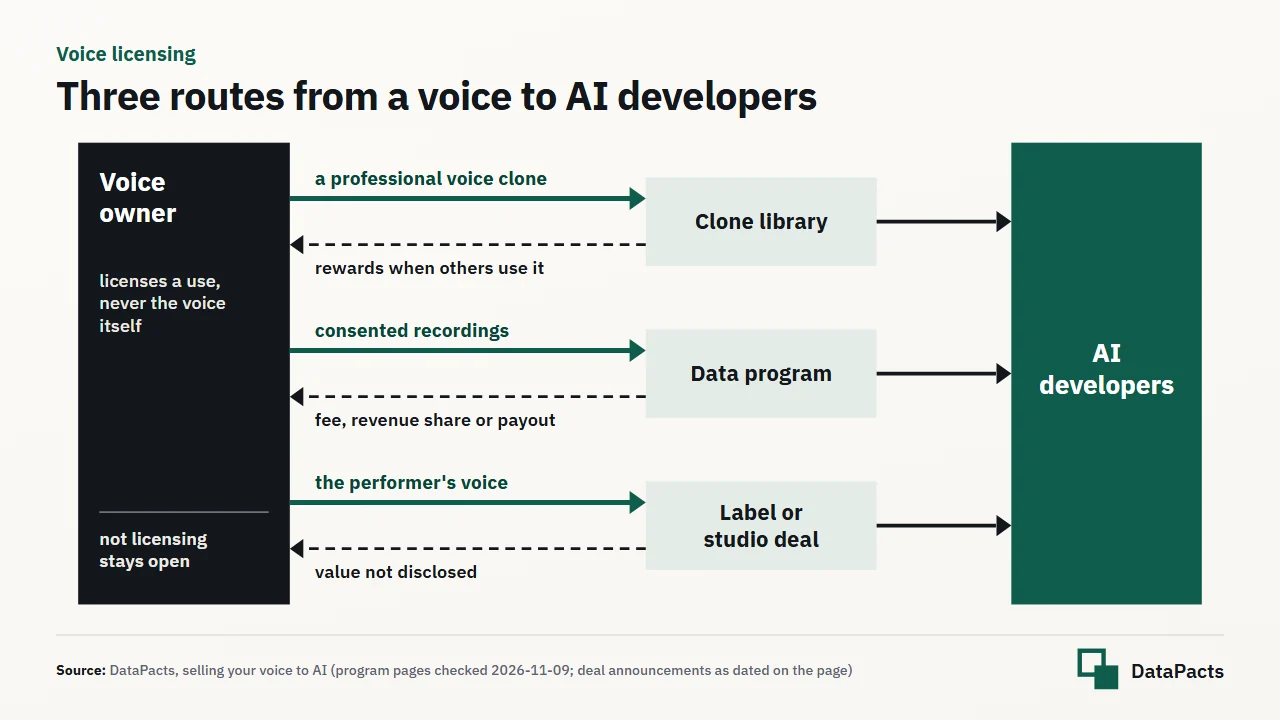
ElevenLabs states a notice period of 30 days to 2 years for voices shared in its Voice Library (checked November 9, 2026), and its only primary payout figure is a blog headline of USD 1 million in total Voice Library payouts across all owners (October 28, 2024).
This page covers voice in AI training data licensing: clones, consented recordings and artist deals.
The DataPacts Editorial Team explains how we source, date and check every figure.
Can You Sell Your Voice to an AI Company?
Yes: a voice can be licensed for AI use, most often as a voice clone shared in a library or as consented recordings delivered to a data program, but the license never transfers the voice, which several US states protect as part of the speaker's identity.
A voice AI developer pays clone owners when others use their clones, data programs require recorded consent before they take recordings, and labels license their artists' voices.
Voice is one of the data types AI companies buy, but it is tied to a person, so consent and likeness rules weigh more here than on most data pages.
Three Routes From a Voice to an AI Developer
A voice reaches AI developers by three routes: a clone library that pays the owner when others use the clone, data programs that collect or license consented recordings, and label or studio deals that license performers' voices.
The table compares six examples and what each says the voice owner receives, as of November 10, 2026 (terms checked November 9, 2026; deals carry announcement dates).
| Route | Company or deal (role) | What it takes | What the voice owner gets, as stated | Source |
|---|---|---|---|---|
| Clone library | ElevenLabs Voice Library (voice AI developer) | Professional Voice Clones of the owner's voice | "earn rewards when others use them" | elevenlabs.io docs |
| Data program | Human Archive contributor app (collects recordings for AI and robotics labs) | voice exchanges, first-person video, depth and motion data | "payouts for submissions that we approve"; no rate published | humanarchive.ai privacy policy |
| Data program | Labelbox Prism (company data program) | "consented likeness and voice" among other data | upfront licensing fee plus revenue share on downstream use | prism.labelbox.com |
| Data program | Protege (intermediary, licenses on providers' behalf) | audio and speech among other domains | revenue share with each use; percentage not public | withprotege.ai |
| Artist deal | Suno and Warner Music Group, 2025-11-25 | licensed music; opt-in for artist names, likeness, voices and compositions | value not disclosed; WMG: "variable economics" | suno.com blog |
| Artist deal | Universal Music Group and ElevenLabs, 2026-09-10 | licensed music and personalized vocals from participating artists | value not disclosed | universalmusic.com |
Protege licenses on the providers' behalf and is not a buyer of the voice, and ElevenLabs pays rewards for the use of a shared clone rather than buying voices.
Disney and OpenAI excluded talent likenesses and voices from their agreement of December 11, 2025. For every buyer side by side, see who buys AI training data.
Voice License Terms by Program: Rewards, Consent and Withdrawal
Programs that take a voice differ on three terms: how the owner is paid, what consent they require, and what happens to the voice after the owner stops sharing or ends the license.
The table compares five programs on those terms, as of November 10, 2026; every value is the program's own statement, checked November 9, 2026.
| Program | Pay (stated) | Consent or eligibility | After the owner stops or the license ends | License scope | Source |
|---|---|---|---|---|---|
| ElevenLabs Voice Library | rewards when others use the voice; more for a longer notice period; custom rates are a legacy feature, not for newly shared voices | Professional Voice Clones only; Instant Voice Clones and Voice Design voices excluded | users keep access for the notice period, 30 days to 2 years; without one, removed immediately | use of the shared clone by Voice Library users | elevenlabs.io/docs/product-guides/voices/voice-library |
| Human Archive contributor app | payouts for approved submissions; approval may be reversed | adults; minors may not be the primary subject | approved submissions kept for the license duration; not recalled on account deletion | licensed to AI and robotics labs under agreements prohibiting re-identification | humanarchive.ai/privacy.html |
| Labelbox Prism | USD 50K start for targeted datasets, USD 1M+ for large partnerships; upfront fee plus revenue share | voice recording sets with "explicit, timestamped consent from real individuals" | kill clause: deletion within 30 days on stated triggers; models already trained cannot be unlearned | exclusive by default; seller keeps ownership | prism.labelbox.com/faq; prism.labelbox.com |
| micro1 Data License Master Terms (updated 2026-11-08) | License Price in the Order Form (s.3) | biometric identifiers and data of children under 18 (or a higher age required by applicable law) excluded unless the Order Form allows (s.5.7, re-read 2026-11-16); licensor indemnifies IP, privacy, publicity and data protection claims (s.8.1) | deletion at the earlier of 120 days after delivery or termination; no duty to delete or retrain licensee materials (s.4.4) | worldwide, nonexclusive, irrevocable, perpetual, sublicensable (s.1.2) | micro1.ai/legal/data-license-master-terms |
| Protege data providers | revenue share with each use; percentage not public | data and content providers | licensees keep access 12 months after termination, academic licensees 3 years (s.7.2) | worldwide, royalty-free, non-exclusive license to Protege (s.1.1); provider indemnifies (s.4.1) | withprotege.ai/provider-terms |
The ElevenLabs process runs in order: the owner creates a Professional Voice Clone, chooses a notice period, submits the clone for sharing, then waits for a team review (no time stated). Instant Voice Clones and Voice Design voices cannot be published.
Company-side terms read differently: Labelbox Prism asks for explicit timestamped consent, and micro1 excludes biometric identifiers unless the Order Form allows them. The program terms compared, dated cover the same clauses for all data types.
What Voice Owners Are Paid, on the Record
No program publishes a per-voice rate: the only primary payout figure for clone owners is ElevenLabs' blog headline of October 28, 2024, "We crossed $1M in Voice Library Payouts", a total across all owners and not a per-person amount.
ElevenLabs states that reward size depends on use by others and the notice period. Company-scale ranges belong to datasets, not single voices: Labelbox Prism states that targeted datasets start around USD 50K (checked November 9, 2026).
SpeechData.ai states that it sells speech datasets at USD 60 to 95 per hour of audio (checked November 9, 2026) and does not disclose what speakers receive. Personal earnings stories lack a primary source and are not used. Other units are in AI training data prices per work, hour and beyond.
Consent and Identity Checks Before a Voice Is Licensed
A voice can be licensed only by the person it belongs to, or with that person's documented consent, and some laws demand more.
Written Releases and Biometric Rules for Voiceprints
A recording used to identify a speaker can be biometric data, and Illinois requires a written release before anyone collects or buys a voiceprint. The Illinois Biometric Information Privacy Act, 740 ILCS 14/15(b), demands written notice and a written release before collecting, capturing, purchasing or receiving a biometric identifier.
Section 15(c) bars selling, trading or profiting from one. Damages are USD 1,000 per negligent violation and USD 5,000 per intentional or reckless one; Public Act 103-0769, effective August 2, 2024, counts repeat collection by the same method as one violation.
The release duty and sale ban are set out in Illinois BIPA and AI training data.
GDPR Article 9(1) makes biometric data for uniquely identifying a person special-category data (applies from May 25, 2018). Under the amended COPPA Rule, a child's voice is personal information, and disclosing it to train AI needs separate verifiable parental consent (compliance date April 22, 2026).
Likeness Statutes That Reach a Cloned Voice
Tennessee's ELVIS Act, in force since July 1, 2024 (Public Chapter No. 588), makes voice a protected attribute, so licensing a named person's voice for cloning needs that person's authorization.
It also creates liability for distributing a tool built mainly to reproduce an identifiable person's voice without authorization. New York Civil Rights Law 50-f, as amended by chapter 616 (signed December 11, 2025), makes knowing unauthorized use of a deceased performer's digital replica actionable.
The NO FAKES Act of 2026 (S. 4591) is a bill, not law. It would cap written, use-specific licenses at 10 years (5 for minors); the Senate reported it on June 24, 2026 (Calendar No. 446), and no later action is recorded as of November 9, 2026. Voice and likeness rights in AI training data are covered statute by statute elsewhere.
This section is information, not legal advice.
Recordings That Hold Other People's Voices
The seller can license their own voice, not the voices of people they recorded: call, meeting and interview recordings need the other speakers' consent before they reach an AI developer.
Mercor lists recordings made without consent as "not a fit" for call-center data, and Toloka states that voices are removed from its capture data (both checked November 9, 2026).
The call and meeting recording consent rules set out when all parties must agree.
What Voice Actors and Meeting Participants Have Alleged in Court
Two pending US cases test voices used without a license: voice actors who say an AI company cloned their recorded voices, and meeting participants who say a transcription service trained on their voiceprints.
In the Southern District of New York, two voice actors allege that Lovo, Inc. used their recorded voices to create and sell AI voice clones, and plead New York right of publicity, consumer protection, contract, trademark and copyright claims.
A renewed motion to dismiss was fully briefed; later rulings are not checked as of November 9, 2026.
In re Otter.AI Privacy Litigation (N.D. Cal., No. 5:25-cv-06911-EKL) concerns plaintiffs who allege meetings were recorded without all-party consent and that conversations and voiceprints trained speech-recognition models, with BIPA 15(a) and 15(b) among the claims. Both are allegations, not findings; the voice actors' case has its own page at Lehrman v. Lovo.
Licensing Your Voice: Benefits, Risks, Downsides and Alternatives, Including Not Licensing
Licensing a voice can earn from recordings that already exist, but a clone outlives the decision: delivered data may not be recalled and a model trained on it cannot be untrained.
Benefits
- Rewards flow from others' use of a shared clone, per ElevenLabs.
- A notice period limits how long access continues.
- Artist opt-in models, as in the Suno and Warner Music Group deal, let performers choose.
Risks
- Delivered data is kept: Protege licensees keep access 12 months after termination, and Human Archive does not recall approved submissions on account deletion.
- A clone can be misused, as the Lovo allegations show.
- Under micro1's terms the licensor carries publicity indemnities.
Downsides
- No per-voice rate is published.
- Company terms can be perpetual and irrevocable (micro1, s.1.2).
- Income depends on others using the voice.
Alternatives
- Share on a platform with a long notice period.
- License recordings only, with no clone.
- License through a label or studio deal.
- Not licensing at all, which is a valid outcome; the page on whether to sell or license your data sets out that choice.
Voice Next to Speech Corpora, Call Recordings and Contributor Work
This page covers a person's own voice as a licensed asset and identity; recorded speech sold in bulk, recorded calls, music, recording jobs and the individual seller's wider options each have their own page. Voice-over work for clients is not covered.
SpeechData.ai states that every speaker signed explicit commercial-use consent, and Common Voice is released under CC0. The neighboring pages:
- Selling speech and audio data: corpora and audio sold in bulk.
- Selling call recordings: recorded calls and sales calls.
- Music as AI training data: catalogs, stems and vocals.
- Biometric data in AI training: voiceprints under biometric laws.
- Individuals selling their own data: photos, video and other personal media.
- AI training jobs and platforms: recording and rating work paid by the task.
- Customer consent before licensing data: consent for voices a company holds.
Frequently Asked Questions
How much can you earn by selling your voice to AI?
No per-voice rate is published by any program checked. ElevenLabs' only primary figure is a total across all owners, and rewards rise with others' use and a longer notice period. Valuation methods and public price points are in what data is worth to AI companies.
How do you sell your voice on ElevenLabs?
The owner creates a Professional Voice Clone, sets a notice period of 30 days to 2 years, submits it for sharing and passes review. Instant Voice Clones cannot be shared, per ElevenLabs (checked November 9, 2026).
Can you stop an AI company using your voice after licensing it?
Sharing can stop, but the terms decide what remains. ElevenLabs users keep access for the notice period; company licenses can be perpetual, and trained models are not unlearned. Term, deletion and revocation clauses are explained in AI data licensing agreements.
Can you sell a voice clone of someone else?
Not without that person's authorization. Labelbox Prism asks for explicit timestamped consent for likeness and voice, and the ELVIS Act creates liability for unauthorized voice tools.