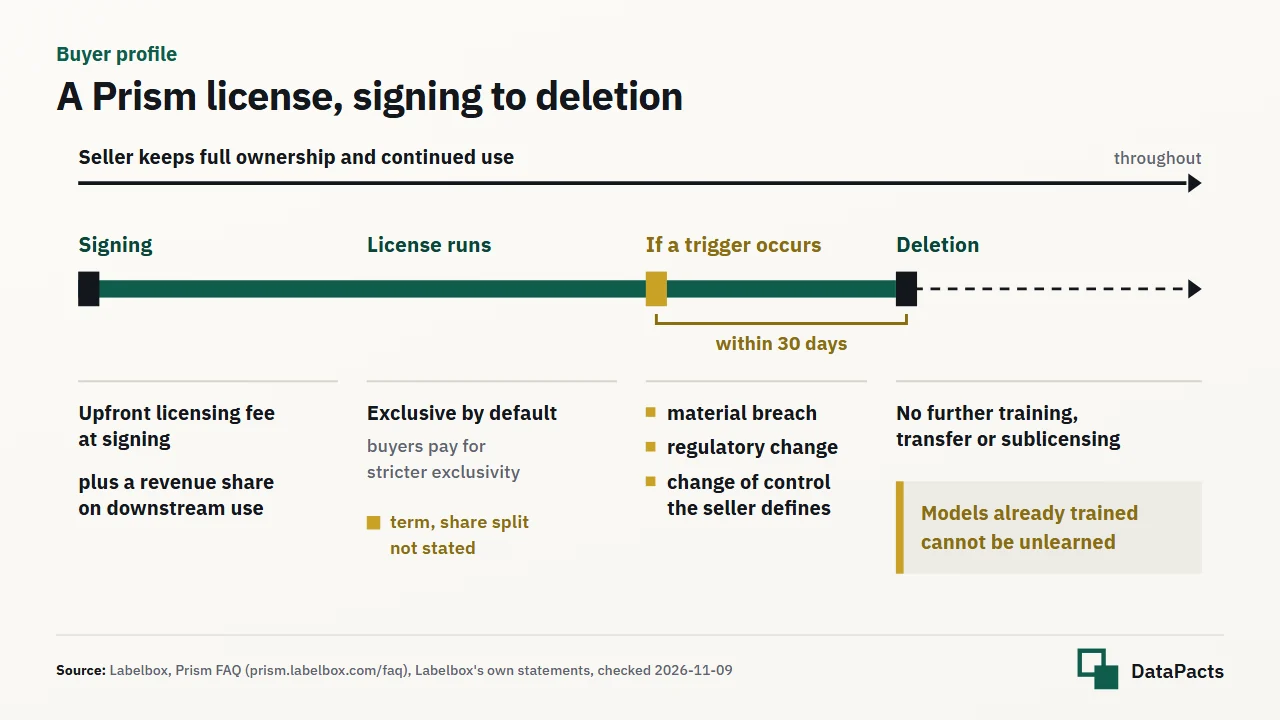
Labelbox states that targeted datasets start around USD 50,000 and that large partnerships can reach USD 1 million or more, and that a 30-day kill clause forces deletion while models already trained "cannot be unlearned" (Prism FAQ, checked 2026-11-09).
Every figure on this page is Labelbox's own claim, checked 2026-11-09, and its own pages disagree on how fast a quote arrives. This profile is one entry in an independent reference on AI training data licensing. It profiles Labelbox as a buyer of data only, so its labeling software is not reviewed here.
Each figure below carries its source and check date, and how DataPacts sources and dates every figure is set out in the methodology.
What Labelbox Buys Through Prism: Operational Records, Reasoning Traces and Consented Media
Prism lists eight kinds of company data it wants, from financial and scientific reasoning traces to robotics telemetry and consented likeness and voice (checked 2026-11-09). The Prism home page and FAQ name these categories:
- Financial and scientific reasoning traces
- Cross-system interaction data from work tools such as Salesforce, Jira and Slack
- Longitudinal customer support logs
- Multimodal medical records
- Robotics telemetry, listed on the home page
- Code generation and edit traces
- Consented likeness and voice
- SAP data and financial workbooks
The list describes work records rather than public content. A company's tickets, chat threads, CRM history and code reviews show how people reason through real tasks, which is the material Prism says it licenses onward to AI developers.
Media sets carry a stricter condition. The Prism home page describes "Video, still image, and voice recording sets with explicit, timestamped consent from real individuals." A company holding call recordings or video without such consent records therefore holds material outside that category until consent is documented.
Prism sets no explicit size rule, and Labelbox states that distressed and wound-down companies are eligible (checked 2026-11-09). That puts Prism among the programs open to a closed business, and the wider options for selling data from a defunct company, including court-supervised routes, are covered on selling data from a defunct company.
Labelbox Company Identity
Prism is a Labelbox brand rather than a separate company: its pages read "Prism powered by Labelbox", and Labelbox also runs the Alignerr contributor network. The table lists each attribute with its source, as of 2026-11-09.
| Attribute | Value | Source |
|---|---|---|
| Brand | Labelbox; programs Prism (company data) and Alignerr (contributors) | prism.labelbox.com/about; labelbox.com |
| Legal entity on the Prism pages | Not stated on the Prism pages (footer reads "(c) 2026 Labelbox") | prism.labelbox.com/about |
| Websites | labelbox.com; Prism at prism.labelbox.com | labelbox.com |
| Country | United States | labelbox.com |
| Founded | Not stated in the sources checked | n/a |
| Registry number | None published | n/a |
| Type | Training-data company that licenses operational data from companies | labelbox.com |
| Latest funding | Series E announced 2026-10-14 (Labelbox's claim) | Labelbox Series E post |
Labelbox's founding year, leadership and revenue are not stated in the sources checked, so none of them is given here. The two programs face different people: Prism addresses companies that hold records, while Alignerr addresses individual experts who do paid tasks, and only Prism makes Labelbox a buyer of company data.
Labelbox Prism Program Terms, Dated
Labelbox states that Prism pays an upfront licensing fee at signing plus a revenue share on downstream use, and that licenses are exclusive by default (checked 2026-11-09). Set against program terms compared across buyers, Prism is among the programs that combine an upfront fee with a revenue share.
Every row below is Labelbox's claim, with the page that states it. Where the home page and the FAQ disagree, both statements appear.
The table compares Prism's stated terms, as of 2026-11-09.
| Term | What Labelbox states | Page | Checked | Source |
|---|---|---|---|---|
| Payment structure | "an upfront licensing fee at signing plus a revenue share on downstream use"; split not published | FAQ | 2026-11-09 | prism.labelbox.com/faq |
| Dataset value | "Smaller, more targeted datasets typically start around $50K"; "large-scale enterprise data partnerships can reach $1M+" | FAQ | 2026-11-09 | prism.labelbox.com/faq |
| Distributed to date | "$100M+"; "1k+ companies licensing" (undated marketing claims) | Home | 2026-11-09 | prism.labelbox.com |
| Time to first wire | "From first call to first wire in under 21 days." | Home only | 2026-11-09 | prism.labelbox.com |
| Stages | Scope about 10 minutes; processing 1 to 3 days; license 5 to 10 days | Home | 2026-11-09 | prism.labelbox.com |
| Valuation | Written quote within 48 hours versus preliminary valuation within one business day; both on the home page (re-checked 2026-11-16), the second also in the FAQ | Home and FAQ | 2026-11-16 | prism.labelbox.com; prism.labelbox.com/faq |
| Exclusivity | Exclusive by default; seller keeps full ownership and continued use; buyers pay for stricter exclusivity | FAQ | 2026-11-09 | prism.labelbox.com/faq |
| Kill clause | Deletion within 30 days after material breach, regulatory change or a seller-defined change of control | FAQ | 2026-11-09 | prism.labelbox.com/faq |
| After revocation | "Models already trained on the data cannot be unlearned"; "no further training, transfer, or sublicensing is permitted post-revocation" | FAQ | 2026-11-09 | prism.labelbox.com/faq |
| License term, indemnity, audit | Not stated | FAQ | 2026-11-09 | prism.labelbox.com/faq |
| Referral fee | None published | Home and FAQ | 2026-11-09 | prism.labelbox.com/faq |
| Eligibility | No explicit size rule; distressed and wound-down companies eligible; media sets need explicit, timestamped consent | FAQ and home | 2026-11-09 | prism.labelbox.com/faq; prism.labelbox.com |
How a Prism License Works: From Scoping Call to First Wire
Labelbox describes Prism as a short sequence: a scoping call of about 10 minutes, processing in 1 to 3 days and a license in 5 to 10 days, as its home page states (checked 2026-11-09). The steps in Labelbox's order:
- Scope: a call of about 10 minutes on what data the company holds.
- Process: 1 to 3 days of processing on Labelbox's side.
- License: 5 to 10 days to a signed license.
- First wire: the upfront fee, which the home page places "under 21 days" from the first call.
The two valuation promises do not match. The Prism home page promises both a written quote within 48 hours and a preliminary valuation within one business day, and the FAQ repeats the second (re-checked 2026-11-16). Both are Labelbox's statements, and neither says whether the first number binds Labelbox at signing.
The 21-day claim sits on the Prism home page only; the FAQ, which carries the license conditions, does not repeat it.
The stated durations cover Labelbox's steps only and leave out the work that stays with the seller, such as the rights audit, consent records and internal approvals. Typical durations at other buyers are set out under how long an AI data licensing deal takes.
What a Prism License Leaves the Seller: Exclusivity, Kill Clause and No Unlearning
Prism licenses are exclusive by default, while the seller keeps full ownership of the data and its continued use, Labelbox states (checked 2026-11-09). The company can go on using its own records internally; what it gives up is the freedom to license them to others.
Labelbox adds that buyers pay for stricter exclusivity, so exclusivity carries a price. An exclusive license removes parallel income from other buyers for as long as it runs, and Prism does not publish how long that is. The trade-offs of exclusive vs non-exclusive data licenses are covered in the contract guide.
The FAQ describes a kill clause that forces deletion within 30 days after a material breach, a regulatory change, or a change-of-control trigger that the seller defines. The seller-defined trigger gives the company a say: it names the ownership changes that let it pull the data.
Revocation has a hard limit, which the FAQ states in its own words: "Models already trained on the data cannot be unlearned." After revocation, "no further training, transfer, or sublicensing is permitted post-revocation." Deletion stops future use; it does not reach a model already trained on the records.
Prism's pages leave three terms unstated: the license term, indemnity and audit rights. A seller learns them only from the contract itself, and what deletion and machine unlearning clauses can and cannot secure is a separate negotiation topic.
The Prism FAQ, checked 2026-11-09, is the page that states these license conditions; the home page carries the marketing figures discussed next.
Labelbox Payout Claims: From About USD 50K to USD 1M+
Labelbox states that smaller, targeted datasets "typically start around $50K" and that large enterprise data partnerships "can reach $1M+" (Prism FAQ, checked 2026-11-09). These are ranges for dataset value, not a price list, and the FAQ does not say what moves a dataset from one end to the other.
The payment has two parts: an upfront licensing fee at signing and a revenue share on downstream use. Prism publishes neither the split between the two nor the share percentage, nor when revenue-share income arrives after a downstream sale.
The Prism home page adds two larger figures: "$100M+" distributed and "1k+ companies licensing", both undated marketing claims checked 2026-11-09. Such advertised totals sit beside other reported payouts to data sellers, which separate advertised from confirmed amounts.
Labelbox's separate statement of "400+ customers" in its Series E post counts a different population and is not combined with the Prism figure.
The two parts carry different risks. The upfront fee is fixed at signing and does not depend on what happens downstream, while the revenue share depends on how often, and at what price, Labelbox licenses the records onward, which the seller cannot observe directly.
Without a published share percentage or reporting terms, the revenue share cannot be forecast from the program pages.
A range is a claim, not a confirmed payment to any named seller. A company comparing offers can ask for the quote in writing, with the upfront amount, the share percentage, the payment dates and the reporting the seller will receive on downstream use.
Is Labelbox Legit? What the Record Shows
Labelbox is an identifiable company with published program pages and a funding round it announced on 2026-10-14, and DataPacts' records hold no court case, data breach or regulator action involving Labelbox or Prism as of 2026-11-09. Prism publishes its license conditions, including the kill clause and the limit on unlearning.
The absence of a record is not a clean bill of health; it means no such event appears in the court dockets, regulator notices and filings checked. The log of data buyer incidents holds no Labelbox entry as of that date.
Labelbox's own pages contradict each other in two places. The first is the pair of valuation promises set out in the process section above.
The second is the size of its expert network: Labelbox's home page counts "2.6M+ skill-tested experts across 200+ domains", while its Series E post speaks of "more than 4 million people" in its expert network, without naming Alignerr.
Several points stay unconfirmed in the sources checked: the legal entity named on the Prism pages, Labelbox's founding year and leadership, and Prism's license term, indemnity and audit terms.
A seller confirms the contracting entity from the license agreement itself, and asks for the license term, indemnity and audit provisions in writing before signing, since an exclusive license without a stated term has no visible end.
Contributor complaints, such as Alignerr's two conflicting FAQ answers on pay after an account is deactivated, belong to the contributor side and are covered on the Alignerr profile described below.
Benefits, Risks, Downsides and Alternatives to Licensing Data to Labelbox
Prism offers an upfront fee plus a revenue share and lets the seller keep ownership, but its default exclusivity and the limits on deletion bind the seller for longer than the payment suggests. The four lists below set out both sides, each item based on Labelbox's terms checked 2026-11-09.
Benefits
- Money at signing: an upfront licensing fee, plus a revenue share on downstream use.
- Ownership stays with the seller, including continued internal use.
- A kill clause with 30-day deletion and a change-of-control trigger the seller defines.
- Distressed and wound-down companies are eligible.
Risks
- Models already trained on the data cannot be unlearned after revocation.
- License term, indemnity and audit rights are not stated on the program pages.
- The contracting entity is not named on the Prism pages and must be read from the contract.
- The headline totals ("$100M+", "1k+ companies") are undated claims, checked 2026-11-09.
Downsides
- Default exclusivity blocks parallel licensing of the same records to other buyers.
- The revenue share percentage and its payment timing are not published.
- No referral program is published, so introducers have no stated terms.
Alternatives
- Turing Project Lazarus: license to Turing exclusive for the first 6 months, during which Turing may license the record to more than one lab, "Nothing upfront", revenue share (checked 2026-11-17).
- SuperAnnotate: licensing rights "for a set period", the seller approves each buyer, data deleted after the agreed period, paid "on delivery, and on each relicense" (checked 2026-11-09).
- Other company data programs on the parent page.
- Not licensing at all, and keeping the records.
No program is the default choice. Keeping data, licensing it non-exclusively, or using it internally are all legitimate outcomes, and alternatives to selling data to AI labs sets out each, including keeping it.
Labelbox Prism Among Company Data Partnership Programs
Prism is one of the company data programs run by labeling vendors, alongside Centific, Scale AI, SuperAnnotate, Toloka and Turing. The parent page lists every one of the company data partnership programs on record.
Among the closest contrasts, Turing Project Lazarus states a 6-month exclusive license to Turing under which Turing may license the record to more than one lab, SuperAnnotate lets the seller approve each buyer, and Scale AI is the other large labeling vendor with a program.
The vendors themselves are compared as data labeling companies, and the full answer to who buys AI training data sits in the buyers hub.
The decision differs by seller: operating companies licensing their data weigh exclusivity against ongoing use, while payment structures such as upfront, milestones and revenue share shape cash flow. Separate pages on Labelbox Prism alternatives, Labelbox vs Scale AI and Labelbox vs Mercor follow.
More About Labelbox
Labelbox Jobs, Careers and Alignerr
People looking for Labelbox jobs as contributors are directed to Alignerr, an expert network "powered by Labelbox" whose Terms of Use name ALIGNERR LLC as the contracting party.
Pay claims, screening and terms are profiled separately on Alignerr, and the Labelbox-ALIGNERR LLC relationship is not stated on its pages. Other AI training jobs and platforms are compared in the human data section.
Labelbox's Series E and Company Finances
Labelbox announced a Series E of more than USD 100 million, including equity and a credit facility, led by Infinitum Partners at a USD 1.25 billion pre-money valuation, on 2026-10-14 (Labelbox's post).
The same post states "400+ customers" and that Labelbox "reached profitability this year"; no revenue figure is published, and the round sits with others under funding and valuations of AI data companies.
Frequently Asked Questions About Labelbox Prism
What is Labelbox Prism?
Prism is Labelbox's program for licensing company data to AI developers, paying an upfront fee plus a revenue share under licenses that are exclusive by default. The seller keeps ownership and continued use, as Labelbox states (checked 2026-11-09).
How much does Labelbox Prism pay for data?
Labelbox states that targeted datasets typically start around USD 50,000 and large partnerships can reach USD 1 million or more, checked 2026-11-09; these are claims, not confirmed payments. The revenue share percentage is not published.
Does Labelbox pay a referral fee for introductions?
No Prism referral program is published on the pages checked on 2026-11-09. Introducers therefore have no stated terms with Labelbox, unlike some other company data programs.
Can a closed company license data to Labelbox?
Labelbox states that distressed and wound-down companies are eligible for Prism. Who signs for a closed company, and whether the records are still the company's to license, are questions for the seller to settle first.
What is Labelbox's valuation?
Labelbox states a USD 1.25 billion pre-money valuation for its Series E, announced 2026-10-14. The round is Labelbox's own claim from its announcement post.