Programs set staff and age thresholds, and the most fully documented filed example is Tempus AI, a clinical-data company.
Not licensing is a valid outcome. An operating company's archive is one source in AI training data licensing.
DataPacts Editorial Team checked every figure here against its primary source on November 9, 2026; the page on how we source, date and check every figure sets out the rules.
Which Operating Companies License Records, and What Programs Require of Them
The operating companies that license records are established businesses with full-time staff and several years of history, because programs price workflows, and workflows need people and time to accumulate. Each threshold is the program's own statement, checked November 9, 2026.
- Endless states roughly 30+ employees and several years of history, and it licenses the data on to labs on the company's behalf.
- Handshake AI states 20+ full-time employees and 3+ years in operation on its license pages, but no minimum on its Data Partnerships page.
- micro1 states 30+ full-time employees and data primarily in English.
- Turing Project Lazarus states that it accepts active, winding-down and wound-down companies.
Mercor's listings, published 2026-10-17, state size bands from 5 to 2,000 employees for most sectors, 50 to 5,000 agents for call centers and any size for imaging centers (checked 2026-11-09). Which programs fit a company's size and country is shown by published acceptance criteria by company size.
Records a Trading Business Holds That AI Buyers Ask For
Buyers ask an operating company for records that show how work is done, from internal messages to sector records such as physician notes or process runs. The table groups the records programs name, as of 2026-11-09, in their own wording.
| Record family | Records programs name | Programs naming them | Source |
|---|---|---|---|
| Internal communications | Slack, Teams, Gmail, Outlook; internal communications | Handshake AI, Mercor, micro1 | joinhandshake.com/ai/data-partnerships; mercor.com/data; micro1.ai/data-partnerships |
| Documents, SOPs and knowledge bases | SOPs, process documentation, knowledge bases, templates; operating procedures, training materials | Handshake AI, micro1 | same |
| Tickets and project histories | support tickets, bug tracking; technical documentation and issue histories | Handshake AI, micro1 | same |
| CRM and sales | CRM records and sales playbooks; Salesforce | Mercor, micro1 | same |
| Finance and operations | finance SOPs, reconciliations, reporting workflows; logistics and fulfillment; financial models, underwriting workflows | Handshake AI, micro1 | same |
| Code | GitHub; software and engineering documentation | Mercor, micro1 | same |
| Sector records | construction drawings, RFIs, daily logs; free-text physician notes; run or build records with outcomes; lab notebooks | Mercor listings (published 2026-10-17) | api.data.mercor.com listings |
| Agent trajectories | agent task trajectories, with company approval; USD 1 to 2 million a year (micro1's claim) | micro1 | micro1.ai/data-partnerships |
Mercor's listings exclude data owned by a customer, partner or sponsor, and data already licensed exclusively (checked 2026-11-09). Each family has its own page among the data types AI companies buy, such as selling chat messages, licensing a company email archive and selling or licensing source code.
Operating-Company Deals Documented in Filings and on Buyers' Pages
Few operating companies disclose their data licenses, and the ones that do are public companies or counterparties to public companies, whose filings give value, term and structure. The table lists the documented cases as of 2026-11-09, with values as the named source states them.
| Date | Operating company (seller) | Counterparty | Records | Value and structure as stated | Source |
|---|---|---|---|---|---|
| 2024-09-18 | Lions Gate Entertainment Corp. | Runway AI, Inc. | film and TV catalog, for a model customized for Lionsgate's use | no financial terms disclosed | runway.com news |
| 2025-04 | Tempus AI, Inc. | Pathos AI, Inc. | de-identified multimodal oncology dataset | USD 200 million license fees over three years, including USD 50 million upfront; model license back to Tempus | Tempus 10-K FY2025, SEC |
| 2026-04-19 | Anysphere, Inc. (Cursor) | Space Exploration Technologies Corp. (including xAI) | developer interaction data | compute and option agreement; no data price; fees only in defined termination cases | SpaceX 424B4, SEC |
| 2026-10-14 | Tempus AI, Inc. | Bristol-Myers Squibb Company | de-identified multimodal oncology records plus access and services | USD 137.5 million fixed payments through 2031-12-31 | Tempus 10-Q Q3 2026, SEC |
| 2026-10-22 | Tempus AI, Inc. | Pathos AI, Inc. (sublicense to BMS) | 500,000 de-identified neurology records over five years | up to USD 55.0 million: USD 100 per delivered record plus USD 5.0 million for updates | Tempus 10-Q Q3 2026, SEC |
No seller-confirmed amount from a private operating company under a program deal is on record. Every filed deal is logged among AI data licensing deals.
What the Tempus Filings Show About How a Trading Company Is Paid
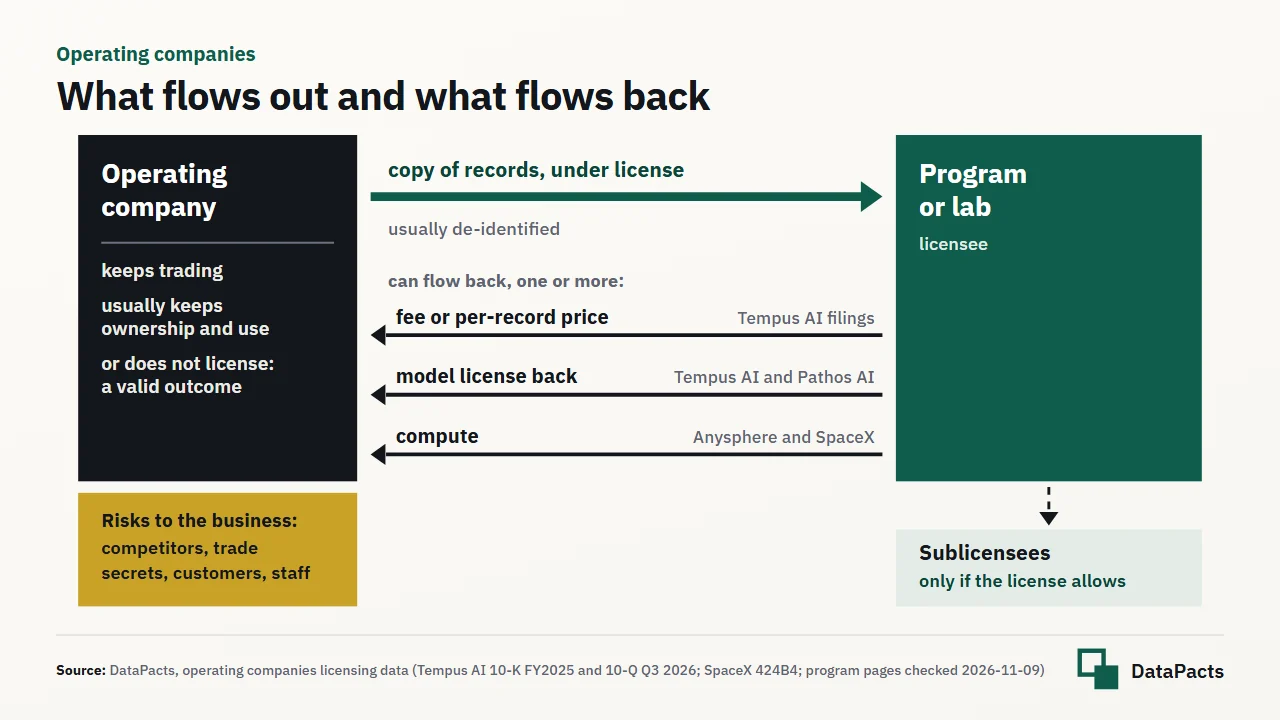
Tempus AI's filings show that a trading company's data license can combine an upfront fee, payments over years, a per-record price and rights back in the model trained on the data.
In the 2025 license, Pathos AI trains a foundation model, Tempus receives a license to that model and Tempus pays Pathos USD 35 million (Tempus 10-K FY2025).
The Neuro order of 2026-10-22 prices records one by one at USD 100 per delivered record, with an exclusivity arrangement. In the BMS statement of work of 2026-10-14, BMS may terminate on 12 months' notice with a substantial termination fee (Tempus 10-Q Q3 2026).
Cash is not the only consideration. Anysphere's agreement with SpaceX of 2026-04-19 is a compute and option agreement, and its fees are payable in defined termination cases, not a price for data; SpaceXAI's summary of 2026-09-21 states Grok 4.7 training included anonymized Cursor workflow data. The filings are collected under Tempus AI clinical data licensing deals.
Program Offers to Operating Companies Are Claims, Not Paid Amounts
Company data programs publish ranges for operating companies, and every range is the program's own offer, checked November 9, 2026, not an amount any company confirms receiving.
On 2026-10-09 micro1 announced a USD 1 billion commitment over 12 months to enterprise data acquisition, financed by Citi and Hercules Capital, which is a commitment and not money paid.
Handshake AI shows two figures that do not agree: a headline "Earn $100K to $4M+" and an estimator saying "Your data could be worth up to $100,000" (checked 2026-11-09). Labelbox states around USD 50K to 1M+ and Endless "Get up to $4M" (checked 2026-11-09).
Mercor's referral counters show submitted referrals, not closed deals. The programs that license operating companies' records are compared with dated terms on their own page.
Risks to the Core Business When a Trading Company Licenses Its Records
An operating company keeps its customers, staff, competitors and contracts after the license is signed, so the risks that matter most are those that reach the business, not the dataset.
Competitors Training on the Same Records
Under a nonexclusive license, the buyer or its customers can train models that a competitor later uses, and some grants let the data pass through several tiers of sublicensees. micro1's Data License Master Terms (updated 2026-11-08) state an irrevocable, perpetual, nonexclusive grant, sublicensable through multiple tiers, with micro1 owning derivatives, models and weights. Turing states that "the same record can go to more than one lab".
Some terms limit this. micro1's section 5.1 warrants that the licensor has not granted a third party rights to the same data on the same or substantially similar terms, and Labelbox states that its license is exclusive by default.
The license, not the program, decides which recipients can be excluded. Price and lock-in trade off in exclusive and non-exclusive data licenses.
Trade Secrets and Customers' Confidential Information
Workplace archives hold the company's own trade secrets and secrets it received from customers and partners under confidentiality duties, and a license can weaken the first and breach the second.
Under 18 U.S.C. 1839(5), misappropriation includes disclosure by one who acquired a secret under a duty to maintain secrecy (Defend Trade Secrets Act, in force 2016-05-11).
SI 2018/597 reg. 2 (in force 2018-06-09) defines a UK trade secret as secret, commercially valuable because secret and subject to reasonable steps to keep it secret.
Directive (EU) 2016/943 Art. 4(4) (transposition deadline 2018-06-09) makes use or disclosure unlawful where the person knew or ought to have known the secret came from someone using it unlawfully.
micro1's terms keep confidentiality three years after termination and indefinitely for trade secrets, and Mercor states that no lab ever sees raw data (checked 2026-11-09). Before any sample leaves, check customer consent and confidentiality clauses.
Customers, Staff and Platform Terms
A trading company licenses records about people it still serves and employs, so a license that surprises customers or staff costs trust the business depends on.
FTC staff wrote on 2024-02-13 that retroactive, surreptitious changes toward more permissive AI-training data practices "may be unfair or deceptive", a staff post and not a rule. GDPR Art. 6(4) requires a compatibility check for a new purpose not based on consent or law (applies from 2018-05-25).
Slack's API Terms, effective 2025-10-10, bar apps offered outside the organization from using API data to train an LLM.
Staff messages in the archive raise employee notice and consent questions.
Models That Keep What They Learned, and Income That May Not Recur
Ending a license rarely removes the data from models already trained, while the income a license brings can end on schedule or on notice. micro1 states no duty to delete or retrain Licensee Materials (section 4.4), and Labelbox states that models already trained on the data cannot be unlearned.
Filings show how income ends. Reddit's 10-Q for Q3 2026 (2026-10-29) states that substantially all licensing contract value comes from two partners whose agreements are "approaching the end of their respective current terms". Informa described its Taylor and Francis data access revenue of USD 75m+ in 2024 as non-recurring.
A buyer's rights over a trained model are set in retraining and model retention rights.
Benefits, Risks, Downsides and Alternatives for a Trading Company, Including Not Licensing
For a trading company, a data license turns an existing by-product into income and sometimes into model access, at the price of exposure that stays with the business after the money arrives, and not licensing is a valid outcome.
Benefits
- Per-record income, as in Tempus AI's USD 100 per delivered record (10-Q Q3 2026).
- A model license back or compute, as in Tempus's Pathos license and Anysphere's compute agreement.
- Buyer-paid preparation: Turing states it covers de-identification, cleanup and packaging.
- Ownership and continued use of the records, as Labelbox states.
Risks
- Competitors using models trained on the same records.
- Trade secrets and customers' confidential information leaving the company.
- Retroactive changes to customer terms, as the FTC staff post of 2024-02-13 warns.
- A counterparty's own security record: Mercor reported breach dates of 2026-03-24 and 2026-03-30 to the California Attorney General.
Downsides
- An exclusive license ties up the records, as Labelbox's default shows.
- micro1 deems data accepted after 30 business days (s.1.3) and caps liability at three times the fees (s.7.2).
- Income can end on a notice right or at the end of a term.
Alternatives
- Use the records internally, as Tempus does for its own LLMs.
- Commission a model for the company's own use, as Lionsgate did with Runway.
- License a nonexclusive, de-identified subset.
- Not licensing at all.
Each option leaves the company's duties in place. The general decision is in whether to sell or license data to AI companies.
Where an Operating Company Goes From Here: Process, Sectors and Other Seller Types
An operating company follows the same seller process as every company, and its sector and ownership change which steps carry the most weight. It is one entry among every type of seller, and the guide to sell or license company data to AI companies covers the path. The steps in order:
- data sale readiness
- data inventory for an AI data sale
- rights audit
- PII removal and de-identification
- AI data licensing agreements
Sector limits are set out in data licensing by industry. Investor consent, code ownership and exit effects for venture-backed startups licensing data while operating are covered there, not here. Once trading stops, see data from a shut-down or defunct company, and after a merger see data from acquired companies.
This page is information, not legal advice.
Programs, Data Types and Rules Named on This Page
The terms, records and rules above come from these programs' own pages, the data-type pages and the statutes cited, checked November 9, 2026.
Programs
- Endless
- Handshake AI data buyer profile
- Labelbox Prism
- Mercor data buyer profile
- micro1 data buyer profile
- Turing Project Lazarus
- AI data partnership payouts and program terms compared
Data types
- Computer-use and agent trajectory data
- Selling chat messages
- Selling or licensing source code
- Licensing a company email archive
Rules
Frequently Asked Questions
Can an operating company license its data and keep using it?
Yes, under a license the company usually keeps ownership and continued use of its records, and the buyer receives a copy under the license terms. Labelbox states the seller keeps ownership and continued use, and Turing states ownership does not change hands (both checked 2026-11-09).
How much do AI companies pay an operating company for its records?
Public figures are either filed deals, such as Tempus AI's USD 100 per delivered record, or program ranges that are offers, not confirmed payments. micro1 states USD 100K to 500K for its first tier (checked 2026-11-09). See what company data is worth to AI companies for methods.
Does licensing company data help competitors?
It can, because a nonexclusive license lets the buyer train or sublicense models that competitors may use, unless the license limits recipients or fields of use. micro1's section 5.1 warranty bars a prior grant on the same or substantially similar terms (checked 2026-11-09).