Programs state headcount floors and pay ranges, each a dated claim: micro1 states 30+ full-time employees, and Mercor's Game Studio listing states USD 100,000 to 1,000,000 to the company for studios of 10 to 500 staff (checked 2026-11-09).
No filing or study measures how a license moves a startup's valuation. The page covers floors, consent, code ownership and exit terms across AI training data licensing.
DataPacts Editorial Team checked every figure here against its primary source on November 9, 2026; the page on how we source, date and check every figure sets out the rules.
What a Funded Startup Holds That AI Developers License
A funded startup's licensable records are the ones its product and team create while operating: repositories, product interaction data and the chat, ticket and document history of how the work was done.
- Code repositories with commit history, which Mercor's Software Company listing asks for as private repositories never public, mirrored or open-sourced (checked 2026-11-09).
- Product interaction data generated by users of the startup's tool, and workspace records: chat, tickets and documents.
Interaction data has a filed precedent. Anysphere, the company behind Cursor, signed a compute and option agreement with SpaceX dated 2026-04-19; SpaceX expects that access to Cursor developer interaction data "will enhance our model training" (SpaceX 424B4), and the filing states no data price. xAI's summary of 2026-09-21 states that Grok 4.7's training data included anonymized Cursor workflow data.
Headcount and History Floors That Programs State
Most company-data programs state a minimum headcount or years of history, and the floors on record start at about 10 to 30 staff, which leaves many seed-stage startups outside them. The table compares the floors seven programs publish for operating companies, as of 2026-11-09, each value the program's own claim.
| Program | Type | Size and history floor it states | Other condition relevant to startups | Source |
|---|---|---|---|---|
| Endless company data licensing | Data vendor that takes a license and places data with several labs | Roughly 30+ employees, several years of history | Non-exclusive; English documentation; US, UK, Canada prioritized | endless-data.com |
| Handshake AI Data Partnerships | Human-data platform | Data Partnerships page: no minimum; license and referral pages: 20+ full-time employees and 3+ years | Contradiction kept visible | joinhandshake.com/ai/data-partnerships |
| Mercor Game Studio listing | Human-data platform | 10 to 500 employees; USD 100,000 to 1,000,000 to the company (published 2026-10-17) | Released games and studio records | api.data.mercor.com listing game-studio |
| Mercor Software Company listing | Human-data platform | 3+ years of commit history from at least 10 engineers; 50,000+ lines the company owns outright | Private repositories never public, mirrored or open-sourced | api.data.mercor.com listing software-company |
| micro1 Company Data Partnerships | Human-data platform | 30+ full-time employees | Data primarily in English; US companies first | micro1.ai/data-partnerships |
| Polyshares data licensing | Data vendor | "Any company with real operating history"; names "venture backed, middle market or founder owned" | License term contradicts itself across its own pages | polyshares.com |
| Replay data licensing | Data vendor | Lowest band 20 to 50 employees: USD 10K to 100K; 50 to 250: USD 100K to 1M; 250+: USD 1M+ | Upfront cash plus perpetual revenue share; de-identified data only | replay.ai |
Handshake's own pages disagree on a minimum (checked 2026-11-09). Below the floors, the options are a code-only listing, waiting or not licensing. All terms sit under company data partnership programs.
Investor Consent Rights and Investor Reporting Before a License Is Signed
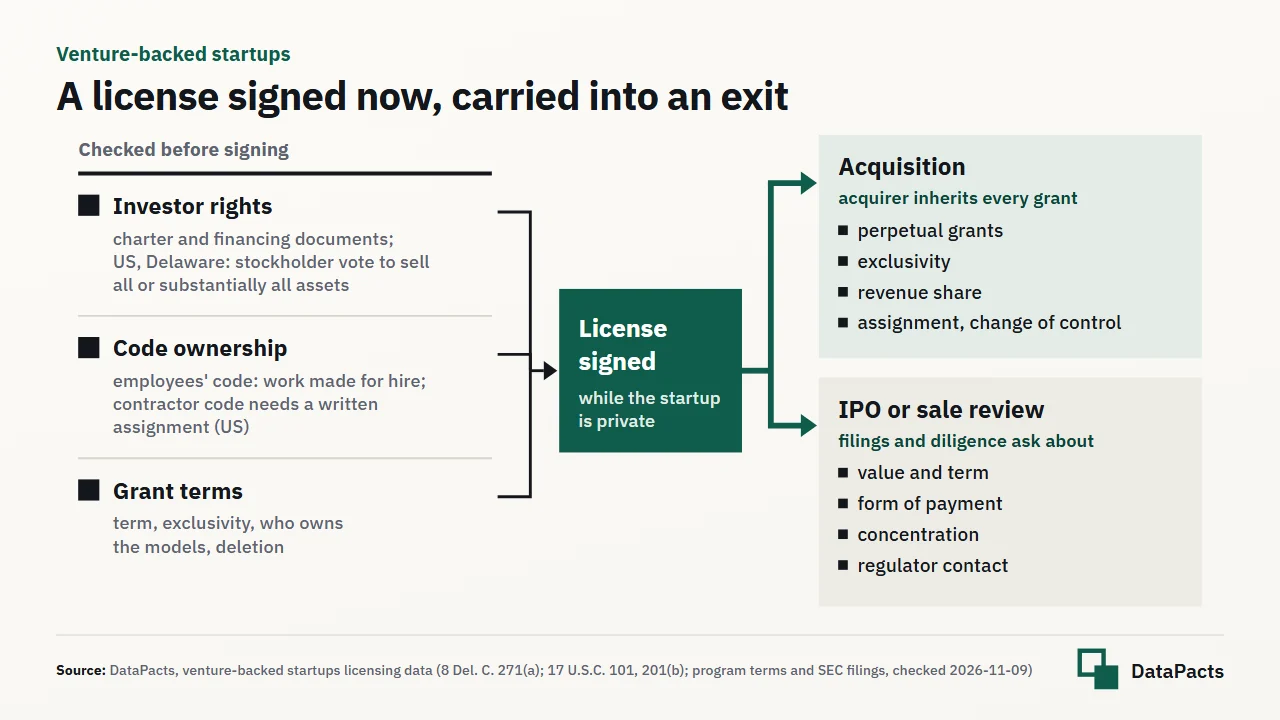
A startup's investors do not sign its data license, but the charter, the financing documents and corporate law can give them a vote, a veto or a right to be told before it is signed.
Consent Rights Written Into the Charter and Financing Documents
Whether any investor must consent to a data license depends on the startup's own certificate of incorporation and investor agreements, so the first check is to read them for consent rights over asset sales, exclusive licenses and IP transfers.
Corporate law adds one fixed rule for Delaware companies: under 8 Del. C. 271(a), a sale, lease or exchange of all or substantially all assets needs authorization by a majority of the outstanding voting stock at a meeting on at least 20 days' notice.
Whether a license can reach that threshold is a question for counsel; the resolution itself belongs to board and shareholder approval for a data licensing deal.
Grant Terms Investors Will Ask About
The grant terms that outlast an investment horizon are the ones investors look for: how long the license runs, whether it is exclusive, who owns what the buyer builds and whether the data can be deleted. Published terms show the range (checked 2026-11-09):
- Duration: micro1's master terms, last updated 2026-11-08, grant a worldwide, nonexclusive, irrevocable, perpetual license (s.1.2).
- Exclusivity: Labelbox Prism states exclusive by default; micro1 and Endless state non-exclusive terms.
- Ownership: under micro1's s.2.2 the licensee owns derivatives, models, weights and outputs.
- Deletion: micro1's s.4.4 sets no duty to delete or retrain models built from the data, and Labelbox states that trained models cannot be unlearned.
The startup also checks its investor agreements for reporting duties. The clause list sits in the guide to AI data licensing agreements.
Code IP a Startup Must Hold Before It Licenses a Repository
Code listings ask for code the company owns outright, so a startup whose founders wrote code before incorporation or whose contractors never signed assignments has repositories it cannot yet license.
Mercor's Software Company listing asks for 50,000+ company-owned lines and 3+ years of commit history from at least 10 engineers (checked 2026-11-09). Under 17 U.S.C. 101 and 201(b), an employee's work within the scope of employment is a work made for hire, while contractor code needs a written assignment.
The indemnity stays with the startup. Under micro1's master terms s.8.1 (checked 2026-11-09), the licensor indemnifies IP, privacy, publicity and data protection claims from the data, and s.7.2 caps liability at 3x fees with carve-outs for fraud, gross negligence and wilful misconduct.
Repositories also hold other parties' material. Under 18 U.S.C. 1839(5), disclosing a secret held under a duty of secrecy can be misappropriation, so customer or partner secrets stay out of the license (see the Defend Trade Secrets Act).
Authorship by author group and the commit-history check are covered on the page about who owns the code you want to sell.
How a License Signed Now Travels Into an Acquisition or IPO
A data license signed while the startup is private stays with the company when it is acquired or goes public, so its assignment, exclusivity and payment terms become part of what the acquirer or IPO investors examine.
Assignment and Change-of-Control Wording in Published Terms
Published terms show two approaches to a change of control: one buyer's terms let either party assign the license in a merger without asking, and one program lets the seller define a change of control that ends the license.
Under micro1's master terms s.9.1 (checked 2026-11-10), either party may assign the agreement without consent in a merger or acquisition, with written notice, but not to a competitor of the other party.
Labelbox states that Prism's kill clause forces deletion within 30 days on material breach, regulatory change or a change-of-control trigger the seller defines (checked 2026-11-09).
Polyshares's home page says "Defined material for a defined term" while its track record says "Perpetual exclusive license to the operational record". Clause drafting for a sale of the business is covered under data licenses in an M&A sale.
Perpetual Grants, Revenue Shares and Exclusivity an Acquirer Inherits
An acquirer inherits every grant the startup made, so a perpetual license keeps running after the deal and an exclusive one limits what the acquirer can do with the same data. micro1's grant is perpetual and sublicensable through multiple tiers, and Replay states upfront cash plus a perpetual revenue share (Replay, checked 2026-11-09), an income stream that passes with the company.
Labelbox states that Prism is exclusive by default, that the seller keeps ownership and continued use, and that buyers pay for stricter exclusivity; Endless states non-exclusive terms (both checked 2026-11-09).
Under micro1's s.4.2, exclusivity exists only through an Order Form, so the startup's license file needs both documents. The trade-offs are set out under exclusive vs non-exclusive data licenses.
What Public Filings Show: Disclosure, Concentration and Regulator Questions
Companies that report to the SEC have disclosed their data licenses, and the filings show what an IPO or acquisition review asks about: value, term, form of payment, concentration and regulator contact.
In its FY2025 10-K, Tempus states that Pathos licenses data for USD 200 million over three years, with USD 50 million upfront paid as of April 2025, and that Pathos may pay up to 50 % of the fees in Series D preferred stock, which can make the seller an investor in its buyer.
Reddit's S-1, filed 2024-02-22, states January 2024 arrangements with an aggregate contract value of USD 203.0 million, terms of two to three years and a minimum of USD 66.4 million expected in 2024; the counterparties are not named.
Its S-1/A discloses a non-public FTC inquiry letter received 2024-03-14 about licensing user content to train AI, with no outcome found.
Reddit's 10-Q for Q3 2026, filed 2026-10-29, states that substantially all of its licensing contract value comes from two partners whose agreements are approaching the end of their current terms, as covered under Reddit's AI data licensing deals.
What a Data License Does to a Startup's Valuation, and What the Record Cannot Show
No filing or study on record measures how a data license moves a startup's valuation, so the effect can only be described through the accounting and the contract terms.
Under IAS 38.63 internally generated data archives are not recognized as intangible assets, and under IAS 38.113 a gain on sale is not classified as revenue. Reddit recognizes licensing revenue generally ratably over the license period (10-K FY2025, checked 2026-11-09).
For a buyer of the whole business, 26 U.S.C. 197(a) and (d)(1)(C)(ii) amortize a purchased information base ratably over 15 years, and concentration matters too, since two licensees carried substantially all of Reddit's licensing contract value in the Q3 2026 10-Q.
Revenue timing and asset treatment differ between US GAAP and IFRS, as set out under accounting for data licensing revenue.
Benefits, Risks, Downsides and Alternatives for a Venture-Backed Startup
Licensing data can bring a startup non-dilutive cash while it operates, but the grant usually outlives the investment horizon, and not licensing remains a valid choice.
Benefits
- Income without issuing shares, as in Mercor's game studio range (checked 2026-11-09).
- Ownership kept, as Endless and Labelbox state.
- A revenue share keeps paying after an acquisition.
Risks
- The IP indemnity stays with the company (micro1 s.8.1).
- Exclusive or perpetual grants must be accepted by an acquirer.
- Customer or partner trade secrets inside repositories, and concentration and regulator questions at an IPO.
Downsides
- Trained models cannot be unlearned, and micro1's s.4.4 imposes no duty to retrain.
- Management time is not measured in any source on record.
- Revenue may be recognized over time, as Reddit's is.
Alternatives
- License only employee-written code or a narrow dataset.
- Wait until history and assignments exist.
- Grant non-exclusive terms only.
- Do not license at all.
The options are compared under alternatives to selling data to AI labs.
Steps Before a Startup Signs Its First Data License
A startup reaches a signed license in six steps, and the first two decide whether it survives a later financing or acquisition review.
- Read the charter and investor agreements for consent and reporting rights.
- Confirm assignments for every code author group.
- List the systems and exclude customer and partner material.
- Decide exclusive or non-exclusive and the term before pricing.
- Compare written offers from more than one program on assignment, change of control, deletion and payment.
- Record the board and any investor approvals and keep the license file for later diligence.
Where Startup Licensing Meets Operating, Defunct and Acquired Companies
This page covers the startup-specific questions; the general rules for operating, shut-down and acquired companies sit on their own pages. The parent page compares every type of seller. General eligibility sits under operating companies licensing their data.
A closing startup moves to the rules for selling data from a shut-down or defunct company, where wind-down services act as intermediaries, not buyers, and after a sale the page on data from acquired companies applies.
The process follows the guide to sell or license company data to AI companies. These pages cover the checks a startup completes first: data sale readiness, the rights audit, customer consent and confidentiality clauses, employee notice and consent, due diligence in an AI data deal and tax on data licensing income. This page is information, not legal advice.
Programs, Deals and Filings Named on This Page
The terms above come from these programs' own pages, checked November 9, 2026, and from SEC filings.
- Cursor (Anysphere) and SpaceX AI agreement
- Endless
- Handshake AI data buyer profile
- Labelbox Prism
- Mercor data buyer profile
- micro1 data buyer profile
- Polyshares
- Replay
- Tempus AI clinical data licensing deals
- AI data partnership payouts and program terms compared
- Who buys AI training data
Frequently Asked Questions
Can a startup license its data to AI companies while still operating?
Yes; several company-data programs accept operating companies, but most state a floor of about 10 to 30 staff and several years of records. micro1 states 30+ full-time employees and Handshake's license pages state 20+ and 3+ years (checked 2026-11-09).
Do a startup's investors have to approve a data licensing deal?
Only where the charter, the investor agreements or corporate law give them a vote; Delaware requires a stockholder majority for a sale of all or substantially all assets.
Does licensing data change what a startup is worth in an acquisition?
No published figure measures the effect; what an acquirer examines is the license itself: term, exclusivity, assignment, indemnity and how revenue is recognized.
Public price points are covered under what company data is worth to AI companies.