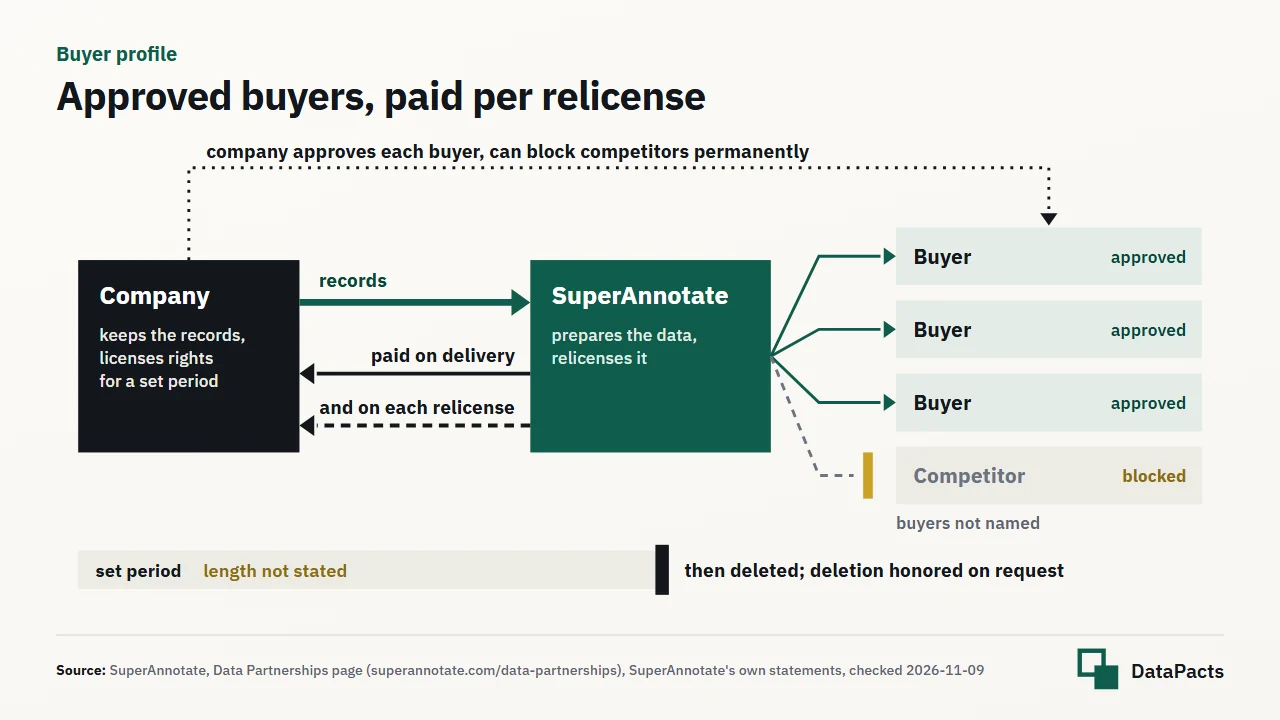
Every figure on this page is SuperAnnotate's own claim, checked 2026-11-09, and where the program page is silent the text says so instead of filling the gap.
This profile is one entry in an independent reference on AI training data licensing. SuperAnnotate is profiled here as a licensee of company records only, so its annotation software is not reviewed.
Each term below carries its source and check date, and how DataPacts sources and dates every figure is set out in the methodology.
What SuperAnnotate Licenses From Companies: Records of How Work Gets Done
SuperAnnotate lists five groups of records it wants, from Slack threads and email chains to screen recordings of multi-step tasks (checked 2026-11-09). Its wording for each group:
- Slack threads, email chains and handover notes
- Process docs, runbooks and wikis
- Tickets, approvals, escalations, incident reviews and QA trails
- Inspection reports, equipment logs, specifications, claims files and pricing histories
- Screen recordings of multi-step tasks
The groups share one trait: they record decisions and process rather than finished output. None of them is public content, so a company holding such records is the only source for them.
A handover note shows what an employee passed on and why, and a QA trail shows how an item moved from rejection to approval, which is the reasoning that finished documents leave out.
Tickets and approvals are the clearest case. How buyers value issue trackers and service-desk tickets for AI training depends on how complete the trail of escalations and approvals is, and SuperAnnotate lists exactly those trails by name.
Screen recordings of multi-step tasks add a different format, since they show work performed across several applications. SuperAnnotate does not say in its program record how such recordings are collected or what consent they need.
On eligibility, SuperAnnotate states "Any size, any industry, anywhere. You need records built up over time and the rights to license them." (re-checked 2026-11-16). It sets no minimum headcount and no numeric history threshold, unlike programs on the parent page that publish both.
SuperAnnotate Company Identity
SuperAnnotate runs Data Partnerships under its own brand at superannotate.com, and the program page does not name the legal entity that signs the license. The table lists each attribute with its source, as of 2026-11-09.
| Attribute | Value | Source |
|---|---|---|
| Brand and program | SuperAnnotate; SuperAnnotate Data Partnerships | superannotate.com/data-partnerships |
| Legal entity on the Data Partnerships page | Not stated | superannotate.com/data-partnerships |
| Website | superannotate.com; program at superannotate.com/data-partnerships | superannotate.com |
| Country | United States | superannotate.com/privacy-policy |
| Founded | Not stated in the sources checked | n/a |
| Registry number | None published | n/a |
| Type | Annotation and human-data company that licenses operational records to buyers the company approves | superannotate.com/data-partnerships |
SuperAnnotate's funding, investors and headcount are not stated in the sources checked, so none of them is given here. The brand covers three separate activities: Data Partnerships (licensing of company records, the subject of this page), contributor work for annotation projects and annotation software, and only the first makes SuperAnnotate a licensee of company data.
SuperAnnotate Data Partnerships Program Terms, Dated
SuperAnnotate states an indicative valuation of "$100K – $1M+" per data partnership and pays "on delivery, and on each relicense" (checked 2026-11-09). Set against program terms compared across buyers, it is the only entry on the parent page with payment per relicense.
Every row below is SuperAnnotate's claim, taken from its Data Partnerships page and checked on the date shown. Where the page is silent, the row says "not stated".
The table compares the stated terms of the program, as of 2026-11-09.
| Term | What SuperAnnotate states | Checked | Source |
|---|---|---|---|
| Program | SuperAnnotate Data Partnerships | 2026-11-09 | superannotate.com/data-partnerships |
| Data wanted | Five groups: chat and email, process documents, tickets and QA trails, inspection and claims records, screen recordings | 2026-11-09 | superannotate.com/data-partnerships |
| Indicative valuation | "$100K – $1M+" | 2026-11-09 | superannotate.com/data-partnerships |
| Pricing factors | Rarity, depth and exclusivity | 2026-11-09 | superannotate.com/data-partnerships |
| Payment trigger | "on delivery, and on each relicense" | 2026-11-09 | superannotate.com/data-partnerships |
| License form | "You're licensing rights for a set period, not selling the data" | 2026-11-09 | superannotate.com/data-partnerships |
| Buyer control | The seller approves each buyer and "can block competitors permanently" | 2026-11-09 | superannotate.com/data-partnerships |
| Retention and deletion | Retained for an agreed period, then deleted; deletion honored on request | 2026-11-09 | superannotate.com/data-partnerships |
| Process | Scoping call; assessment with sample review and valuation; agreement; preparation and licensing | 2026-11-09 | superannotate.com/data-partnerships |
| Eligibility | "Any size, any industry, anywhere."; "You need records built up over time and the rights to license them." | 2026-11-16 | superannotate.com/data-partnerships |
| Referral fee | None published | 2026-11-09 | superannotate.com/data-partnerships |
| License length, seller's share per relicense, de-identification party, buyers named | Not stated | n/a | n/a |
How a SuperAnnotate Data Partnership Works: Scoping Call to Licensing
SuperAnnotate describes four steps: a scoping call, an assessment with a sample review and valuation, an agreement, and preparation of the data and licensing to buyers the company approves (checked 2026-11-09). The steps in SuperAnnotate's order:
- Scoping call: a first conversation about what records the company holds.
- Assessment: a sample review and a valuation of the records.
- Agreement: the license contract between the company and SuperAnnotate.
- Preparation and licensing: SuperAnnotate prepares the data and licenses it to buyers the company has approved.
The program record gives no duration for any step, no processing location and no party responsible for removing personal data. Those gaps matter most for the third item, because records such as email chains and Slack threads carry names and contact details of employees and customers.
A seller can ask who handles PII removal and de-identification before the sample review, since a sample shared before cleaning already exposes the raw records. The same question settles whether the company or SuperAnnotate carries the cost and the liability for missed identifiers.
Before the sample review, a company can also ask in writing which buyers are in view, how long the sample stays with SuperAnnotate and under which terms it is deleted if no agreement follows.
None of these points appears on the program page, so each answer comes from the sales conversation and belongs in the agreement.
SuperAnnotate's Valuation Claim and Payment on Each Relicense
SuperAnnotate gives an indicative valuation of "$100K – $1M+" and states that it prices data on "rarity, depth, and exclusivity" (checked 2026-11-09). The page names three pricing factors and publishes no formula that links them to a figure.
"On each relicense" means that income repeats when the same records are licensed again to another buyer the company approves, so the payment is not a one-off fee.
The parent page lists SuperAnnotate as the only program under payment per relicense, and the factors behind what company data is worth to AI companies explain why rarity and depth move a valuation.
The page also does not say whether the first payment on delivery is a fixed amount or an advance against later relicense income. Three things are not published: the seller's share per relicense, how many relicenses to expect and any minimum amount.
The order of magnitude therefore stays open: a company cannot tell from the page whether a relicense adds a small recurring amount or a large one. Without them, income from repeated licensing cannot be forecast from the program page, and the first payment on delivery is likewise unquantified.
The figure is an indicative valuation, which is a claim and not a confirmed payment. No seller has confirmed an amount on the public record, and an advertised range, like other reported payouts to data sellers, stays separate from amounts a named party confirms.
What a SuperAnnotate License Leaves the Seller: Set Period, Buyer Approval and Deletion
SuperAnnotate states "You're licensing rights for a set period, not selling the data" (checked 2026-11-09). The company keeps the records and grants rights for a set period.
Relicensing means that more than one buyer may receive the same records during that period. The company does not hand the records to a single counterparty; SuperAnnotate passes them on to each buyer the company has approved.
The seller approves each buyer and "can block competitors permanently", SuperAnnotate states. A permanent block lets a company keep its records away from a direct rival for the whole period. That control sits between the two poles of exclusive vs non-exclusive data licenses: several buyers may take the records, but the company decides which.
Labelbox Prism licenses exclusively by default (checked 2026-11-09) and Turing Project Lazarus states a license to Turing that is exclusive for the first 6 months (checked 2026-11-17), so SuperAnnotate's approval right is a distinct arrangement.
After the agreed period, the records are deleted, and SuperAnnotate states that deletion is honored on request. The program page does not say how long the retention period lasts or what deletion covers once a buyer has trained a model on the records.
Several terms remain unstated in the program record: the length of the set period, whether licenses are exclusive by default, indemnity and audit rights. A seller learns them only from the contract.
What deletion and machine unlearning clauses can and cannot secure is a negotiation topic for that contract, since a deletion promise stops future use but does not reach a model that has already learned from the records.
Is SuperAnnotate Legit as a Licensee of Company Data? What the Record Shows
SuperAnnotate is an identifiable US company with a published Data Partnerships page, and DataPacts' records hold no court case, data breach or regulator action involving it as of 2026-11-09. It also publishes a privacy policy, which is the source for its recorded country; the program page itself names no legal entity.
The page publishes a good deal: a valuation range, the payment trigger, the license form, buyer approval and deletion on request. It leaves out the license length, the seller's share per relicense, the party that de-identifies and the names of the buyers.
The absence of a record is not a clean bill of health; it means no such event appears in the court dockets, regulator notices and filings checked. The log of data buyer incidents holds no SuperAnnotate entry as of that date.
Several points stay unconfirmed in the sources checked: the legal entity named on the program page, the founding year, the funding history and the buyers that receive the data. A seller confirms the contracting entity from the license agreement itself and asks for the unstated terms in writing before signing.
Reviews of SuperAnnotate that appear in search results concern contributor work, which the section below sets apart from the licensing of company records.
Benefits, Risks, Downsides and Alternatives to Licensing Data Through SuperAnnotate
SuperAnnotate's program keeps the seller in control of who receives the records and pays again on each relicense, but it publishes no license length, no revenue share and no buyer names. The four lists below set out both sides, each item based on terms checked 2026-11-09.
Benefits
- The seller approves each buyer and can block competitors permanently.
- Payment on delivery and again on each relicense.
- A license for a set period, not a sale, with deletion after the agreed period and on request.
- No size or industry limit: "Any size, any industry, anywhere."
Risks
- The party that removes personal data is not stated.
- The contracting entity is not named on the program page and must be read from the contract.
- The buyers are not named, so the seller learns who receives the records only through the approval step.
- Relicensing spreads the same records across several buyers.
Downsides
- The valuation is indicative only, and no seller has confirmed an amount.
- The seller's share per relicense is not published.
- No referral program is published, so introducers have no stated terms.
Alternatives
- Labelbox Prism: exclusive by default, an upfront fee at signing plus a revenue share on downstream use (checked 2026-11-09).
- Turing Project Lazarus: license to Turing exclusive for the first 6 months, during which Turing may license the record to more than one lab, nothing upfront, revenue share (checked 2026-11-17).
- Scale AI: exclusivity, term and deletion terms not published (checked 2026-11-09).
- Other company data programs on the parent page.
- Not licensing at all, and keeping the records.
The difference to the alternatives is one of control. Prism's exclusive default trades parallel income for a single buyer relationship, Lazarus gives Turing a 6-month exclusive license, and SuperAnnotate leaves the buyer choice with the company while stating no license length.
No program is the default choice. Keeping data, licensing it to a single buyer or using it internally are all legitimate outcomes, and alternatives to selling data to AI labs sets out each, including keeping it.
SuperAnnotate Among Company Data Partnership Programs
SuperAnnotate is one of several annotation and human-data companies that run a company data program, alongside Labelbox, Scale AI and Turing.
The parent page lists every one of the company data partnership programs on record. Labelbox Prism licenses exclusively by default, Scale AI publishes no exclusivity, term or deletion terms, and Turing Project Lazarus states that it pays a revenue share every time a record sells (checked 2026-11-09).
The vendors are compared as data labeling companies that also license company records, and the full answer to who buys AI training data sits in the buyers hub.
The decision differs by seller: operating companies licensing their data weigh approval rights against reach, and runbooks sit with SOPs, playbooks and process documentation. Payment per relicense compares with other structures under when and how AI data buyers pay.
More About SuperAnnotate
SuperAnnotate AI Trainer Work and SME Careers
SuperAnnotate also recruits contributors for annotation and AI trainer projects, a separate activity from licensing company records that this profile does not cover. Pay, screening and terms for such work are compared under AI training jobs and platforms compared. How to check whether AI training work is legit is answered in the human data section.
Frequently Asked Questions About SuperAnnotate Data Partnerships
What does SuperAnnotate do?
SuperAnnotate is an annotation and human-data company that, through Data Partnerships, licenses companies' operational records and relicenses them to buyers the company approves. It states that the seller licenses rights for a set period and does not sell the data (checked 2026-11-09).
Where is SuperAnnotate based?
The United States is SuperAnnotate's recorded country, as of 2026-11-09. No registry number is published.
How much does SuperAnnotate pay for company data?
SuperAnnotate states an indicative valuation of USD 100K to USD 1M+, with payment on delivery and on each relicense, checked 2026-11-09; these are claims, not confirmed payments. The seller's share per relicense is not published.
Does SuperAnnotate pay a referral fee for introductions?
No referral program is published for Data Partnerships as of 2026-11-09. Introducers have no stated terms.
Which AI companies receive the data SuperAnnotate licenses?
SuperAnnotate names no buyer in the program record; the company approves each buyer and can block competitors permanently. The approval right is SuperAnnotate's claim, checked 2026-11-09.