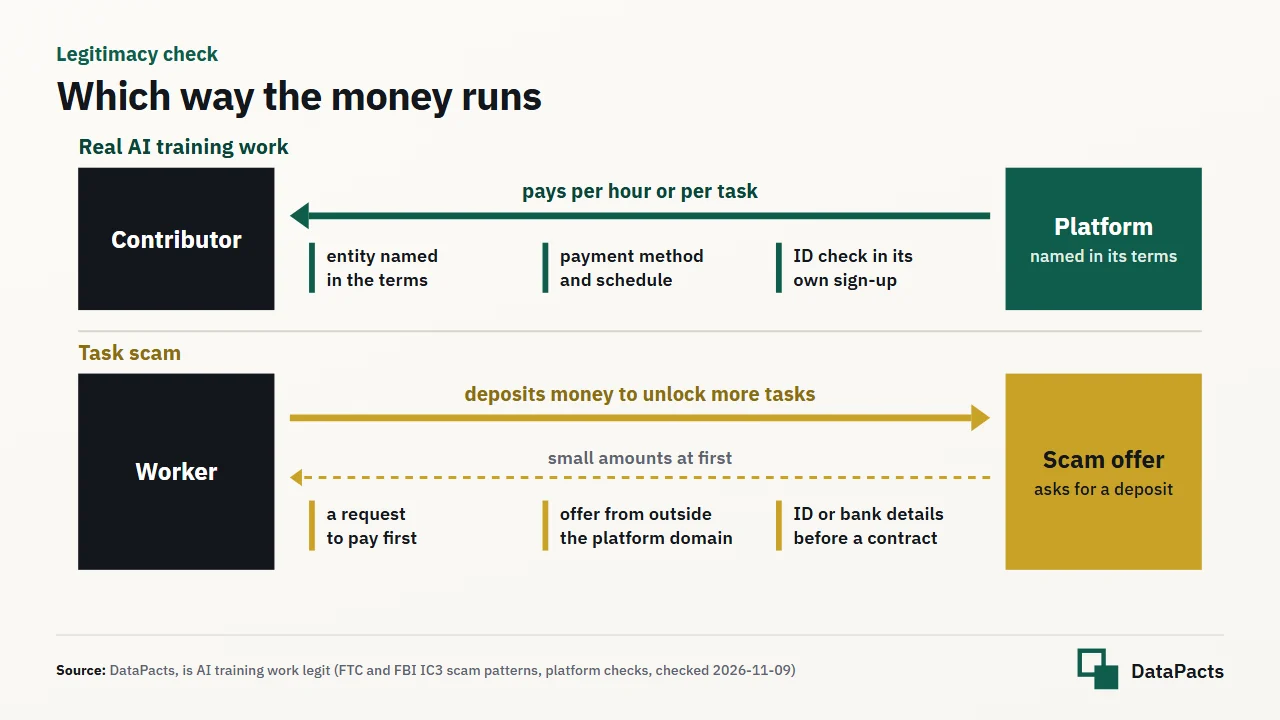
US authorities classify these scams as job and task scams, advance-fee fraud and business impersonation: the FBI's Internet Crime Complaint Center (IC3) counted 7,097 advance-fee complaints with USD 102,074,512 in losses for 2024, and the FTC's Impersonation Rule, 16 CFR 461.3, has been in force since 2024-04-01.
This page gives checks and dated records, not a verdict on any platform. It places the work inside AI training data licensing as the human route, in which labs pay people to create data instead of licensing data that already exists.
Platform pages were read on 2026-11-09, and five platforms carry court, regulator or platform records as of 2026-11-10, among them the final approval of the McKinney v. Scale AI settlement on 2026-10-30.
What makes AI training work legitimate: a named payer, a written contract and paid tasks
Legitimate AI training work has an identifiable operator that names itself in written terms, describes how and when it pays, and pays the contributor rather than the other way round.
Outlier's Terms of Use name Scale AI, Inc. and its affiliate Smart Ecosystem Inc., doing business as Outlier AI, and the platform states weekly payment on Tuesdays through PayPal, Airtm or ACH (checked 2026-11-09).
Mindrift, run by Toloka AI BV, states that payments are processed bi-weekly and that the amount is shown before a task starts (checked 2026-11-09).
A named payer also leaves a paper trail. The McKinney v. Scale AI class settlement reports contributor payments on Form 1099, which ties the work to a named company.
Being real does not make a platform fair, since deactivation and ownership of the work are set by terms the platform writes, and AI training jobs and platforms compared sets those terms side by side.
Scam patterns aimed at AI training applicants, as US authorities describe them
US authorities describe the scams that imitate AI training work as job and task scams, advance-fee fraud and business impersonation, and each has a record the FTC or the FBI publishes.
The FTC's consumer guidance "How To Avoid a Scam" is the general reference, and the four patterns below are matched to the regulator record that covers each.
Paying to unlock tasks: the task scam
A task scam pays small amounts for simple online tasks, then asks the worker to deposit money to unlock more tasks or earnings.
The FTC data spotlight of 2024-12-12, titled "Paying to get paid: gamified job scams drive record losses", describes this pattern as gamified job scams. The direction of money is the test: the platforms checked state that they pay per hour or per task (checked 2026-11-09).
Fees for training, equipment or a starter kit
An offer that charges for training, a certificate, software or equipment before any paid task follows the advance-fee pattern that the FBI's IC3 counts as its own crime type.
IC3 recorded 7,097 advance-fee complaints and USD 102,074,512 in losses in its 2024 report. DataAnnotation's Starter Assessment, about an hour long and taken once, and Outlier's onboarding of 30 to 90 minutes are both taken on the platform itself (checked 2026-11-09).
Recruiters posing as a known AI training platform
Posing as a real platform, or falsely claiming to recruit for one, is unlawful business impersonation under the FTC Impersonation Rule, 16 CFR 461.3, in force since 2024-04-01. The rule makes it unfair or deceptive to materially and falsely pose as a business or to misrepresent affiliation with, or endorsement by, a business.
The check is the sender domain against the platform's own domain: outlier.ai, dataannotation.tech, alignerr.com, joinhandshake.com and mindrift.ai (checked 2026-11-09).
No court, FTC or IC3 record of a scam using a named AI training platform's name was found, so this page makes no claim about any. Impersonation aimed at companies that sell data is a separate pattern, covered by is that data licensing email legitimate.
ID and bank details asked for outside the platform's own site
Real platforms do check identity, but inside their own sign-up flow: Alignerr uses Persona ID verification and Outlier verifies ID and location, so a request for ID scans or bank logins by chat or email before sign-up does not match how these platforms work (checked 2026-11-09).
Even platform-side checks are contested: noyb filed GDPR complaints about Outlier's checks and tracking on 2026-10-27, which the record table lists.
How to check a platform before the first task: entity, terms and payment method
Three checks take minutes and use only the platform's own pages: who the terms name as the contracting party, what the terms say about work product, disputes and deactivation, and how and when the platform pays. The table compares six checks with examples quoted from platforms' own pages, as of 2026-11-09.
| Check | What to look for | Example from a platform's own pages (checked 2026-11-09) | Source |
|---|---|---|---|
| Contracting entity | a legal entity named in the terms, not only a brand | Outlier: Scale AI, Inc. and Smart Ecosystem Inc., doing business as Outlier AI; Alignerr: ALIGNERR LLC ("powered by Labelbox"); Handshake AI Fellowship: Stryder Corp. d/b/a Handshake and Handshake AI Solutions, LLC; Mindrift: Toloka AI BV | outlier.ai/legal/terms-of-use; alignerr.com; joinhandshake.com/ai; mindrift.ai |
| Consistency of the entity | the same name in the terms and the privacy policy | Shipd: Datacurve AI, Inc. (Contributor Terms) vs Datacurve, Inc. (privacy policy) | shipd.ai/terms |
| Published terms | a terms page with a date, read before the first task | Outlier: Terms of Use effective 2026-05-11 vs footer "last revised" 2026-03-13; DataAnnotation: no public terms of service found, privacy notice effective 2026-06-23 | outlier.ai/legal/terms-of-use; app.dataannotation.tech/da-privacy-policy |
| Work product, disputes, deactivation | who owns the work, how disputes are decided, pay after removal | Outlier: irrevocable assignment of Work Product (s.4(b)), individual AAA arbitration with class waiver and a 30-day opt-out for US residents (s.10); Alignerr FAQ: no pay after a rejected deactivation appeal vs "All Alignerrs are paid for completed work" | outlier.ai/legal/terms-of-use; alignerr.com/en/faqs |
| Payment method and schedule | named methods and a schedule, with money flowing to the contributor | Outlier: weekly, Tuesdays, via PayPal, Airtm or ACH; DataAnnotation: PayPal, deposits "within a few days after you request them"; Mindrift: bi-weekly, amount shown before the task | outlier.ai; dataannotation.tech; mindrift.ai |
| Identity checks inside the platform | ID verification run in the platform's own sign-up flow | Alignerr: Persona ID verification; Outlier: ID and location verification, VPN prohibited | alignerr.com; outlier.ai |
Registry numbers are not published on these pages, so the entity name in the terms is the check.
A contradiction on a platform's own pages, such as two dates on one Terms of Use page or two entity names for Shipd, is a reason to ask the platform a question, not proof of a scam. Dated rates belong to the page on pay for AI training work, by platform and field.
What the public record shows for each platform
The record that bears on legitimacy comes from three primary sources only: court dockets, filings with regulators and the platform's own statements, and for four of the five operators listed it shows identifiable defendants or notifying companies, not anonymous schemes.
The table lists one row per platform, alphabetically, as of 2026-11-10; allegations are marked, and the platform name leads to its profile.
| Platform | Operator in the record | Record (type, date) | Status (as of) | Source |
|---|---|---|---|---|
| Alignerr | ALIGNERR LLC | no court or regulator record in the sources checked; contradictions on its own FAQ (platform statement) | as of 2026-11-09 | alignerr.com/en/faqs |
| DataAnnotation | Surge Labs, Inc. dba DataAnnotation | Cavalier v. Surge Labs (Superior Court of California, County of San Francisco, filed 2025-05-20): misclassification and unpaid training and qualification time (allegations) | pending as of 2026-11-09 | clarksonlawfirm.com complaint PDF |
| Handshake AI Fellowship | Stryder Corp. d/b/a Handshake; Handshake AI Solutions, LLC | Boggs v. Stryder Corp. (N.D. Cal. 3:26-cv-07498-TSH, filed 2026-07-20): FLSA and Cal. Lab. Code 2775 misclassification (allegations) | stayed pending mediation, Dkt. 22, 2026-10-22; status report due 2027-02-05 | courtlistener.com |
| Mercor | Mercor.io Corporation | White v. Mercor.io Corporation (N.D. Tex. 6:26-cv-00201-H, filed 2026-05-08; amended complaint 2026-06-25 pleads a 26 U.S.C. 7434 subclass, allegations); breach notice to the California Attorney General 2026-06-25 (regulator filing; breach dates 2026-03-24 and 2026-03-30; 24 months of TransUnion credit monitoring offered); In re Mercor.io Corporation Data Breach Litigation (N.D. Cal. Lead Case 3:26-cv-02821-WHO); security incident update 2026-06-25 (platform statement) | White: motion to compel arbitration (Dkt. 19, 2026-07-09) fully briefed by Dkt. 27 (2026-09-03); docket lists an order on it on 2026-11-12 (Dkt. 28), text not read as of 2026-11-16; breach case: stay pending mediation stipulated 2026-07-21 (Dkt. 44) | courtlistener.com; oag.ca.gov; archive.org RECAP; mercor.com blog |
| Outlier | Scale AI, Inc. and Smart Ecosystem Inc. | McKinney v. Scale AI (Superior Court of California, County of San Francisco, CGC-24-620481): wage-and-hour class settlement, final approval 2026-10-30, gross USD 12,500,000, payments on Form 1099; Schuster v. Scale AI (N.D. Cal. 3:25-cv-00620-JSC); Ramey v. Scale AI (N.D. Cal. 3:24-cv-06999); five GDPR complaints by noyb with Interet a Agir, DIPLab and Reversing.Works (filed with authorities in France, Italy, the Netherlands and Austria, 2026-10-27) | McKinney final approval 2026-10-30; Schuster voluntarily dismissed 2026-08-10; Ramey joint notice of settlement 2025-02-11 (Dkt. 32), terms not public; noyb complaints filed, no decision found | cw.simpluris.com; courtlistener.com; noyb.eu |
The table covers operators with a record in the sources checked. It is not a list of all platforms, and a platform without a row has not been cleared by its absence.
What a complaint, settlement or review does and does not prove about a platform
A lawsuit or regulator complaint shows that a named operator exists and is answerable, while its outcome, not its filing, says whether a claim was proven.
The McKinney final approval of 2026-10-30 is a court-approved settlement of a class action, not a finding on the claims. The Cavalier, Boggs and White complaints are allegations, and the table gives the latest recorded step of each.
A voluntary dismissal is not a settlement: Schuster was dismissed by the plaintiffs on 2026-08-10, and no settlement is recorded. The noyb complaints are filed with data protection authorities, and no decision has been found.
Reviews and forum threads are unchecked, self-selected reports and are not evidence of anything about a platform. Each case is set out with its docket entries in contributor lawsuits against human data platforms.
Taking, checking or declining an AI training offer: benefits, risks, downsides and alternatives
Taking work from a checked platform pays some people for flexible remote hours, while the risks sit less in outright scams than in terms the platform sets and can change. The four lists below weigh the choice neutrally, as of 2026-11-10.
Benefits
- The platforms state schedules and methods: Outlier pays weekly and Mindrift bi-weekly, with the Mindrift amount shown before the task (checked 2026-11-09).
- Mindrift states no fixed hours, so work can fit around other commitments.
Risks
- The scam patterns above: payment to unlock tasks, fees before work, impersonated recruiters and ID requests off-platform.
- Outlier's terms assign Work Product irrevocably and require individual arbitration for US residents unless the contributor opts out within 30 days.
- Alignerr's FAQ gives two answers on pay after a rejected deactivation appeal.
- A platform breach can expose contributor data: Mercor notified the California Attorney General of one on 2026-06-25.
Downsides
- Alignerr states no obligation to pay for the interview, so interview time can be unpaid.
- DataAnnotation's privacy notice, effective 2026-06-23, allows collection of facial recognition data from contractors.
- DataAnnotation publishes no terms of service that were found on 2026-11-09, so the contract is not readable in advance.
Alternatives
- Another platform with published terms and a named entity.
- Employed roles with a named employer.
- Participant panels for research studies, where the researcher sets pay.
- Not taking the work at all, which is a valid outcome.
The classification of contributors as contractors or employees is set out in contractor or employee, and ID checks and breaches in contributor privacy on human data platforms.
Reporting a suspected AI training job scam
A suspected AI training job scam is reported to the FBI's Internet Crime Complaint Center at ic3.gov and to the platform whose name was used, after saving every message and payment record.
IC3 received 1,008,597 complaints in its 2025 report, and the FTC enforces the Impersonation Rule, 16 CFR Part 461, which is published on ecfr.gov.
- Save messages, email headers, sender addresses and payment records.
- Report at ic3.gov.
- Tell the named platform through its own site, not through the contact details in the suspicious message.
How this page is compiled: primary records only, check dates, no verdicts
Every check and record on this page comes from a platform's own pages, a court docket or a regulator or complainant filing, each with the date it was read, and the page gives no rating or verdict on any platform.
Platform pages were checked on 2026-11-09 and dockets as of 2026-11-09 or 2026-11-10, following how we source, date and check every figure. Forums, review sites, job boards and competitor guides are never sources. This page is information, not legal advice.
Where legitimacy checks meet the rest of human data work
This page checks whether an offer and a platform are real; the pages below cover the human data companies, expert work by field, assessments, privacy and how contributors are classified.
- human data for AI: the companies
- expert contributor work by field
- AI trainer assessments
- contributor privacy on human data platforms
- contractor or employee
- how DataPacts is funded: no platform pays for a place on this page
Frequently asked questions
Is AI training a real job?
AI training is real contract work for named operators, not employment. Mindrift states "no employment contract and no fixed hours", and Outlier's terms are an agreement with Scale AI, Inc. and its affiliates. Whether a given operator classifies contributors correctly is contested in court, as the record table shows.
Can Reddit threads and review sites tell you whether a platform is legit?
No, Reddit threads and review sites are unchecked, self-selected reports and are not evidence. DataPacts uses platform pages, court dockets and regulator filings only, and gives no rating of any platform.
What should I do if I already paid or sent my ID?
Stop contact, save every message and payment record, and report to ic3.gov and to the impersonated platform through its own site. No report guarantees recovery of money, and the platform's own sign-up flow is the only place its ID check is run.