No court or agency decision on the status of AI training contributors appears in the records checked as of 2026-11-09.
Contributors are the human route within AI training data licensing, and this page explains the tests and the records, not anyone's status. The fact-check note below links the method.
DataPacts Editorial Team: how we source, date and check every figure.
What the contractor label changes for AI training contributors
The label decides whether minimum wage, overtime and paid holiday rules apply, who pays payroll taxes, and which tax form a contributor receives. In the US, 29 U.S.C. 206 and 207 set minimum wage and overtime for employees, and UK workers are entitled to the National Minimum Wage and statutory paid holiday (GOV.UK, read 2026-11-10).
Outlier's Terms of Use (effective 2026-05-11) state that it withholds no tax except as required by law (s.3). For payments made after 2025-12-31, Form 1099-NEC is due at USD 2,000 under 26 U.S.C. 6041(a) as amended by Pub.
L. 119-21 s.70433, and, as of 2026-11-09, self-employment tax is 15.3 % on net earnings of USD 400 or more (26 U.S.C. 1401). Filing detail belongs to the page on taxes for AI training contributors.
How platforms label contributors in their own terms
Every platform whose terms are on record engages contributors as independent contractors or leaves the status unstated, and four of the five have a misclassification claim on record, three of them pending.
The table compares five platforms by contracting entity, stated status, pay and tax terms and claims on record, as of 2026-11-09, in alphabetical order.
| Platform | Contracting entity on record | Status stated in own terms | Pay and tax terms stated | Classification claim on record | Source | Profile |
|---|---|---|---|---|---|---|
| Alignerr | ALIGNERR LLC ("powered by Labelbox") | independent contractors under the Terms of Use | no obligation to pay for the interview | none recorded | alignerr.com/en/faqs; alignerr.com/privacy | Alignerr |
| DataAnnotation | Surge Labs, Inc. dba DataAnnotation (court record) | not stated: no public terms of service found | no minimum hours; Starter Assessment about an hour | Cavalier v. Surge Labs, filed 2025-05-20, pending (allegations) | dataannotation.tech/faq; complaint | DataAnnotation |
| Handshake AI Fellowship | Stryder Corp. d/b/a Handshake; Handshake AI Solutions, LLC | not recorded | not recorded | Boggs v. Stryder Corp., N.D. Cal. 3:26-cv-07498-TSH, stayed pending mediation 2026-10-22 (allegations) | courtlistener.com docket | Handshake AI Fellowship |
| Mercor | Mercor.io Corporation | not recorded on the pages checked | not recorded | White v. Mercor.io Corporation, N.D. Tex. 6:26-cv-00201-H, pending (allegations) | courtlistener.com Dkt. 16 | Mercor |
| Outlier | Scale AI, Inc. and Smart Ecosystem, Inc. | independent contractor (FAQ) | weekly via PayPal, AirTM or ACH; no withholding except as required by law (ToS s.3, effective 2026-05-11); individual arbitration, class waiver, 30-day opt-out for US residents (s.10) | McKinney v. Scale AI, CGC-24-620481, final approval 2026-10-30 | outlier.ai/faq; outlier.ai/legal/terms-of-use | Outlier |
A label in the terms is the platform's position, not a legal finding, and both the Directive (Art. 4(2)) and the ABC test look past it. Outlier's class waiver with a 30-day opt-out shapes how a claim can proceed.
Four classification tests that decide the label
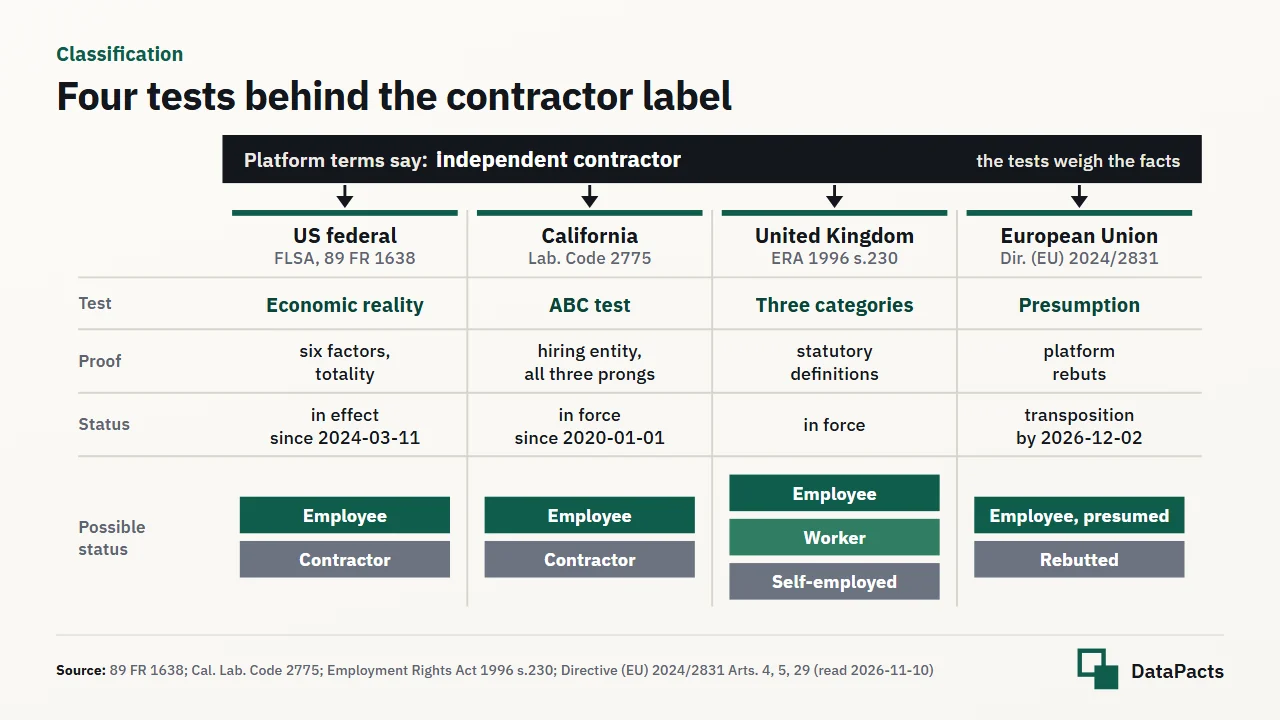
Four tests apply to most AI training contributors, depending on where they work: a federal economic reality test in the US, the stricter ABC test in California, three statutory categories in the UK and an EU presumption of employment from 2026-12-02.
The table compares the four tests by instrument, question asked, burden and status, as of 2026-11-10.
| Jurisdiction | Instrument | Test | Who must prove what | Status and date | Source |
|---|---|---|---|---|---|
| United States (federal) | FLSA; 2024 rule 89 FR 1638 | economic reality: economically dependent (employee) or in business for themself (contractor); six factors | totality of the circumstances | in effect since 2024-03-11; NPRM 91 FR 9932 of 2026-02-27 not final | federalregister.gov; dol.gov |
| California | Cal. Lab. Code 2775 et seq. (AB 5, amended by AB 2257) | ABC test: (A) free from control, (B) outside the usual course of business, (C) independent trade | hiring entity proves all three prongs | in force 2020-01-01 | dir.ca.gov |
| United Kingdom | Employment Rights Act 1996 s.230 | employee (contract of employment); worker (personal work for a party not the individual's client or customer); self-employed | statutory definitions | in force | legislation.gov.uk; gov.uk |
| European Union | Directive (EU) 2024/2831, Arts. 4 and 5 | presumption of employment where facts indicate direction and control | platform rebuts | in force 2024-12-01; transposition by 2026-12-02 | eur-lex.europa.eu |
United States: the FLSA economic reality test and the 2026 proposal
Under the Fair Labor Standards Act, a contributor is an employee when economically dependent on the platform for work and an independent contractor when in business for themself, judged on six factors under the 2024 rule in effect since 2024-03-11. The rule (89 FR 1638, published 2024-01-10) rescinds the 2021 contractor rule, and the Department of Labor's FAQ (read 2026-11-10) names the factors: opportunity for profit or loss depending on managerial skill, investments by the worker and the potential employer, degree of permanence, nature and degree of control, whether the work is integral to the employer's business, and skill and initiative.
A proposed rule, 91 FR 9932, was published on 2026-02-27 after the Department's announcement of 2026-02-26, and it also covers the Family and Medical Leave Act and the Migrant and Seasonal Agricultural Worker Protection Act.
Its comment period closed on 2026-04-28, and dol.gov shows no final rule as of 2026-11-10, so the proposal is not law.
California: the ABC test of Labor Code 2775
California presumes a worker is an employee unless the hiring entity proves all three prongs: free from its control, work outside its usual course of business, and customarily engaged in an independent trade. The test sits in Cal. Lab.
Code 2775 et seq., codified by AB 5 and amended by AB 2257, in force since 2020-01-01, and the burden is on the hiring entity (dir.ca.gov, checked 2026-11-09). Prong B reads on the hiring entity's usual course of business, which for a platform that produces training data is the question the wording itself raises.
United Kingdom: employee, worker and self-employed
UK law sorts people into employees, workers and the self-employed, and a contributor who must do the work personally for a platform that is not their own client can be a worker even without an employment contract.
Employment Rights Act 1996 s.230(1) defines an employee as an individual working under a contract of employment, and s.230(3)(b) defines a worker as an individual who undertakes to perform work or services personally for a party that is not a client or customer of a business the individual carries on (legislation.gov.uk, read 2026-11-10).
GOV.UK adds that a worker has a limited right to subcontract and does not work through their own limited company, with rights to the National Minimum Wage and statutory paid holiday (read 2026-11-10).
European Union: the platform work presumption of Directive (EU) 2024/2831
Directive (EU) 2024/2831 requires every EU member state to presume an employment relationship between a digital labour platform and a person performing platform work where facts indicating direction and control are found, and puts the burden of rebuttal on the platform (Art. 5(1) and 5(2)).
The directive entered into force on 2024-12-01 and member states must bring transposing measures into force by 2026-12-02 (Art. 29(1)); it is a directive and does not apply directly to a platform before national law implements it.
Art. 2(1)(a) defines a digital labour platform by four requirements, including organizing paid work of individuals at a distance by electronic means and the use of automated monitoring or decision-making systems, and Art. 2(1)(c) covers a person performing platform work irrespective of the designation of the relationship.
Recital 19 names microwork or crowdwork platforms, which give clients a flexible workforce for small tasks performed remotely, "such as tagging". Art. 4(2) makes the facts of actual performance, including automated systems, the guide to whether an employment relationship exists, over the contractual label (EUR-Lex, read 2026-11-10).
The presumption applies in administrative and judicial proceedings on employment status, not in tax, criminal or social security proceedings unless national law extends it (Art. 5(3)). A person may start proceedings (Art. 5(4)), and a competent authority that considers a person wrongly classified initiates action (Art. 5(5)).
For contracts ongoing on 2026-12-02 the presumption covers only the period from that date (Art. 5(6)), and the Commission reviews the directive by 2029-12-02 (Art. 30). The record checked as of 2026-11-10 holds no national transposing law.
How the facts of AI training work meet the tests
The tests weigh how the work is actually done, and the platforms' own pages and the complaints record several of the facts they look at: quality scoring, time tracking, unpaid assessments and gross pay without withholding. Each fact below names the factor it bears on and gives no verdict.
- Alignerr states a calibration phase and a composite quality and speed score, which bear on control (checked 2026-11-09).
- Alignerr states Hubstaff time tracking with periodic screenshots, which bears on control and, in the EU, on automated monitoring under Art. 2(1)(a) (checked 2026-11-09).
- DataAnnotation states a Starter Assessment of about an hour and no minimum hours, which bear on permanence and control (checked 2026-11-09).
- Boggs alleges unpaid assessments and onboarding, and Cavalier alleges unpaid training and qualification exams; both are allegations.
- Outlier pays weekly via PayPal, AirTM or ACH and withholds no tax except as required by law (Terms s.3, checked 2026-11-09).
These facts are inputs, not conclusions, and whether a given platform meets Art. 2(1)(a) is for national authorities and courts after transposition. Pay and assessment terms sit side by side in AI training jobs and platforms compared.
What the contributor cases plead about classification
Four contributor lawsuits contest the contractor label, and only one has ended: McKinney v. Scale AI, Superior Court of California, County of San Francisco, CGC-24-620481, settled for a gross USD 12,500,000 with final approval on 2026-10-30, and the class notice allocates contributor payments to non-wages reported on Form 1099.
Boggs (FLSA and Labor Code 2775) is stayed pending mediation since 2026-10-22, Cavalier is pending as of 2026-11-09, and White (misclassification and 26 U.S.C. 7434) is pending as of 2026-11-09. The dockets, amounts and status of each case sit on the page on contributor lawsuits against human data platforms.
Working as a contractor on AI training platforms: benefits, risks, downsides and alternatives
Contractor status trades employment protections for flexibility, and what each contributor gives up depends on the test of the place they work.
Benefits
- Own hours: DataAnnotation states no minimum hours.
- Pay hourly or per task at Outlier, as Outlier states (checked 2026-11-09).
- Weekly payment of tasks at Outlier by PayPal, AirTM or ACH.
Risks
- No minimum wage or overtime protection unless the person is reclassified (29 U.S.C. 206, 207; UK National Minimum Wage for workers).
- Individual arbitration with a class waiver at Outlier unless opted out within 30 days (s.10).
- Unpaid assessment time, alleged in Boggs and Cavalier; Alignerr states no obligation to pay for the interview.
Downsides
- Self-employment tax of 15.3 % on net earnings of USD 400 or more, as of 2026-11-09.
- Form 1099 instead of wage withholding.
- No UK statutory paid holiday unless the person is a worker or employee (GOV.UK).
Alternatives
- Employed roles where a platform or vendor offers them; none is named in the records checked.
- For EU contributors, the Art. 5 presumption from 2026-12-02.
- A status claim before a court or a complaint to a competent authority (Art. 5(4), 5(5)).
- Not taking the work at all.
No option is recommended; each depends on country and facts.
Dates that can change a contributor's classification
Four dated events can change how contributors are classified or what the record shows, and the next is the EU transposition deadline on 2026-12-02.
The table lists the dates in chronological order, as of 2026-11-10.
| Date | Event | Source |
|---|---|---|
| 2026-12-02 | EU member states' transposition deadline; presumption applies to ongoing contracts from this date (Arts. 29(1), 5(6)) | eur-lex.europa.eu |
| 2027-02-05 | status report due in Boggs v. Stryder Corp. (Dkt. 22) | courtlistener.com |
| 2027-09-13 | status conference on distribution in McKinney v. Scale AI | final approval order |
| 2029-12-02 | Commission review of the Directive, including the effectiveness of the presumption (Art. 30) | eur-lex.europa.eu |
| open | final rule on the 2026 FLSA proposal (none published as of 2026-11-10) | dol.gov |
How this page is compiled: statutes, rules, terms and dockets only
Every statement comes from a statute, a regulation, official guidance, a platform's own terms or a court record, each with the date it was read.
Platform pages were checked on 2026-11-09, EUR-Lex, dol.gov, legislation.gov.uk and GOV.UK were read on 2026-11-10, and dockets are as of 2026-11-09, following how we source, date and check every figure. Forums, job boards and law-firm marketing are never sources, and this page is information, not legal advice.
Where classification meets pay, tax and the rest of human data work
This page covers how contributors are classified; the pages below cover the companies, pay, privacy, legitimacy checks, tax and the settlement record.
- human data for AI: the companies
- pay for AI training work: stated rates, dated
- contributor privacy on human data platforms: ID checks, monitoring and breaches
- is AI training work legit: scams and how to check a platform
- McKinney v. Scale AI: the settlement record in full
- AI training work next to a day job: employer rules for a second job
- how DataPacts is funded: no platform pays for a place on this page
Frequently asked questions
Are AI trainers employees or independent contractors?
The platforms whose terms are on record engage them as independent contractors; whether that label holds depends on the test of the place they work, and courts have not ruled on it for AI training contributors in the records checked. Outlier and Alignerr state contractor status in their own terms (checked 2026-11-09).
Does the EU Platform Work Directive cover AI training platforms?
Recital 19 names microwork platforms with small remote tasks such as tagging, and Art. 2(1)(a) sets four requirements for a digital labour platform. Whether a given platform meets them is for national authorities and courts after transposition by 2026-12-02.
Is Outlier work paid on a W-2 or a 1099?
Outlier's FAQ and Terms engage contributors as independent contractors with no withholding except as required by law (checked 2026-11-09). The McKinney class notice reports settlement payments on Form 1099 as non-wages.