The judgment is a first-instance decision and is not final as of November 10, 2026.
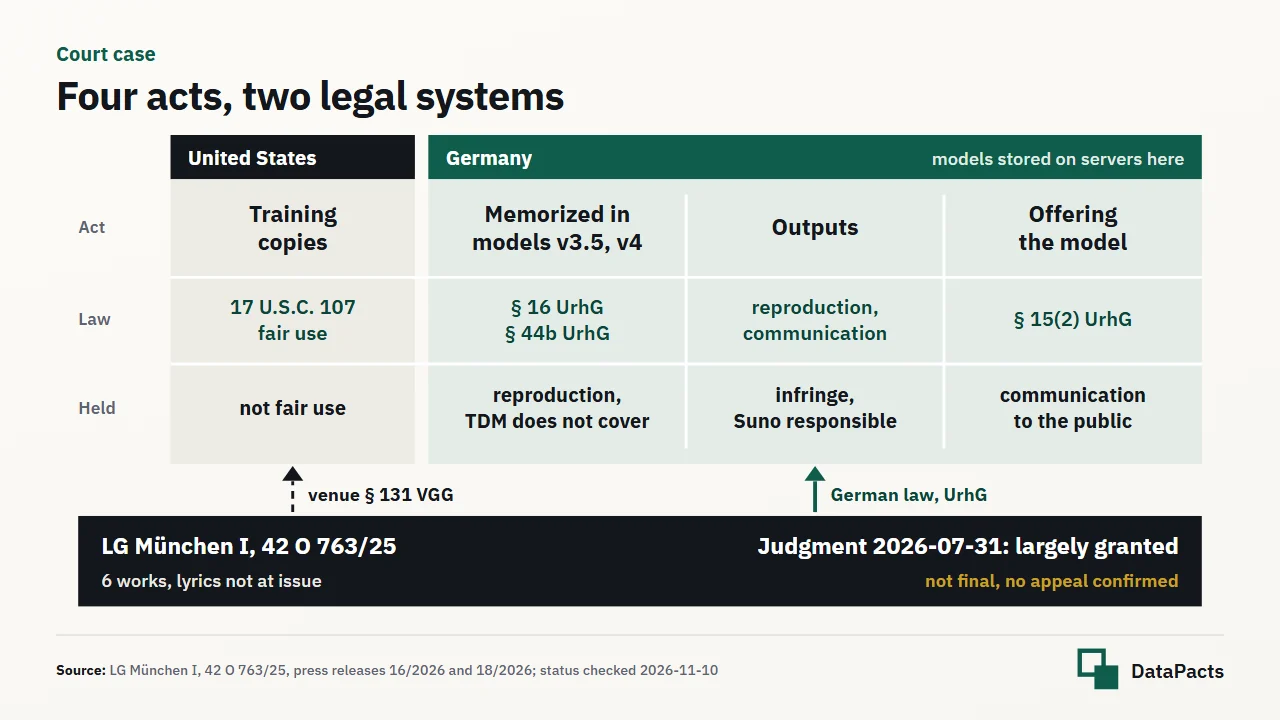
The court held that Suno's training copies made in the United States are not fair use, that the six works are memorized in its models and that the outputs infringe.
This page is part of the independent reference on AI training data licensing and gives no legal advice. DataPacts is not affiliated with GEMA, Suno or any other party.
All dates and dockets below come from the court's press releases and GEMA's own statement, and how figures are sourced and dated is set out on the methodology page.
GEMA v. Suno at a Glance: Court, Docket, Parties and Status
The case has a first-instance judgment that is not final, and no later court notice on it has been published as of November 10, 2026. The table lists the case record as of 2026-11-10.
| Field | Value | Source |
|---|---|---|
| Case | GEMA v. Suno | LG München I press release 16/2026 |
| Court | Landgericht München I (Munich Regional Court I), 42nd civil chamber (copyright) | press release 16/2026 |
| Docket | 42 O 763/25 | press releases 1, 6, 11 and 16/2026 |
| Claimant | GEMA Gesellschaft für musikalische Aufführungs- und mechanische Vervielfältigungsrechte | gema.de imprint |
| Defendant | Suno, Inc. | press release 16/2026; suno.com |
| Filed | 2025-01-21 (GEMA's statement) | gema.de, 2026-07-31 |
| Works | 6 musical works; lyrics not at issue | press release 16/2026 |
| Judgment | 2026-07-31, claims largely granted | press release 16/2026 |
| Status | not final; no appeal confirmed in a court or GEMA source (checked 2026-11-10) | press releases 16 to 18/2026; gema.de |
Two kinds of source sit behind the table. The court's press releases supply the docket, the hearing steps, the works and the holdings.
GEMA's own statement supplies the filing date, the license and payment demand and the venue argument, and this page labels each of those as GEMA's statement. Suno's own statement on the judgment is not part of the record used here.
What GEMA Claimed: Six Works and Suno's Models v3.5 and v4
GEMA claimed an injunction, information and damages for infringement of six musical works through Suno's training copies, the works' memorization in its model versions v3.5 and v4, and the outputs those models generate.
GEMA sues as the society that manages its members' rights, an economic association under § 22 of the German Civil Code (BGB). The court's press release names six works, listed in the table, and states that infringements through the song lyrics were not at issue, which separates this case from GEMA's lyrics suit against OpenAI.
| Work | Scope | Source |
|---|---|---|
| "Atemlos durch die Nacht" | music; lyrics not at issue | press release 16/2026 |
| "Rasputin" | music; lyrics not at issue | press release 16/2026 |
| "Big in Japan" | music; lyrics not at issue | press release 16/2026 |
| "Forever Young" | music; lyrics not at issue | press release 16/2026 |
| "Mambo No. 5" (refrain) | music; lyrics not at issue | press release 16/2026 |
| "Daddy Cool" | music; lyrics not at issue | press release 16/2026 |
Six works in GEMA v. Suno, Munich Regional Court I, 42 O 763/25, as of 2026-07-31.
GEMA states that it filed the suit on January 21, 2025. The court's press releases give no filing date, so the date rests on GEMA's statement alone.
The three routes of the claim are different acts with different law behind them. The training copies were made in the United States and are judged under US law.
The memorization in the models and the outputs concern Germany, where the models were stored on servers. That split explains why one judgment applies both a US defense and German provisions of the UrhG.
From Filing to Judgment: The Munich Hearing Timeline, 2025 to 2026
Five dated steps lead from the filing to the judgment: the suit of January 21, 2025, the postponed hearing of January 26, 2026, the oral hearing of March 9, 2026, the pronouncement date of June 12, 2026 and the judgment of July 31, 2026. The table gives each step with its source, as of 2026-11-10.
| Date | Step | Source |
|---|---|---|
| 2025-01-21 | GEMA files suit (GEMA's statement) | gema.de |
| 2026-01-26 | scheduled hearing postponed after a bias motion | press release 1/2026 |
| 2026-03-09 | oral hearing; pronouncement set for 2026-06-12 | press release 6/2026 |
| 2026-06-12 | pronouncement postponed to 2026-07-31 | press release 11/2026 |
| 2026-07-31 | judgment: claims largely granted; not final | press release 16/2026 |
The January hearing was postponed after a bias motion filed by Suno as the defendant, and the June pronouncement was moved to July 31, 2026. Press releases 1/2026 and 11/2026 are the sources for both steps, and this page gives their dates without further procedural detail.
From the filing to the judgment 556 days passed, and 144 days passed between the oral hearing and the judgment. Between the judgment and the status check of November 10, 2026, 102 days passed without a court notice on the case, although a notice would appear only if the parties or the court publish it.
What the Munich Court Held on July 31, 2026
The 42nd civil chamber largely granted GEMA's claims for an injunction, information and damages, and its reasons address four separate acts: training copies in the US, memorization in the models, the outputs and the offering of the model.
The court's press release does not say which claims were dismissed, so this page writes "largely granted" and describes no dismissed part.
Each of the four acts is assessed on its own legal basis, and the diagram shows them side by side.
The reasons are taken from the court's press release of July 31, 2026, not from the written judgment, which this page does not quote. Where GEMA's statement goes further than the press release, the text says so.
Training Copies Made in the United States: US Law Applied, No Fair Use Defense
The court held that Suno's training copies made in the United States are governed by US law and are not fair use, because the outputs were substantially similar to the works. The doctrine itself (17 U.S.C. 107) and the US rulings on it are covered in fair use and AI training in US law.
For this case, the point is narrow: a German court applied the US defense to copies made in the US. In the United States, the record labels' suit against Suno in Massachusetts is still in discovery as of 2026-11-09, with no fair use ruling recorded.
Works Memorized in Models Stored on Servers in Germany
The six works are memorized in Suno's models v3.5 and v4, which were stored on servers in Germany, and the court held that this memorization is a reproduction under § 16 UrhG that the text and data mining exception in § 44b UrhG does not cover.
The same chamber drew a comparable line between corpus copies and memorization in the model in GEMA v. OpenAI, decided on 2025-11-11.
The two German exceptions, § 44b and § 60d UrhG, are explained in full in German text and data mining rules in UrhG sections 44b and 60d, so this page does not repeat how they work.
Outputs, Suno's Responsibility and Offering the Model
The court held that the outputs infringe and that Suno, not its users, is responsible for them. The responsibility holding matters for any AI developer whose product creates music on request, because it places the output with the operator of the model and not with the person who asks for it.
Offering the model itself infringes the right of communication to the public under § 15(2) UrhG, independent of any single output.
This is a separate act from training and from memorization: the offer of the model is assessed on its own, so the holding does not depend on proving a particular song in a particular output.
Why a Munich Court Ruled on Training in the United States
The court based its international jurisdiction over the US training acts on § 131(1) and (2) of the German Collecting Societies Act (VGG). The provision gives collecting societies such as GEMA a special venue for related claims, and the court applied it to claims that rest on acts in the United States.
GEMA states that suits in Munich are possible wherever training takes place because the systems are operated in Europe. That is GEMA's own statement of 2026-07-31, not a holding in the court's press release.
GEMA v. Suno Status as of November 10, 2026: Not Final
The judgment of July 31, 2026 is not final, as the court's own press release states, and no court notice of an appeal or a later decision has been published as of November 10, 2026. Press release 16/2026 says that the judgment is "nicht rechtskräftig" (not final).
The re-check of November 10, 2026 covered the court's later press releases up to 18/2026 of October 29, 2026, which carry no notice on this case, and GEMA's statement of July 31, 2026, which does not say that Suno appealed.
The accurate reading is therefore "no appeal confirmed in a court or GEMA source", which is neither "appealed" nor "not appealed". No settlement is recorded.
The status line on this page changes only on a court notice or a party's own statement, and never on commentary.
Trade-press and law-firm posts that predict an appeal are not treated as evidence of one. The next check is triggered by any new press release of the Munich Regional Court that names 42 O 763/25.
What the Judgment Signals to Holders of Music Rights
The judgment does not set a license fee: it grants an injunction, information and damages, while the statement that Suno must take a license and pay comes from GEMA, not from the court's press release. GEMA states that it has offered an AI licensing model since September 2024.
GEMA's licensed route for training is PLAI by GEMA, a catalog of about 57,000 works and about 178,000 audio files, which are GEMA's figures checked on 2026-11-09. GEMA says contributors are paid "anteilig und angemessen" (proportionately and appropriately) and publishes no formula. Collective licensing for AI training covers PLAI by GEMA and the other society licenses.
For holders of music rights, the dated facts point in two directions. A court has treated memorization of music in a model as a reproduction that needs permission, and a society has a catalog route for training licenses.
At the same time the judgment is one first-instance decision on six works, it is not final, and it sets no price. It does not decide how other courts, or other German chambers, will treat the same questions.
What the judgment does not decide:
- a price or license term for any AI developer
- the amount of damages
- the outcome of any appeal
Label, publisher and society deals for music are covered on the page for musicians, labels and publishers licensing music for AI training.
Where GEMA v. Suno Sits Among Other Music Training-Data Cases
GEMA v. Suno is one of two GEMA suits decided by the same Munich chamber, and Suno also faces the record labels' suit in Massachusetts.
Every tracked case with its docket and status is in the case tracker of AI copyright lawsuits over training data. The table compares the three nearest music cases as of 2026-11-09.
| Case | Court and docket | Status | Source |
|---|---|---|---|
| GEMA v. OpenAI | LG München I, 42 O 14139/24 | judgment 2025-11-11 largely for GEMA over the lyrics of nine songs; not final | LG München I press release 11/2025 |
| Record Labels v. Suno | D. Mass. 1:24-cv-11611-FDS; second action 1:26-cv-14275 | discovery; Warner's claims dismissed (Doc. 174, letter of 2025-12-09); second action of 2026-09-18 over 60,202 recordings | CourtListener, Doc. 174 |
| Music Publishers v. Anthropic (Concord I) | N.D. Cal. 5:24-cv-03811-EKL | summary judgment ruling pending | Anthropic S-1/A, SEC |
Suno and Warner Music Group announced a partnership on licensed music on 2025-11-25, with no value disclosed, and Warner's US claims were dismissed by stipulation (Doc. 174, letter of 2025-12-09). The Warner license does not touch GEMA's claims. The licensing side of Suno is covered in how Suno licenses music.
More About GEMA v. Suno
Decided Versus Still Open
The Munich court has decided liability at first instance; finality, any appeal and the amount of damages remain open.
| Decided at first instance | Still open |
|---|---|
| claims largely granted | finality of the judgment |
| US training copies not fair use | appeal (none confirmed) |
| memorization and outputs infringe | amount of damages (not in the record here) |
This page is information, not legal advice.
Frequently Asked Questions About GEMA v. Suno
Did GEMA win against Suno?
Yes at first instance: the Munich court largely granted GEMA's claims on 2026-07-31. The judgment is not final, so the result can still change on appeal.
Is the GEMA v. Suno judgment final?
No: the court's press release 16/2026 states that the judgment is not final. No appeal is confirmed in a court or GEMA source as of 2026-11-10.
Which songs were at issue in GEMA v. Suno?
Six musical works were at issue, listed in the works table above, and the lyrics were not at issue. The works are all music catalog titles, and music as AI training data (a separate page, not yet published) covers music as a training data type.
Did GEMA and Suno settle?
No settlement between GEMA and Suno is recorded. Suno's Warner license of 2025-11-25 concerns the US label suit, not GEMA.
Does the judgment say how much Suno must pay?
No amount is published in the court's press release. The court granted the information claim, no damages figure is public, and GEMA's demand that Suno take a license is GEMA's statement.