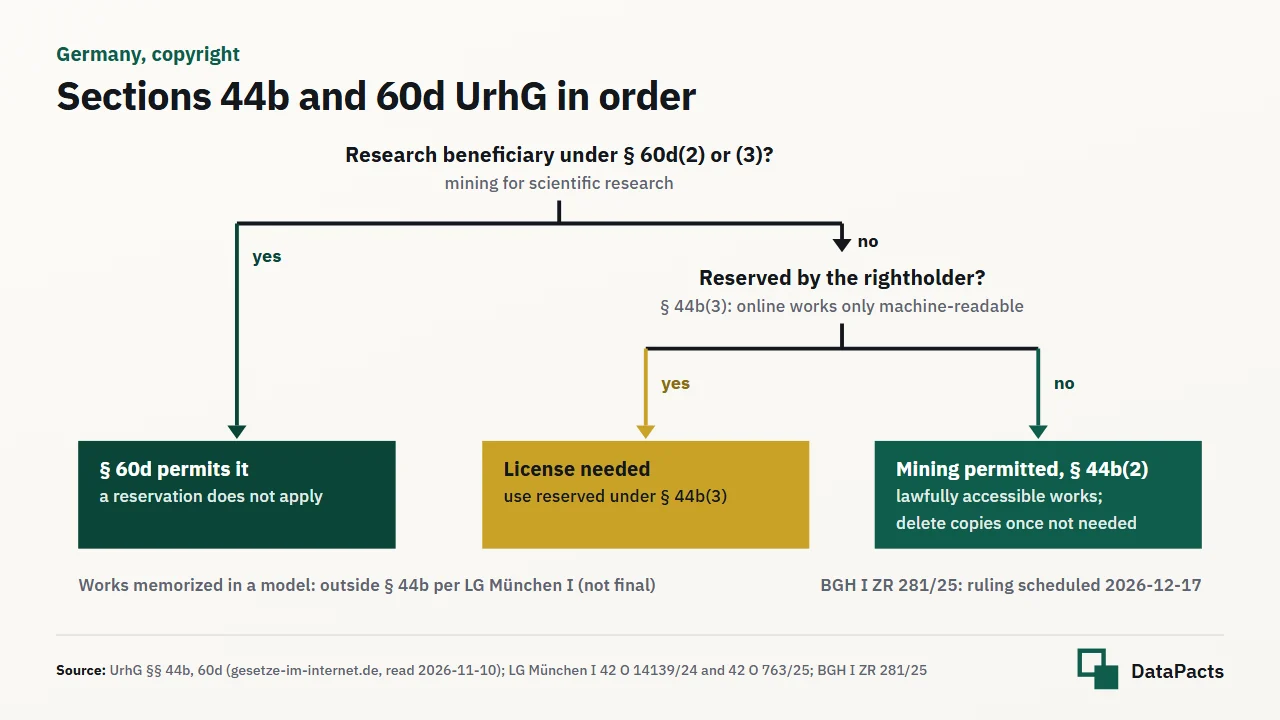
Section 44b implements Art. 4 and section 60d implements Art. 3 of Directive (EU) 2019/790.
The Federal Court of Justice (Bundesgerichtshof, BGH) has scheduled its pronouncement in I ZR 281/25 for 2026-12-17, so the highest-court reading is open as of 2026-11-10. This page walks each subsection, the court readings and the licensing decision, as the German copyright layer of AI training data licensing.
Statute text was read on gesetze-im-internet.de on 2026-11-10 and rulings are dated from court sources, as set out in the method for sourcing and dating every figure.
Sections 44b and 60d UrhG, Subsection by Subsection
The two sections split German text and data mining into a general permission that a rightholder can reserve and a research permission that it cannot. The table paraphrases the German text in English as of 2026-11-10.
| Provision | What it says (summary of the German text) | Who may rely on it | Reservation applies | Source |
|---|---|---|---|---|
| § 44b(1) | Definition: automated analysis of one or more digital or digitized works to obtain information, in particular patterns, trends and correlations | n/a (definition) | n/a | gesetze-im-internet.de |
| § 44b(2) | Reproductions of lawfully accessible works permitted for text and data mining; delete once no longer needed | Anyone, commercial or not | Yes | gesetze-im-internet.de |
| § 44b(3) | Use under (2) only if not reserved; for online works the reservation is effective only if machine-readable | Rightholder (reserves) | n/a | gesetze-im-internet.de |
| § 60d(1) | Reproductions under § 44b(1) and (2) sentence 1 permitted for scientific research | Beneficiaries in (2) and (3) | No | gesetze-im-internet.de |
| § 60d(2) | Research organizations: non-commercial, all profits reinvested, or state-recognized public-interest mandate; excluded if a private company with decisive influence has preferential access to results | Research organizations | No | gesetze-im-internet.de |
| § 60d(3) | No. 1 publicly accessible libraries and museums, archives, film and audio heritage institutions; No. 2 individual researchers without commercial purposes | Cultural heritage institutions, individual researchers | No | gesetze-im-internet.de |
| § 60d(4) | Non-commercial beneficiaries may share with a defined group for joint research or with third parties checking quality, until that work ends | Non-commercial beneficiaries | No | gesetze-im-internet.de |
| § 60d(5) | Beneficiaries under (2) and (3) No. 1 may retain copies with adequate safeguards as long as needed for research or verification | Research organizations, heritage institutions | No | gesetze-im-internet.de |
| § 60d(6) | Rightholders may take necessary measures for the security and integrity of networks and databases | Rightholder | n/a | gesetze-im-internet.de |
The in-force date of each section is not stated here.
The Statutory Definition in Section 44b(1) and Where AI Training Fits
Section 44b(1) defines text and data mining as the automated analysis of one or more digital or digitized works to obtain information, in particular about patterns, trends and correlations. The definition is the gateway for both sections, because section 60d(1) permits reproductions "nach § 44b Absatz 1 und 2 Satz 1" for scientific research.
The statute does not name AI training. The Higher Regional Court of Hamburg, according to the BGH notice, treated the automated matching of an image with its description as such an analysis and found it unnecessary to decide whether later training of generative models also qualifies.
The Regional Court of Munich I held that copying during training into a model is not text and data mining (see the memorization section below). No outcome of the BGH proceedings is implied here.
Copies of Lawfully Accessible Works and the Deletion Duty in Section 44b(2)
Section 44b(2) permits reproductions of lawfully accessible works for text and data mining and requires them to be deleted once they are no longer needed for that purpose. "Lawfully accessible" is the condition for the permission.
This page records no German ruling that defines it, although the BGH notice mentions that the picture agency's terms barred automated access to the preview image, and no holding on that point is stated here.
The deletion duty contrasts with the retention that section 60d(5) allows for research. For a developer, the duty concerns the mining copies, while what a model retains after training raises the separate memorization question.
The Rightholder Reservation in Section 44b(3) and Its Form for Online Works
Under section 44b(3), mining under subsection 2 is permitted only if the rightholder has not reserved it, and a reservation for works accessible online is effective only if made in machine-readable form. For offline works the statute sets no form, and nothing more is read into the text here.
The German wording differs from Art. 4(3) of the Directive (transposition deadline 2021-06-07), which requires a reservation "in an appropriate manner, such as machine-readable means in the case of content made publicly available online".
The Directive's rule and its opt-out are covered on the page about the EU text and data mining exception and its opt-out.
For a holder, the practical consequence is that a plain-language line in terms of use was not shown to suffice in the appellate ruling recorded here. Protocol names are left to the border section below.
How the Hamburg Courts Treated a Reservation Written in Plain Words
The Higher Regional Court of Hamburg held a reservation ineffective on its record because the photographer had not shown that it was machine-readable when the images were retrieved in the second half of 2021.
The Regional Court of Hamburg dismissed the claim on 2024-09-27 (310 O 227/23), and the BGH notice gives no reasoning for that judgment.
The appeal was dismissed on 2025-12-10 (5 U 104/24): the retrieval was a reproduction under section 16(1) UrhG, justified by section 44b, and the reservation in natural language was not enough on that record. The Revision is before the BGH, with pronouncement scheduled for 2026-12-17 at 08:45.
Parties, dataset facts and procedure sit on the page on Kneschke v. LAION in the Hamburg courts and at the Federal Court of Justice.
Section 60d UrhG: Mining for Scientific Research Without a Reservation
Section 60d permits the reproductions defined in section 44b(1) and (2) sentence 1 for scientific research, and a rightholder's reservation under section 44b(3) does not apply to them.
The section implements Art. 3 of the Directive; at EU level Art. 7(1) protects Art. 3 against contract override, while Art. 4 can be excluded by contract. The German rule on contract override is not stated here.
The Higher Regional Court of Hamburg applied section 60d(1) in addition to section 44b ("zudem"), not in the alternative.
Who Qualifies Under Section 60d(2) and (3), and Who Is Excluded
Research organizations, cultural heritage institutions and individual researchers may rely on section 60d, each under its own conditions.
- Section 60d(2): research organizations (universities, research institutes, other bodies doing scientific research) that pursue no commercial purpose, reinvest all profits in research, or act under a state-recognized public-interest mandate.
- Section 60d(3) No. 1: publicly accessible libraries and museums, archives, and film and audio heritage institutions.
- Section 60d(3) No. 2: individual researchers without commercial purposes.
Section 60d(2) excludes organizations that cooperate with a private company holding decisive influence and preferential access to the research results.
The Hamburg appellate court held LAION e.V. (Hamburg register of associations, VR 25085) to be a research organization doing applied research, and held that commercial users of the open dataset did not change this, per the BGH notice. The association's output is described on the page for LAION-5B and Re-LAION-5B.
Sharing, Retention and Network Security Under Section 60d(4) to (6)
Section 60d adds three rules that section 44b lacks: limited sharing, retention for research and protective measures for rightholders.
- Subsection 4: non-commercial beneficiaries may make copies available to a defined group for joint research or to individual third parties checking research quality, ending when that work ends.
- Subsection 5: beneficiaries under subsection 2 and subsection 3 No. 1 may keep copies with adequate safeguards against unauthorized use as long as needed for research or verifying results.
- Subsection 6: rightholders may take necessary measures to protect the security and integrity of their networks and databases.
Retention under subsection 5 is the opposite of the deletion duty in section 44b(2).
Section 44b and Model Training: Corpus Copies Versus Works Memorized in a Model
The Regional Court of Munich I has twice drawn a line between copies made to assemble a training corpus, which section 44b can cover, and works memorized in a model, which it does not.
In GEMA v. OpenAI (42 O 14139/24, 2025-11-11, lyrics of nine songs) the court held that section 44b covers copies needed to compile the dataset, such as format conversion and temporary storage in memory.
Copying into the model during training is "kein Text und Data Mining", an analogy was rejected, memorization is a reproduction under section 16 UrhG and the outputs infringe. The judgment is not final.
In GEMA v. Suno (42 O 763/25, 2026-07-31, six musical works) the court held that memorization in versions 3.5 and 4 on servers in Germany infringes section 16 UrhG and that section 44b does not apply; training copies made in the United States were governed by US law. That judgment is not final either.
The Hamburg ruling and the Munich rulings concern different acts, dataset building versus model content, so they do not contradict each other on their records. Neither Munich judgment binds the BGH.
German Rulings on Sections 44b and 60d, Dated
Four judgments and one scheduled pronouncement make up the German case law on the two sections recorded here, each with court, docket, date and status, as of 2026-11-10.
| Date | Court and docket | Case | Holding on §§ 44b or 60d | Status | Source | Page |
|---|---|---|---|---|---|---|
| 2024-09-27 | LG Hamburg, 310 O 227/23 | Kneschke v. LAION | Claim dismissed (no reasoning stated here) | Appealed | bundesgerichtshof.de | n/a |
| 2025-11-11 | LG München I, 42 O 14139/24 | GEMA v. OpenAI | § 44b covers corpus copies, not works memorized in the model | Not final | justiz.bayern.de | GEMA v. OpenAI |
| 2025-12-10 | OLG Hamburg, 5 U 104/24 | Kneschke v. LAION | Appeal dismissed: § 44b (reservation not shown machine-readable for H2 2021) and in addition § 60d(1); three-step test met | Revision pending | bundesgerichtshof.de | n/a |
| 2026-07-31 | LG München I, 42 O 763/25 | GEMA v. Suno | Memorization on servers in Germany infringes § 16 UrhG, § 44b not applicable | Not final; appeal status not checked | justiz.bayern.de | GEMA v. Suno |
| 2026-12-17 (scheduled) | BGH, I ZR 281/25 | Kneschke v. LAION | Pronouncement at 08:45; hearing held 2026-09-03; no decision as of 2026-11-10 | Pending | bundesgerichtshof.de | n/a |
No ruling in the table is final: the Regional Court of Hamburg judgment was appealed, the Higher Regional Court of Hamburg judgment is under Revision and both Munich judgments are not final. The full tracker is linked in the border section.
Using the Section 44b Reservation in a Licensing Decision: Benefits, Risks, Downsides and Alternatives, Including Not Licensing
A German rightholder can reserve its works, license them, or leave them to the exceptions, and not licensing at all remains a valid choice.
Benefits
- An effective machine-readable reservation takes online works out of section 44b mining, so commercial mining needs a license.
- General-purpose AI model providers must keep a copyright policy that identifies and complies with Art. 4(3) reservations (Regulation (EU) 2024/1689 Art. 53(1)(c), applying from 2025-08-02).
- Licensing through a collecting society is a route, described under collective licensing for AI training.
Risks
- Section 60d mining stays permitted whatever the reservation says.
- The only appellate ruling recorded here found the reservation on its record not shown machine-readable.
- The BGH may read section 44b differently on 2026-12-17; no outcome is implied.
Downsides
- Both Munich judgments are not final.
- This page records no German price or remuneration for text and data mining uses.
Alternatives
- Not reserving and not licensing.
- Reserving without licensing.
- Licensing through a collective.
- Waiting for the BGH pronouncement, without implying an outcome.
The full decision is set out on the page that asks should you sell or license your data to AI companies.
Beyond Sections 44b and 60d: EU Rules, Reservation Protocols and the German Data Deal
Sections 44b and 60d are the copyright layer of German law. Staff data, works councils and the rest of a German data deal are on the Germany page.
- How to express a reservation in machine-readable form: machine-readable TDM reservations.
- The duty on model providers to honor reservations: EU AI Act Article 53 and the copyright policy.
- How other countries treat mining: copyright and AI training across jurisdictions.
- Every tracked case with its status: AI copyright lawsuits over training data.
- Contract and computer-misuse claims beside copyright: is web scraping for AI training legal.
- Warranty and scope clauses for licensed works: AI data licensing agreements.
- Every jurisdiction: AI training data law by jurisdiction.
What This Page Does Not Cover
This page covers copies made to mine works for AI training under German law, not whether AI outputs can be protected by copyright. Sections 44a, 87b and 95a UrhG are not the text and data mining provisions and are not described here.
How This Page Is Sourced and Dated
Statute text is quoted from gesetze-im-internet.de as read on 2026-11-10, and every ruling cites the court, docket and date from the court's own notice or press release.
The approach is explained in how we source, date and check every figure. This page is general information about German copyright law, not legal advice for any specific deal or dispute.
Frequently Asked Questions
Can a commercial AI developer rely on section 60d UrhG?
Not as a commercial developer: section 60d covers research organizations that pursue no commercial purpose, reinvest all profits in research or hold a state-recognized public-interest mandate. It excludes bodies under the decisive influence of a private company with preferential access to results. The Higher Regional Court of Hamburg held that commercial users of an open dataset did not change the research status of its publisher.
Has the Federal Court of Justice ruled on section 44b?
Not yet: the BGH heard I ZR 281/25 on 2026-09-03 and will pronounce its decision on 2026-12-17 at 08:45. As of 2026-11-10 no decision exists, and no outcome is stated here.
Does section 44b UrhG cover what a model memorizes?
Not according to the Regional Court of Munich I, whose two judgments, neither final, hold that works memorized in a model fall outside section 44b. The judgments are GEMA v. OpenAI (2025-11-11) and GEMA v. Suno (2026-07-31); corpus copies were treated differently in the first.