The Federal Court of Justice (Bundesgerichtshof, BGH) has scheduled its pronouncement in Kneschke v LAION for 2026-12-17.
This page sets out the German statutes, rulings and regulator positions as of 2026-11-09, for the data holder and the AI developer. It belongs to the wider reference on AI training data licensing and covers EU rules only where Germany differs from or adds to them.
Each figure is dated and checked against the official text, as described in the method for sourcing and dating every figure.
What German Law Adds to EU Rules Before a Company Licenses Data for Training
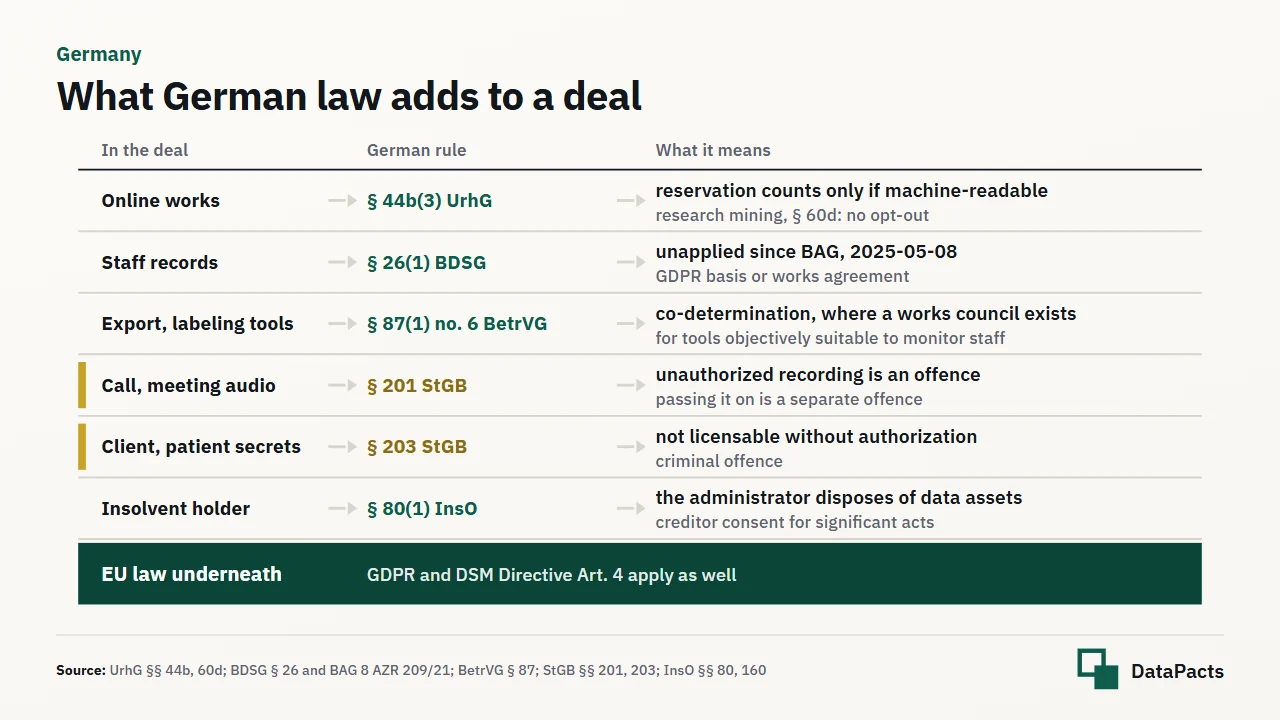
German law decides six things on top of the EU instruments.
- Reservation form: section 44b(3) UrhG, machine-readable for online works.
- Research mining: section 60d UrhG allows it without an opt-out.
- Staff data: section 26(1) BDSG, unapplied since 2025-05-08, so the GDPR basis carries it.
- Works council: section 87(1) no. 6 of the Works Constitution Act (Betriebsverfassungsgesetz, BetrVG).
- Recordings and professional secrets: sections 201 and 203 of the Criminal Code (Strafgesetzbuch, StGB).
- Estate sales: the Insolvency Code (Insolvenzordnung, InsO).
The GDPR (Regulation (EU) 2016/679, applies from 2018-05-25) applies directly, and Article 4(3) of Directive (EU) 2019/790 already requires machine-readable online reservations.
German Statutes, Rulings and Regulator Positions in a Training Data Deal
Fifteen German statutes, regulator positions and open items shape a training-data license, and the table gives each citation, its date and whether it is final, pending or open. "Open" means no primary source was verified on 2026-11-09, not that no rule exists.
| Instrument | Citation | Dates | What it decides in a data deal | Final, pending or open | Source |
|---|---|---|---|---|---|
| Copyright Act, commercial mining | § 44b UrhG (implements DSM Art. 4) | in force, date open; re-read 2026-11-10 | copies of lawfully accessible works allowed unless reserved; online reservation effective only machine-readable (§ 44b(3)) | final; scope before the BGH | gesetze-im-internet.de |
| Copyright Act, research mining | § 60d UrhG (implements DSM Art. 3) | in force | research mining without opt-out; privately controlled organizations with privileged access excluded | final | gesetze-im-internet.de |
| GDPR | Regulation (EU) 2016/679 | applies from 2018-05-25 | legal basis, notices, transfers for personal data in the set | final | eur-lex.europa.eu |
| Federal Data Protection Act, employee data | § 26 BDSG; BAG 8 AZR 209/21 | § 26(1) unapplied since 2025-05-08 | staff archives need a GDPR basis or an Art. 88(2) works agreement; § 26(8) covers applicants and former staff | final | bundesarbeitsgericht.de |
| Works Constitution Act | BetrVG § 87(1) no. 6, § 87(2), § 80(3), § 90(1) no. 3 | in force | co-determination over monitoring-capable tools; conciliation board decides without agreement | final | gesetze-im-internet.de |
| Telecom secrecy | § 3 TDDDG | in force 2021-12-01; renamed 2024-05-14 | binds public or commercial telecom providers; employers generally not (Federal Network Agency 2025-07, LDI NRW 2024) | final | gesetze-im-internet.de |
| Confidentiality of the spoken word | § 201 StGB | in force | unauthorized recording and passing on are offences; up to 3 years (5 for officials) | final | gesetze-im-internet.de |
| Professional secrets | § 203 StGB; § 205(1) | in force | client and patient secrets not licensable without authorization; up to 1 year, 2 for payment | final | gesetze-im-internet.de |
| Trade Secrets Act | GeschGehG § 2 no. 1 | in force; re-read 2026-11-10 | defines a protected trade secret; third-party secrets not the seller's to license | final | gesetze-im-internet.de |
| Insolvency Code | §§ 80(1), 159, 160 InsO | in force | administrator disposes of data assets; creditor consent for significant acts | final | gesetze-im-internet.de |
| DSK asset-deal resolution | resolution of the joint conference of data protection authorities | 2024-09-11 | pre-signing transfer in principle not permitted without consent; about 6 weeks objection period | regulator position, not law | datenschutzkonferenz-online.de |
| DSK AI guidance | DSK guidance list | 2024-05-06 | content not stated | regulator position; content open | datenschutzkonferenz-online.de |
| AI Act national enforcement | not stated | not stated | not stated | open | n/a |
| US-Germany treaty rates on royalties | IRS Tax Treaty Table 1, Rev. May 2023, income codes 10 and 12 | as of 2026-11-09 | 0% US withholding for German residents, subject to limitation on benefits | final | irs.gov |
| German withholding on royalties paid abroad | not stated | not stated | not stated | open | n/a |
How Each German Rule Reaches the Seller and the Buyer
The table lists each rule; the sections below show what each one asks of the data holder and of the AI developer.
Reserving Online Works in Machine-Readable Form, and the Research Carve-Out
Section 44b UrhG allows reproductions of lawfully accessible works for text and data mining, and section 44b(3) lets the rightholder reserve that use, but for works accessible online a reservation is effective only in machine-readable form.
Under section 44b(2) the copies are deleted once they are no longer needed. The section implements Article 4 of the DSM Directive, see the EU text and data mining exception and its opt-out.
Section 60d UrhG is the separate research carve-out: research organizations, cultural heritage institutions and individual researchers may mine without any opt-out, organizations controlled by a private company with privileged access are excluded, and section 60d(5) allows retention with safeguards.
For a seller, a plain-language line on a terms page may not count, so the reservation is recorded machine-readably before any talks. The in-force date of section 44b is not stated here.
The Hamburg and Munich Rulings on Dataset Copies and Memorized Works
Kneschke v LAION is the German test of a natural-language reservation: the Regional Court of Hamburg dismissed the photographer's claim (310 O 227/23, 2024-09-27), and the Higher Regional Court of Hamburg dismissed his appeal on 2025-12-10 (5 U 104/24).
Per the BGH case notice, the reservation was not shown machine-readable in the second half of 2021, and the use was in addition covered by section 60d(1) UrhG.
The BGH (I ZR 281/25) heard the appeal on points of law on 2026-09-03, and the pronouncement is scheduled for 2026-12-17, per Kneschke v. LAION before the Federal Court of Justice.
The Regional Court of Munich I has ruled twice, neither judgment final. In GEMA v OpenAI (42 O 14139/24, 2025-11-11, nine song lyrics) section 44b covers copies made to assemble a training corpus but not works memorized in the model.
In GEMA v Suno (42 O 763/25, 2026-07-31, six works) memorization on servers in Germany infringes section 16 UrhG, and section 44b does not apply.
Staff Records: What Remains of Section 26 BDSG
Germany's employee-data provision, section 26 of the Federal Data Protection Act (BDSG), cannot carry a license of staff archives, because the BAG held on 2025-05-08 (8 AZR 209/21) that section 26(1) does not meet Article 88 GDPR and stays unapplied.
The BAG relies on CJEU C-34/21 (2023-03-30) and C-65/23 (2024-12-19). Section 26(8) BDSG treats applicants and former staff as employees.
There an employer moved staff data to a group server to test software, and the BAG held that real data may be used for tests under Article 6(1)(f) GDPR only where dummy data do not suffice.
A temporary works agreement allowed 9 data fields, more were uploaded, and the court awarded EUR 200 on 2025-05-08. A basis for a license therefore comes from the GDPR or from a works agreement meeting Article 88(2), as explained under employee data under GDPR Article 88.
Tools That Can Monitor Staff Need the Works Council's Agreement
Where a works council (Betriebsrat) exists, introducing technical devices that can monitor employee behavior or performance needs its co-determination under BetrVG § 87(1) no. 6, and without agreement the conciliation board (Einigungsstelle) decides (§ 87(2)).
In case 1 ABR 7/15 (2016-12-13) the BAG held that a device is designed to monitor when it is objectively suitable to collect conduct or performance information, whatever the employer intends. Export, labeling or de-identification tooling can therefore fall under the right.
The council also has AI-specific rights: an expert where it must assess AI (§ 80(3)), timely information on planned work procedures including AI (§ 90(1) no. 3) and AI-supported selection guidelines (§ 95(2a)).
Mailboxes Where Private Use Is Allowed: The Section 3 TDDDG Question
Telecom secrecy under § 3 of the Telecommunications Digital Services Data Protection Act (TDDDG, renamed from TTDSG on 2024-05-14) binds providers of publicly available or commercially offered telecom services, and the old question was whether an employer allowing private email use becomes one.
Federal Network Agency guidance (July 2025) treats employer offers to employees as generally not covered, and the North Rhine-Westphalia data protection authority (LDI NRW, 29th report, 2024) holds that the secrecy no longer applies to such employers. The GDPR still applies.
Call and Meeting Audio: The Offence in Section 201 StGB
Recording non-public spoken words without authorization is a crime under § 201 StGB, punishable by up to 3 years or a fine (up to 5 years for public officials, § 201(3)), and making such a recording available to a third party is a separate offence.
Licensing such audio can be criminal on top of GDPR exposure. Germany has no one-party consent rule.
Secrets the Seller Does Not Own: Section 203 StGB and the GeschGehG
Some archive records are other people's secrets, and German criminal law forbids passing them on: § 203 StGB covers secrets entrusted to physicians, lawyers, tax advisers, auditors and private health, accident and life insurers, with up to one year or a fine, two years where the offender acts for payment (§ 203(6)), prosecuted only on request (§ 205(1)).
The Trade Secrets Act (Gesetz zum Schutz von Geschäftsgeheimnissen, GeschGehG) § 2 no. 1 defines a trade secret as information that is not generally known or readily accessible, has economic value for that reason and is subject to reasonable secrecy measures by its lawful holder with a legitimate interest in secrecy.
Customers' and suppliers' secrets in tickets or email are likewise not the seller's to license.
When the Data Holder Is Insolvent
On opening of insolvency proceedings the power to dispose of the estate, data assets included, passes to the insolvency administrator (Insolvenzverwalter) (§ 80(1) InsO), who realizes it after the report meeting (§ 159) with creditor consent for particularly significant acts (§ 160). The sale mechanics are covered in German insolvency and data sales.
Royalty Payments Between Germany and the United States
A US buyer paying a royalty to a German-resident seller withholds 0% on copyright royalties (income code 12) and other industrial royalties (income code 10) under IRS Table 1, Rev. May 2023, subject to the limitation-on-benefits test. German withholding on royalties paid by a German buyer to a non-resident is not stated here.
Positions of German Data Protection Authorities and Courts on Training
For the joint conference of German data protection authorities (Datenschutzkonferenz, DSK), no rule on licensing data to AI developers is recorded here, but its asset-deal resolution of 2024-09-11 shows how it reads transfers of customer and staff data.
Before signing, transfers of customer, supplier and employee data are in principle not permitted without consent, with an exception for key persons, and special categories need explicit consent. AI guidance dated 2024-05-06 is listed by the DSK, and its content is not described here.
The Higher Regional Court of Cologne (15 UKl 2/25, 2025-05-23) rejected a consumer association's interim application against Meta, finding on summary review that AI training can be a legitimate interest. The proceedings are in Meta AI training on EU user data.
Enacted, Pending and Scheduled: German Changes as of November 2026
Fourteen dated items changed how German law and German courts treat data used for training, and the table keeps statutes, judgments and regulator positions apart.
| Date | Item | Citation or actor | Status as of 2026-11-09 | Source |
|---|---|---|---|---|
| 2026-12-17 (scheduled) | BGH pronouncement in Kneschke v LAION | BGH I ZR 281/25 | scheduled 08:45; no decision yet | bundesgerichtshof.de |
| 2026-09-03 | BGH hearing | BGH I ZR 281/25 | held | bundesgerichtshof.de |
| 2026-07-31 | GEMA v Suno judgment | LG München I 42 O 763/25 | not final | justiz.bayern.de |
| 2025-12-10 | Appeal in Kneschke v LAION dismissed | OLG Hamburg 5 U 104/24 | appeal on points of law pending | bundesgerichtshof.de |
| 2025-11-11 | GEMA v OpenAI judgment | LG München I 42 O 14139/24 | not final | justiz.bayern.de |
| 2025-07 | NI-ICS guidance: employer offers generally not telecom services | Bundesnetzagentur | guidance | bundesnetzagentur.de |
| 2025-05-23 | Interim application against Meta's AI training rejected | OLG Köln 15 UKl 2/25 | decided; main proceedings not found | nrwe.justiz.nrw.de |
| 2025-05-08 | § 26(1) BDSG left unapplied; EUR 200 damages | BAG 8 AZR 209/21 | final | bundesarbeitsgericht.de |
| 2024-12-19 | Art. 88 rules must meet Arts. 5, 6(1), 9 | CJEU C-65/23, referred by the BAG | decided | eur-lex.europa.eu |
| 2024-09-27 | Photographer's claim against LAION dismissed | LG Hamburg 310 O 227/23 | appealed | bundesgerichtshof.de |
| 2024-09-11 | Asset-deal resolution | DSK | adopted | datenschutzkonferenz-online.de |
| 2024-05-14 | TTDSG renamed TDDDG | Art. 8, Act of 6 May 2024 | in force | gesetze-im-internet.de |
| 2024-05-06 | AI guidance listed | DSK | published; content not stated | datenschutzkonferenz-online.de |
| 2023-03-30 | National Art. 88 rules missing Art. 88(2) disregarded | CJEU C-34/21 (Hessian reference) | decided | eur-lex.europa.eu |
Neither GEMA judgment is final and the BGH pronouncement is scheduled, so no outcome is written here. National AI Act enforcement is not stated. Every tracked ruling on training data is listed under AI copyright lawsuits over training data.
German Publishers and Rights Holders in Recorded AI Deals
Six recorded deals or offers involve German publishers or a German collecting society, and only one of them, Axel Springer's 2023 agreement with OpenAI, states training in its own announcement.
| Date | Parties | What it covers, per the stating party | Training stated? | Stated by |
|---|---|---|---|---|
| 2023-12-13 | OpenAI and Axel Springer SE | ChatGPT summaries with attribution; content "for advancing the training" of OpenAI's models | yes | Axel Springer |
| 2024-10-01 | Microsoft and Axel Springer (among others) | Copilot Daily pulls only from authorized sources | not stated | Microsoft |
| 2025-12-10 | Google and Der Spiegel (among others) | enhanced content for AI features in Google News; Google pays participants | not stated | |
| 2026-02-03 | Microsoft Publisher Content Marketplace and Business Insider (Axel Springer brand) | grounding AI answers, usage-based, "paid on delivered value" | not stated | Microsoft |
| by 2026-07-27 | Meta and Süddeutsche Zeitung (among others) | real-time news and links in Meta AI answers | not stated | Meta |
| checked 2026-11-09 | PLAI by GEMA (licensor offering, not a buyer) | training catalog, ca. 57,000 works, ca. 178,000 audio files, exclusive per customer | offered for training | GEMA |
No party discloses a value for these deals. GEMA is a licensor, never a buyer, and display and grounding are not training licenses. All recorded deals are compared in AI data licensing deals.
Benefits, Risks, Downsides and Alternatives of Licensing Data Under German Law, Including Not Selling
German law lets a company license data it holds the rights to, and the machine-readable reservation gives online content license value, but staff data, works council rights and criminal limits add conditions, and not licensing remains a valid choice.
Benefits
- A recorded machine-readable reservation keeps a license necessary for commercial mining under section 44b(3) UrhG.
- A 0% US treaty rate applies to royalties paid to German residents, subject to limitation on benefits.
- The DSK and court positions show what regulators expect.
Risks
- Sections 201 and 203 StGB create criminal exposure for recordings and professional secrets.
- Staff can claim damages, as in the BAG case (EUR 200, 2025-05-08).
- The rulings in Kneschke v LAION and the Munich cases are still pending at the BGH or not final.
Downsides
- A works council agreement or a conciliation board procedure costs time before any income.
- Open national items on withholding and AI Act enforcement mean advice per deal.
Alternatives
- License only content without staff or third-party data.
- Keep the data and record a machine-readable reservation.
- License de-identified data.
- Not selling or licensing at all, among the alternatives to selling data to AI labs.
Beyond the German Layer: EU Instruments, Topic Comparisons and the Sale
German law stops at the EU layer above it and at the contract; the pages below cover the EU instruments, compare topics across jurisdictions and apply the rules to a sale.
- European Union rules for AI training data, the parent and the EU layer above German law.
- AI training data law by jurisdiction, every jurisdiction compared.
- GDPR and AI training data, legal basis, notices and transfers.
- copyright and AI training across jurisdictions, how copyright exceptions compare.
- employee data and AI training rules by jurisdiction.
- call and meeting recording consent rules compared.
- machine-readable TDM reservations, how to make a reservation machine-readable.
- employee notice and consent, the employee step in a sale.
- sell or license company data to AI companies, the steps of a sale.
- Austria rules for licensing data, the neighbor next door.
- EU Trade Secrets Directive, the EU trade secrets layer.
How This Page Is Sourced and Dated
Every rule here cites the federal law portal gesetze-im-internet.de, the court's own decision or notice, or the regulator's own document, with the check date.
The rules for dating and checking are set out in the method for sourcing and dating every figure. This page is general information about German law, not legal advice for any specific deal.
Frequently Asked Questions
How does a rightholder in Germany reserve online works from AI mining?
By a reservation in machine-readable form. For works accessible online, section 44b(3) UrhG makes a reservation effective only if it is machine-readable.
Can a German company license employee emails on the basis of section 26 BDSG?
No, section 26(1) BDSG is unapplied since the BAG ruling of 2025-05-08. A basis comes from the GDPR or from a works agreement that meets Article 88(2).
Has the Federal Court of Justice decided Kneschke v LAION?
No, the pronouncement is scheduled for 2026-12-17. Both Hamburg courts ruled for LAION, on 2024-09-27 and 2025-12-10.
Is passing call recordings to an AI buyer a crime in Germany?
Yes, where the recording was made or passed on without authorization. Section 201 StGB provides up to 3 years or a fine.