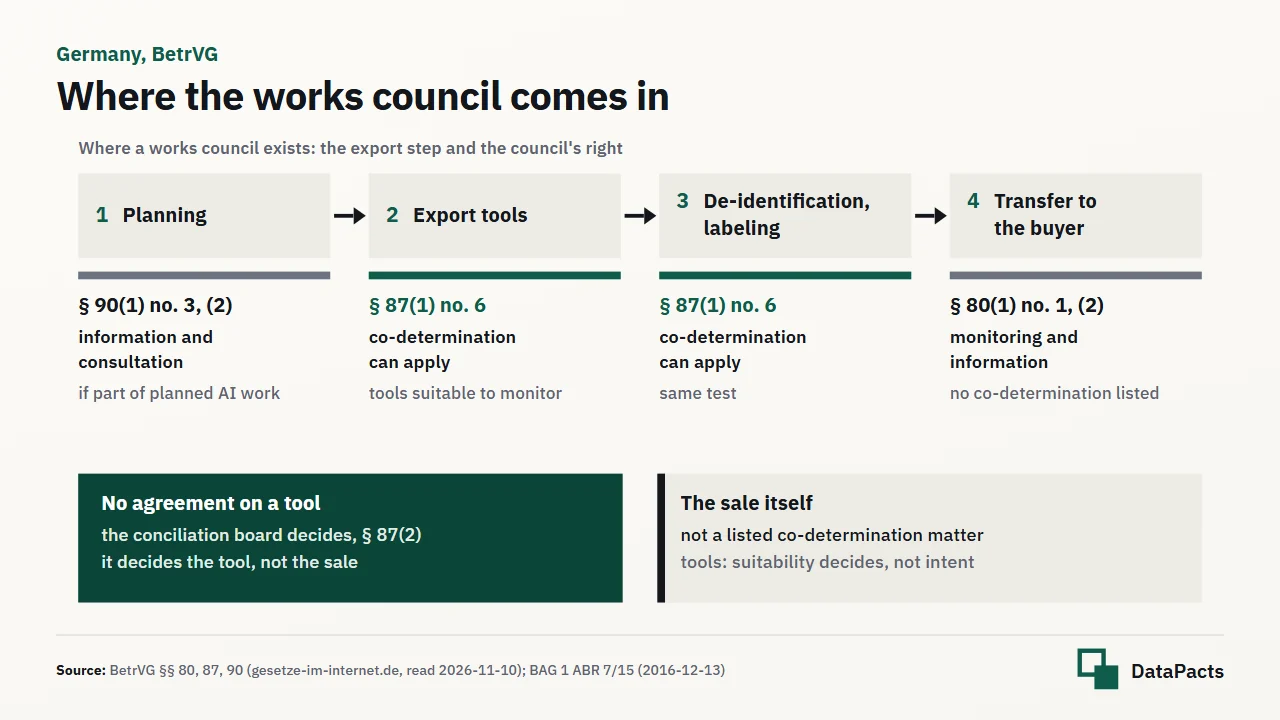
The sale itself is not a listed co-determination matter, and the council decides about the tools, not about whether the company may license.
This page, as of 2026-11-10, sets out the co-determination test, the Federal Labour Court (BAG) rulings, the information and expert rights, works agreements, the conciliation board and the choice whether to license at all.
It is written for German holders and for buyers' counsel, and it is the German labor-law layer of AI training data licensing.
Does Exporting Staff Data for an AI License Trigger Co-determination?
It can: the sale itself is not a listed co-determination matter, but the technical devices used to collect, export or process staff data for it fall under § 87(1) no. 6 BetrVG when they are objectively suitable to monitor behavior or performance, which the BAG decides by suitability, not intent.
Section 87(1) applies only where no statutory or collective-agreement rule exists, and no. 6 covers the introduction and use of technical devices designed to monitor the behavior or performance of employees.
This page has located no BAG decision on exporting staff data for sale as of 2026-11-10. The analysis is that export, labeling or de-identification tooling on company systems can fall under the right, and that existing IT works agreements on email, chat or ticket tools may restrict AI training uses.
Both points are analysis of the statute and the case law, not a ruling on a data sale.
The separate question of the GDPR basis belongs to the sibling page: section 26(1) BDSG has been unapplied since the BAG ruling of 2025-05-08 (8 AZR 209/21), as set out for employee data and AI training in Germany after the BAG ruling.
The BetrVG Rights That Reach a Training Data License
Nine provisions of the BetrVG decide whether the works council co-determines, is informed and consulted, or may call in an expert when staff data are licensed for training. The table, as of 2026-11-10 and read on gesetze-im-internet.de, states the statutory text; its application to a data license is analysis, not a ruling.
| Provision | Right or rule (statutory text) | Effect | Data-sale relevance (analysis) | Source |
|---|---|---|---|---|
| § 1(1) | Works councils are elected in establishments with as a rule at least five permanent employees entitled to vote, three of them eligible | Threshold | No council, no co-determination | gesetze-im-internet.de |
| § 77(2), (4) to (6) | Works agreements are made jointly in writing, apply directly and bindingly, can be terminated with three months' notice unless agreed otherwise, and continue after expiry in matters a conciliation board could decide | Binding rules | Vehicle for agreeing export and processing terms | gesetze-im-internet.de |
| § 80(1) no. 1, § 80(2) | The council monitors that laws and agreements in employees' favor are applied; the employer informs it in good time and comprehensively | Information | The council can ask how staff data leave the company | gesetze-im-internet.de |
| § 80(3) | Where the council must assess the introduction or use of AI, calling in an expert is deemed necessary | Expert by agreement with the employer | AI questions in a license can be assessed by an expert | gesetze-im-internet.de |
| § 87(1) no. 1 | Order of the establishment and conduct of employees | Co-determination | Application to a license not recorded | gesetze-im-internet.de |
| § 87(1) no. 6 | Introduction and use of technical devices designed to monitor behavior or performance | Co-determination | Export, de-identification and labeling tools | gesetze-im-internet.de |
| § 87(2) | Without agreement the conciliation board decides; its decision replaces the agreement | Binding decision | Resolves a deadlock on the tool, not on the sale | gesetze-im-internet.de |
| § 90(1) no. 3, § 90(2) | Timely information on planned work procedures including AI; consultation early enough for proposals to be considered | Information and consultation | Applies if the license is part of planned AI work procedures | gesetze-im-internet.de |
| § 95(2a) | Selection-guideline rights apply also where AI drafts the guidelines | Consent rights on guidelines | Relevant only if licensed data feed hiring guidelines | gesetze-im-internet.de |
What the Federal Labour Court Counts as a Monitoring Device
Two decisions of the BAG's First Senate mark the line: a device that collects conduct data is a monitoring device whatever the employer intends, while a tool that records no actual conduct and is run by a person is not.
The table, as of 2026-11-10 and read on bundesarbeitsgericht.de, lists them with the 2025 ruling on the sibling page's topic.
| Date | Court and file number | Subject | Holding relevant to a data license | Status | Source |
|---|---|---|---|---|---|
| 2013-12-10 | BAG, 1st Senate, 1 ABR 43/12 (order) | Manager's use of an online route planner to check a travel claim | No co-determination: no actual conduct recorded, check started and assessed by a person | Decided | bundesarbeitsgericht.de |
| 2016-12-13 | BAG, 1st Senate, 1 ABR 7/15 (order) | Employer Facebook page with visitor posts | Objective suitability decides, intent is irrelevant; collection alone is monitoring; third-party entries count | Decided | bundesarbeitsgericht.de |
| 2025-05-08 | BAG, 8th Senate, 8 AZR 209/21 | Staff data beyond a temporary works agreement sent to a group system to test software | 9 fields allowed, more transferred; EUR 200 non-material damages | Decided (final) | bundesarbeitsgericht.de |
The parties are not named in the published records.
Objective Suitability Decides, Not Intent (1 ABR 7/15)
In order 1 ABR 7/15 of December 13, 2016, the BAG held that a technical device is designed to monitor when it is objectively suitable to collect and record information on employees' behavior or performance, and that the employer's intent does not matter.
The case concerned an employer's Facebook page with a visitor-post function. Collecting the data is already monitoring, whether or not the employer later uses it.
Data entered by third parties are enough, so the visitors' posts counted. For a seller, an archive of messages written by staff and customers, and a tool that collects and stores them by person, fits that reasoning. This is analysis, not a holding on data sales.
The Facebook page was a tool of the employer, yet the BAG looked only at what the function could collect, which is why a message archive held in a workspace tool is not exempt because the company never meant to watch anyone.
Where the Court Found No Co-determination Right (1 ABR 43/12)
In order 1 ABR 43/12 of December 10, 2013, the BAG found no co-determination right over a manager's use of an online route planner to check an employee's travel claim, because the tool recorded no actual driving behavior and the check was started and assessed by a person. The works council's appeal was dismissed.
A one-off manual extraction by a person differs from a tool that collects conduct data, and whether a given export pipeline falls on either side stays open for each system.
The court stressed that the check was triggered only by human action, so an automated pipeline that gathers messages by author without anyone starting a specific check looks different from the route planner.
Slack, Email and Ticket Exports: Where the Works Council Comes In
A training data license on internal systems involves up to four steps the works council can see: planning, export, de-identification and labeling, and transfer to the buyer.
- Planning: § 90(1) no. 3 requires timely information on planned work procedures including AI, and § 90(2) requires consultation early enough for proposals to be considered. Whether licensing counts as planning a work procedure is analysis.
- Export and processing tools: § 87(1) no. 6 applies on the 1 ABR 7/15 test, notably where tools show messages per person.
- De-identification and labeling: the same test applies to tooling that processes staff messages before delivery.
- Transfer to the buyer: no co-determination matter is listed, but § 80(1) no. 1 lets the council monitor compliance with laws and works agreements, and § 80(2) gives it information rights.
Where the council must assess AI, an expert is deemed necessary (§ 80(3)). The plan also limits what can be exported in the first place, and the council's information right under § 80(2) can reach the question of what leaves the company, as shown under Slack export rights by plan.
Works Agreements Covering a Data License: Form, Effect and Limits
A works agreement (Betriebsvereinbarung) is the usual way to settle a co-determined matter: employer and works council conclude it jointly in writing, and it applies directly and bindingly to the staff (§ 77(2) and (4) BetrVG).
It can be terminated with three months' notice unless agreed otherwise (§ 77(5)), and in matters a conciliation board could decide its rules continue after expiry until replaced (§ 77(6)). Existing IT works agreements on email, chat or ticket tools may already limit new uses such as AI training.
Under CJEU judgment C-65/23 of 2024-12-19, a works agreement used as an Article 88 GDPR rule must also meet Articles 5, 6(1) and 9(1)-(2), and the parties' discretion on necessity does not prevent full judicial review.
In 8 AZR 209/21 a temporary works agreement allowed 9 data fields, more were transferred, and the BAG awarded EUR 200 on 2025-05-08. The depth sits with employee data under GDPR Article 88.
When Employer and Works Council Do Not Agree: The Conciliation Board
If employer and works council cannot agree on a co-determined matter, the conciliation board (Einigungsstelle) decides, and its decision replaces their agreement (§ 87(2) BetrVG). The board decides the device question, not whether the company may sell the data, so a works council cannot turn the conciliation board into a veto over the license.
The works council and the employer can also settle the matter earlier by a works agreement that fixes which systems may be exported, who runs the tools and which fields stay out. The consequences of introducing a device without co-determination are not stated on this page.
Licensing Staff Data With a Works Council in Place: Benefits, Risks, Downsides and Alternatives, Including Not Licensing
Involving the works council adds a step before any income, but it also gives a license a documented process, and not licensing remains a valid choice.
Benefits
- A written works agreement binds directly and documents the scope (§ 77(2), (4)).
- The council's expert under § 80(3) can resolve AI questions inside the agreed process.
- A documented process helps show that a works agreement used as an Article 88 rule meets Articles 5, 6(1) and 9 (C-65/23); the seller's steps are in employee notice and consent when licensing internal communications.
Risks
- A conciliation board procedure follows if no agreement is reached (§ 87(2)).
- Damages claims arise where data go beyond a works agreement (8 AZR 209/21).
- An existing IT works agreement may already exclude the use.
Downsides
- Time and expert costs come before any income (§ 80(3)).
- The agreement can be terminated with three months' notice, and after-effect rules apply (§ 77(5), (6)).
Alternatives
- License only data without staff information.
- License de-identified data under an agreement.
- Keep the data internal.
- Do not license at all.
Whether to license at all is covered in should you sell or license your data to AI companies.
Beyond Co-determination: Staff Data Law, Other Countries and the Seller Process
Co-determination is one German rule for staff data; the legal basis, telecom secrecy, recordings and other countries' works councils sit on their own pages. The parent page covers the rules for licensing data for AI training in Germany.
- Employee data rules by jurisdiction, including Austria
- Works council consent in the Netherlands, a consent right rather than co-determination
- Telecom secrecy and private use of work email and chat in Germany
- Recorded speech and call data in Germany
- Licensing a company email archive for AI training
- Selling issue trackers and service-desk tickets for AI training
- PII removal and de-identification before licensing data
- Alternatives to selling data to AI labs
- AI training data law by jurisdiction
What This Page Does Not Cover
This page covers staff data a company licenses for AI training, not the introduction of AI assistants or chatbots for staff to use at work. Individual employment disputes and works council elections are outside the reference.
How This Page Is Sourced and Dated
Every statutory rule cites the BetrVG section from the official federal text and every ruling cites the BAG file number and date. The method is explained in how we source, date and check every figure. This page is general information about German labor law, not legal advice for any specific deal or works council.
Frequently Asked Questions
Does selling a Slack archive need the Betriebsrat's agreement?
Not the sale as such, but where a works council exists the tools used to export and process staff messages can need its co-determination under § 87(1) no. 6 BetrVG. The BAG test is objective suitability to monitor, and no decision on a data sale has been located as of 2026-11-10. The works council monitors compliance with laws and agreements, so it can also ask how staff data leave the company.
Can the works council block an AI data sale?
It cannot veto the sale itself. Over a co-determined device, disagreement goes to the conciliation board, whose decision replaces the agreement (§ 87(2) BetrVG).
Does a company without a works council need to do anything?
No co-determination applies, but the GDPR basis and notice duties remain. Councils can be elected in establishments with as a rule at least five permanent employees entitled to vote (§ 1(1) BetrVG).