The question already has a dated record: an FTC staff statement on quietly changed terms (2024-02-13), an FTC inquiry into Reddit's licensing of user content (letter received 2024-03-14), a Dutch regulator's notice to Twitch users (2026-08-20) and a flight attendants' union objecting to the Spirit Airlines data sale (2026-11-03), a sale not approved as of 2026-11-09.
This page sets out both sides: the case for and the case against, how customers, staff, creators and paid contributors see a license, the record of objections and rulings, what buyers' own terms say, and the choice not to license at all.
Ethics is the part of AI training data licensing that law alone does not settle. DataPacts gives no verdict on any deal.
Every figure below names its source and its date, following the rules in how we source, date and check every figure.
What the ethics question asks when a company licenses data for AI training
The ethics question asks whether a license matches what the people in the data were told and can still expect, beyond whether it is lawful. A company that licenses support tickets, chat archives or a photo library passes on records that customers, staff and creators produced for another purpose.
That purpose gap is where objections start: FTC Office of Technology staff wrote on 2024-02-13 that "it may be unfair or deceptive for a company to adopt more permissive data practices" by changing terms quietly.
The four questions that recur in the objections on record are listed below.
- Expectation: what the people in the data were told when it was collected.
- Consent and objection: whether they can say yes or no to AI training.
- Reversal: whether the use can be undone; Labelbox states that "models already trained on the data cannot be unlearned" (checked 2026-11-09).
- Share: whether anyone in the data receives part of the license fee.
Law and ethics overlap, but they are not the same test. A license can meet every legal requirement and still draw objections from users, unions or regulators, as the dated record further down shows, while the legal tests themselves belong to the law pages.
Two related questions stand apart from the ethical one: reputational risk to the company and privacy risk to the people in the data. Each has its own page in the table below.
The ethics pages at a glance
Four pages take the ethical side one part at a time: reputation, privacy, staff and creators. The table lists them as of 2026-11-10, company-level risks first and the people in the data second, with the key record each page rests on.
| Page | What it covers | Key record |
|---|---|---|
| Reputational Risk of Licensing Data to AI | how a license can affect trust in the company, and the objections on record | the dated record on this page |
| Privacy Risk to People in Licensed Data | re-identification, children's data and what de-identification does not remove | COPPA Rule amendments 2025-04-22; EDPB Opinion 28/2024 |
| The Employee Perspective on Company Data Sales | how staff see the sale of their messages and records | Spirit asset schedule, Dkt. 1463 |
| Consent and Compensation for Creators: Opt-in, Revenue Splits and Settlements | opt-in, revenue splits and settlements for authors, artists and other creators | Authors Guild statements of 2024-11-19 and 2024-12-12 |
The case for licensing data to AI developers
The case for licensing rests on three points: it brings income from records a company already holds, it replaces copying without permission with a contract, and it lets the holder set limits on use. Each point has a filing or an official document behind it.
Income is the first point. Reddit's S-1 reports data arrangements entered in January 2024 with an aggregate contract value of USD 203.0 million over terms of two to three years, and it does not name the counterparties.
Informa, the owner of Taylor & Francis, reports USD 75m+ of AI-related data access revenue for 2024, which it describes as non-recurring. For a holder, a license turns an archive into revenue without selling the business.
A contract in place of unlicensed copying is the second point. The US Copyright Office, in the pre-publication version of its Part 3 report on generative AI training (2025-05-09), recommends letting the voluntary licensing market develop without government intervention and says that knowing use of a dataset of pirated works should weigh against fair use, without being determinative.
The cost of the other route is on record too: Bartz v. Anthropic (N.D. Cal. 3:24-cv-05417-AMO) ended in a USD 1.5 billion non-reversionary settlement, with final approval and judgment entered on 2026-07-20 (Dkt. 680).
Limits by contract are the third point. The HarperCollins terms published by the Authors Guild on 2024-11-19 cap model outputs at 200 consecutive words and/or 5 % of a book, and the license runs only for authors who sign a separate opt-in addendum.
Whether a particular company should license at all is a separate decision, set out under whether to sell or license your data to AI companies.
The case against, and the objections behind it
The case against rests on four points: the people in the data may never have agreed to AI training, a trained model cannot give the data back, the money does not always reach the people who made the records, and income from a license may not last. The objections on record follow these four lines.
Consent and terms come first. FTC staff (2024-02-13) say that quietly adopting more permissive data practices may be unfair or deceptive.
The Dutch data protection authority, the Autoriteit Persoonsgegevens, in its guidance on generative AI and the GDPR (2026-07-13), calls consent as a basis for training difficult and nearly impossible to meet as informed and specific.
The same guidance says the model builder, as the buyer of the data, must check that any personal data was lawfully obtained and may be used for the new purpose.
Reversal is the second line. FTC staff wrote on 2024-01-09 that in prior enforcement actions the FTC has required businesses that unlawfully obtained consumer data to delete products, including models and algorithms, built with it.
Buyers' own terms point the same way: Labelbox states that trained models cannot be unlearned, and micro1's Data License Master Terms (s.4.4, updated 2026-11-08) set no duty to delete or retrain licensee materials (checked 2026-11-09).
Durability of income is the last line. Shutterstock's Data, Distribution and Services revenue was USD 15.8 million in Q3 2026, against USD 65.7 million in Q3 2025, a revenue category that is not limited to AI licensing (Shutterstock reports one operating segment).
Reddit's 10-Q for the quarter ended 2026-09-30 says its agreements with its two main partners "are approaching the end of their respective current terms". The legal side of each objection, from consent to copyright, is covered in AI training data law by jurisdiction.
How the people inside the data see a license
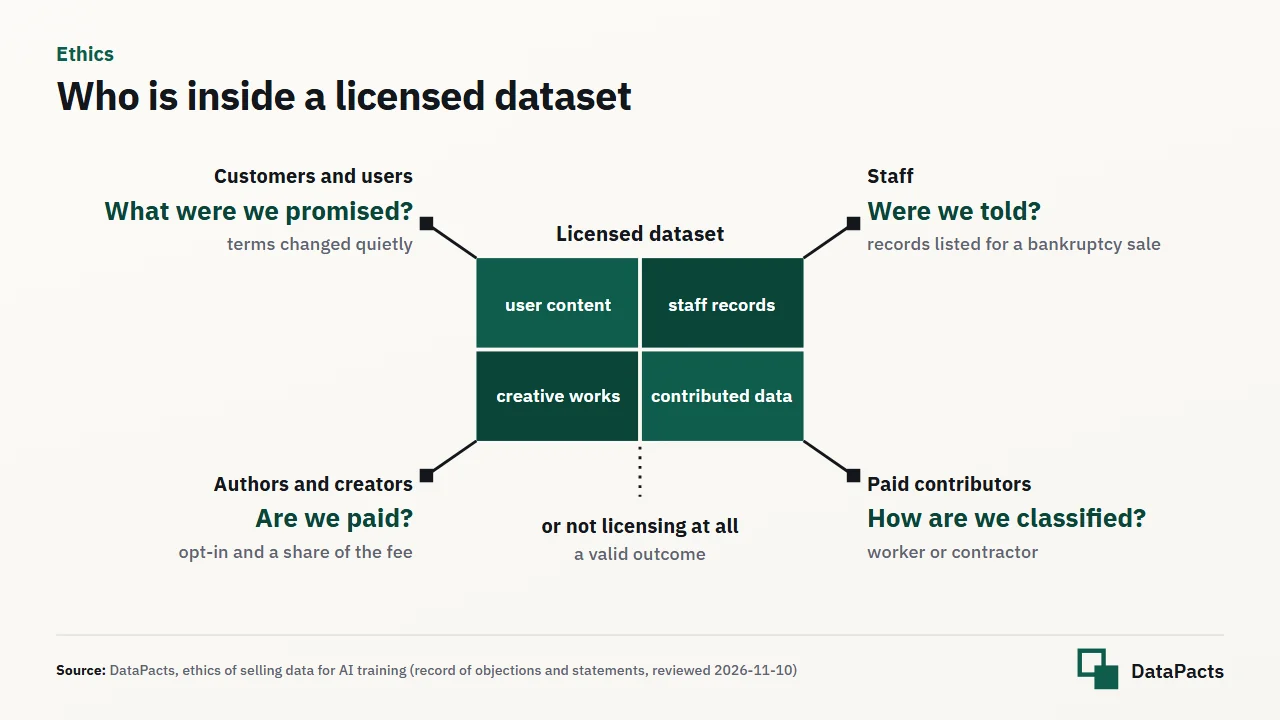
Each group inside a licensed dataset asks a different question: customers ask what they were promised, staff ask whether they were told, creators ask whether they are paid, and contributors ask how they are classified.
Customers and platform users
Customers and platform users meet AI training through the terms of the services that hold their content, and several services now state limits there. Slack says it trains generative AI on customer data only with affirmative opt-in consent.
Zoom's terms (s.10.2, page effective date 2023-08-11) say Zoom does not use audio, video, chat or other communications-like customer content to train Zoom or third-party AI models.
YouTube's third-party training setting is off by default, and YouTube says it "isn't facilitating payments between third-party companies and creators or other rights holders at this time". Figma began content training on 2024-08-15, on by default only for Starter and Professional plans. All four are the services' own statements, checked 2026-11-09.
Children's data carries a stricter rule. The amended COPPA Rule (published 2025-04-22, compliance date 2026-04-22) treats disclosure of a child's personal information to third parties to train AI as not integral to the service, so it requires separate verifiable parental consent.
What a seller's existing customer contracts allow is a contract question, covered under customer consent and confidentiality clauses before licensing data for AI.
Staff whose messages and records are in the archive
Staff often learn of a data sale after it is signed, and a bankruptcy sale can include their records. The Spirit Airlines asset schedule (Dkt. 1463) lists 175,658 employee records as included.
Ifeoma Ajunwa of Emory University told MIT Technology Review (2026-10-13) that employers should have express consent before selling workers' data, and attorney Greg Ewing called such sales "legally radioactive" in the same article.
Authors, artists and other rightholders
Creators' organizations accept licensing on two conditions: an individual opt-in and a fixed share of the fee. The Authors Guild states that a fair author share of AI licensing revenue is 75 to 85 % (2024-12-12).
On 2024-11-19 it published HarperCollins's offer of USD 5,000 per title, split 50-50 between HarperCollins and each author who opts in; the Guild names the licensee only as "an unknown AI company".
Image contributors have a payment route of their own. Shutterstock announced its Contributor Fund on 2022-10-25 and states that the first earnings from AI dataset deals were issued to contributors in Q4 2022 (checked 2026-11-09). YouTube, by contrast, states that it does not facilitate payments to creators who allow third-party training.
Contributors paid to produce training data
People paid to write, rate or record data for AI developers raise a separate question: whether they are treated as workers. McKinney v. Scale AI (San Francisco Superior Court, CGC-24-620481) settled for a gross USD 12,500,000, with the order granting final approval filed on 2026-10-30, and contributor payments are reported on Form 1099, not W-2.
The question also reaches European regulators. noyb states that on 2026-10-27 it filed 5 GDPR complaints about Scale AI's Outlier platform in France, Italy, the Netherlands and Austria; it has published no authority reference numbers. Contributor work and pay are covered under human data for AI: expert contributor work, pay and platforms.
Objections, inquiries and rulings on record, dated
The record below lists reactions to licensing, or to training on held data, that a regulator, court, organization or the company itself documented, each with its date and source. It is ordered by date, as of 2026-11-10; the Meta and Twitch rows concern platforms training on their own users' data, not a sale.
| Date | Company or data | What happened | Raised by | Status or outcome | Source |
|---|---|---|---|---|---|
| 2024-02-13 | AI companies changing terms (general) | staff statement: adopting more permissive data practices quietly may be unfair or deceptive | FTC Office of Technology staff | staff blog, not a Commission rule | ftc.gov |
| 2024-02-27 | Automattic (WordPress.com, Tumblr) | public posts shared with select AI companies only from sites that have not opted out; partners asked to remove past content after new opt-outs | Automattic (own post) | buyers and value not disclosed | automattic.com |
| 2024-03-14 | Reddit, Inc. | FTC letter of non-public inquiry into licensing user content to train AI | FTC, per Reddit's S-1/A | outcome not found | sec.gov |
| 2024-06-06 | Meta (training its own models on user posts; not a sale) | complaints to 11 data protection authorities | noyb (states) | see 2025-05-23 | noyb.eu |
| 2024-11-19 | HarperCollins | per-author opt-in addendum, USD 5,000 per title split 50-50 | Authors Guild (publishes the terms) | licensee not named | authorsguild.org |
| 2025-05-23 | Meta (not a sale) | interim injunction against training on Facebook and Instagram user data rejected, OLG Köln 15 UKl 2/25 | Verbraucherzentrale NRW (applicant) | main proceedings not found as of 2026-11-09 | nrwe.justiz.nrw.de |
| 2026-08-20 | Twitch (Amazon; not a sale) | notice to users that the "Training for Generative AI" setting is on by default | Autoriteit Persoonsgegevens (Dutch DPA) | advice to users | autoriteitpersoonsgegevens.nl |
| 2026-10-05 | Spirit Airlines estate | supplemental report on the de-identified data sale (Dkt. 1684) | court-appointed consumer privacy ombudsman | approval "would be appropriate" after passenger data excluded | courtlistener.com |
| 2026-10-08 | Spirit Airlines estate | letter from members of Congress on the proposed sale | AFA-CWA (publishes the letter) | signatory figures differ between sources | afacwa.org |
| 2026-11-03 | Spirit Airlines estate | public objection by the flight attendants' union | Sara Nelson, AFA-CWA, to KTIV | sale not approved as of 2026-11-09; hearing 2026-11-17 (Dkt. 1779) | ktiv.com |
The record shows that objections cluster around three triggers: changed terms, unclear opt-outs, and employee or passenger records in a bankruptcy sale.
None of the rows records a lost customer, a measured boycott or a share-price effect, and no such outcome of a data license is documented in the sources reviewed for this page. Sara Nelson of AFA-CWA summed up the union's position to KTIV on 2026-11-03: "AI is a fast-growing industry that is completely unregulated."
Spirit Airlines is the most documented case (Bankr. S.D.N.Y. 25-11897 (SHL)). Google LLC was the successful bidder at USD 10,000,000 and Mercor.io Corporation the alternate bidder at USD 7,500,000 at the auction of 2026-08-14 (Dkt. 1463); the sale is not approved as of 2026-11-09, with a hearing set for 2026-11-17 (Dkt. 1779).
The ombudsman's supplemental report (Dkt. 1684) found approval "would be appropriate" from a privacy perspective after the passenger databases were excluded and a de-identification agent was hired. The court process behind that report is set out under US bankruptcy data sales and the consumer privacy ombudsman.
What buyers' own terms say about consent and reversal
Some buyers write consent into their admission rules, and the same terms say a trained model is not returned. These statements are the buyers' own wording, not an assessment by DataPacts.
Defined.ai's Data Partnerships page requires data that is "ethically sourced" with consent, documentation and the right to commercialize it for AI training (Defined.ai states, checked 2026-11-09). Mercor's call center and digital health listings name "recordings made without consent" as not a fit (Mercor states, checked 2026-11-09).
Reversal is limited in the same documents. Labelbox states that models already trained on the data cannot be unlearned, and micro1's master terms set no duty to delete or retrain licensee materials, with backups excluded from deletion (s.4.4).
Breaches, complaints and disputes involving the buyers themselves are logged under data buyer incidents: breaches, complaints and disputes.
Weighing a license on ethical grounds: benefits, risks, downsides and alternatives, including not selling
A license can be defended on ethical grounds when the people in the data were told, can object and share in the result, and it is hard to defend when none of those hold. The four lists below sort the points from the sections above.
The benefits of licensing, seen ethically, are these three.
- Contract over copying: a license with use limits in place of uncontrolled copying, the route the Copyright Office report favors.
- A share for creators: payment to the people in the data where an opt-in split exists, as in the HarperCollins addendum.
- Creditor value under supervision: in a bankruptcy, a court-supervised sale with an ombudsman's review, as in the Spirit case (not approved as of 2026-11-09).
The risks are these three.
- Objections: reactions from regulators, unions or users, as in the dated record.
- Privacy exposure: records that are not de-identified, or children's data that needs separate parental consent.
- Reputational harm: damage to trust that outlasts the deal, analyzed on the reputation page in the table above.
The downsides are these two.
- No recall: data cannot be taken back from models already trained on it.
- Uncertain income: revenue that the licensors themselves describe as non-recurring or near the end of its terms.
The alternatives, including not selling, are these four.
- License only consented data: limit the license to records whose people agreed or were told.
- Opt-in per person: let each author or contributor decide, as the HarperCollins addendum does.
- License through a collective: let a collective of rightholders set the terms.
- Not selling or licensing at all: keep the data, which leaves every other option open.
Each of these paths, with its own trade-offs, is compared under alternatives to selling data to AI labs, including not selling at all.
Where these questions meet the law, the seller process and the trackers
The ethical questions on this page each have a legal or practical counterpart, and the pages below take them one at a time.
- Employee notice and consent when licensing internal communications for the steps a company takes before staff data leaves.
- Legitimate interest (Article 6(1)(f)) for AI training data, including the OLG Köln ruling.
- PII removal and de-identification before licensing.
- AI data licensing deals with parties, dates and sources.
- AI copyright lawsuits over training data, including Bartz v. Anthropic.
- Training data provenance: who held which right.
- Meta AI training on EU user data.
- Collective licensing for AI training.
- Creators selling content for AI training.
This page is information, not legal advice.
Frequently asked questions
Is selling data to AI ethical?
It depends on whether the people in the data were told, can object and are treated fairly; the law sets the floor, not the answer. FTC staff said on 2024-02-13 that quietly adopting more permissive data practices may be unfair or deceptive, which is why expectation weighs as heavily as legality.
Can people in a licensed dataset object after the sale?
They can object to the company, but a model already trained usually keeps what it learned. Meta's case shows the dispute: Meta says objections to training are honored at any time, while noyb says Meta limits their effect to objections made before training starts.
Does de-identifying the data settle the ethical question?
It reduces the privacy side but not the consent or payment side. EDPB Opinion 28/2024 (adopted 2024-12-17) treats a model as anonymous only if the likelihood of extracting personal data, or obtaining it through queries, is insignificant.
Do AI data buyers check whether data was ethically sourced?
Some state consent conditions in their own terms; none of those statements is an independent audit. Defined.ai requires consent and documentation, and Mercor's listings exclude recordings made without consent, both as the buyers state (checked 2026-11-09).