DataVendor lists and handles assets rather than acquiring them, and every DataVendor figure on this page is DataVendor's own statement, checked 2026-11-09. Its fee is 20 % of vendor earnings at withdrawal, and a sale licenses an asset rather than transferring it.
This page records the operator, the dated vendor terms, the listing process, fees, license wording and what is not on record, as part of an independent reference on AI training data licensing.
What DataVendor Handles: Private Codebases, Raw Data, Tasksets and RL Environments
DataVendor's documentation names four kinds of asset a vendor may list, plus ticket history sent with code.
- Private codebases, with their version history.
- Raw data such as documents, logs, emails and org charts.
- HUD tasksets.
- RL environments, accepted only together with a HUD taskset.
- Issue or ticket history from Linear and Jira, which DataVendor's what-you-can-sell page lists next to codebases.
DataVendor states that public repositories cannot be estimated and are excluded from listings, and that only organizations may list. Vendors supply the assets and set the price, and DataVendor does not acquire them. Holders of code have other routes, set out under licensing source code and codebases to AI companies.
DataVendor Company Identity and Its Relation to HUD
DataVendor and HUD are the same company on the record: DataVendor's operator and HUD's site footer both name Human Union Data, Inc., a US company.
The table lists the identity attributes on record as of 2026-11-09.
| Attribute | Value | Source |
|---|---|---|
| Operator | Human Union Data, Inc. | docs.datavendor.ai/introduction; hud.ai footer |
| Brand | DataVendor (HUD) | datavendor.ai |
| Website | datavendor.ai, documentation at docs.datavendor.ai | datavendor.ai |
| Registry number | none found on the primary pages checked 2026-11-09 | n/a |
| Headquarters country | United States | ycombinator.com/companies/hud |
| Founded | 2025, per Y Combinator's company page for HUD | ycombinator.com/companies/hud |
| Program | Y Combinator Winter 2025, San Francisco, team of 24 per Y Combinator | ycombinator.com/companies/hud |
| Type | marketplace for private AI training and evaluation data | docs.datavendor.ai/introduction |
HUD's own description is a platform for building RL environments, tasksets and evals, plus the DataVendor marketplace "where AI labs buy training and evaluation data", which is HUD's wording and not DataPacts' description of the model.
The environment-building side of the company is covered in HUD's profile as an RL environment platform; this page stays with the marketplace terms.
DataVendor Vendor Program Terms, Dated
DataVendor publishes its vendor terms in its documentation, and every row below is DataVendor's own statement, checked 2026-11-09.
The table compares what DataVendor states on each term, as of 2026-11-09.
| Term | What DataVendor states | Checked | Source |
|---|---|---|---|
| Program | DataVendor vendor program | 2026-11-09 | docs.datavendor.ai/sell/become-a-vendor.md |
| Who may list | Organizations only; no application review | 2026-11-09 | docs.datavendor.ai/sell/become-a-vendor.md |
| Data accepted | Private codebases, raw data, HUD tasksets, RL environments with a HUD taskset; public repositories cannot be estimated | 2026-11-09 | docs.datavendor.ai/sell/what-you-can-sell.md; estimate-your-codebase.md |
| Signup | Work email; Mutual NDA, Vendor Platform Access Agreement, DPA and Vendor Data Sharing Agreement through pre-checked boxes | 2026-11-09 | docs.datavendor.ai/sell/become-a-vendor.md |
| Buyers | Join a waitlist and are invited | 2026-11-09 | docs.datavendor.ai/overview/how-it-works.md |
| Price | Set by the vendor | 2026-11-09 | docs.datavendor.ai/sell/what-you-can-sell.md |
| Platform fee | 20 % of earnings, assessed only at withdrawal, never on referral fees | 2026-11-09 | docs.datavendor.ai/overview/faq.md; sell/fees-and-limits.md |
| Minimum withdrawal | USD 1,000 before fees | 2026-11-09 | docs.datavendor.ai/sell/fees-and-limits.md |
| Credits | Earnings convertible 1:1, fee-free and "irreversible" | 2026-11-16 | docs.datavendor.ai/sell/fees-and-limits.md |
| Refunds and chargebacks | No refunds; USD 15 dispute fee to the vendor on a lost chargeback | 2026-11-09 | docs.datavendor.ai/overview/faq.md |
| Referral | A referral link credits first vendor access; no amount stated | 2026-11-09 | docs.datavendor.ai/sell/become-a-vendor.md |
| License | A sale licenses, does not transfer; entitlement survives unpublishing | 2026-11-09 | docs.datavendor.ai/overview/faq.md; overview/how-it-works.md |
The table shows no buyer names and no price list for labs, and none is on record. The terms are one side of a comparison, and the same rows for other buyers and marketplaces sit under program terms compared, where each value keeps its own check date.
How Listing and Selling on DataVendor Works
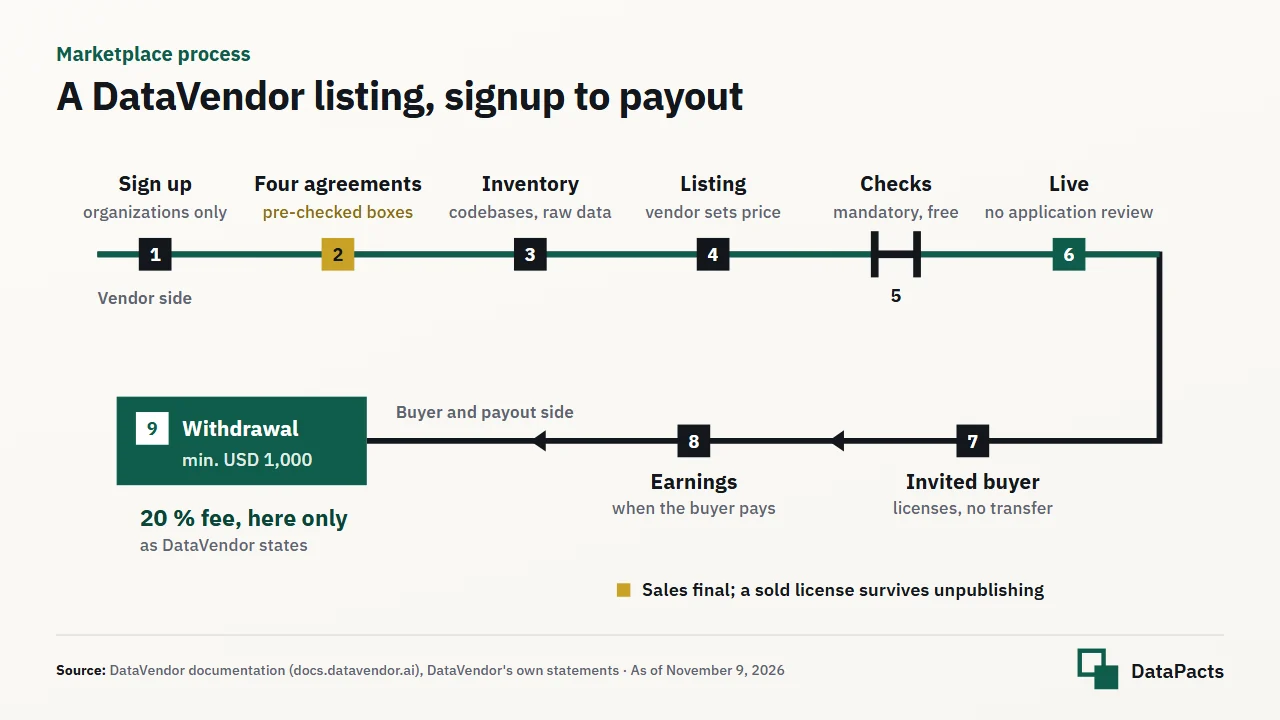
A vendor reaches a live listing in six steps on DataVendor's own description, with no application review.
- The organization signs up with a work email.
- It accepts the four agreements.
- It adds assets to its Inventory.
- It creates a listing and sets the price.
- It passes the mandatory free checks.
- The listing goes live, or the vendor answers a buyer opportunity.
DataVendor's mandatory checks cover credentials and personal data in the listing text, the presence of tasks, whether an environment builds and whether a repository is readable with its Git history.
Optional recommended checks are priced in credits and lead to a "DV quality certified" badge, which is DataVendor's own label. Purchases are anonymous to the vendor except for offers, so a vendor does not see which buyer licensed an asset.
The four agreements are accepted through pre-checked boxes at signup, so an organization accepts all four at signup unless it unticks them, and reading them first is the vendor's own task.
The clauses behind them are what a seller reads in NDAs before sharing data, and DataVendor's own texts for the Vendor Data Sharing Agreement and the DPA are not reproduced here.
DataVendor Fees, Withdrawal and Payout Timing
DataVendor states that it keeps 20 % of vendor earnings and charges it only when earnings are withdrawn, never on referral fees (checked 2026-11-09).
The table sets out how the fee and withdrawal terms work, as of 2026-11-09, with no worked amounts.
| Item | DataVendor's statement | Source |
|---|---|---|
| Fee rate | 20 % of earnings | docs.datavendor.ai/overview/faq.md |
| When charged | At withdrawal only | docs.datavendor.ai/sell/fees-and-limits.md |
| Not charged on | Referral fees; conversion to credits | docs.datavendor.ai/sell/fees-and-limits.md |
| Minimum withdrawal | USD 1,000 before fees | docs.datavendor.ai/sell/fees-and-limits.md |
| Earnings available | When the buyer pays | docs.datavendor.ai/sell/fees-and-limits.md |
| Withdrawal review | Typically within 3 business days | docs.datavendor.ai/sell/fees-and-limits.md |
| Lost chargeback | USD 15 dispute fee to the vendor | docs.datavendor.ai/overview/faq.md |
On timing, DataVendor states that earnings become available as soon as the buyer pays and that a withdrawal review typically completes within 3 business days; this is DataVendor's statement and not a promise.
Because the fee falls at withdrawal, earnings held on the platform or converted 1:1 into credits carry no fee on DataVendor's terms, though DataVendor states the conversion is irreversible. How other channels set when AI data buyers pay, including clawbacks, is covered on the payment page.
The referral carve-out is narrow: a referral link credits first vendor access, DataVendor states no amount, and the 20 % is never taken from referral fees. The parent page compares the published fees of self-serve marketplaces side by side, with DataVendor's 20 % at withdrawal among them.
Codebase and Task Prices as DataVendor States Them
DataVendor states three price points in its own documentation, re-checked 2026-11-10, and none is confirmed by a buyer or a vendor.
- About USD 30,000 per license is the floor for a good codebase.
- Some single-codebase deals exceeded USD 10 million (re-checked 2026-11-10).
- Opportunities are usually priced around USD 500 to 1,500 per task, with hundreds to thousands of tasks per request (re-checked 2026-11-10).
Source for all three: docs.datavendor.ai what-you-can-sell page, DataVendor's claims.
These are claims for two reasons. DataVendor does not name the deals behind them, and vendors set their own prices, so a listing can sit anywhere relative to the floor.
No vendor-confirmed amount received is on record. The same figures sit beside other builders' prices under RL environment price points, where the comparison across builders belongs.
What a DataVendor Sale Grants: License, Ownership and Personal Data
A DataVendor sale is a license, not a transfer: its FAQ states that "A sale licenses your assets for a commercial use rather than transferring them" (checked 2026-11-09).
DataVendor's vendor documentation words it differently: "A sale licenses your assets for a commercial use. The usual starting point is that you keep ownership and grant the rights that use needs; the exact rights depend on the agreement behind the listing."
The two texts are separate wordings on separate pages and are not merged here. The second adds that the exact rights depend on the agreement behind each listing, which a vendor can only read for itself.
A buyer's entitlement survives a vendor's edits or unpublishing, and sales are final with no refunds, so withdrawing a listing does not recall a license already sold.
For personal data, DataVendor states that purchased files (repositories, raw data and Harbor tasks) are cleaned of personal information within 2 business days, and that tasksets and environments are not cleaned.
A vendor who lists a taskset therefore cannot rely on DataVendor to remove personal information from it. The clauses that AI data licensing agreements usually carry on scope, deletion and warranties are explained on the contract page.
DataVendor Reputation, Complaints and What Is Not on Record
No complaint, lawsuit or regulator action against DataVendor or Human Union Data, Inc. was found from a primary or named-person source on 2026-11-09.
What is documented is the operator's name, its published vendor terms and its Y Combinator listing for HUD, all dated above. A short public record is not evidence either way, and a vendor judging reputation has only the operator's own pages to read.
What stays off the record is as important. No lab buyer is named on the record, HUD's page saying only that AI labs buy there. No vendor-confirmed amount received is on record. DataPacts states neither a launch date nor a public-listing status for the company.
Benefits, Risks, Downsides and Alternatives to Listing on DataVendor
Listing on DataVendor lets an organization set its own price and keep ownership under a license, but the fee is 20 % of earnings and the agreements are accepted at signup through pre-checked boxes.
Benefits
- The vendor sets the price (DataVendor, checked 2026-11-09).
- A sale licenses the asset, and DataVendor states the usual starting point is that the vendor keeps ownership.
- The 20 % fee falls only at withdrawal, and conversion to credits is fee-free.
- There is no application review for organizations.
Risks
- Four agreements are accepted through pre-checked boxes.
- Sales are final, with no refunds, and a buyer's entitlement survives unpublishing.
- Tasksets and environments are not cleaned of personal information.
- The public record on the operator is short.
Downsides
- The platform takes 20 % of earnings, and the minimum withdrawal is USD 1,000 before fees (checked 2026-11-09).
- Buyers are admitted by invitation from a waitlist, so the buyer pool is DataVendor's to define.
- The vendor does not see who bought, except through offers.
Alternatives
- A direct license to an AI developer.
- Another marketplace or listing site.
- A broker or sell-side adviser.
- An RL environment builder.
- Keeping the data and not licensing it at all.
None of these suits every holder, and the first call is whether to license at all. The page on alternatives to selling data sets out the options including keeping it.
DataVendor Among Marketplaces, RL Environment Builders and Seller Guides
DataVendor is one of 19 marketplaces compared on DataPacts, and it is run by a company that also builds RL environments.
The parent compares fees and eligibility across AI training data marketplaces, including self-serve sites such as FileYield, Datarade and Opendatabay and managed ones such as Magma; Kled differs, as a contributor app that takes the license itself.
On the builder side, RL environments are explained with every route to sell an RL environment or task set. The seller guides cover how to sell a dataset through a listing or directly and the trade-offs of selling direct or through a broker.
The wider answer to who buys AI training data is on the hub, and DataVendor's referral link sits among referral programs of AI data buyers.
More About DataVendor
DataVendor and Individual Contributors
DataVendor admits organizations, not individuals, so a person looking for paid AI training work is served by contributor platforms instead. Individuals compare AI training jobs and platforms on a separate page.
Frequently Asked Questions About DataVendor
Is DataVendor legit?
DataVendor is run by Human Union Data, Inc., the company behind HUD, publishes its vendor terms, and has no complaint on record from a primary source as of 2026-11-09. That is a short record, and it is not a recommendation.
What fee does DataVendor charge vendors?
DataVendor states it keeps 20 % of earnings, charged only at withdrawal and not on referral fees, with a USD 1,000 minimum withdrawal (checked 2026-11-09).
Is DataVendor the same company as HUD?
Yes on the record: both name Human Union Data, Inc. HUD builds RL environments and tasksets, and DataVendor is its marketplace.
Can AI labs buy from DataVendor without an invitation?
No; DataVendor states that buyers join a waitlist and are invited, while vendors sign up self-serve.