Published terms decide which is possible: Turing's 6-month exclusive license still lets Turing license the record to more than one lab, and micro1's nonexclusive grant carries a no-prior-grant warranty (terms last updated November 8, 2026).
Talking to one buyer, or to none, is a valid outcome, and running several is one approach to AI training data licensing.
Examples carry their check or filing date; the DataPacts Editorial Team explains how we source, date and check every figure.
One Winner or Several Licensees: What Running Buyers in Parallel Means
A parallel process ends in one of two ways: one buyer wins an exclusive license or sale, or several buyers each receive a non-exclusive license to the same data.
- Competitive process: several bidders, one grant, and the losing bidders receive nothing. Spirit Airlines is the filed example.
- Non-exclusive stacking: several grants, each buyer paying separately. Reddit's arrangements of January 2024 are the filed example of several grants, though Reddit does not state whether they are exclusive.
A sequence, one buyer after another, is a third pattern and is governed by the same warranties.
Four Ways to Run Several AI Data Buyers at Once
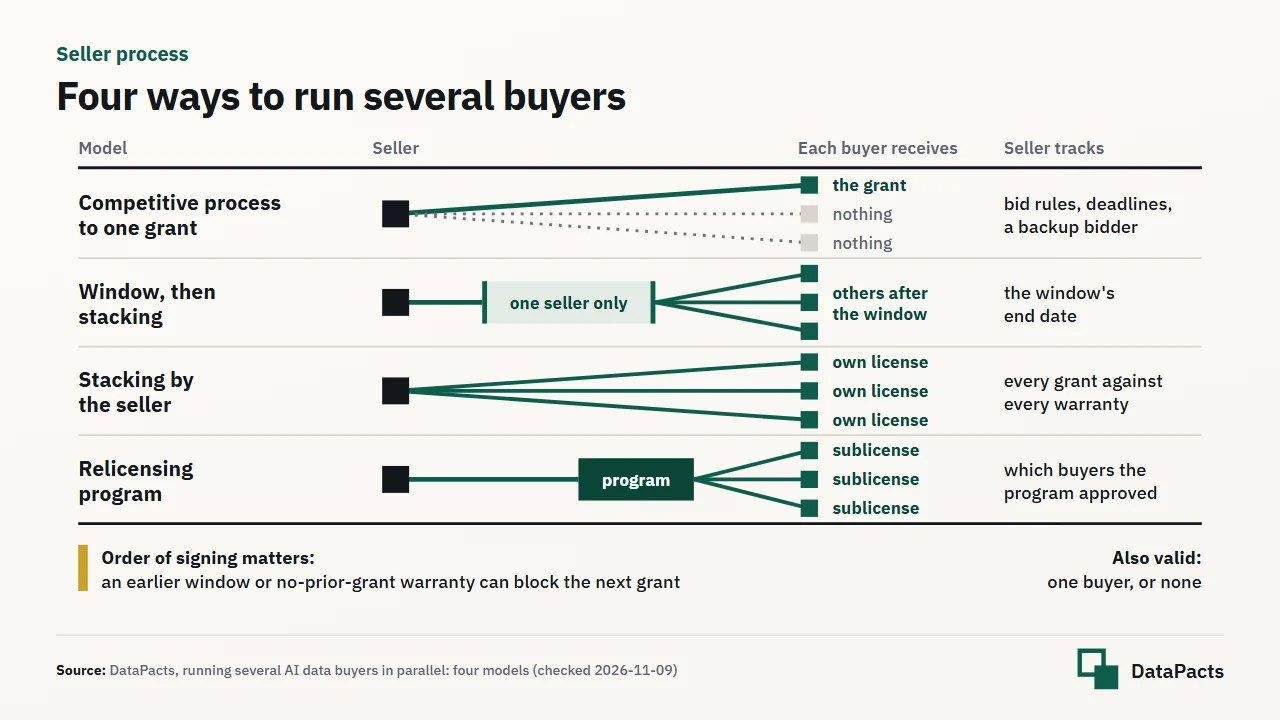
Published terms and filings show four ways to run several buyers, which differ in what each buyer receives and what the seller must track. The table compares them as of 2026-11-09.
| Model | What each buyer receives | What the seller tracks | Filed or published example | Source and date |
|---|---|---|---|---|
| Competitive process to one grant | the winner: the grant; the others: nothing | bid rules, deadlines, a backup bidder | Spirit: Google LLC successful bid USD 10,000,000, Mercor.io Corporation alternate bid USD 7,500,000; not approved | Bankr. S.D.N.Y. 25-11897, Dkt. 1463 (2026-08-14), Dkt. 1779 |
| Window, then stacking | one seller first, others after the window | the window's end date | Turing: exclusive license to Turing for the first 6 months, during which Turing may license the record to more than one lab; then extend or end the term | lazarus.turing.com, 2026-11-17 |
| Stacking by the seller | a separate license each | every grant against every warranty | Reddit January 2024 arrangements, USD 203.0 million aggregate; Stack Overflow with Google Cloud and OpenAI; Tempus with Pathos and BMS | Reddit S-1 (2024-02-22); stackoverflow.co (2024-02-29, 2024-05-06); Tempus 10-K FY2025, 10-Q Q3 2026 |
| Stacking through a relicensing program | a sublicense from the program | which buyers the program approved | SuperAnnotate pays "on each relicense"; Endless; HUMXN | superannotate.com; endless-data.com; humxn.io, 2026-11-09 |
Each value is the stating party's own wording or a court or SEC filing; deal values are aggregate where the filer gives no split.
A program that relicenses, such as SuperAnnotate or HUMXN, runs the stacking itself. The counterparty types are compared under choosing a buyer for your data.
Competitive Processes for Company Data
A competitive process asks several buyers to bid for the same grant and awards it to one, and the only fully documented example for company data comes from a bankruptcy court.
What a Court-Run Auction Shows: Successful, Alternate and Late Bids
The Spirit Airlines chapter 11 case shows every stage of a competitive process for company data on the docket. The bidding procedures order was entered on 2026-06-22 (ECF No. 1213) and the auction followed.
The Notice of Auction Results (Dkt. 1463, 2026-08-14) names Google LLC as the successful bidder at USD 10,000,000 and Mercor.io Corporation as the alternate bidder at USD 7,500,000. micro1 filed a Notice of Intent to submit a competing and superior bid on 2026-09-03 (ECF No. 1556, as recited in Dkt. 1684), and no filing gives an amount.
The sale is not approved as of November 9, 2026, and the hearing is adjourned to 2026-11-17 (Dkt. 1779).
23andMe was a bankruptcy asset sale, not an AI-training license, but it shows that a later bid can displace an auction winner: Regeneron's USD 256.0 million auction result of 2025-05-17 was superseded by TTAM Research Institute's USD 305.0 million (sale order 2025-06-27, closing 2025-07-14).
Sales of personal data in US bankruptcy run under 11 U.S.C. 363(b)(1) with a consumer privacy ombudsman under s.332, which is the subject of the rules behind US bankruptcy data sales.
Running Bids Outside a Court
No operating company has published how it ran competing bids for company data, so the steps below come from the published intake processes of individual programs, not from a market norm.
- Give the same data description to every bidder.
- Sign a separate NDA with each, as Turing's online mutual NDA and Patronus's sample under NDA do.
- Set a sample policy, with deletion of material if there is no deal, as Patronus states.
- Ask for one written offer per bidder by a common date.
Withdrawing from one program has a lag: Pangea states that withdrawal after presentation needs 30 days' notice, processes may continue for 90 days and completed licenses survive (checked November 9, 2026). Comparing the offers once they arrive is covered by evaluating an offer for your data.
Exclusivity Windows That Pause Parallel Selling
An exclusivity window is a fixed period in which one party alone may sell or license the data, and parallel selling stops for the scope it covers until the window ends.
Turing states, checked November 17, 2026, that the license to Turing is exclusive for the first 6 months after signing, during which Turing may license the same record to more than one lab, and that the company can then extend or end the term.
Labelbox states that Prism licenses are exclusive by default, and Tempus agreed in a side letter not to license neurology records to third parties other than BMS, Pathos and certain subcontractors for 18 months (10-Q, quarter to 2026-09-30).
Pricing and narrowing exclusivity is covered under exclusive vs non-exclusive data licenses.
No-Prior-Grant Warranties and the Order of Signing
A no-prior-grant warranty makes the seller promise each new buyer that it has not already granted the same rights to someone else, so the order of signing decides which promises remain true.
What micro1's Section 5.1 Promises Each New Buyer
micro1's Data License Master Terms take a nonexclusive license and still ask the licensor to warrant that no third party already holds the same rights on similar terms.
The grant in s.1.2 is nonexclusive, irrevocable and perpetual (last updated November 8, 2026, re-read November 10, 2026). Section 5.1, headed "Due Authority", warrants that the licensor has not granted a third party rights to the same Data on the same or substantially similar terms.
For parallel selling, a seller that signs a similar license elsewhere first cannot give this warranty truthfully, while signing micro1 first leaves later grants outside the warranty's wording. Liability is capped at 3 times the fees under the Order Form (s.7.2), and the master terms hold no exclusivity term.
Ownership Warranties Repeated in Every License
Each additional license repeats the seller's ownership warranty, so running several buyers multiplies the promises a single rights gap could break. Pangea states an uncapped ownership warranty.
Protege's provider terms have the provider indemnify (s.4.1) with a cap of 2 times fees in 12 months (s.6.2), and micro1's licensor indemnifies IP, privacy, publicity and data protection claims from the Data (s.8.1). A rights audit before the first license keeps every later warranty true.
Keeping a Register of Every Grant
A grant register lets the seller answer every no-prior-grant question from one record instead of from memory. No buyer publishes a register requirement; the list is practical guidance.
- Licensee and signing entity.
- Data covered: systems, years and exclusions.
- Grant type and any window with its end date.
- Field of use and term.
- Warranty and non-circumvention wording.
- Payment trigger.
Non-Exclusive Stacking: The Same Data Licensed to Several Buyers
Stacking licenses the same data to several buyers in turn, and filings and announcements show sellers doing it with platform, technical Q&A and clinical data. Reddit's S-1 states USD 203.0 million in aggregate contract value for data licensing arrangements entered in January 2024, with terms of two to three years and counterparties not named.
Google (announced 2024-02-22, "to display, train on, and otherwise use") and OpenAI (announced 2024-05-16, Data API access, with training not stated in Reddit's post) are the announced licensees.
Reddit's Q3 2026 10-Q says its agreements with its two main partners "are approaching the end of their respective current terms"; see Reddit's AI data licensing deals with Google and OpenAI.
Stack Overflow announced Google Cloud (2024-02-29) and OpenAI (2024-05-06), with values not disclosed. Neither Reddit nor Stack Overflow states whether its licenses are exclusive.
Tempus licensed oncology data to Pathos (USD 200 million over three years, 2025) and to BMS (records, Lens access and services, USD 137.5 million in fixed payments through 2031-12-31, 2026-10-14), then neurology records to Pathos.
Programs Built to Relicense the Same Data
Some programs take a non-exclusive license and place the same data with several buyers themselves, so the stacking happens inside one contract. Each claim is the program's own, checked November 9, 2026.
- Endless states "You can license the same data to anyone else" and licenses on to labs.
- HUMXN states non-exclusive licenses are "sellable to several buyers, ongoing feed renews", offers exclusive ones, and says exclusive licenses pay more up front.
- SuperAnnotate states the seller approves each buyer and "can block competitors permanently", with payment "on delivery, and on each relicense".
- Turing states "the same record can go to more than one lab".
These programs are licensees that sublicense, not brokers.
Clauses That Slow Stacking Around One Buyer
A non-exclusive program can still slow a parallel sale through tails that outlast the relationship. Defined.ai states no exclusivity and no minimums (s.3.5) with a 12-month non-circumvention period. Protege licensees keep access for 12 months after termination and academic licensees for 3 years (s.7.2), and Pangea's run-off lasts 90 days.
Clauses That Decide the Order of Several Deals
Six published clause types decide whether a second buyer can be signed now, later or not at all. The table lists them alphabetically as of 2026-11-09.
| Clause | Effect on a second buyer | Published example | Source and check date |
|---|---|---|---|
| Exclusive grant by default | blocks the scope it covers | Labelbox Prism | prism.labelbox.com/faq, 2026-11-09 |
| Licensee access after termination | earlier licensee keeps using the data | Protege s.7.2: 12 months, academic 3 years | withprotege.ai/provider-terms, 2026-11-09 |
| No-prior-grant warranty | earlier similar grants breach it | micro1 s.5.1 | micro1.ai/legal/data-license-master-terms, 2026-11-08 version |
| Non-circumvention | no direct deal with the program's buyers for a period | Defined.ai, 12 months | defined.ai/supplier-program, 2026-11-09 |
| Sole-seller window | no other seller until it ends | Turing, 6-month exclusive license to Turing; Tempus side letter, 18 months | lazarus.turing.com, 2026-11-17; Tempus 10-Q Q3 2026 |
| Withdrawal notice and run-off | exit from one program is not immediate | Pangea: 30 days' notice after presentation, processes may continue 90 days | pangea.ai/code-licensing/companies, 2026-11-09 |
Each new order form should be read for these clauses before the next signature; buyer-by-buyer values sit in the license clause matrix.
Several Buyers or One: Benefits, Risks, Downsides and Alternatives
Running several buyers can raise the total paid for the same data, but it multiplies warranties, confidentiality duties and the work of keeping the grants consistent.
Benefits:
- Several payments for one dataset, as SuperAnnotate's "each relicense" payment and Reddit's separate arrangements show.
- A competing bid can replace a winner, as in the 23andMe sale.
- No single buyer controls the data.
Risks:
- A broken no-prior-grant warranty.
- A window or non-circumvention clause signed early blocks later deals.
- More parties hold samples.
Downsides:
- Withdrawal lags.
- More NDAs and more administration.
- No public evidence that parallel processes raise prices for company data.
Alternatives:
- One exclusive grant priced for exclusivity.
- One program that relicenses on the seller's behalf.
- A single non-exclusive license and nothing more.
- Not licensing at all.
Other routes are set out under alternatives to selling data to AI labs.
Where Running Several Buyers Sits in the Process to Sell or License Company Data
Running several buyers belongs to step 7 of the seller process, after valuation and offers and before the NDA, sample and contract steps. The guide to sell or license company data to AI companies covers all steps:
- Previous: evaluating an offer
- Same step: selling direct or through a broker, how to sell a dataset
- Next: the data manifest, NDAs before sharing data with an AI buyer, samples, clean rooms and proving data quality, due diligence in an AI data deal
- Later: negotiating an AI data licensing deal, term sheets, order forms and LOIs, AI data licensing agreements
- Timing: how long an AI data licensing deal takes
- Related clause: indemnities and warranties in AI data licenses
Not Legal Advice, and What This Page Does Not Cover
This page explains how several buyers can be run in parallel for information and is not legal advice; a lawyer should review each grant against the earlier ones before signing. Competition-law limits on exclusivity or bidding are not covered.
Terms, Filings and Deals Cited on This Page
The examples come from these terms and filings, checked on November 9, 2026, or dated by filing.
- AI data licensing deals tracker
- Company data partnership programs
- HUMXN buyer profile
- Labelbox Prism buyer profile
- micro1 data buyer profile
- Pangea.ai buyer profile
- Spirit Airlines' data archive sale in bankruptcy
- Stack Overflow AI licensing deals
- SuperAnnotate buyer profile
- Tempus AI clinical data licensing deals
- Turing Project Lazarus profile
Frequently Asked Questions
Can I sell the same data to multiple AI companies?
Yes, where no earlier license is exclusive; Reddit and Stack Overflow each licensed data to more than one buyer, without stating exclusivity terms. An exclusivity window or a no-prior-grant warranty in an earlier contract can block the next grant.
See exclusive data licenses, their windows and carve-outs.
How do competing offers for company data work?
Several buyers bid for the same grant and one wins; in the Spirit Airlines case Google LLC was the successful and Mercor the alternate bidder (Dkt. 1463), and the sale is not approved as of November 9, 2026.
What is a no-prior-grant warranty?
A seller's promise that it has not already granted the same rights to anyone else, as in micro1 s.5.1 (terms last updated November 8, 2026).
The term is defined in the AI training data glossary.
What is an exclusivity window in a data deal?
A period in which one party alone may sell or license the data, such as the first 6 months after signing in which Turing states the license to Turing is exclusive (checked November 17, 2026).