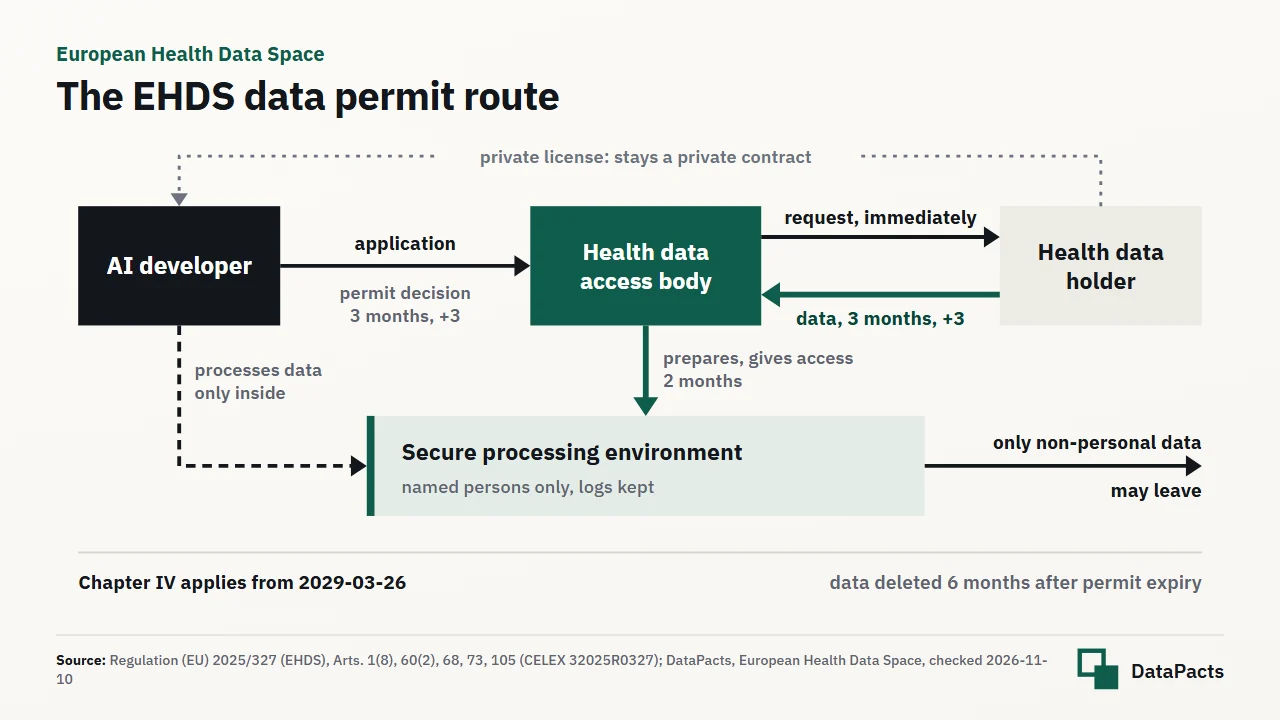
Access for AI training is limited to scientific research related to health or care and runs inside a secure processing environment, and fees follow cost, not market price. Holders must supply data to the access body, while a holder's own license to an AI buyer stays a private contract.
This page covers dates, purposes, permit steps, fees, the opt-out, holder duties and penalties, and compares the permit route with private licensing in AI training data licensing, for holders and for developers.
What the EHDS Regulation Means for AI Training Data
The EHDS creates a second, public route to health data for AI training: instead of buying from a holder, a developer applies to a health data access body, which collects the data from holders and grants access under a permit.
The act is Regulation (EU) 2025/327 of February 11, 2025, published as OJ L, 2025/327 on March 5, 2025 (CELEX 32025R0327). "Secondary use" is processing for the Chapter IV purposes other than the original purpose, and a data permit is an administrative decision (Art. 2).
The Regulation complements the GDPR and is without prejudice to the GDPR, the Data Governance Act, the Data Act and the Trade Secrets Directive (Art. 1(3)), and it "shall not affect access to electronic health data for secondary use agreed in the framework of contractual or administrative arrangements between public or private entities" (Art. 1(8)), so a private license of health data stays under Art. 9 and the other rules of GDPR and AI training data.
When the Secondary-Use Rules Apply
The Regulation entered into force on March 25, 2025 and applies from March 26, 2027, but Chapter IV on secondary use, the part that covers AI training, applies from March 26, 2029 (Art. 105). Some categories and the third-country link come in 2031 and 2035.
Table: the dates of Regulation (EU) 2025/327 that matter for secondary use, as of 2026-11-10.
| Date | Step | Provision | Source |
|---|---|---|---|
| 2025-02-11 | Regulation adopted | Regulation (EU) 2025/327 | eur-lex.europa.eu |
| 2025-03-05 | Published in the Official Journal | OJ L, 2025/327 | eur-lex.europa.eu |
| 2025-03-25 | Entry into force | Art. 105, first paragraph (20th day after publication) | eur-lex.europa.eu document information |
| 2027-03-26 | General application; Member States name access bodies; templates for applications, permits and requests; secure-environment requirements | Art. 105; Arts. 55(6), 70, 73(5) | eur-lex.europa.eu |
| 2029-03-26 | Chapter IV (secondary use, including AI training) applies; national rules extending holder duties notified | Art. 105; Art. 50(4) | eur-lex.europa.eu |
| 2031-03-26 | Categories added: determinants of health, genetic and genomic, other omic, clinical trial and study data, research cohorts | Art. 105; Art. 51(1)(b), (f), (g), (m), (p) | eur-lex.europa.eu |
| 2035-03-26 | Third countries and international organizations can join HealthData@EU | Art. 105; Art. 75(5) | eur-lex.europa.eu |
AI Training as a Permitted Purpose, and the Uses the EHDS Prohibits
Access bodies may grant data for training, testing and evaluation of algorithms, including in medical devices, in vitro diagnostic medical devices, AI systems and digital health applications, but only as scientific research related to health or care (Art. 53(1)(e)(ii)).
That research must contribute to public health or health technology assessments, or ensure high quality and safety of healthcare, medicinal products or medical devices, "with the aim of benefiting end-users, such as patients, health professionals and health administrators".
Purposes (a) to (c), such as public health and official statistics, are reserved to public sector bodies and EU bodies (Art. 53(2)), so a private developer relies on (d) to (f), in practice (e).
Data may be processed only for the permit's purposes, and Art. 54 prohibits these uses:
- decisions detrimental to a natural person based on their electronic health data;
- decisions on job offers, less favorable terms of work, insurance or credit;
- advertising or marketing activities;
- developing products or services that may harm individuals or society, such as illicit drugs, alcohol, tobacco, weapons or addictive design;
- activities in conflict with national ethical provisions.
Whether training a given general-purpose model meets the Art. 53(1)(e) condition is not stated.
How an AI Developer Obtains Health Data Under an EHDS Permit
An EHDS project runs in eight steps, from the application to deletion of the data, and each step carries a deadline set in the Regulation.
Table: the eight steps of a data permit and their deadlines, as of 2026-11-10.
| Step | What happens | Deadline or limit | Article | Source |
|---|---|---|---|---|
| 1 Application | developer files a health data access application (or a health data request for statistics only) | incomplete application: 4 weeks to complete | 67, 68(4), 69 | eur-lex.europa.eu |
| 2 Decision | access body checks purpose, necessity, GDPR Art. 6(1) basis, expertise, safeguards; issues or refuses a permit | 3 months, extendable by 3 | 68(1), (4), (9) | eur-lex.europa.eu |
| 3 Request to holder | body requests the data immediately after the permit | immediately | 68(7) | eur-lex.europa.eu |
| 4 Holder delivery | holder puts the data at the body's disposal | 3 months, extendable by 3 | 60(2) | eur-lex.europa.eu |
| 5 Preparation and access | body combines, pseudonymizes or anonymizes, gives access in the secure environment | 2 months from receipt | 57(1)(b), 66, 68(7) | eur-lex.europa.eu |
| 6 Processing | named persons only; logs at least 1 year; export of non-personal data only | permit duration up to 10 years, renewable once up to 10 | 68(12), 73 | eur-lex.europa.eu |
| 7 Results | results published, anonymous data only, EHDS acknowledged | 18 months after processing ends | 61(4) | eur-lex.europa.eu |
| 8 Deletion | data in the environment deleted | 6 months after permit expiry | 68(12) | eur-lex.europa.eu |
Health Data Access Bodies and Trusted Health Data Holders
Each Member State designates one or more health data access bodies, public bodies that decide applications, collect data from holders, prepare it and give access, and must name them to the Commission by March 26, 2027 (Art. 55(6)).
The bodies keep a public dataset catalog and publish permits and refusals within 30 working days (Art. 57(1)(j)). One application can cover holders in several Member States (Art. 67(3)).
Trusted health data holders (Art. 72) assess applications for their own data and propose a decision within 2 months; the access body decides within 2 months and is not bound. The identities of the designated bodies are not yet published.
Data Permits, Anonymized Requests and the Secure Processing Environment
A developer either applies for a data permit to work with record-level data inside a secure processing environment or submits a health data request that returns only anonymised statistics (Arts. 67 to 69).
The application states who has access, the purpose, the expected benefit, the data and whether they are anonymised or pseudonymised, the safeguards and the period (Art. 67(2)).
The body checks criteria including a GDPR Art. 6(1) basis and the applicant's expertise (Art. 68(1)). Data are anonymised by default and pseudonymised only where anonymised data cannot serve the purpose, with the key held by the body or a trusted third party (Art. 66).
Access runs only through the secure processing environment (Art. 73): named persons only, logs kept at least one year, and export only of non-personal data. Inside it, the access body is processor for the developer as controller (Art. 74(1)).
The developer must not give third parties access or re-identify anyone, and must publish results within 18 months containing only anonymous data (Art. 61). Outside this route, holders prepare data as described in de-identification before licensing data.
EHDS Fees: Cost Recovery, Not a Market Price
Access bodies and trusted holders may charge fees, but the fees must be in proportion to the cost of making the data available and must not restrict competition (Art. 62(1)).
The fees can cover assessment, the permit, preparation, anonymization and provision of the data. Reduced fees are possible for public bodies, university researchers and microenterprises (Art. 62(1)).
The fee may include the holder's compilation costs, which are paid to the holder. If holder and user do not agree within one month of the permit, the access body may set the fee, and disputes go to the dispute bodies of Art. 10 of the Data Act (Art. 62(2), (4)).
Fee principles are to follow by implementing act (Art. 62(6)), and no fee amount is published yet. Cost recovery differs from private prices, covered in what company data is worth to AI companies.
The Opt-out and Its Public-Interest Exception
Every person may opt out of secondary use of their personal electronic health data at any time, without giving a reason, and can reverse that choice (Art. 71(1)).
Member States provide the opt-out mechanism (Art. 71(2), 58(2)). Opted-out data are excluded only from permits and requests approved after the opt-out, so permits already issued continue (Art. 71(3)).
Member States may provide a narrow exception for public sector bodies or entities with public health tasks, for purposes (a) to (c) or important public-interest research where the data cannot be obtained otherwise (Art. 71(4)).
A private AI developer acting on its own account is not among them. GDPR supervisory authorities enforce the opt-out (Art. 65), and holders need not re-identify data to honor it (Art. 71(8)).
What Changes for Hospitals and Other Health Data Holders
Hospitals, clinics, health product developers, wellness app makers and health researchers become health data holders with a duty to supply data to the access body on request, unless they are individuals or microenterprises (Arts. 2, 50(1)). Member States may extend the duty to those exempt, and 17 minimum categories of data apply (Arts. 50(2), 51(1)).
Table: what the Regulation changes for a hospital or other holder, as of 2026-11-10.
| Topic | Rule | Article | Source |
|---|---|---|---|
| Who is a holder | bodies in healthcare or care, developers of health products or services, wellness app makers, health researchers, mortality registries, with a right or obligation to process personal health data as controller, or control over non-personal data through product design | 2 | eur-lex.europa.eu |
| Exempt | natural persons, including individual researchers; microenterprises (Member States may extend the duty to them) | 50(1), (2) | eur-lex.europa.eu |
| Data covered | 17 minimum categories, from EHR data and claims data to genomic, device, wellness app, registry, clinical trial and biobank data | 51(1)(a) to (q) | eur-lex.europa.eu |
| Supply duty | make data available on request under a permit or approved request | 60(1) | eur-lex.europa.eu |
| Deadline | within 3 months of the access body's receipt of the request, extendable by 3 | 60(2) | eur-lex.europa.eu |
| Catalogue | describe datasets for the national catalogue; check the description at least annually | 60(3) | eur-lex.europa.eu |
| IP and trade secrets | flag protected parts and justify; body protects them and refuses access where the risk cannot be addressed | 52(2), (3), (5) | eur-lex.europa.eu |
| Costs | compilation and preparation costs may be included in the fee, paid to the holder | 62(2) | eur-lex.europa.eu |
| Role | controller for making data available to the body | 74(1) | eur-lex.europa.eu |
The duty is owed to the access body, not to a buyer. A holder's own license to a developer remains a contract under the GDPR and national law (Art. 1(8)).
Protected intellectual property and trade secrets are flagged by the holder, and access is refused where a serious risk cannot be addressed (Art. 52). The private side is in medical practices and healthcare providers licensing data.
Penalties for Holders and AI Developers Under the EHDS
Access bodies can fine holders that withhold data to obstruct its use or miss the delivery deadline and developers that misuse permits, with fine ceilings set in the Regulation and periodic penalty amounts set under national law.
For holders, the body can impose a periodic penalty payment per day of delay and exclude repeat offenders from applications for up to five years (Art. 63(4)). As of 2026-11-10, holders face fines up to EUR 10,000,000 or 2 % of worldwide annual turnover, whichever is higher (Art. 64(4)).
For developers, the body can revoke a permit and exclude the user for up to five years (Art. 63(3)).
As of 2026-11-10, breaches of the Art. 61(1), (5) and (6) duties carry the same ceiling, while prohibited use, extracting personal data, re-identification and ignoring enforcement measures carry fines up to EUR 20,000,000 or 4 % (Art. 64(5)).
Permit Route or Private License Under the EHDS: Benefits, Risks, Downsides and Alternatives, Including Not Licensing
For a holder, the EHDS is a duty rather than a sale, and for a developer it is one route among several, so each side weighs the permit route against private licensing and against doing neither.
Benefits
- One application can reach holders in several Member States (Art. 67(3)).
- The holder recovers its compilation costs through the fee (Art. 62(2)).
- Anonymised-by-default access lowers the holder's disclosure exposure (Art. 66).
Risks
- Re-identification or extraction of personal data carries the highest fine ceiling above (Art. 64(5)).
- Results must be published within 18 months (Art. 61).
- Data protected by intellectual property or trade secrets can be refused (Art. 52).
Downsides
- Chapter IV applies from 2029-03-26, some categories from 2031-03-26 (Art. 105).
- Fees cover cost, so they are no market price (Art. 62(1)).
- Only non-personal data leaves the secure processing environment (Art. 73).
Alternatives
- Private licensing under GDPR Art. 9 and national law (Art. 1(8)).
- Anonymous aggregated statistics under national secondary-use laws such as Finland's Act 552/2019 as amended by 1159/2025.
- A health data request that returns anonymised statistics only (Art. 69).
- Not licensing at all, which carries no EHDS cost beyond the holder's statutory duty.
The full decision on private licensing is in should you sell or license your data to AI companies.
Beyond the EHDS: GDPR, Other EU Instruments and National Health Data Rules
The EHDS is one EU instrument among several. The overview of EU rules for AI training data sets it beside the GDPR, the AI Act, the TDM exception and the Data Act.
- Medical and clinical data for AI training: clinical records and filed prices.
- Special category data in AI training: the Art. 9 exceptions.
- EU Data Act and AI training data: fee dispute bodies.
- EU Data Governance Act: intermediation.
- EU AI Act Article 53: training data disclosure.
- EU Digital Omnibus: pending GDPR changes.
- Findata and the Secondary Use Act: a national permit authority.
- HIPAA and AI training data: the US counterpart.
- Medical imaging and pathology data: imaging sets.
- Alternatives to selling data to AI labs: including not selling.
- AI training data law by jurisdiction: every jurisdiction.
What This Page Does Not Cover
This page covers secondary use of health data for AI training, not patients' own access to their records or the rules for EHR systems under the same Regulation.
How This Page Is Sourced and Dated
Every rule here cites the article of Regulation (EU) 2025/327 as published in the Official Journal and checked on EUR-Lex on November 10, 2026. The method is described in how we source, date and check every figure. This page is general information about EU law, not legal advice for any specific project or license.
Frequently Asked Questions
Can an AI developer export health data obtained under an EHDS permit?
Only non-personal data, including anonymised statistics, can leave the environment. Personal data stays inside it (Art. 73(2)), and as of 2026-11-10 extracting it can bring a fine of up to EUR 20,000,000 or 4 % of turnover (Art. 64(5)).
Does an opt-out remove data from an AI project that already has a permit?
No, an opt-out applies to permits and requests approved after it. Projects permitted earlier continue (Art. 71(3)).
Can a hospital charge for data it supplies through the EHDS?
Yes, through the access body. The fee may include the holder's compilation and preparation costs, and that part is paid to the holder. If holder and user do not agree within one month of the permit, the body may set the fee (Art. 62(2), (4)).