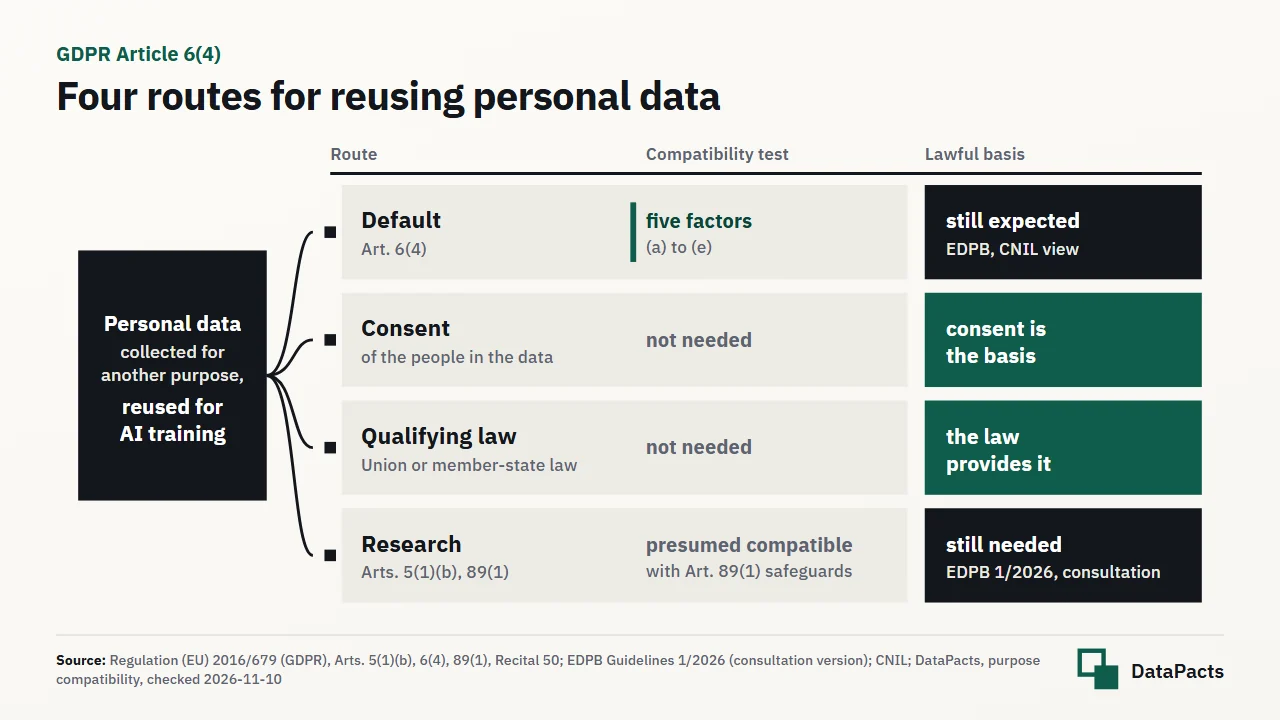
The research presumption in Articles 5(1)(b) and 89(1) can replace the test, but only for research that meets the EDPB's indicators.
The rule sits in Regulation (EU) 2016/679 (CELEX 32016R0679), applicable since May 25, 2018, and forms the purpose limitation layer of AI training data licensing. Positions are stated as of November 10, 2026. The parent page summarizes the five factors, and this page reads them for a sale.
When Licensing Records for AI Training Is Further Processing
A company that licenses records it collected to deliver a service, sell or employ people is processing them for a purpose other than the one they were collected for, so the disclosure to an AI buyer is further processing.
Article 5(1)(b) requires personal data to be collected for specified, explicit and legitimate purposes and not further processed in a manner incompatible with them, and Article 5(2) makes the controller able to demonstrate compliance, so the test is documented.
The buyer's training is the buyer's own purpose, and the test on this page is the seller's.
The Court's Test Database Ruling: Digi (C-77/21)
The Court of Justice held on October 20, 2022 in Digi (C-77/21) that copying customer data into a new database for testing and error correction is further processing that purpose limitation allows only where it is compatible with the original purposes under the Article 6(4) criteria.
The same judgment held that storage limitation (Article 5(1)(e)) bars keeping the copy longer than the tests need. For a seller, a training extract is a new copy with its own purpose and its own retention period. The Court did not rule on AI.
Three Routes That Replace the Compatibility Test
Article 6(4) applies only where the reuse is not based on consent or on a qualifying law, and Article 5(1)(b) presumes research reuse compatible, so the table sets the default test beside the three routes that replace it. The table is as of 2026-11-10, from the Official Journal text.
| Route | Citation | Compatibility test needed? | Lawful basis still needed? | Source |
|---|---|---|---|---|
| Default: further processing for a new purpose | Art. 6(4) | yes, five factors | yes, per EDPB, CNIL and the parent page | eur-lex.europa.eu |
| Consent of the people in the data | Art. 6(4) opening words | no | consent is the basis | eur-lex.europa.eu |
| Union or member-state law that is a necessary and proportionate measure for Art. 23(1) objectives | Art. 6(4) opening words; Recital 50 | no | the law provides it | eur-lex.europa.eu |
| Scientific or historical research, statistics, archiving in the public interest | Art. 5(1)(b); Art. 89(1) | no, presumed compatible with Art. 89(1) safeguards | yes (EDPB Guidelines 1/2026, consultation version) | eur-lex.europa.eu; edpb.europa.eu |
Each route still leaves the other GDPR duties in place.
The Five Article 6(4) Factors Read for a Data Sale
Article 6(4) lists five factors and Recital 50 phrases them more fully, adding the reasonable expectations of the people in the data and safeguards in both the original and the new processing. The table is as of 2026-11-10.
| Factor | Art. 6(4) text (summary) | Recital 50 adds | Question for a seller | Source |
|---|---|---|---|---|
| (a) Link | link between collection purposes and the intended further processing | same | how far is training a buyer's model from the service the data were collected for? | eur-lex.europa.eu |
| (b) Context | context of collection, in particular the relationship between people and controller | "reasonable expectations" based on that relationship "as to their further use" | did terms or notices at collection mention AI or disclosure to third parties? | eur-lex.europa.eu |
| (c) Nature | in particular Art. 9 and Art. 10 data | the nature of the data | do free-text fields hold health, union, criminal or other sensitive items? | eur-lex.europa.eu |
| (d) Consequences | possible consequences for the people | consequences of the intended further processing | what follows once a third party trains on the data? | eur-lex.europa.eu |
| (e) Safeguards | may include encryption or pseudonymization | safeguards in both the original and the further processing | pseudonymization, filtering, contract limits | eur-lex.europa.eu; edpb.europa.eu; cnil.fr |
Link and Context: What the People in the Data Could Expect
The first two factors ask how close AI training by a third party is to the original purpose and what the people could reasonably expect from their relationship with the company, in Recital 50's words, as to further use.
A buyer's general model sits further from a service purpose than the company's own support tool, which is a comparison and not a rule. Terms and notices at collection shape expectations; see customer consent and confidentiality clauses before licensing data.
In its AI Insights Report of September 2026, the Irish Data Protection Commission considers it unlikely that a controller can show that people expect private messages to be used for AI training.
Nature of the Data and Consequences for the People
The third and fourth factors weigh what the records contain and what disclosure to a buyer could do to the people in them, and Article 6(4)(c) names special category and criminal-offence data as aggravating.
Free text in tickets can carry Article 9 or 10 items. Recital 50 also prohibits further processing that conflicts with a legal, professional or other binding obligation of secrecy, which matters for client-confidential content.
Control is lost once a third party trains on the data. EDPB Opinion 28/2024 (adopted December 17, 2024, soft law) lists erasure of the dataset or the model among possible corrective measures (para. 114). Article 9 handling has its own page on special category data in AI training.
Safeguards That Support Compatibility
The fifth factor counts appropriate safeguards, and Article 6(4)(e) names encryption and pseudonymization as examples.
The EDPB's Guidelines 01/2025 on Pseudonymisation say risk reduction may support both the Article 6(4) test and the Article 6(1)(f) balance, but exist only as a consultation version (January 17 to March 14, 2025), with no final text as of November 9, 2026.
The CNIL notes that a license agreement can limit possible reuse, for example through field-of-use limits, deletion and a ban on onward sharing.
Pseudonymized records stay personal data for the holder of the key, while anonymized data leave the GDPR; see anonymization vs pseudonymization for AI training data.
Recital 50 and the Separate Legal Basis Question
Recital 50 states that where further processing is compatible, no legal basis separate from the one that allowed collection is required, but current regulator guidance still expects a lawful basis for the new processing.
The recital says "no legal basis separate from that which allowed the collection of the personal data is required". A recital guides interpretation and is not an article.
The positions differ side by side. EDPB Guidelines 1/2026 (consultation version, footnote 40) require an Article 6(1) basis even where research reuse needs no compatibility test. The CNIL says that even when a reuse is compatible, a legal basis is identified and people are informed.
UK GDPR Article 5(3), as amended by the Data (Use and Access) Act 2025 section 71 and in force since February 5, 2026, states that compatible processing is not lawful by that fact alone.
A seller's disclosure usually rests on legitimate interests, which the page on legitimate interest for AI training data treats as the basis most sellers rely on.
The Research Presumption in Articles 5(1)(b) and 89(1): Where It Applies
Article 5(1)(b) provides that further processing for archiving in the public interest, scientific or historical research or statistical purposes is not considered incompatible, provided it meets the safeguards of Article 89(1).
Those safeguards require data minimization, allow pseudonymization where the purposes can be met that way, and require that where the purposes can be met with data that do not identify people, they must be met that way. Recital 159 reads scientific research broadly, including technological development and privately funded research.
Six Indicators of Scientific Research in EDPB Guidelines 1/2026
The EDPB's Guidelines 1/2026, adopted on April 15, 2026 as a version for public consultation, list six key-indicative factors, and research meeting all six can be presumed scientific research:
- a methodical and systematic approach
- adherence to ethical standards
- verifiability and transparency
- autonomy and independence
- objectives of contributing to general knowledge and wellbeing, where commercial aims are not excluded
- potential to contribute to scientific knowledge
A controller missing a factor must justify the research label. The consultation ran from April 16 to June 25, 2026, and the text is not final as of November 10, 2026.
Why a Commercial Training License Rarely Qualifies
A license that delivers records to a buyer for a commercial model usually fails the research indicators, because the EDPB's own Example 3 treats a retailer's analysis of customer data, run only for its commercial interests with no shared results or independent review, as not scientific research.
Example 2 contrasts a start-up's generative AI bias research with ethical review, a university partner and published results, which counts. Under paragraph 26, data given to another controller for its own research need no compatibility test on either side, but both need a legal basis.
The CNIL adds that machine learning techniques alone do not make processing statistical, and presumes research or statistical reuse compatible only if the results are not used for decisions about the people.
Regulator and Court Positions on Reusing Data for AI
Regulators and the Court of Justice have addressed reuse of existing data in a small set of documents, and only some of them concern AI training directly. The table is as of 2026-11-10, oldest first.
| Date | Issuer and document | Position on reuse | Legal status | Source | Page |
|---|---|---|---|---|---|
| 2022-10-20 | Court of Justice, Digi (C-77/21), First Chamber | copy of customer data for tests is further processing, allowed only if compatible under the Art. 6(4) criteria and kept no longer than needed | judgment | eur-lex.europa.eu (CELEX 62021CJ0077) | n/a |
| 2024-06-07 | CNIL, AI how-to sheet on re-use of data (sheet 4; English summary page dated 2026-01-05) | a third party transmitting data collected for another purpose runs the compatibility test; a license agreement can limit reuse; the re-user checks the dataset | non-binding guidance | cnil.fr | France: CNIL guidance on AI training data |
| 2024-09-11 | DSK (German supervisory authorities), asset-deal resolution | disclosing customer, supplier and employee data to a bidder before signing in principle not permitted without consent; about six weeks' objection period for customer data; special category data only with explicit consent | authorities' resolution | datenschutzkonferenz-online.de | German insolvency and data sales |
| 2025-01 | EDPB Guidelines 01/2025 on Pseudonymisation | risk reduction may support Art. 6(4) and Art. 6(1)(f) | consultation version, no final as of 2026-11-09 | edpb.europa.eu | n/a |
| 2025-05-21 | Irish DPC statement on Meta AI training | the measures it reviewed included a compatibility assessment, before Meta's planned EU training start of 2025-05-27 | regulator statement | dataprotection.ie | n/a |
| 2026-02-05 | UK GDPR Art. 5(1)(b), 5(3) as amended by DUAA 2025 s.71 (S.I. 2026/82) | compatible processing is not lawful by that fact alone | in force (UK, not EU) | legislation.gov.uk | UK GDPR after the Data (Use and Access) Act 2025 |
| 2026-04-15 | EDPB Guidelines 1/2026 on scientific research | research indicators; presumption replaces the test but not the legal basis; Example 3 | consultation version (2026-04-16 to 2026-06-25) | edpb.europa.eu | n/a |
Guidance documents are not binding law.
Worked Example: Support Tickets and Customer Records Licensed for Training
Take an EU software company that holds several years of support tickets and CRM records collected to serve and sell to customers, and an AI buyer that asks to license them for training a language model; the table runs the five factors on those facts.
The example is illustrative and not a legal opinion, and its facts are hypothetical. The table is as of 2026-11-10.
| Factor | Facts in the example | Points toward compatibility | Points against | What the seller can change |
|---|---|---|---|---|
| (a) Link | tickets collected to resolve support requests; buyer trains a general language model | the text is the same kind of material either way | different purpose and a different controller | narrow the field of use in the license |
| (b) Context | customers in a contract; terms and notices at collection did not mention AI training or disclosure | business customers may expect service analytics | expectations "as to their further use" do not cover a sale; private messages unlikely expected | consent or fresh notice before any reuse |
| (c) Nature | free text with names, contact details and, in some tickets, health or payment details; client-confidential content | structured fields can be dropped | Art. 9 items need an Art. 9(2) exception; secrecy obligations bar reuse | filter Art. 9 items and confidential clients out |
| (d) Consequences | records leave the company and enter a model | none recorded | loss of control; corrective measures can reach the model | contract limits on onward sharing and deletion |
| (e) Safeguards | none planned in the first offer | pseudonymization supports the test | none in place | pseudonymize or anonymize before delivery |
On these facts, factors (a) and (b) weigh against reuse unless the deal changes. The routes left are anonymization before delivery, consent or fresh notice, or not licensing at all, and the table is not a ruling on any real company.
Ticket content and buyer terms sit on the data-type page on selling customer support tickets and chats for AI training.
What a Compatible Reuse Still Requires From Seller and Buyer
A compatible purpose does not end the seller's duties: Article 13(3) requires the seller to inform people about the new purpose before the further processing starts.
The buyer, as a controller receiving data it did not collect, informs people under Article 14 within a reasonable period and within one month at the latest (Article 14(3)(a)).
The CNIL expects a re-user to check that the dataset was not manifestly unlawfully built or transmitted, and recommends an agreement stating the source, the collection context, the legal basis, the notices given and compatibility guarantees.
Notice content and exemptions sit on the page on GDPR notices before a data sale.
Relying on Compatibility: Benefits, Risks, Downsides and Alternatives, Including Not Licensing
A documented compatibility test can support reusing existing records for a training data license, but it rarely favors a sale of raw customer data, and not licensing remains a valid choice.
Benefits
- A written test meets the accountability duty in Article 5(2).
- Safeguards such as pseudonymization strengthen both the Article 6(4) test and the Article 6(1)(f) balance.
- Contract limits on reuse count as safeguards.
Risks
- An incompatible disclosure breaches purpose limitation.
- Regulators read expectations from the collection context.
- Corrective measures can reach the buyer's dataset or model.
- Secrecy obligations bar reuse outright.
Downsides
- The research presumption rarely fits a commercial license.
- Notice is due before the reuse starts.
- Filtering and pseudonymization reduce what the buyer receives.
Alternatives
- License only anonymized data.
- Ask the people for consent.
- Contribute data to a genuine research project that meets the EDPB indicators (consultation version).
- License non-personal data only.
- Do not license at all.
The full set of options is on the page on alternatives to selling data to AI labs.
Beyond Article 6(4): The Other GDPR Steps and Related Pages
Compatibility is one of the GDPR steps in a data deal. The parent page sets compatibility among the GDPR steps beside the legal basis, special categories, notices, impact assessments, staff rules, transfers and model anonymity.
- Staff data: staff records and national rules
- Transfers: after the test: the transfer tool
- Model anonymity: the buyer's model after training
- Impact assessment: the impact assessment
- Proposed reform: pending changes, not law
- Data types: customer records as a data type
- Contract: contract limits that act as safeguards
- Other jurisdictions: reuse rules outside the EU
How This Page Is Sourced and Dated
Every rule here cites the Official Journal text of Regulation (EU) 2016/679, the Court of Justice judgment or the regulator's own document, with the date it was read.
The method is described in how we source and date every rule, and this page is general information about the GDPR, not legal advice for any specific deal.
Frequently Asked Questions
What does Article 6(4) GDPR require?
Where reuse rests neither on consent nor on a qualifying law, the controller weighs the link between purposes, the context of collection, the nature of the data, the consequences and the safeguards.
Does compatible further processing need its own legal basis?
Recital 50 says no separate basis is needed, but EDPB Guidelines 1/2026 and the CNIL still expect a lawful basis, and UK law now says so expressly.
Is AI model training scientific research under the GDPR?
Only where the work meets the research indicators in EDPB Guidelines 1/2026 (consultation version); a commercial training license usually does not.