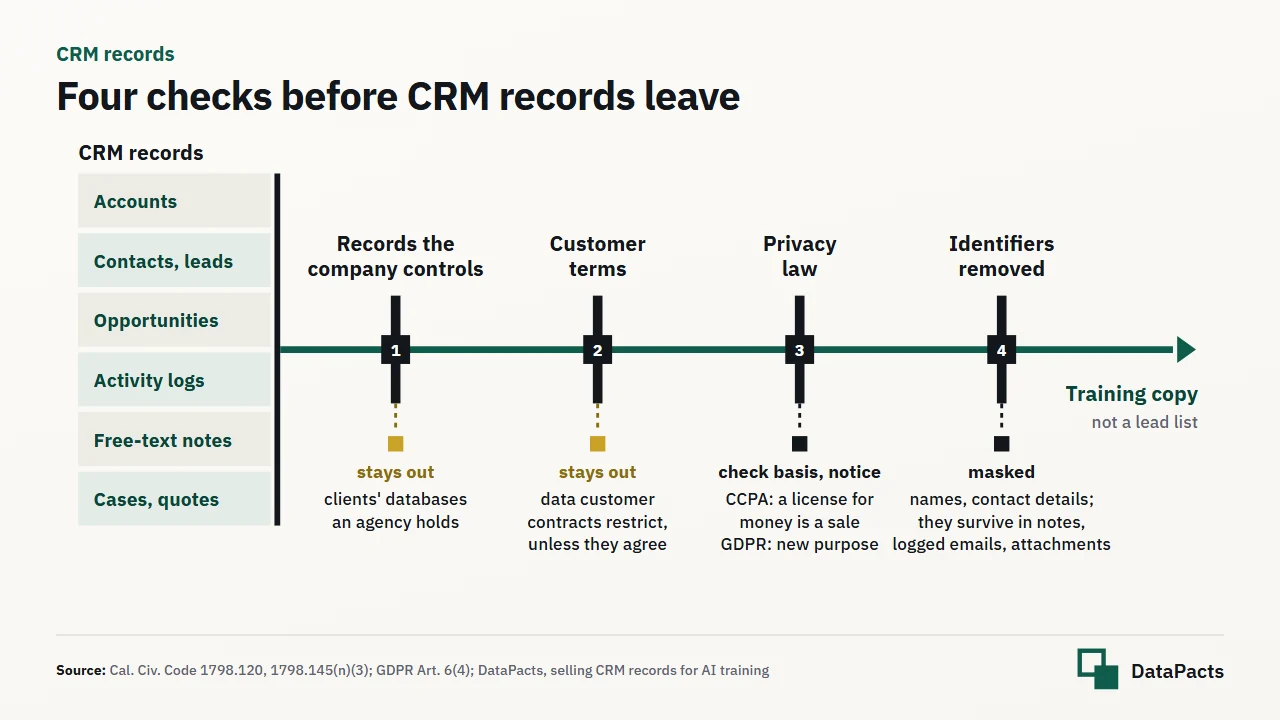
A CRM is one record type in AI training data licensing, and the customers and contacts inside the records decide most of what can be licensed. Not licensing stays a valid result.
Program terms were checked on November 9, 2026 and the statutes and the court record on November 10, 2026, as described in how we source, date and check every figure.
What a CRM Holds, and What Licensing It for AI Training Covers
A CRM holds the record of every customer relationship: companies, the people at them, open and closed deals, and the calls, emails and notes that moved each deal. Six record families:
- Accounts and companies
- Contacts and leads
- Opportunities and deal stages
- Activity logs: calls, meetings and logged emails
- Free-text notes
- Cases, quotes and products
Programs describe this material in their own words: micro1 "CRM records and sales playbooks" and Replay "sales conversations" (checked November 9, 2026). The parent page lists data types AI companies buy.
A training license grants the right to use a copy of the records for model training. It is not a sale of leads or contact lists.
Which AI Data Programs Ask for CRM and Sales Records
CRM, Salesforce or HubSpot appear in the wanted-data lists of 19 programs and intermediaries, almost always next to email, chat and tickets rather than on their own.
The table compares what each names in its own words, one stated condition and its stated pay, as of 2026-11-10, with every value taken from the company's own page checked 2026-11-09; licensees and programs come first, then intermediaries, alphabetical within each group.
| Company (role) | CRM or sales records it names (own words) | One stated condition | Stated pay (claim) | Source |
|---|---|---|---|---|
| AfterQuery (licensee) | "CRM", with email, chat, tickets, support | customer identities masked; re-identification test before delivery | no figures; intake bands from "Under $50k" to "$500k+" | afterquery.com |
| Centific (licensee) | "Salesforce, Workday, ServiceNow, SAP, HubSpot, Zendesk" | exclusions enforced in extraction code | no dollar figures | centific.com |
| Collinear AI (RL-environment builder) | "Salesforce", "HubSpot" | one-time snapshot; seller keeps ownership | no amounts | collinear.ai |
| Labelbox Prism (data vendor) | "cross-system interaction data (Salesforce, Jira, Slack)" | exclusive by default | "typically start around $50K"; "can reach $1M+" | prism.labelbox.com |
| Mercor (program) | "Salesforce" among tools; SaaS listing "CRM, billing and support desk in daily use" | not a fit: "Empty or barely used CRMs" | SaaS listing USD 55,000 to 350,000 for the whole dataset | mercor.com; api.data.mercor.com |
| micro1 (program) | "CRM records and sales playbooks"; "Sales & CRM" | 30+ full-time employees, primarily English | USD 100K to 500K, 500K to 3M and 3M+ tiers | micro1.ai |
| Mode (licensee) | "CRM and sales records" | "Mode buys the filtered copy" | "could be worth $100K–$5M" | data.mode.inc |
| Nyne (licensee) | "Salesforce, HubSpot, Workday, ServiceNow, SAP, Zendesk" | training and evaluation only, not published | "Six-figure payouts" | nyne.ai |
| Polyshares (licensee) | "CRM history" | "Defined material for a defined term" on the home page vs "Perpetual exclusive license" in its track record | "Typically $100K to $2M" | polyshares.com |
| Replay (licensee) | "CRM", "sales conversations" | only de-identified data licensed | upfront cash plus perpetual revenue share; tiers by headcount | replay.ai |
| Scale AI (program) | "Salesforce, HubSpot, Workday, ServiceNow, SAP, Zendesk" | anonymizes inside the company's environment | "$10K–$1M+ illustrative" | scale.com |
| Turing (program) | CRM (Salesforce, HubSpot, Pipedrive) | license to Turing exclusive for the first 6 months; Turing may license the record to more than one lab in that term (checked November 17, 2026) | revenue share, split not published | lazarus.turing.com |
| AIData.Broker (broker, seller-side) | "company records (chat, email, docs, tickets, CRM, code)" | excludes data whose value depends on identifying people | seller fee on broker-run sales from 12 % | aidata.broker |
| Corpus Bridge (broker, seller-side) | "Salesforce/HubSpot/Zendesk" | seller pays a success fee after closing | percentage not published | corpusbridge.com |
| DataSupply.ai (introducer) | "CRM and project records" | metadata-only manifest; personal details removed | 20 % success fee on an accepted offer | datasupply.ai |
| OpenTrain AI (referral page) | "CRM" | never receives or holds data | companies pay nothing | opentrain.ai |
| Pangea.ai (marketplace) | "CRM" | non-exclusive license for a set use and term | "around $100K to $2M" | pangea.ai |
| Sureform (platform that identifies buyers) | "CRM, ERP, accounting, project management, ticketing" | raw data deleted after processing | no range published | sureformhq.com |
| Troveo (marketplace, licenses on the seller's behalf) | "CRM, sales and support" | company never named publicly | estimator "directional" | troveo.ai |
The first twelve rows run their own programs. AIData.Broker, Corpus Bridge, DataSupply.ai, OpenTrain AI, Pangea.ai, Sureform and Troveo license on the holder's behalf, introduce or handle the sale, and none acquires the records itself.
No program publishes a CRM-only price or a CRM-only program. All company data partnership programs are compared on a separate page.
What Makes CRM History Worth Licensing
AI buyers value a CRM that was used every day for years and connects to the company's other systems; an empty or barely used CRM is, in one program's words, not a fit.
Mercor's SaaS listing asks for a "CRM, billing and support desk in daily use" and 50 GB or more of tabular data, and it lists "Empty or barely used CRMs" as not a fit.
It states a range of USD 55,000 to 350,000 to the company for the whole dataset (published October 17, 2026, checked November 9, 2026).
That range covers production databases, accounting, billing and support data together, so no part of it is a price for the CRM.
Mercor also states that "Connecting more tools generally results in a higher payout", and AfterQuery names years of history, connected systems, the kind of work and how hard the data is to recreate as price factors (both checked November 9, 2026).
Book value gives no anchor either: IAS 38.63 (Commission Regulation (EC) No 1126/2008) bars recognizing internally generated customer lists as intangible assets. License income is covered under accounting for data licensing revenue.
Customers, Prospects and Business Contacts: Whose Personal Data Sits in a CRM
Almost every CRM row names a person: a customer, a prospect, a contact at a client company or the salesperson who logged the call. Staff named in activity logs raise a separate employee-notice question, listed in the seller steps below. The legal statements in this section are information, not legal advice.
Under the CCPA: Contact Records Licensed for Money
Business contact records fall under the full CCPA rules in a California license, because the CCPA exemption for business-to-business data stopped operating on January 1, 2023 (Cal. Civ. Code 1798.145(n)(3)).
Licensing personal information for money is a sale, and 1798.120 gives consumers the right to opt out. The CCPA reaches businesses above its thresholds, among them annual gross revenue over USD 26,625,000 (adjusted for inflation, effective January 1, 2025).
Cal. Code Regs. tit. 11, sections 7150 to 7157, effective January 1, 2026, require a risk assessment before a business sells personal information, and processing that began earlier is assessed by December 31, 2027. The page on CCPA/CPRA and AI training data in California sets out both rules.
Under the GDPR: Customer Records Reused for a New Purpose
Licensing customer records collected to sell and support is a new purpose, so under the GDPR (Regulation (EU) 2016/679, applying since May 25, 2018) it needs a legal basis and a compatibility test before any record leaves the company.
Disclosure to an AI developer needs an Article 6 basis, usually Article 6(1)(f), and Article 6(4) lists compatibility factors, among them (b), the relationship between data subjects and the controller.
Article 13(3) requires information to data subjects before further processing for another purpose. Under Article 14(3)(a) a recipient informs them at the latest within one month. Article 35 requires an impact assessment before processing likely to result in a high risk.
The German Data Protection Conference (DSK) resolution of September 11, 2024 on asset deals says that transferring customer data for due diligence before signing is in principle not permitted without consent.
Customers get an objection period of about six weeks. It concerns asset deals, so it applies here by analogy only. Notices, bases and transfers are covered under GDPR legal basis, notices and transfers.
Customer Agreements That Limit What Leaves the CRM
A company can license only CRM records it controls; records it holds for clients, or that its customer contracts restrict, stay out unless those customers agree.
Mercor's SaaS listing names "Agencies holding their clients' databases" as not a fit, its cybersecurity listing accepts "customer data only with customer agreement", and its manufacturing listing excludes "Data restricted by customer contracts" (checked November 9, 2026).
An FTC staff post of February 13, 2024 states that adopting more permissive data practices such as AI training through a surreptitious, retroactive amendment to terms or a privacy policy may be unfair or deceptive under 15 U.S.C. 45.
Clause-level detail sits under customer consent and confidentiality clauses. The order of checks is the same for every CRM.
What Comes Out of CRM Records Before Delivery
Programs that take CRM data state that names and contact details are removed or masked before a lab sees the records, and some keep the work inside the seller's systems.
AfterQuery masks customer identities, never uses credentials and runs a re-identification test, and it says "no process removes all risk on its own". Centific enforces exclusions in its extraction code (both checked November 9, 2026).
Scale AI anonymizes inside the company's environment before extraction, and Mercor states that "No AI lab buyer or third-party vendor ever sees your raw data". Replay licenses only de-identified data, and AIData.Broker excludes data whose value depends on identifying people (all checked November 9, 2026).
Free-text notes, logged emails and attachments are the fields where names survive masking, because a contact's name appears in a note about a call. Methods and standards are in PII removal and de-identification before licensing.
Customer Profiles Left Out of a Court-Supervised Data Sale: Spirit Airlines
A court-supervised AI data sale on a public docket left the customers out: the asset schedule of Spirit Airlines marks 97,500,000 passenger customer profiles "Not Included" while listing employee records and workplace systems.
The revised schedule (ECF 1802, November 9, 2026) lists 175,658 employee records and 1,986,737,423 emails as Included, and consumer transaction systems stay excluded (Dkt. 1684, October 5, 2026).
The debtors named Google LLC successful bidder at USD 10,000,000 and Mercor.io Corporation alternate bidder at USD 7,500,000 for the whole schedule in In re Spirit Aviation Holdings, Inc., No. 25-11897 (SHL), Bankr.
S.D.N.Y. The sale hearing was set for November 17, 2026, and no sale order was on the docket as of November 18, 2026.
For included data, the debtors adopted the de-identification standard of Cal. Civ. Code 1798.140(m) in a letter of August 5, 2026. The route is described under US bankruptcy data sales under Section 363(b)(1).
Licensing CRM Records: Benefits, Risks, Downsides and Alternatives, Including Not Licensing
Licensing CRM history can earn from records that already exist, but it puts customers' and contacts' data in a third party's training set, and a trained model cannot be untrained.
Benefits
- Records that already exist can earn income within the claims programs state (Mercor, micro1 and Scale AI above).
- Pangea.ai states a non-exclusive license for a set use and term, and Collinear AI states that the seller keeps ownership (checked November 9, 2026).
Risks
- Licensing business contacts for money is a sale in California, with an opt-out and a risk assessment.
- A retroactive change to customer terms to allow AI training may be unfair or deceptive under the FTC staff post.
- Labelbox states that models already trained cannot be unlearned.
Downsides
- micro1's Data License Master Terms (updated November 8, 2026) describe an irrevocable, perpetual license.
- Turing states that the license to Turing is exclusive for the first 6 months after signing (checked November 17, 2026).
Alternatives
- License other workplace data without the CRM, as the Spirit schedule lists employee records and email without the passenger profiles.
- License a de-identified subset, as Replay describes.
- Limit the recipients in the scope, since Replay states that it sells only to frontier AI and data labs.
- Do not license at all, and weigh whether to sell or license your data against keeping the records in-house.
Where CRM Records Sit Among Workplace Data, Source Systems and the Seller Steps
CRM records overlap with four neighbors that have their own pages: sales calls, support tickets, email and order records. HubSpot's help page states that engagements are not in record exports (checked November 9, 2026).
Neighboring data types:
- Recorded sales calls
- Support tickets and chats
- Email outside the CRM
- Orders and bookings
- Billing and ERP records
- Project and IT tickets
Source systems:
Seller steps that apply to CRM records:
- The complete seller guide
- Who owns the records
- Salespeople named in activity logs
- Every clause of a licensing agreement
The rules by country are in the law by country, and privacy policy changes and the FTC cover the US side.
Frequently Asked Questions
Can a company sell its CRM data to AI companies?
A company can license a copy of its CRM data if it controls the records and its customer terms and privacy law allow it. The programs in the table above name CRM among the records they ask for.
Do business contacts in a CRM count as personal data?
Business contacts have been fully covered by the CCPA since January 1, 2023, when the exemption in Cal. Civ. Code 1798.145(n)(3) stopped operating. Under the GDPR every disclosure of personal data needs an Article 6 basis, compared in privacy law and AI training data by jurisdiction.
How much is CRM data worth to an AI buyer?
No CRM-only price is public; the one range tied to a company is Mercor's, for a whole SaaS dataset.
Valuation methods are in what company data is worth to AI companies.
Can an agency license its clients' CRM data?
An agency cannot license its clients' CRM data without the clients. Mercor lists agencies holding their clients' databases as not a fit (checked November 9, 2026).