This page covers personal information, generative AI duties, export and data accounting as of 2026-11-09, each rule with its citation and date, within AI training data licensing as a whole.
What Chinese Law Decides When a Company Licenses Data for AI Training
Chinese law decides four things in a training data deal: whether personal information in the data may be provided, what the buyer must show about its sources, whether the data may leave China, and how the holder books the data.
- Personal information: the PIPL, in force 2021-11-01.
- Buyer sourcing duties: the Interim Measures for Generative AI Services, in force 2023-08-15, and Article 19 of the Network Data Security Management Regulations, in force 2025-01-01.
- Export: PIPL Articles 38 to 40 and CAC Order No. 16.
- Accounting: the Ministry of Finance provisions 财会〔2023〕11号.
A Chinese copyright exception for training, the Data Security Law detail and court rulings are not covered here yet.
Chinese Instruments That Apply to a Training Data Deal
Seven Chinese laws, regulations, rules and policy documents shape a training data license; each row gives the citation, the date and whether it binds. The Data Security Law row is named because the Interim Measures cite it.
The table lists the instruments in deal order, as of 2026-11-09, with article texts read on 2026-11-10.
| Instrument | Citation | Dates | What it decides in a data deal | Binding status | Source |
|---|---|---|---|---|---|
| Personal Information Protection Law (个人信息保护法) | adopted by the NPC Standing Committee 2021-08-20 | in force 2021-11-01 (Art. 74) | legal basis, separate consent to provide (Art. 23) and to export (Art. 39), transfer mechanisms (Art. 38) | in force | cac.gov.cn |
| Interim Measures for Generative AI Services (生成式人工智能服务管理暂行办法) | CAC and six agencies, Order No. 15 (2023) | in force 2023-08-15 (Art. 24) | lawful-source, IP and consent duties for training data (Art. 7); labeling (Art. 8) | in force | cac.gov.cn |
| Network Data Security Management Regulations (网络数据安全管理条例) | State Council Decree No. 790 | in force 2025-01-01 | security management of training data (Art. 19) | in force | gov.cn |
| Provisions on Promoting and Regulating Cross-Border Data Flows (促进和规范数据跨境流动规定) | CAC Order No. 16 | in force 2024-03-22 (Art. 14) | export exemptions and thresholds (Arts. 3, 5, 7, 8) | in force | cac.gov.cn |
| Data Security Law (数据安全法) | cited in Interim Measures Art. 7(5) | not covered here | important data and export rules not covered here | named as a law in Interim Measures Art. 7(5); status not covered here | cac.gov.cn (citing text) |
| Interim Provisions on Accounting Treatment of Enterprise Data Resources | MOF 财会〔2023〕11号 | signed 2023-08-01, published 2023-08-21 | accounting and disclosure of data resources | issued; application date not covered here | kjs.mof.gov.cn |
| 15th Five-Year Plan for Copyright Work | NCAC 国版发〔2026〕3号 | notice 2026-08-31, published 2026-09-07 | AI training content not covered | policy, not law | ncac.gov.cn |
Personal Information in a Chinese Training Set: Consent Under the PIPL
The PIPL, adopted 2021-08-20 and in force 2021-11-01, governs every personal record a Chinese holder would license.
Legal Bases and Separate Consent for Providing Data to an AI Developer
A Chinese holder needs a legal basis under PIPL Art. 13 to process personal information, and Art. 23 adds notice and the individual's separate consent before it provides that information to another handler such as an AI developer.
Art. 13 lists seven bases: consent; contract or human resources management; legal duties; public health emergencies or protection of life and property; news reporting and public oversight in the public interest; lawfully public information within a reasonable scope; and other cases set by law.
Under Art. 23 the individual must be told the recipient's name, contact details, purpose, method and categories of data. "Separate" consent means a consent specific to the provision, not bundled into a general privacy notice.
Art. 66 orders correction and, if the handler refuses, a fine of up to CNY 1 million; serious cases carry fines of up to CNY 50 million or 5% of prior-year turnover. The comparison with other regimes is in privacy law and AI training data.
Publicly Available and Sensitive Personal Information
Personal information that individuals published themselves or that was lawfully made public may be processed within a reasonable scope under PIPL Art. 27, unless the individual clearly refuses, and consent is needed where processing has a significant impact on the person.
For scraped or public datasets, the scope stays "reasonable"; Art. 27 is not a blanket permission.
PIPL Art. 28 defines sensitive personal information to include biometric data, religious belief, specific identity, medical health, financial accounts, location tracking and the data of minors under 14. Voice, face and health datasets therefore carry the stricter category; its extra conditions are not covered here.
What the Interim Measures for Generative AI Ask of Training Data
The Interim Measures for the Management of Generative Artificial Intelligence Services require providers to carry out pre-training and optimization training on data and foundation models from lawful sources, without infringing intellectual property and with consent or another legal basis for personal information.
The CAC issued them with the NDRC, the Ministry of Education, the Ministry of Science and Technology, the MIIT, the Ministry of Public Security and the National Radio and Television Administration as Order No. 15 (2023), in force 2023-08-15 (Art. 24).
Art. 2 applies them to services that generate text, images, audio or video for the public in the PRC and excludes organizations that develop the technology without offering services to the domestic public.
Art. 7 adds two further duties: effective measures to improve the quality, authenticity, accuracy, objectivity and diversity of training data, and compliance with the Cybersecurity Law, the Data Security Law, the PIPL and regulators' requirements.
Art. 8 adds labeling rules, quality assessment, spot checks and labeler training, and Art. 19 of State Council Decree No. 790 (in force 2025-01-01) adds security management of training data.
The duties bind the provider, so a seller meets them as provenance documents and rights warranties that a buyer in China asks for; see indemnities and warranties in AI data licenses.
Sending Training Data Out of China: PIPL Mechanisms and the 2024 Cross-Border Provisions
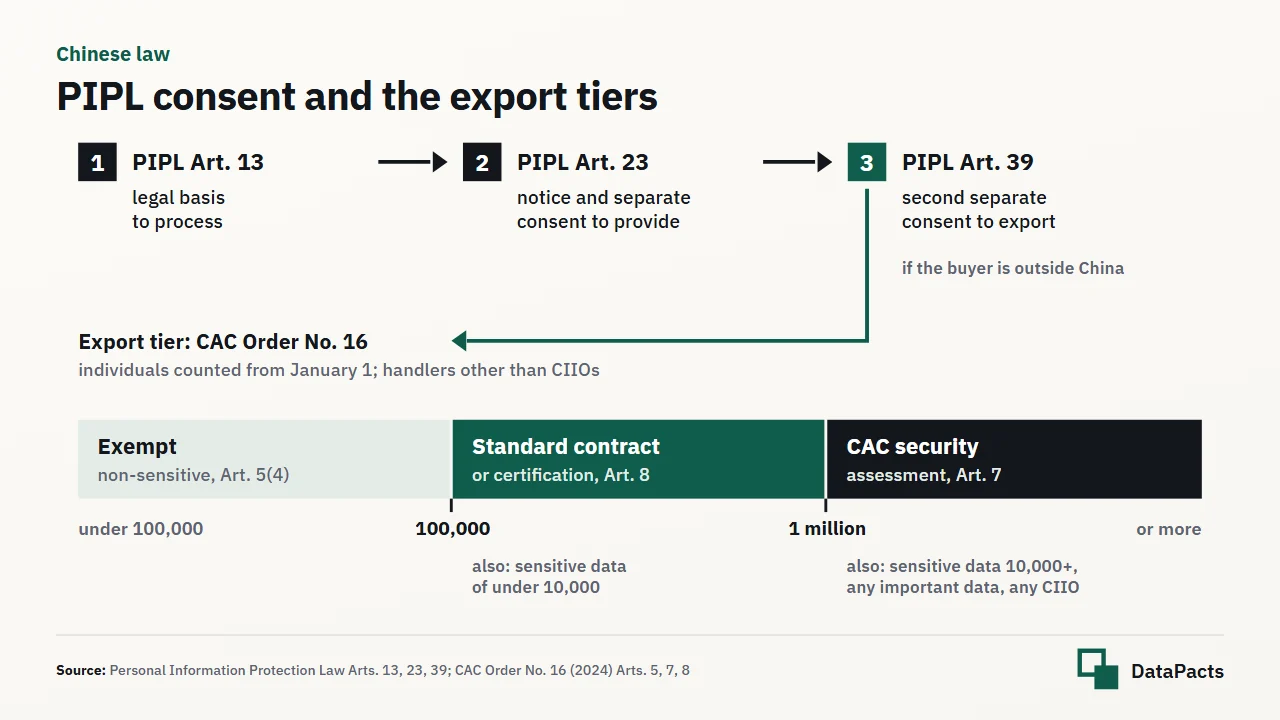
Personal information licensed to a buyer outside China needs one of the PIPL Art. 38 mechanisms and a second separate consent under Art. 39, and CAC Order No. 16 of 2024 sets volume thresholds that decide which mechanism applies.
Art. 38 lists a CAC security assessment (Art. 40), certification by a professional institution, a CAC standard contract, or other conditions, and the handler must ensure the foreign recipient meets PIPL standards.
Art. 39 requires notice of the recipient's identity, contact, purpose, method, categories of data and how individuals exercise rights against it. Art. 40 requires CIIOs and handlers reaching the volume set by the CAC to store personal information locally and obtain an assessment.
The Provisions on Promoting and Regulating Cross-Border Data Flows (CAC Order No. 16) took effect on publication, 2024-03-22 (Art. 14).
Art. 3 exempts data from trade, transport, academic cooperation, manufacturing and marketing that contains no personal information or important data. For handlers other than critical information infrastructure operators (CIIOs), volumes count cumulatively from January 1 of the year:
- Under 100,000 individuals, non-sensitive: exempt (Art. 5(4)).
- 100,000 to under 1 million individuals, or sensitive data of under 10,000: standard contract or certification (Art. 8).
- 1 million individuals or more, sensitive data of 10,000 or more, or any important data: CAC security assessment (Art. 7).
- CIIOs: security assessment for any personal information or important data (Art. 7).
The definition of "important data" is outside this page, and the separate consent of Art. 39 applies in every tier. The wider route for sellers outside the US is in selling data to AI companies from outside the US.
In Force, Issued and Unverified: China as of November 2026
Four Chinese instruments on this page are in force, two are issued documents whose application or content is not fully recorded, and one law is cited without its detail; the table dates each step.
The table lists the dated steps, newest first, as of 2026-11-09, each with its official source.
| Date | Item | Step | Status as of 2026-11-09 | Source |
|---|---|---|---|---|
| 2026-09-07 | NCAC 15th Five-Year Copyright Plan | published (notice dated 2026-08-31) | policy plan | ncac.gov.cn |
| 2025-01-01 | Network Data Security Management Regulations | in force | in force | gov.cn |
| 2024-03-22 | CAC Order No. 16 cross-border provisions | published and in force | in force | cac.gov.cn |
| 2023-08-21 | MOF data resources accounting provisions | published (signed 2023-08-01) | issued | kjs.mof.gov.cn |
| 2023-08-15 | Interim Measures for Generative AI Services | in force | in force | cac.gov.cn |
| 2021-11-01 | PIPL | in force | in force | cac.gov.cn |
| 2021-08-20 | PIPL | adopted by the NPC Standing Committee | completed | cac.gov.cn |
The NCAC plan is policy, and its AI training content is not covered here, nor are Supreme People's Court guidance, technical standards or Chinese court rulings on AI copyright.
The Hailuo case brought by Disney, Universal and Warner Bros. Discovery against MiniMax is a US federal case (C.D. Cal. 2:25-cv-08768-SB-E, filed 2025-09-16, motions to dismiss denied 2026-05-22), not a Chinese court case; see Disney and others v. MiniMax.
Licensing From China and to Buyers in China
A Chinese holder licensing to a foreign buyer and a foreign holder licensing to a buyer in China each meet one rule on their own side.
On the Chinese side, the Ministry of Finance Interim Provisions on Accounting Treatment of Enterprise Data Resources (财会〔2023〕11号, notice signed 2023-08-01, published 2023-08-21) standardize how enterprises account for and disclose data resources; their application date is not covered here.
For payments to a Chinese licensor, IRS Table 1 (Rev. May 2023) lists a 10% US treaty withholding rate for China on copyright royalties (income code 12) and on know-how and other industrial royalties (income code 10), subject to the treaty text and its limitation on benefits.
For data going the other way, 28 CFR Part 202, effective 2025-04-08, prohibits licensing bulk US sensitive personal data, even when de-identified, to buyers in or linked to China and five other countries of concern. The limits are set out in the DOJ bulk sensitive data rule.
Benefits, Risks, Downsides and Alternatives of Licensing Data Under Chinese Law, Including Not Selling
Chinese law makes a licensed dataset's provenance something a buyer must show, which gives documented sellers an advantage, while consent and export steps add cost, and not licensing remains a valid choice.
Benefits
- The lawful-source duty in Interim Measures Art. 7 creates demand for documented data.
- Exports of non-sensitive personal information of under 100,000 individuals per year by handlers other than CIIOs are exempt (Order No. 16 Art. 5(4)).
- Enterprises can account for data resources under 财会〔2023〕11号.
Risks
- PIPL fines reach CNY 50 million or 5% of prior-year turnover in serious cases (Art. 66).
- A CAC security assessment applies at 1 million individuals or for important data (Order No. 16 Art. 7).
- The meaning of important data and court practice are not covered here.
Downsides
- A cross-border license of personal information needs two separate consents, under Arts. 23 and 39.
- US treaty withholding of 10% applies to royalties paid to China, per IRS Table 1.
Alternatives
- License non-personal data only; Order No. 16 Art. 3 exempts such data collected in trade, transport, academic cooperation, manufacturing and marketing where it holds no important data.
- License within China to avoid export steps.
- Keep volumes under the exempt threshold.
- Do not sell or license at all; see alternatives to selling data to AI labs.
Beyond China: Comparisons, Neighboring Jurisdictions and the Seller Process
Chinese rules stop at the consent, sourcing and export questions; the pages below cover comparisons, neighbors and the sale.
- AI training data law by jurisdiction: the parent page.
- Sell or license company data to AI companies: the steps of a sale or license.
- Rights audit before licensing: whether the holder owns what it licenses.
- Customer consent before licensing data: consent and confidentiality clauses.
- Training data provenance: documenting lawful sources.
- Withholding tax on data license payments: treaty rates including China.
- Accounting for data licensing revenue: booking data as an asset.
- Copyright and AI training across jurisdictions: copyright models compared.
- Employee data and AI training rules: employee data rules by jurisdiction.
- Japan, South Korea, India, Hong Kong, Taiwan and Singapore: neighboring jurisdictions; Hong Kong is a separate legal system.
How This Page Is Sourced and Dated
Every rule here cites the official text on cac.gov.cn, gov.cn or a ministry site, with the date it was read. The rules are set out in how we source, date and check every figure. This page is general information about Chinese law, not legal advice for any specific deal.
Frequently Asked Questions
Can personal information be licensed to an AI developer in China without consent?
Not as a rule. PIPL Art. 13 lists the legal bases, Art. 23 adds notice and separate consent for providing data to another handler, and public data may be processed only within a reasonable scope (Art. 27).
Do the Interim Measures for Generative AI apply to a company that sells data?
They bind providers serving the public in China, not sellers directly (Art. 2). A seller meets the Art. 7 lawful-source duties as the sourcing and rights demands of its buyer.
When does exporting training data from China need a CAC security assessment?
For CIIOs, for important data, and from 1 million individuals or sensitive data of 10,000 individuals per year. CAC Order No. 16 Art. 7, in force 2024-03-22, counts volumes cumulatively from January 1.
Does China have a copyright exception for AI training?
That is not covered on this page. Interim Measures Art. 7 requires training without infringing intellectual property; whether a statutory exception exists is not stated here.