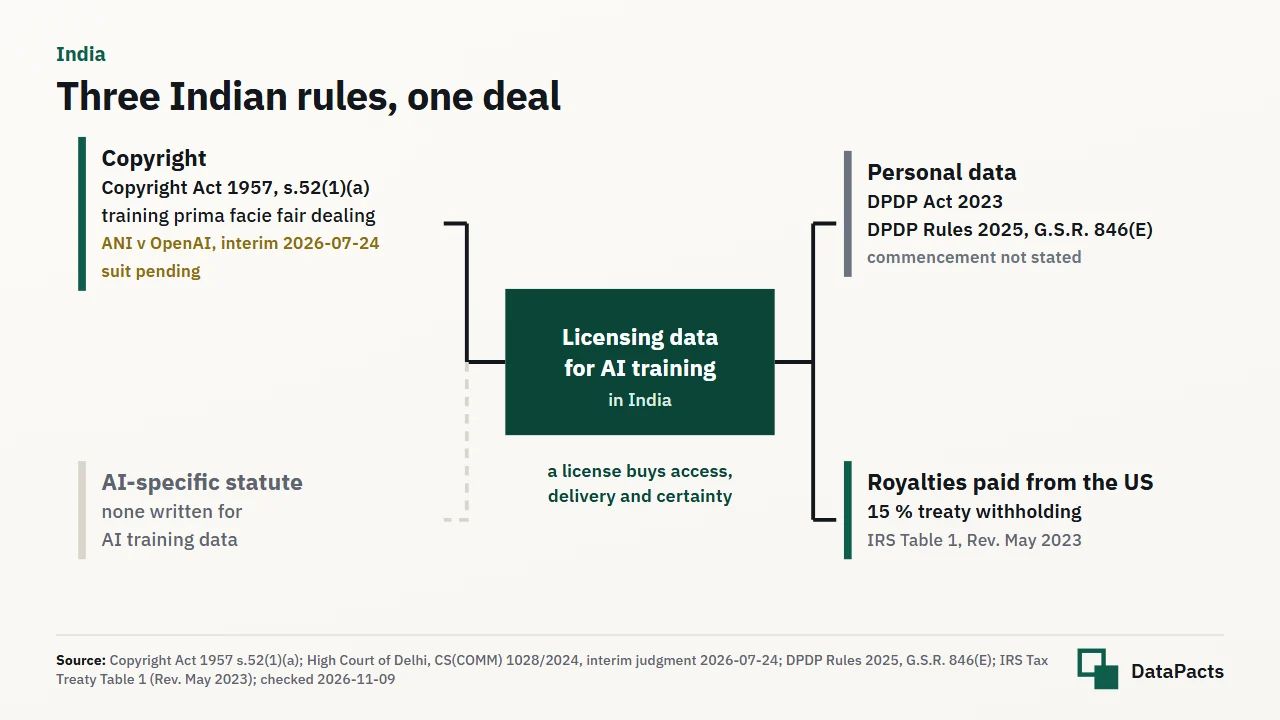
This page covers copyright, personal data and cross-border licensing as of 2026-11-09 within AI training data licensing as a whole. The court reading is interim and the suit is pending, and each rule is cited with its date.
What Indian Law Decides When a Company Licenses Data for AI Training
Indian law decides three things in a training data deal that this page can date: whether works may be copied for training without a license, what personal data rules attach to a dataset, and what tax applies when a foreign buyer pays.
- Copyright: section 52(1)(a) of the Copyright Act 1957, as read in CS(COMM) 1028/2024 on 2026-07-24 (interim).
- Personal data: the Digital Personal Data Protection Act, 2023 and the Digital Personal Data Protection Rules, 2025, notified by the Ministry of Electronics and Information Technology (MeitY) as G.S.R. 846(E).
- Cross-border payment: 15 % US treaty withholding on royalties paid from the US, per IRS Table 1 (Rev. May 2023).
- AI statute: no AI-specific statute is covered on this page.
Employee data, recording consent, database rights and trade-secret rules for India are not covered yet.
Indian Instruments and Rulings That Apply to a Training Data Deal
Four Indian instruments and one ruling shape a training data license; each row gives the citation, the verified date and whether it binds. Three rows carry no verified date, and the page says so instead of estimating.
The table lists the instruments in deal order, as of 2026-11-09, and the ruling's case record is not yet published.
| Instrument or ruling | Citation | Verified date | What it decides in a data deal | Binding status | Source |
|---|---|---|---|---|---|
| Copyright Act 1957, s.52(1)(a) | Copyright Act, 1957, s.52(1)(a) (fair dealing, private or personal use including research) | in force; commencement not stated here | whether copying for training needs permission | in force; official text not opened, cited through the judgment | Delhi High Court judgment PDF (livelaw.in) |
| ANI Media Pvt. Ltd. v Open AI OpCo LLC | High Court of Delhi, CS(COMM) 1028/2024 | interim judgment 2026-07-24 | prima facie: storage private, training fair dealing, outputs not shown to infringe | interim; suit pending as of 2026-11-09 | Delhi High Court judgment PDF (livelaw.in) |
| Digital Personal Data Protection Act, 2023 | number and sections not stated here | not stated | duties attached to personal data in a dataset | statute; commencement not stated here | n/a |
| Digital Personal Data Protection Rules, 2025 | G.S.R. 846(E), notified by MeitY | notification date not stated | detailed data-fiduciary duties | notified; phased commencement not stated here | MeitY (meity.gov.in) |
| US-India treaty withholding (seller side) | IRS Table 1, Rev. May 2023, income codes 10 and 12 | as of 2026-11-09 | 15 % on royalties paid from the US | US administrative table; the treaty governs | irs.gov |
Section 52(1)(a) of the Copyright Act 1957 and Training on Indian Works
The only Indian court reading of copyright and AI training on record here comes from one interim judgment, and it turns on fair dealing.
How the Delhi High Court Read Fair Dealing on 2026-07-24
On 2026-07-24 the High Court of Delhi refused ANI's application for an interim injunction against OpenAI, holding prima facie that training a large language model falls within fair dealing for private or personal use, including research, under section 52(1)(a) of the Copyright Act 1957.
The suit is ANI Media Pvt. Ltd. v Open AI OpCo LLC, CS(COMM) 1028/2024; ANI claims that storing and training on its news content and ChatGPT outputs infringes, and it sought the injunction under Order XXXIX Rules 1 and 2 of the Code of Civil Procedure.
The court made three prima facie findings: storage in a closed space is purely private, training falls within section 52(1)(a) through an updating construction of "research", and no infringement is shown in the outputs at this stage.
Interveners included the Federation of Indian Publishers, DNPA, the Broadband India Forum, IGAP, Flux AI Labs and IMI. The claims, parties and procedure sit on the case page, ANI v. OpenAI claims, rulings and status.
What the Interim Reading Leaves Open
The reading is prima facie and interim, so it does not settle Indian law on training.
- The suit is pending as of 2026-11-09, and the reading can change at trial.
- A statutory text and data mining exception for India is not covered on this page.
- The text of section 52 is cited through the judgment, because no official statutory text was opened for this page.
Japan's Copyright Act Article 30-4 is a statutory exception with a proviso, and the EU requires a machine-readable reservation for online content under Article 4(3) of Directive (EU) 2019/790, as set out in copyright and AI training across jurisdictions.
What a License Still Adds When Training Is Prima Facie Fair Dealing
When training is prima facie fair dealing, a license in India buys access, delivery and certainty rather than permission to analyze.
- Data that is not public reaches a buyer only by delivery, and the fair dealing reading in the ANI judgment concerned ANI news content that OpenAI had stored for training.
- A license removes the risk that the interim reading changes before final judgment.
- A license can carry documented consent for any personal data, which the DPDP regime may require once its rules apply.
An Indian rule on whether a contract can exclude section 52(1)(a), and an Indian database right, are not covered here. The clauses that carry access, delivery and warranties are set out in AI data licensing agreements, clause by clause.
Personal Data in an Indian Training Set: What Is Verified About the DPDP Act and Rules
India's personal data law for training sets is the Digital Personal Data Protection Act, 2023, with the Digital Personal Data Protection Rules, 2025 notified by MeitY as G.S.R. 846(E); this page states only those identifiers until the official texts are read in full.
Other jurisdictions are set side by side in privacy law and AI training data compared.
- Verified: the Act's name, and the Rules' notification by MeitY as G.S.R. 846(E).
- Not stated on this page: the Act's number and sections, any exemption for personal data made publicly available, consent and legitimate-use rules, the Rules' Gazette date and their phased commencement.
For the seller, the practical reading is to treat personal data in an Indian dataset as needing documented consent or a verified exemption, and to check the official Gazette text before relying on any commencement date.
Licensing From India to Domestic and Foreign Buyers
The records here show three channels through which Indian data reaches foreign buyers, and one tax point.
Human Archive, Inc., a Delaware corporation, licenses first-person video and sensor data recorded by adult contributors to AI and robotics labs, and TechCrunch reported on 2026-05-26 that those contributors are mainly gig workers in India; its privacy policy states payouts for approved submissions, checked 2026-11-10. See the Human Archive profile.
Mercor's call-center listing states India among its location preferences, alongside France and francophone markets, Latin America, U.S. Hispanic markets and Japan, checked 2026-11-10.
Google names The Times of India among the publications in its News AI pilot (announced 2025-12-10) and in its 2026-10-15 update states that it pays participating publications "for the delivery and use of enhanced content". It is a content arrangement for AI features, not a training license, and no value is disclosed.
IRS Table 1 (Rev. May 2023) lists 15 % US treaty withholding for India on copyright royalties (income code 12) and on know-how and other industrial royalties (income code 10), subject to the treaty text. Treaty rates and how to claim them are set out in withholding tax on data license payments.
Benefits, Risks, Downsides and Alternatives of Licensing Data Under Indian Law, Including Not Selling
Indian law gives a holder no settled right to stop training on content already accessible, so the case for licensing rests on access, delivery and certainty, and not licensing remains a valid choice.
Benefits
- Delivery of non-public data is the only route to it.
- A license gives certainty while the court reading is interim.
- Foreign buyers state India as a sourcing location.
Risks
- The interim reading can change at trial.
- DPDP duties apply whose commencement is not stated here.
- 15 % withholding applies to royalties paid from the US unless relieved.
Downsides
- A developer may rely on the prima facie fair dealing reading instead of paying for public content.
- Personal data needs consent documentation work.
Alternatives
- License only non-public or non-personal data.
- Wait for a final judgment or a verified DPDP commencement date.
- Keep the data in-house.
- Do not sell or license at all; see alternatives to selling data to AI labs.
Beyond India: Comparisons, Neighboring Jurisdictions and the Seller Process
Indian law stops at the fair dealing reading and the deal; the pages below cover comparisons, neighbors and the sale.
- AI training data law by jurisdiction: the parent page.
- Sell or license company data to AI companies: the steps of a sale or license.
- Rights audit before licensing: whether the holder owns what it licenses.
- Selling data to AI companies from outside the US: the full route for sellers outside the US.
- Web scraping for AI training: scraping rules compared.
- AI copyright lawsuits over training data: rulings in other jurisdictions.
- Japan, China, South Korea, Australia and Singapore: neighboring jurisdictions.
How This Page Is Sourced and Dated
Every rule here cites a court judgment, a ministry record or a buyer's own page, with the date it was checked. Indian government sites could not be opened on 2026-11-09 and 2026-11-10, so statutory texts are cited only where verified.
This page is general information about Indian law, not legal advice for any specific deal. The method is set out in how we source, date and check every figure.
Frequently Asked Questions
Is training an AI model on Indian copyright works lawful?
Prima facie yes under section 52(1)(a), per the 2026-07-24 interim judgment. The suit is pending, so no final Indian ruling exists as of 2026-11-09.
Is the ANI ruling final?
No, the injunction was refused on a prima facie view. The suit, CS(COMM) 1028/2024, is pending as of 2026-11-09.
What US withholding applies to royalties paid to an Indian licensor?
15 % on copyright royalties (code 12) and on know-how and other industrial royalties (code 10). The rate is from IRS Table 1, Rev. May 2023; check the treaty text.