This page covers personal data, the AI statute, copyright and cross-border money as of 2026-11-09, each with its citation and date, within AI training data licensing as a whole. The special provision is passed but not yet in force.
What South Korean Law Decides When a Company Licenses Data for AI Training
South Korean law decides four things in a training data deal: whether personal data in it may be used for AI development, what the national AI statute requires, whether training copies of works need a license, and how cross-border payments are taxed.
- Personal data: the Personal Information Protection Act (PIPA), its 2026 AI special provision and the Personal Information Protection Commission (PIPC).
- AI statute: the Framework Act on AI, amended by Act No. 21311.
- Copyright: the Copyright Act position is not covered here; the question is before the Seoul Central District Court.
- Tax: US treaty withholding rates for Korea.
The base PIPA articles, including the pseudonymized-information rules, PIPC guidance on publicly available data, and Korean employee data and recording rules are not covered on this page yet.
South Korean Instruments That Apply to a Training Data Deal
Six South Korean instruments and regulator measures bear on a training data license; each row gives the citation, the date and whether it binds. Two rows, the Copyright Act and the Unfair Competition Prevention Act, are named because a pending suit relies on them, with their articles not covered.
The table lists the instruments in deal order, as of 2026-11-09 (law.go.kr header re-read 2026-11-10).
| Instrument | Citation | Dates | What it decides in a data deal | Binding status | Source |
|---|---|---|---|---|---|
| Personal Information Protection Act (base) | citation not covered | not covered | consent, provision and pseudonymized information (articles not covered) | statute (detail not covered) | pipc.go.kr |
| PIPA AI special provision (개인정보 활용 특례) | amendment to the PIPA; article and Act number not stated by the PIPC release | passed 2026-08-20; takes effect six months after promulgation | PIPC-supervised use of lawfully collected personal data for AI development | passed, not yet in force | pipc.go.kr |
| Regulatory sandbox (existing system) | PIPC release on the special provision | exceptions for two years by default, up to four | time-limited exceptions, which the PIPC calls a limitation | existing system, not AI-specific | pipc.go.kr |
| Framework Act on AI (AI Basic Act) | 인공지능 발전과 신뢰 기반 조성 등에 관한 기본법, amended by Act No. 21311 | amendment promulgated 2026-01-20, in force 2026-07-21 | framework AI statute; data duties not covered | in force | law.go.kr |
| Copyright Act | not covered | not covered | whether training copies need a license | not covered | n/a |
| Unfair Competition Prevention Act | named in the broadcasters' claims; articles not covered | not covered | protection of content and data beyond copyright | not covered | kba.or.kr (plaintiffs' release) |
Personal Data in a Korean Training Set: The 2026 PIPA AI Special Provision
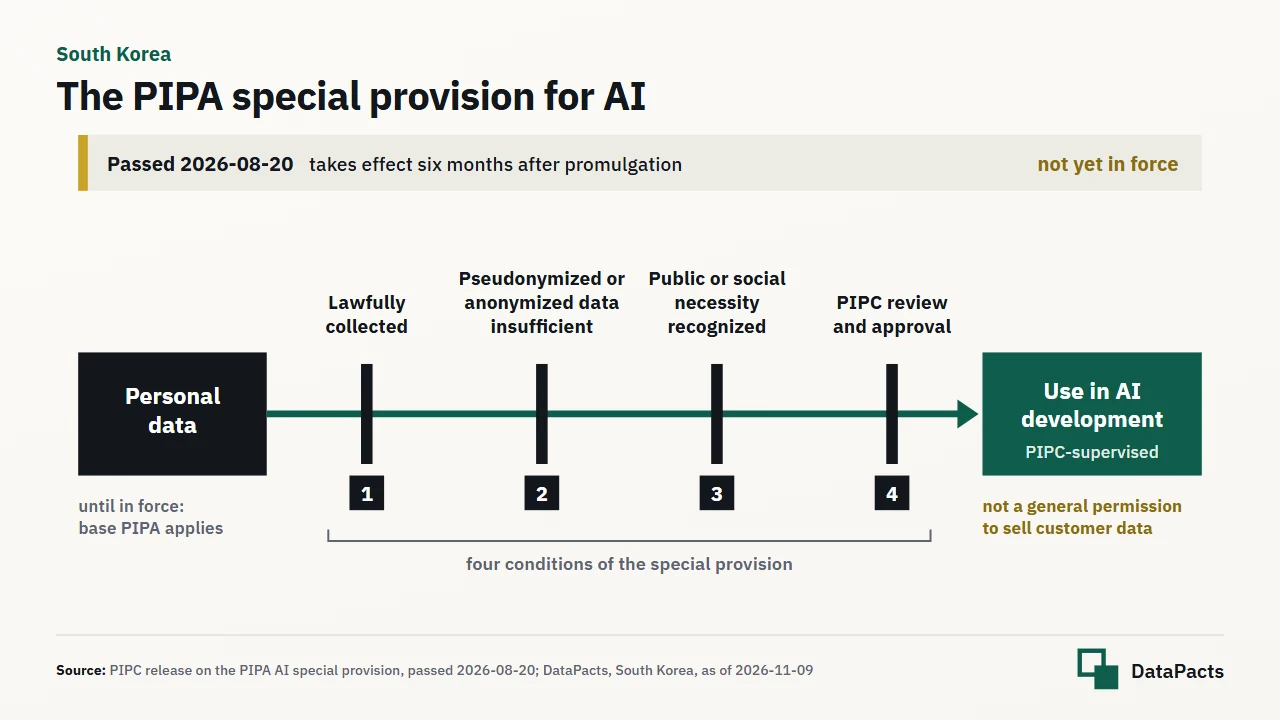
South Korea's National Assembly passed an amendment to the Personal Information Protection Act on 2026-08-20 that creates a special provision for using personal data in AI development, and it takes effect six months after promulgation.
The PIPC (Personal Information Protection Commission, Korea's data protection authority) describes the amendment in its own release (개인정보 활용 특례). The PIPC will review and approve uses under the provision. The article number, Act number and promulgation and in-force dates are not stated on this page. The provision has four conditions:
- It applies to personal data that was lawfully collected.
- It applies only where pseudonymized or anonymized data is insufficient.
- It applies only where public or social necessity is recognized.
- It operates under PIPC supervision and is not a general permission to sell customer data.
The same PIPC release notes that the existing regulatory sandbox grants exceptions only for a limited period, two years by default and up to four, and calls that a limitation. The provision is framed around an AI developer's use under PIPC approval, so a holder cannot treat it as cover for a sale.
Until commencement the base PIPA applies. Its consent and third-party provision rules, the pseudonymized-information articles and PIPC guidance on publicly available data are not covered here. The comparison with other regimes sits in privacy law and AI training data compared.
South Korea's AI Basic Act: The Dated Amendment and What It Does Not Settle
South Korea's framework AI statute, the Framework Act on the Development of Artificial Intelligence and the Creation of a Foundation for Trust (인공지능 발전과 신뢰 기반 조성 등에 관한 기본법), is in force, and its partial amendment, Act No. 21311, was promulgated on 2026-01-20 and took effect on 2026-07-21.
The official source is law.go.kr, whose header reads "[시행 2026. 7. 21.] [법률 제21311호, 2026. 1. 20., 일부개정]" (re-read 2026-11-10). The original Act number and the original commencement date are not stated on this page. Any training data, transparency or licensing duties of the Act are not covered here either. Further amendments are not stated.
Training on Broadcast News: The Korean Copyright Question Before the Courts
Whether training an AI model on copyrighted works needs a license in South Korea is not settled on this page: no Korean copyright exception for training is recorded here, and the question is before the Seoul Central District Court in a suit by three broadcasters.
The Korean Copyright Act and any text and data mining provision are not covered on this page yet. The comparison of copyright models sits in copyright and AI training across jurisdictions.
KBS, MBC and SBS sued Naver at the Seoul Central District Court on 2025-01-13. The Korean Broadcasters Association describes claims of copyright infringement and violation of the Unfair Competition Prevention Act over the use of the broadcasters' news content to train HyperCLOVA and HyperCLOVA X, with damages and a training ban sought.
No case number is published, so none is printed here, and no ruling is recorded. For Korean news and media holders, a license gives a buyer certainty that the pending suit does not; see Korean broadcasters' AI training lawsuit against Naver.
Passed, In Force and Open: South Korea as of November 2026
One Korean amendment on this page is in force, one has passed but awaits commencement, and one lawsuit has no ruling recorded here; the table dates each step.
The table lists four steps, newest first, as of 2026-11-09.
| Date | Item | Step | Status as of 2026-11-09 | Source |
|---|---|---|---|---|
| 2026-08-20 | PIPA AI special provision | passed by the National Assembly | not yet in force; six months after promulgation | pipc.go.kr |
| 2026-07-21 | AI Basic Act amendment, Act No. 21311 | in force | in force | law.go.kr |
| 2026-01-20 | AI Basic Act amendment, Act No. 21311 | promulgated | completed | law.go.kr |
| 2025-01-13 | KBS, MBC and SBS v. Naver | suit filed, Seoul Central District Court | no case number published; no ruling recorded here | kba.or.kr (plaintiffs' release) |
The special provision's commencement depends on its promulgation date, which is not stated here.
Licensing From South Korea to Domestic and Foreign Buyers
A Korean holder can meet a public data platform at home or license to foreign buyers, and each route carries its own fee or tax point.
AI Hub is a government AI data platform run by the Ministry of Science and ICT and the National Information Society Agency (NIA), which states that it holds data in 14 fields (checked 2026-11-09). It is a platform and not a buyer; it sits among national AI data programs.
AWS states that sellers pay an additional 1% regional listing fee on transactions with buyers in South Korea from 2025-04-01, on top of the standard listing fees (checked 2026-11-10).
IRS Table 1 (Rev. May 2023, checked 2026-11-09) lists US treaty withholding for South Korea of 15% on know-how and other industrial royalties (income code 10) and 10% on copyright royalties (income code 12), subject to the treaty text and limitation on benefits.
Software follows the copyright column unless the treaty provides otherwise, and the mechanics sit in withholding tax on data license payments.
Benefits, Risks, Downsides and Alternatives of Licensing Data Under South Korean Law, Including Not Selling
South Korean law gives a holder a new but narrow route for personal data and leaves copyright open, so licensing rests on documented rights and non-personal data, and not licensing remains a valid choice.
Benefits
- A license gives certainty on news and media content while the Naver suit has no ruling recorded.
- Non-personal data avoids the PIPA question.
- A PIPC-supervised route will exist once the special provision takes effect.
Risks
- The special provision is not in force and its promulgation date is not stated.
- PIPC approval is needed and is limited to public or social necessity.
- The copyright treatment of training is not settled on this page.
Downsides
- US treaty withholding of 15% or 10% applies to royalties (IRS Table 1, Rev. May 2023).
- AWS states a 1% additional seller fee on sales to Korean buyers from 2025-04-01.
Alternatives
- License non-personal data only.
- Wait for commencement and PIPC practice before licensing personal data.
- Pseudonymize or anonymise first, noting that the provision applies only where such data is insufficient.
- Do not sell or license at all; see alternatives, including not selling.
Beyond South Korea: Comparisons, Neighboring Jurisdictions and the Seller Process
Korean rules stop at the personal data, statute and copyright questions; the pages below cover comparisons, neighbors and the sale.
- AI training data law by jurisdiction: the parent page.
- Sell or license company data to AI companies: the steps of a sale or license.
- Rights audit before licensing: whether the holder owns what it licenses.
- AI data licensing agreements: the clauses of a license.
- Anonymization vs pseudonymization: what pseudonymized and anonymized data achieve legally.
- Selling data to AI companies from outside the US: the route for sellers outside the US.
- AI training data marketplaces: marketplace fees compared.
- Copyright and AI training across jurisdictions: copyright models compared.
- Employee data and AI training rules: employee data rules by jurisdiction.
- Japan, China and India: neighboring and comparable jurisdictions.
- Taiwan, Singapore and Hong Kong: further jurisdictions in the region.
How This Page Is Sourced and Dated
Every rule here cites law.go.kr, a PIPC release, a court party's own release or a buyer's own terms, with the date it was checked.
The rules for sources and dates are set out in how we source, date and check every figure. This page is general information about South Korean law, not legal advice for any specific deal.
Frequently Asked Questions
Is South Korea's PIPA AI special provision in force?
No, it was passed on 2026-08-20 and takes effect six months after promulgation. The promulgation date is not stated here, so the commencement date is not stated either.
Can a Korean company license customer data for AI training under the special provision?
Not as a general permission. The provision is PIPC-supervised, covers lawfully collected data, and applies only where pseudonymized or anonymized data is insufficient and public or social necessity is recognized.
Is the AI Basic Act in force?
Yes, the Framework Act on AI is in force. Its amendment, Act No. 21311, was promulgated on 2026-01-20 and took effect on 2026-07-21.
Does South Korea have a copyright exception for AI training?
None is recorded on this page. The question is before the Seoul Central District Court in the broadcasters' suit against Naver, filed on 2025-01-13.