This page covers those rules as of 2026-11-10, each with its citation and date, within AI training data licensing as a whole. Guidance from the Office of the Australian Information Commissioner (OAIC) and a government statement of intent are set out as what they are, and neither is law.
What Australian Law Decides Before a Company Licenses Data for Training
Australian law decides four things before a data license: whether the holder is bound by the Privacy Act, whether personal information in the set may be disclosed for training, whether training on protected works needs permission, and how cross-border payments are taxed.
- Privacy Act and APPs: collection, secondary use and overseas disclosure.
- Statutory tort: a civil claim for serious invasions of privacy.
- Copyright Act 1968: no text and data mining exception.
- Tax: the US treaty rate on royalties.
State and territory privacy, surveillance-device and employee-record rules are not covered on this page yet.
Australian Instruments That Apply to a Training Data Deal
Eight Australian instruments, guidance documents and statements shape a training data license, and the table gives each one's citation, date and binding status.
The table lists them in deal order, as of 2026-11-10.
| Instrument | Citation | Dates | What it decides in a data deal | Binding status | Source |
|---|---|---|---|---|---|
| Privacy Act 1988 and Australian Privacy Principles | No. 119, 1988; APPs in Schedule 1; compilation No. 104 (C2004A03712) | compilation date 2026-06-04 | who is bound (s 6D); collection (APP 3), secondary use (APP 6), overseas disclosure (APP 8) | in force | legislation.gov.au |
| Privacy and Other Legislation Amendment Act 2024, Schedule 1 | No. 128, 2024 (C2024A00128) | assent 2024-12-10; Parts 1 to 14 from 2024-12-11 | s 13G penalty tiers; APP 8.3 prescribed countries | in force | legislation.gov.au |
| Statutory tort for serious invasions of privacy | Privacy Act Schedule 2, inserted by POLA Act 2024 Schedule 2 | from 2025-06-10 | civil claim for intrusion or misuse of information | in force | legislation.gov.au |
| APP 1.7 automated decisions | POLA Act 2024 Schedule 1 Part 15 | from 2026-12-10 | privacy policy content for automated decisions | enacted, not yet applicable | legislation.gov.au |
| OAIC guidance on privacy and developing and training generative AI models | OAIC | published 2024-10-21, updated 2024-10-23 | regulator reading of APPs 1, 3, 5, 6, 10 for training | guidance, not law | oaic.gov.au |
| Joint statement on data scraping | OAIC with 11 other authorities | 2023-08-24 | regulators' expectations of sites against unlawful scraping | statement, not law | oaic.gov.au |
| Copyright Act 1968 | No. 63, 1968; compilation No. 65 (C1968A00063) | compilation date 2026-04-02 | no TDM exception; fair dealing ss 40 to 42; s 43B | in force | legislation.gov.au |
| "AI in Australia's interests" statement | Prime Minister, speech | 2026-07-15 | Office of AI; stated intent on artists' control of AI training | policy statement, not law | pm.gov.au |
The Privacy Act 1988 and the Australian Privacy Principles in a Data License
The Privacy Act binds APP entities to 13 principles in Schedule 1, and four of them decide most of a training data deal.
Who the Act Reaches: APP Entities and the Small Business Line
The Privacy Act 1988 (No. 119, 1988) binds APP entities, and a business with annual turnover of AUD 3,000,000 or less is generally exempt as a small business operator (s 6D(1), compilation of 2026-06-04). Two limits matter to a data holder:
- Disclosure for a benefit: an operator that discloses personal information about another individual to anyone else for a benefit, service or advantage is not a small business operator (s 6D(4)(c), (d)). A small company licensing personal data without consent is therefore inside the Act.
- Consent: disclosure with consent or as required or authorised by law does not by itself remove the exemption (s 6D(7)).
Collecting Training Data: APP 3 and Sensitive Information
An organisation may collect personal information only where reasonably necessary for its functions or activities, only by lawful and fair means, and sensitive information only with consent or another listed ground (APP 3.2, 3.3, 3.5).
Sensitive information in s 6(1) includes racial or ethnic origin, political opinions, health information, genetic information and biometric information used for automated verification or identification, with biometric templates.
Voice, face and health datasets therefore often contain sensitive information, and a licensor cannot assume consent was obtained. The comparison with other regimes is in privacy law and AI training data compared by jurisdiction.
Licensing Data Collected for Another Purpose: APP 6
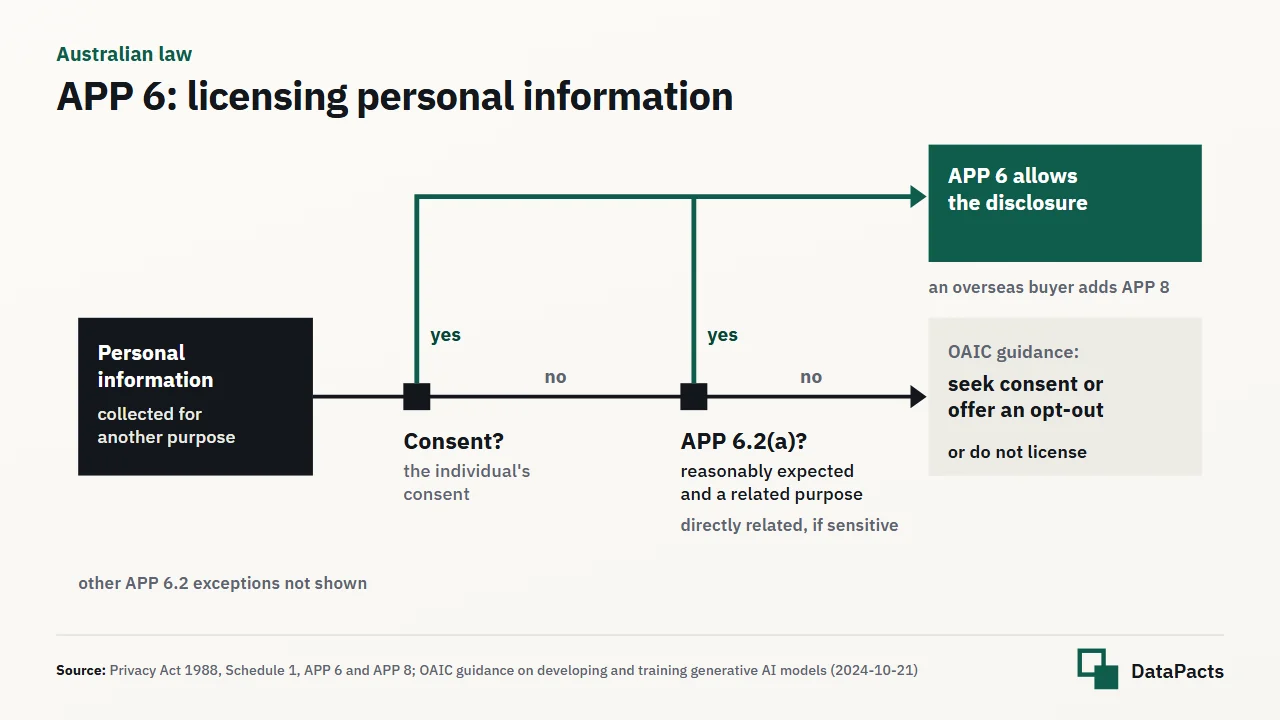
Personal information collected for one purpose may be used or disclosed for another, such as licensing it for training, only with the individual's consent or where an exception in APP 6.2 applies.
Under APP 6.2(a) the individual must reasonably expect the secondary use, and it must be related to the primary purpose (directly related, for sensitive information).
The OAIC reads the expectation at the time of collection and, where it cannot be shown, advises seeking consent or offering a meaningful and informed opt-out. The privacy policy and customer contract decide what was expected, so customer consent before licensing data for AI comes first.
Sending a Dataset to an Overseas Buyer: APP 8
Before disclosing personal information to a recipient outside Australia, an APP entity must take reasonable steps to ensure the recipient does not breach the APPs (APP 8.1), and the recipient's acts can be attributed to the discloser (s 16C). The text gives three routes:
- APP 8.2(a): the recipient is subject to a substantially similar law or binding scheme with enforcement mechanisms.
- APP 8.2(b): the individual gives informed consent after an express statement that APP 8.1 will not apply.
- APP 8.3: prescribed countries or schemes, inserted in 2024; whether any is prescribed is not covered here.
Civil Penalties in Force Since December 2024
A serious interference with privacy is a civil penalty contravention under s 13G in the form in force since 2024-12-11, when POLA Act 2024 Schedule 1 Part 8 added the "serious" test and ss 13H and 13K but left the maximum amounts unchanged.
A body corporate faces up to the greatest of AUD 50,000,000, three times the benefit obtained, or 30% of adjusted turnover in the breach period.
Other persons face up to AUD 2,500,000, and the s 13G(1B) factors include sensitivity and the number of individuals affected. Lower tiers under ss 13H and 13K are not quantified here.
What the OAIC Expects of Developers Training Generative AI Models
The OAIC's guidance on privacy and developing and training generative AI models, published 2024-10-21 and updated 2024-10-23, says that publicly available data is not automatically lawful to use for training. It is regulator guidance, not law, and focuses on APPs 1, 3, 5, 6 and 10 and privacy by design.
On collection, the guidance says that web scraping may be a covert and therefore unfair means of collection. It names third-party datasets, including licensed datasets collected by data brokers, university datasets and Common Crawl, and asks developers to consider each one's data sources and compilation process.
Photographs and recordings of individuals often contain sensitive information and need consent. The legal comparison, including the 2023-08-24 joint statement, is in whether web scraping for AI training is legal.
The guidance treats de-identification as context dependent and possibly difficult to achieve, so removing names does not by itself take a dataset outside the Act.
APPs 8, 11, 12 and 13 are outside its scope, and no OAIC action against a developer is covered here.
Buyers may ask for source records, so PII removal and de-identification before licensing matters in a deal.
The Statutory Tort for Serious Invasions of Privacy, in Force Since June 2025
Since 2025-06-10 an individual in Australia can sue for a serious invasion of privacy under Schedule 2 of the Privacy Act, inserted by the Privacy and Other Legislation Amendment Act 2024.
The claim needs five elements under cl 7(1): an intrusion upon seclusion or misuse of information, a reasonable expectation of privacy, intentional or reckless conduct, seriousness, and a public interest in privacy that outweighs any countervailing interest.
It is actionable without proof of damage (cl 7(2)), and whether the information was already in the public domain is a listed factor (cl 7(5)(f)(iii)).
Express or implied consent is a defense (cl 8(1)(b)). Damages can include emotional distress, with aggravated damages excluded (cl 11).
The limitation period is the earlier of one year after awareness and three years after the invasion (cl 14), and journalists are exempt for journalistic material (cl 15). For a licensor, documented consent is the defense it can show. No ruling on the tort is covered here.
Copyright: No Text and Data Mining Exception in the Copyright Act 1968
The Copyright Act 1968 contains no text and data mining, computational analysis or informational analysis exception, so copying protected works to train a model needs a license unless a listed exception covers it.
A search of the compilation of 2026-04-02 (No. 65) found no hit for "data mining", "text and data", "machine learning" or "artificial intelligence".
The closest provisions are fair dealing for research or study (s 40, with a factor on the effect on the potential market), criticism or review (s 41), parody or satire (s 41A), reporting news (s 42) and professional advice (s 43(2)), and s 43B on incidental temporary reproductions, not from an infringing copy. Australia has fair dealing for listed purposes, not a general fair use defense.
Reports that Australia bans AI training are wrong: no statute bans it, and permission is needed because no exception grants it. On 2026-07-15 the Prime Minister said "No company should use Australian books, music, art or news to build or train AI without the artist's control" and "Our laws will spell that out".
That is a statement of intent, and no law is cited. The comparison with other systems is in copyright and AI training across jurisdictions.
Commenced, Scheduled and Announced: Australia as of November 2026
Seven dated steps changed or will change Australian rules for training data, and the table keeps commenced steps apart from scheduled and announced ones.
The table lists the steps, newest first, as of 2026-11-10.
| Date | Item | Step | Status as of 2026-11-10 | Source |
|---|---|---|---|---|
| 2026-12-10 | POLA Act Sch 1 Part 15 (APP 1.7) | scheduled commencement | not yet applicable | legislation.gov.au |
| 2026-07-15 | Office of AI; statement on AI training and artists' control | established; statement of intent | Office in place; no law cited | pm.gov.au |
| 2025-06-10 | Statutory tort (Privacy Act Sch 2) | commenced | in force | legislation.gov.au |
| 2024-12-11 | POLA Act Sch 1 Parts 1 to 14 | commenced | in force | legislation.gov.au |
| 2024-12-10 | POLA Act 2024 | Royal Assent | enacted | legislation.gov.au |
| 2024-10-21 | OAIC generative AI training guidance | published (updated 2024-10-23) | current guidance | oaic.gov.au |
| 2023-08-24 | Joint statement on data scraping | issued by 12 authorities | statement | oaic.gov.au |
APP 1.7 requires a privacy policy to describe automated decisions that could significantly affect individuals; it concerns policies, not training.
Licensing From Australia: Programs, Deals and Withholding
An Australian holder can reach foreign buyers directly, through programs that name Australia, or through a marketplace, and each route keeps the APP 8 and tax points above.
Mode states three different things about geography, checked 2026-11-09: its referral page lists the US, Canada, the UK and Australia, its referral agreement the US, the EU, Canada and Australia, and its home page the US as the strongest fit.
AWS Data Exchange, a marketplace that hosts third-party listings and is not a buyer, states that providers resident in or organized in Australia are eligible, checked 2026-11-10. Program terms are in the Mode data partnership program profile.
On 2024-05-22 OpenAI and News Corp announced a multi-year partnership covering titles including The Australian and news.com.au. The parties did not disclose a value.
For tax, IRS Table 1 (Rev. May 2023) lists a 5% US treaty withholding rate for Australia on copyright royalties (income code 12) and on know-how and other industrial royalties (income code 10), subject to the limitation on benefits.
Australian goods and services tax on licenses to non-residents is not covered here. The rates by country are in withholding tax on data license payments.
Benefits, Risks, Downsides and Alternatives of Licensing Data Under Australian Law, Including Not Selling
Without a mining exception, protected works have license value, while the APPs, the tort and the s 13G penalties make personal data the costly part of a deal, and not licensing remains a valid choice.
Benefits
- No text and data mining exception exists, so protected works need a license for training unless an exception applies.
- Documented consent answers the APP 6 secondary-use question and the tort's consent defense.
- IRS Table 1 lists a 5% US treaty rate on royalties for Australia.
Risks
- Penalties under s 13G reach the greatest of AUD 50,000,000, three times the benefit or 30% of adjusted turnover.
- The tort is actionable without proof of damage.
- The OAIC expects source checks on scraped and licensed broker datasets, so a buyer may demand them.
Downsides
- Disclosing personal information for a benefit without consent removes the small business exemption.
- An overseas buyer brings APP 8 steps and s 16C attribution.
Alternatives
- License non-personal or de-identified data only.
- Obtain fresh consent or offer an opt-out first.
- Do not sell or license at all; see alternatives to selling data, including not selling.
Beyond Australia: Comparisons, Neighboring Jurisdictions and the Seller Process
Australian law stops at the border and at the deal; the pages below compare jurisdictions, cover neighbors and apply the rules to a sale.
- AI training data law by jurisdiction
- Sell or license company data to AI companies
- AI data licensing agreements
- Selling data to AI companies from outside the US
- Employee data and AI training rules
- Call and meeting recording consent rules
- VAT and sales tax on data licensing
- Japan rules for licensing data
- United Kingdom rules for licensing data
- Canada rules for licensing data
- European Union rules for AI training data
- New Zealand and Singapore: neighboring jurisdictions.
- Biometric data in AI training
How This Page Is Sourced and Dated
Every rule here cites the Federal Register of Legislation, the OAIC, the Prime Minister's published statement or a buyer's own page, with the date it was read; the OAIC guidance text was read from an archived copy dated 2025-12-20. The rules for sources and dates are set out in how we source, date and check every figure.
This page is general information about Australian law, not legal advice for any specific deal.
Frequently Asked Questions
Does Australia have a text and data mining exception for AI training?
No, the Copyright Act 1968 contains none. Training on protected works needs a license unless a listed exception applies.
Can an Australian company license customer data it already holds for AI training?
Only with consent or where APP 6.2 applies. The customer must reasonably expect it and the purpose must be related; otherwise the OAIC advises consent or an opt-out.
When did the statutory privacy tort start?
It started on 2025-06-10. Schedule 2 of the Privacy Act, inserted by the 2024 Act, is actionable without proof of damage.
What is Australia's stance on AI training and copyright?
A statement of intent made on 2026-07-15, with no law cited. The Office of AI was established that day.