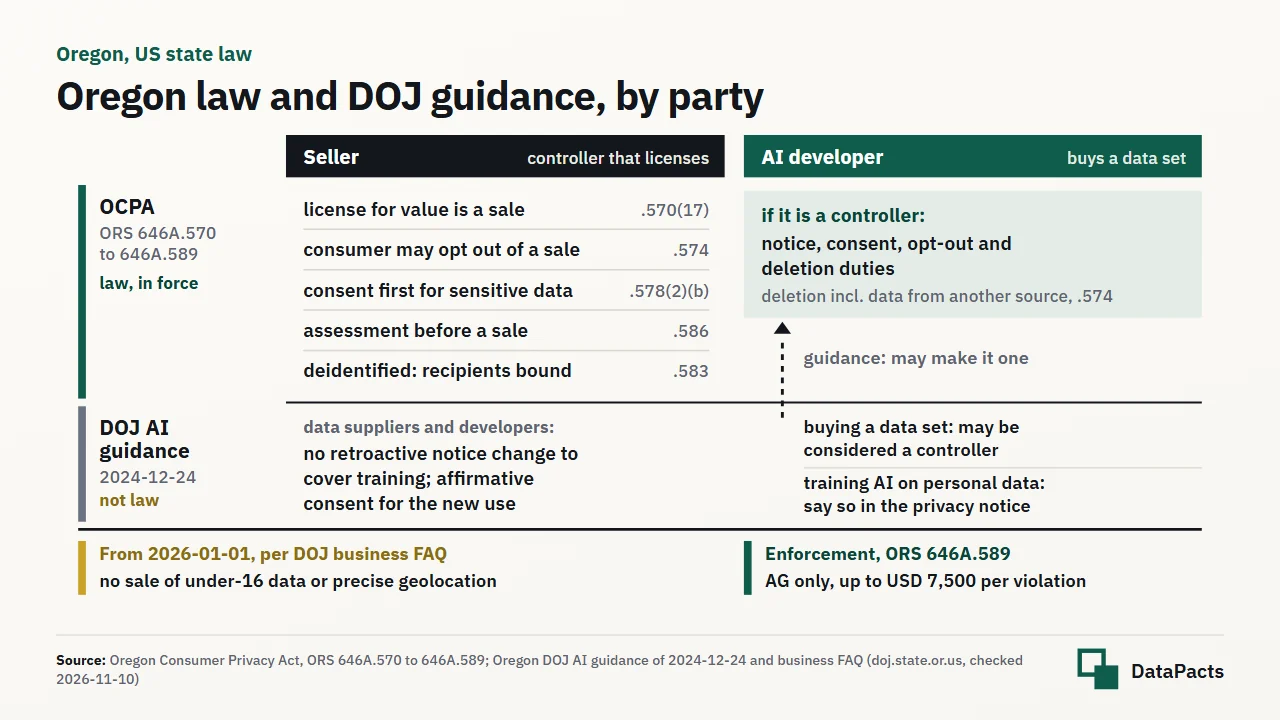
Status is given as of November 10, 2026, covering the statute, the Oregon DOJ guidance of 2024-12-24 and the changes of 2026-01-01. A seller meets the sale, consent and assessment duties, and a buyer the controller duties; together they form the Oregon layer of AI training data licensing.
Oregon Rules on a Training Data Deal at a Glance
Three Oregon sources decide what a seller may license and what a buyer owes afterwards, and a fourth governs recorded conversations; the table gives each one's citation, start date and status as of 2026-11-10.
| Instrument | Citation | In force | Who it binds | What it requires in a data deal | Status | Source |
|---|---|---|---|---|---|---|
| Oregon Consumer Privacy Act (SB 619, 2023) | ORS 646A.570 to 646A.589 | 2024-07-01 | controllers and processors above the thresholds | a license for money or other value is a sale; opt-out; consent for sensitive data; assessment before a sale; deidentified-data contracts | in force | doj.state.or.us FAQ; ORS text |
| Oregon DOJ AI guidance | guidance dated 2024-12-24, citing ORS 646A.578, 646A.574, 646A.586 | 2024-12-24 | AI developers, data suppliers and users | disclose training in the privacy notice; consent for sensitive data and new uses; a buyer may be a controller; 15-day revocation | published guidance, not law | doj.state.or.us |
| OCPA changes operative 2026-01-01 (per the DOJ business FAQ) | ORS 646A.589 as amended; sale bans as described in the FAQ | 2026-01-01 | controllers | no sale of under-16 data or precise geolocation; universal opt-out mandatory; cure period ended | in force | doj.state.or.us FAQ |
| Obtaining contents of communications | ORS 165.540(1)(c) to (e) | not recorded | anyone recording in-person conversations | all participants specifically informed; later use of unlawfully obtained conversations barred | in force | ORS text (oregon.public.law mirror) |
In-person recordings follow ORS 165.540 and are compared on the recording page, linked at the end of this page.
When Licensing Personal Data for AI Training Is a Sale Under the OCPA
Licensing personal data to an AI developer is a sale under ORS 646A.570(17)(a), which defines a sale as the exchange of personal data for monetary or other valuable consideration by the controller with a third party.
The Oregon DOJ business FAQ adds that valuable consideration is not limited to money, so a swap of customer lists counts. Consumers may opt out of a sale (646A.574(1)(d)), and from 2026-01-01 controllers must honor universal opt-out mechanisms, per the same FAQ.
Four exceptions apply (646A.570(17)(b)): a disclosure to a processor; a disclosure to an affiliate or third party to provide a requested product or service; a merger, acquisition, bankruptcy or other transaction in which the third party assumes control of all or part of the assets, including the personal data; and disclosures the consumer directs or intentionally makes public.
The privacy notice must list the categories of personal data shared with third parties and the categories of those third parties (646A.578(4)(d), (e)). A court-supervised transfer is described under US bankruptcy data sales under Section 363(b)(1).
Which Companies the OCPA Covers: 100,000 and 25,000 Consumer Thresholds
The OCPA binds a person that does business in Oregon or serves Oregon residents and, in a calendar year, controls or processes personal data above one of two thresholds (646A.572(1)):
- 100,000 or more consumers, excluding data processed solely to complete a payment;
- 25,000 or more consumers while deriving 25 % or more of annual gross revenue from selling personal data.
The Oregon DOJ business FAQ adds one exception: "As of September 2025, the OCPA applies to all motor vehicle manufacturers, and their affiliates" for personal data from vehicle use, whatever the number of Oregonians (checked 2026-11-16). The enacting bill is not recorded here.
Data the statute sets aside, such as data governed by HIPAA, the Gramm-Leach-Bliley Act or the Fair Credit Reporting Act, public bodies and financial institutions, stays outside (646A.572(2)).
Staff and Business Contacts Fall Outside the Oregon Definition of Consumer
Employee records and business-contact data are not covered, because the OCPA's consumer is a natural person who resides in Oregon and acts in any capacity other than a commercial or employment context (646A.570(7)).
Contracts, recording law and other states' statutes may still reach a Slack or email archive. Staff notice as a seller step is covered under employee notice and consent when licensing internal communications.
Sensitive Data, Children and Location: Consent First and Two Sale Bans Since 2026
A controller may not process sensitive data without first obtaining the consumer's consent (646A.578(2)(b)), and consent under the OCPA is an affirmative act, so inaction is never consent (646A.570(6)). Sensitive data is personal data that (646A.570(18)(a)):
- reveals racial or ethnic background, national origin, religious beliefs, a mental or physical condition or diagnosis, sexual orientation, transgender or nonbinary status, crime-victim status, or citizenship or immigration status;
- is a child's personal data, where a child is under 13, processed in line with COPPA;
- accurately identifies a present or past location within a radius of 1,750 feet;
- is genetic or biometric data, where biometric excludes photos and recordings unless used or generated to identify a person (646A.570(3)(b)).
Per the Oregon DOJ business FAQ (checked 2026-11-10), since 2026-01-01 a controller cannot sell the personal data of a consumer under 16 or a consumer's precise geolocation data at any age, and cannot process under-16 data for targeted advertising or profiling.
Children's data under federal law is covered on the page for COPPA and children's data in AI training.
What the Oregon DOJ's December 2024 AI Guidance Asks of Developers and Data Suppliers
The Oregon Department of Justice's guidance of December 24, 2024 states that developers, suppliers and users of AI may be subject to the OCPA, and that developers using personal data to train AI must say so in a clear privacy notice (ORS 646A.578).
The guidance also expects explicit consent before sensitive data is used to develop or train AI (646A.578(2)(b)). It calls itself guidance, not legal advice.
A Developer That Buys a Data Set May Become a Controller
The DOJ guidance states that a developer that purchases or uses another company's data set for model training may be considered a controller and must meet the same standards as the company that collected the data.
The buyer then inherits notice, consent, opt-out, deletion (including data obtained from another source and derived data, 646A.574(1)(c)) and profiling opt-out duties (646A.574(1)(d)(C)). The guidance expects a data protection assessment, so a seller should expect a buyer to ask for the consent record.
No Retroactive Privacy Notice Changes to Cover Training
Data suppliers and developers cannot legitimize training on previously collected personal data by retroactively or passively changing a privacy notice or terms of use; they must obtain affirmative consent for the new or secondary use (DOJ guidance, citing ORS 646A.578(2)(a)). A consumer who revokes consent must see processing stop within 15 days (646A.578(1)(d)).
Companies below the thresholds can still breach the Unlawful Trade Practices Act if they act against their own stated data policies (ORS 646.607(12), per the guidance). Collecting consent for the training use is covered under customer consent and confidentiality clauses before licensing data.
Deidentified Data Under ORS 646A.583: Duties That Travel With the Set
Deidentified data is not personal data under the OCPA (646A.570(13)(b)), but a controller that holds or discloses it keeps three duties under ORS 646A.583(1).
Deidentified means data that cannot reasonably be used to infer information about, or be linked to, an identified or identifiable consumer or device, or health data deidentified under 45 CFR 164.514 (646A.570(11)). The duties are:
- taking reasonable measures so the data cannot be associated with an individual;
- publicly committing not to reidentify it;
- contracting so that every recipient complies with the controller's OCPA obligations.
A controller that discloses the data must exercise reasonable oversight of that contract and address breaches (646A.583(1)(b)). The techniques behind the definition are described under PII removal and de-identification before licensing data.
Data Protection Assessments Before Selling Personal Data
Selling personal data and processing sensitive data are heightened-risk activities, so a controller must conduct and document a data protection assessment before either (ORS 646A.586(1)). The assessment weighs benefits against risks to consumers and must consider how deidentified data might reduce risk (646A.586(2)).
It covers processing from 2024-07-01 only, it is kept at least 5 years, and the Attorney General may demand it in an investigation, while it stays confidential (646A.586(3), (5) to (7)).
The table dates the changes a seller tracks, as of 2026-11-10.
| Date | Change | Source |
|---|---|---|
| 2024-07-01 | OCPA operative; assessments required for processing from this date | DOJ business FAQ; ORS 646A.586(5) |
| 2024-12-24 | DOJ AI guidance published | doj.state.or.us |
| 2026-01-01 | universal opt-out mechanisms must be honored | DOJ business FAQ |
| 2026-01-01 | no sale of under-16 data or of precise geolocation data | DOJ business FAQ |
| 2026-01-01 | Attorney General no longer required to give notice and a 30-day cure period | DOJ business FAQ; ORS 646A.589(5) |
A license should say which party prepares which assessment, as the page on AI data licensing agreements explains clause by clause.
Enforcement: Attorney General Only, USD 7,500 per Violation, No Cure Period Since 2026
The Oregon Attorney General has exclusive authority to enforce the OCPA and may seek a civil penalty of up to USD 7,500 per violation, while no private right of action exists (ORS 646A.589(4), (8)).
The DOJ business FAQ adds injunctive relief, restitution and disgorgement, and the action must come within 5 years after the last act (646A.589(4), (6)).
Until 2025-12-31, ORS 646A.589(5) required notice and 30 days to cure where the Attorney General found the violation curable.
The DOJ states that as of 2026-01-01 the Attorney General is no longer required to offer notice and an opportunity to cure and can proceed directly to a civil investigative demand or a lawsuit. No enforcement action is named on this page.
Benefits, Risks, Downsides and Alternatives for a Seller Under Oregon Law, Including Not Selling
Oregon law lets a company license data for AI training, but personal data needs a notice that names the use, sensitive data needs consent, and two categories cannot be sold at all, so licensing only deidentified data or not licensing remain valid choices.
Benefits
- Deidentified and publicly available data sit outside personal data.
- Staff and business-contact records are outside the consumer definition.
- A bankruptcy or merger transfer in which the buyer assumes control is not a sale.
- Companies below both thresholds are generally outside the OCPA, per the DOJ business FAQ.
Risks
- Civil penalties of up to USD 7,500 per violation, with no cure period since 2026-01-01.
- A buyer treated as a controller will check consent records.
- Retroactive notice changes do not cover training.
Downsides
- Consumers keep a sale opt-out, and universal opt-out signals must be honored.
- A documented assessment is kept 5 years.
- Recipients need contracts and oversight for deidentified data.
Alternatives
- License deidentified data only.
- Exclude sensitive data without consent, under-16 data and precise geolocation.
- Collect fresh consent for the training use.
- Not selling or licensing at all.
The full range of alternatives to selling data to AI labs, including not selling, is covered on its own page.
Beyond Oregon: Other States, Federal Rules and the Seller Process
Oregon is one state layer on top of federal law. The United States AI training data law page compares it with eleven other states, while the seller pages turn these rules into steps.
- AI training data law outside the US: the jurisdiction overview.
- A state whose privacy law covers staff data: California CCPA/CPRA and AB 2013 training data transparency.
- A neighboring state privacy act: Connecticut CTDPA and AI training data.
- The federal view of retroactive policy changes: FTC rules on AI training data and privacy policy changes.
- The OCPA beside other privacy laws: privacy law and AI training data compared.
- Oregon's in-person recording rule compared: call and meeting recording consent rules by jurisdiction.
- What deidentified data achieves legally: anonymization vs pseudonymization for AI training data.
- The decision before any Oregon sale: should you sell or license your data to AI companies.
- The steps of a sale: sell or license company data to AI companies.
- A stricter sensitive-data sale rule: Maryland MODPA ban on selling sensitive data.
- Health data in a neighboring state: Washington My Health My Data Act.
How This Page Is Sourced and Dated
Every rule here cites the Oregon Revised Statutes, the Oregon DOJ's own guidance and FAQ, or the date they were checked. The methodology page explains how we source and date every rule. This page is general information about Oregon law, not legal advice for any specific deal.
Frequently Asked Questions
Is it legal to sell data to AI companies in Oregon?
Yes, with conditions. A license for money or other value is a sale with an opt-out right, sensitive data needs consent, and under-16 and precise geolocation data cannot be sold since 2026.
Does the Oregon Consumer Privacy Act apply to AI training data?
Yes, whenever a covered controller's set holds Oregon consumers' personal data. The DOJ says training must be disclosed in the privacy notice.
Does Oregon still give companies 30 days to cure a violation?
No. Since January 1, 2026 the Attorney General need not offer notice and a 30-day cure.
Can a company sell location data or teen data for AI training in Oregon?
No, not precise geolocation (1,750 feet) or under-16 data since 2026-01-01. That is the position of the DOJ business FAQ.