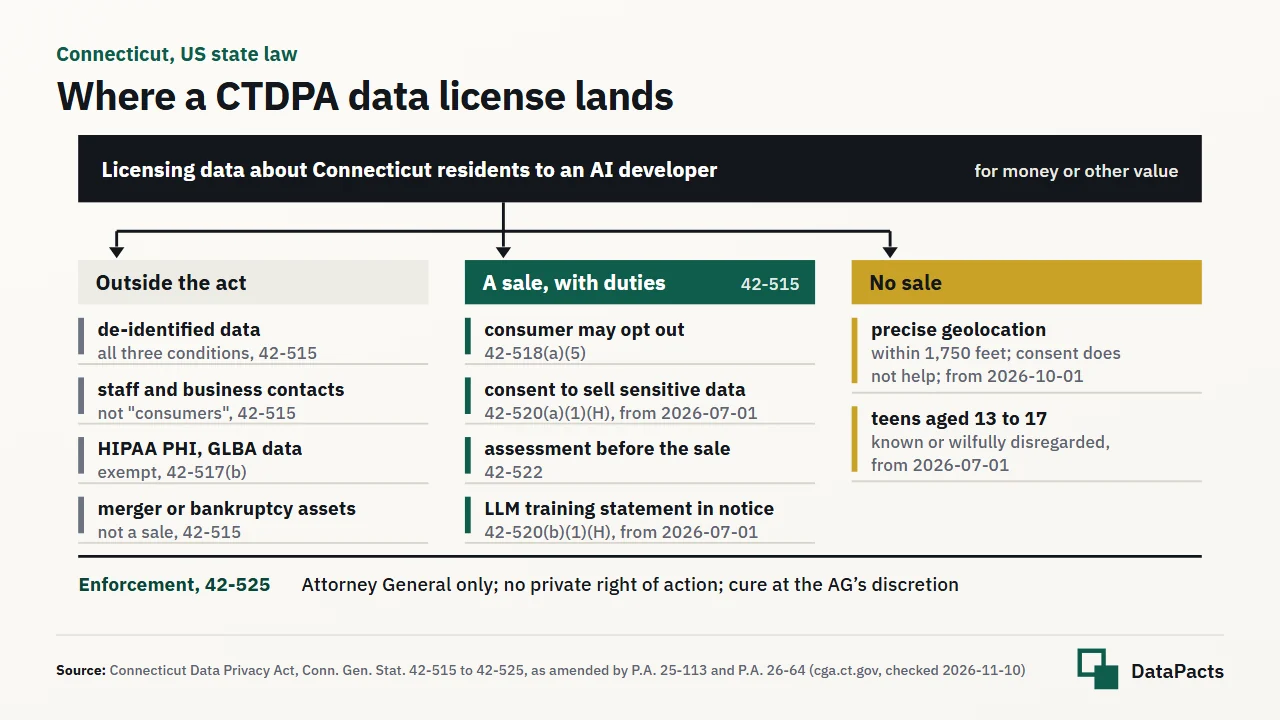
The act has been in force since July 1, 2023, and Public Acts 25-113 (from July 1, 2026) and 26-64 (from October 1, 2026) are both in effect as of November 10, 2026. The developer meets these rules too once it holds the data. The wider context is AI training data licensing as a whole.
Three Connecticut Acts on a Training Data Deal at a Glance
Three public acts make up the CTDPA a seller meets today, and the table gives each one's citation, effective date and what it changed for a data sale. It is as of 2026-11-10.
| Instrument | Citation | Effective | What it means for a data sale | Status | Source |
|---|---|---|---|---|---|
| Connecticut Data Privacy Act (P.A. 22-15) | Conn. Gen. Stat. 42-515 to 42-525 | 2023-07-01 | licensing personal data for money is a sale; opt-out; assessment before a sale; AG enforcement | in force | cga.ct.gov chapter 743jj |
| P.A. 25-113 (SB 1295), approved 2025-06-24 | sections 5 to 12 amending 42-515 to 42-518, 42-520 to 42-522 and 42-524 | 2026-07-01 (impact assessments for activities from 2026-08-01) | any business offering personal data for sale covered; consent before selling sensitive data; no sale of teen data; LLM statement in the notice; list of buyers on request | in effect | cga.ct.gov 2025PA-00113 |
| P.A. 26-64 (SB 4), approved 2026-05-27 | sections 12 to 16 amending 42-515, 42-518, 42-520, 42-521, 42-524 | 2026-10-01 | precise geolocation sale ban; narrower publicly available information; consent for any incompatible new purpose; deletion of public profiles made available for sale | in effect | cga.ct.gov 2026PA-00064 |
| Action for illegal recording of private telephonic communications | Conn. Gen. Stat. 52-570d | not stated | phone recordings need all-party consent, recorded notice or a warning tone | in force | cga.ct.gov chapter 925 |
Which Companies the CTDPA Covers From July 1, 2026
From July 1, 2026, the CTDPA applies to a person that meets any one of three tests in section 42-516, and a company that licenses personal data for money meets the third on its own.
Before that date the thresholds were 100,000 consumers, or 25,000 consumers plus more than 25 percent of gross revenue from selling personal data.
Any Business That Offers Personal Data for Sale
A business that offers consumers' personal data for sale in trade or commerce is covered whatever its size (42-516(3)). The three tests are:
- the business conducts business in Connecticut or targets residents, and processed personal data of at least 35,000 consumers in the preceding calendar year, payment-only data excluded (42-516(1));
- it controls or processes consumers' sensitive data (42-516(2));
- it offers personal data for sale (42-516(3)).
The third test turns on offering a sale, not completing one.
Staff, Business Contacts and Exempt Records
Employee and business-contact records sit outside the CTDPA, because a "consumer" excludes an individual acting in a commercial or employment context whose dealings with the controller occur solely in that role (42-515).
California has covered staff and business contacts since 2023-01-01. Slack, email or HR archives about Connecticut staff fall under employment and contract rules, as set out in employee notice and consent when licensing internal communications.
Exemptions that matter are protected health information under HIPAA (42-517(b)(1)), data subject to Title V of the Gramm-Leach-Bliley Act ((b)(17)) and limited data sets ((b)(18)); nonprofit organizations are exempt as entities ((a)(3)).
When Licensing Personal Data to an AI Developer Is a Sale Under Section 42-515
A "sale of personal data" is the exchange of personal data for monetary or other valuable consideration by the controller to a third party (42-515), so a cash license, a revenue share or a license paid in model access to an AI developer is a sale. Personal data excludes de-identified data and publicly available information. Six transfers are excluded:
- to a processor, to an affiliate, or for a product the consumer requested;
- at the consumer's direction;
- of mass-media data that is not audience-restricted;
- of assets in a merger, acquisition or bankruptcy.
The consumer may opt out of a sale (42-518(a)(5)) and, from 2026-07-01, may obtain a list of the third parties to which the controller sold the consumer's data (42-518(a)(7)), so the buyer's name can reach the consumer.
California reaches the same sale result under a different statute, set out in California CCPA rules on selling personal information.
Public and Scraped Content After October 1, 2026
From October 1, 2026, P.A. 26-64 narrows what counts as publicly available information, so more public-facing content in a training set stays personal data under the CTDPA.
Biometric data collected without the consumer's knowledge, combined data, genetic data unless the consumer made it public, and website content where the consumer kept a reasonable expectation of privacy, including audience restriction, no longer count as public.
The same act adds a right to delete publicly available information collated into a consumer profile made available on a public website or for sale, and the inferences drawn from it (42-518(a)(3)). A seller of forum or review archives checks audience settings first.
Sensitive Data: Consent Before Any Sale, and the Geolocation Ban
Since July 1, 2026, a controller may not sell a consumer's sensitive data without the consumer's consent (42-520(a)(1)(H)), and since October 1, 2026 no controller or third party may sell precise geolocation data at all (42-520(a)(3), 42-521(a)(2)).
Consent is a clear affirmative act and excludes acceptance of broad terms of use and agreement obtained through dark patterns (42-515). The table lists the nine categories, as of 2026-11-10.
| Category | Rule for a sale | Source |
|---|---|---|
| racial or ethnic origin, religious beliefs, health condition or diagnosis, sex life or sexual orientation, nonbinary or transgender status, citizenship or immigration status | consent before sale (from 2026-07-01) | 42-515, 42-520(a)(1)(H) |
| consumer health data | consent before sale | same |
| genetic or biometric data, or information derived from it | consent before sale | same |
| personal data collected from a known child | processed under COPPA; consent before sale | 42-520(a)(1)(D), (H) |
| status as a crime victim | consent before sale | 42-515, 42-520(a)(1)(H) |
| precise geolocation data (within 1,750 feet) | sale banned from 2026-10-01 | 42-520(a)(3), 42-521(a)(2) |
| neural data | consent before sale | 42-515, 42-520(a)(1)(H) |
| financial account or card number with access code | consent before sale | same |
| government-issued identification number not required to be displayed | consent before sale | same |
Precise geolocation means a location within a radius of 1,750 feet. The ban does not reach the content of communications or utility metering data, and for location consent does not help.
Teenagers Aged 13 to 17
A controller may not sell the personal data of a consumer it knows, or wilfully disregards, is at least 13 but younger than 18 (42-520(a)(1)(I) from 2026-07-01); before that date the rule covered ages 13 to 15 and allowed a sale with consent.
Data collected from a known child under 13 is sensitive data processed under COPPA, and the federal rule sits on its own page, COPPA and children's data in AI training.
The Large Language Model Statement in a Seller's Own Privacy Notice
Since July 1, 2026, a controller's privacy notice must include a statement disclosing whether it collects, uses or sells personal data for the purpose of training large language models (42-520(b)(1)(H), added by P.A. 25-113).
The notice also lists the categories sold, the categories of third parties and its last update month and year; a generally applicable notice suffices (42-520(b)(4)).
The duty sits on the seller, not only the developer. Developer-side disclosure duties are compared in training data transparency rules and initiatives.
New Purposes and Retroactive Notice Changes After Collection
A company that collected personal data for service and now wants to license it for AI training needs the consumer's consent, unless training is reasonably necessary to, or compatible with, the purposes disclosed at collection (42-520(a)(1)(B)). Two rules apply:
- the test weighs the consumer's reasonable expectation at collection, the link between the new and old purposes, the impact on the consumer, the relationship and context, and safeguards such as encryption or pseudonymization; P.A. 26-64 deletes the word "material" from 2026-10-01, so the test covers any new purpose;
- a retroactive material change to the notice or practices requires notice to affected consumers and a reasonable opportunity to withdraw consent to materially different processing of data already collected (42-520(b)(3)).
The federal view of quiet terms changes is covered in FTC rules on privacy policy changes.
De-identified and Pseudonymous Data Under Sections 42-515 and 42-523
De-identified data falls outside personal data when the controller meets all three conditions of section 42-515, and a buyer receiving it is bound by contract. The conditions are:
- reasonable measures so the data cannot be associated with an individual;
- a public commitment to process it only in de-identified form and not to re-identify it;
- contractual obligations on every recipient to meet both.
A controller that discloses de-identified or pseudonymous data must exercise reasonable oversight of those contractual commitments and address breaches (42-523(e)). Pseudonymous data kept apart from identifying information is outside the access, correction, deletion and portability rights (42-523(d)). The techniques are in PII removal and de-identification before licensing data.
Data Protection Assessments Before a Sale, and Profiling Impact Assessments
A controller must conduct and document a data protection assessment before it sells personal data or processes sensitive data, because both count as processing that presents a heightened risk of harm (42-522(a), (b)).
The Attorney General may require the controller to disclose an assessment, which stays confidential and exempt from public records requests. One assessment can cover comparable operations, and one made for another law counts if reasonably similar (42-522(d) to (f)).
A controller that profiles consumers for decisions with legal or similarly significant effects also conducts an impact assessment (42-522(c)), for processing created or generated on or after 2026-08-01, a deployer topic for the buyer.
Recorded Phone Calls in a Connecticut Data Set: Section 52-570d
Connecticut allows a phone call to be recorded only with all parties' prior consent in writing or at the start of the recording, a verbal notice recorded at the start, or an automatic warning tone repeated about every 15 seconds (Conn.
Gen. Stat. 52-570d(a)). A call archive recorded without one of the three carries civil liability. The state-by-state comparison is on call and meeting recording consent rules by jurisdiction.
How the Connecticut Attorney General Enforces the CTDPA
The Connecticut Attorney General has exclusive authority to enforce the CTDPA, and a violation is an unfair trade practice under section 42-110b (42-525(a), (e)). Three points shape exposure:
- there is no private right of action (42-525(d));
- the 60-day notice and cure period, required where the Attorney General found a cure possible, ran from 2023-07-01 to 2024-12-31, and since 2025-01-01 the Attorney General decides whether to offer a cure, weighing factors such as the number of violations, the size of the company and the sensitivity of the data (42-525(b), (c));
- the Attorney General can demand a data protection assessment.
Penalty amounts are not stated here.
Connecticut Privacy Amendments by Date, as of November 2026
Seven dates decide which version of the CTDPA governs a data sale, and the table lists them in order.
| Date | Event | Source |
|---|---|---|
| 2023-07-01 | CTDPA in force; 60-day notice and cure period begins | 42-525 history |
| 2025-01-01 | cure becomes discretionary for the Attorney General | 42-525(c) |
| 2025-06-24 | P.A. 25-113 approved | SB 1295 bill status |
| 2026-05-27 | P.A. 26-64 approved | SB 4 bill status |
| 2026-07-01 | P.A. 25-113 CTDPA amendments effective | 2026 Supplement notes |
| 2026-08-01 | impact assessments for new profiling activities | 42-522(g)(2) |
| 2026-10-01 | P.A. 26-64 CTDPA amendments effective | P.A. 26-64 ss. 12 to 16 |
Benefits, Risks, Downsides and Alternatives for a Seller Under Connecticut Law, Including Not Selling
Connecticut law lets a company license data for AI training, but sale, sensitive-data and notice rules each add a condition, and licensing only de-identified data or not licensing at all remain valid choices.
Benefits
- Staff and business-contact records are outside "consumer".
- De-identified data meeting the three conditions is outside personal data.
- An asset transfer in a merger or bankruptcy is not a sale.
Risks
- Attorney General enforcement as an unfair trade practice, with a cure at its discretion.
- A consumer may obtain the list of buyers.
- Selling geolocation is banned outright.
Downsides
- Consent is required before selling sensitive data.
- A documented assessment comes before the sale.
- The LLM statement goes in the seller's own notice.
- Audience-restricted public content stays personal data.
Alternatives
- License de-identified data only.
- Exclude sensitive, geolocation and teen data.
- Ask consent for the new purpose.
- Not selling or licensing at all.
The full range is covered in alternatives to selling data to AI labs.
Beyond Connecticut: Other States, Federal Rules and the Seller Process
Connecticut is one state layer on top of federal law. The United States AI training data law page compares it with the other states, while the seller pages turn these rules into steps.
- AI training data law outside the US: the jurisdiction overview.
- Oregon OCPA and AI training data: another state with an AI-training notice rule.
- Virginia VCDPA and AI training data: another state privacy act.
- Maryland MODPA ban on selling sensitive data: a state that bans selling sensitive data.
- GLBA and licensing financial customer data: financial data exempt from the CTDPA.
- The CTDPA beside the GDPR and other privacy laws: privacy law and AI training data compared.
- Health data exempt from the CTDPA: HIPAA and AI training data.
- Consent and confidentiality clauses with customers: customer consent before licensing data.
- What pseudonymous data achieves legally: anonymization vs pseudonymization for AI training data.
- Recipient duties written into the license: AI data licensing agreements.
- The asset-transfer exception in insolvency: US bankruptcy data sales.
- The decision before any sale: should you sell or license your data to AI companies.
- The steps of a sale: sell or license company data to AI companies.
How This Page Is Sourced and Dated
Every rule here cites the Connecticut General Statutes as published by the General Assembly, including the 2026 Supplement and Public Acts 25-113 and 26-64, checked on cga.ct.gov on November 10, 2026.
The methodology page explains how we source, date and check every figure. This page is general information about Connecticut law, not legal advice for any specific deal.
Frequently Asked Questions
Does Connecticut have a data privacy law?
Yes: the Connecticut Data Privacy Act, Conn. Gen. Stat. 42-515 to 42-525, in force since July 1, 2023 and amended from July 1 and October 1, 2026.
Does the CTDPA apply to licensing data for AI training?
Yes, when the data holds Connecticut residents' personal data. Licensing it for money is a sale with an opt-out, and any business offering personal data for sale is covered.
Must a Connecticut privacy notice mention AI training?
Yes for covered controllers. Since July 1, 2026 the notice states whether personal data is collected, used or sold to train large language models.
What changed in Connecticut privacy law in 2026?
Wider coverage and consent for selling sensitive data from July 1. From October 1 came a geolocation sale ban, a narrower public-information exclusion and a stricter new-purpose test.