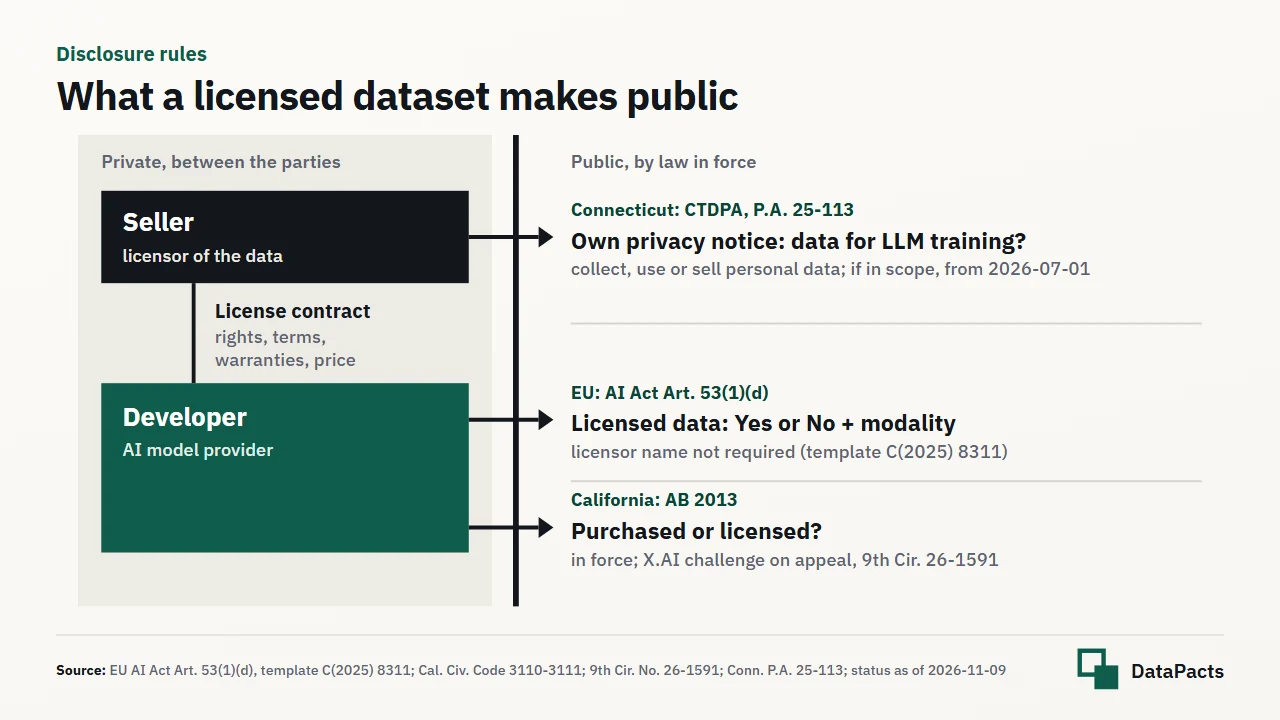
Two duties in force bind developers: Article 53(1)(d) of the EU AI Act and California's AB 2013. A third, in Connecticut, can reach the seller itself through its privacy notice.
Bills are pending, and research audits score how much developers disclose. This page compares them from the side of the company whose data was licensed, within AI training data licensing.
The finding is the same across the rules: they publish categories, not contracts, none recorded here requires the price, and the EU template does not require the licensor's name.
Every date and status below is as of 2026-11-09, sourced as described in how we source, date and check every figure.
What training data transparency makes public, and what stays private
Transparency rules publish categories, not contracts: they disclose the type, source class and size of training data, none recorded here requires the price, and the EU template does not require the licensor's name. The categories a disclosure can carry are:
- Data type or modality, such as text, image, audio or video.
- Source class: licensed, scraped, user data or synthetic.
- Size bands or counts.
- Collection or processing period.
Transparency is the public layer. The record of who held which right, on what terms and with what warranties is the private layer, kept by seller and buyer and shown only in due diligence.
The motive behind disclosure rules is copyright: a rightsholder cannot object to a use it cannot see, so the rules aim at making use visible rather than at pricing it. This page keeps to the disclosure mechanics, and the private record sits under training data provenance.
Five disclosure rules and bills compared by what they reveal about licensed data
Three of the five instruments below are in force and two are bills, and only one of them, Connecticut's, can put a duty on the company that sells the data rather than on the AI developer. The table compares them as of 2026-11-09, in force first by date of application, then bills by introduction date.
| Instrument | Jurisdiction and citation | Who must disclose | What becomes public about licensed data | Status as of 2026-11-09 | Source |
|---|---|---|---|---|---|
| AI Act, public summary of training content | EU; Regulation (EU) 2024/1689, Art. 53(1)(d); template C(2025) 8311 (2025-12-05) | providers of general-purpose AI models (the open-source exemption does not cover (d)) | licensed datasets as Yes or No plus modality (s.2.2.1); intermediary datasets listed only if publicly known (s.2.2.2) | applies from 2025-08-02; AI Office enforcement from 2026-08-02; models placed before 2025-08-02 by 2027-08-02 | eur-lex.europa.eu; digital-strategy.ec.europa.eu |
| AB 2013, Generative AI: Training Data Transparency | California; Cal. Civ. Code 3110-3111 | developers of generative AI | high-level dataset summary, including whether data was purchased or licensed and whether it holds personal information | in force from 2026-01-01 per amicus brief; challenge on appeal, 9th Cir. No. 26-1591 | Ninth Circuit amicus filing (DktEntry 28.1) |
| CTDPA as amended by P.A. 25-113 (SB 1295) | Connecticut; Conn. Gen. Stat. 42-515 to 42-525 | controllers in scope, including any business offering personal data for sale | privacy notice says whether personal data is collected, used or sold to train large language models | in force; LLM statement from 2026-07-01 | cga.ct.gov |
| PL 2338/2023 (AI bill), copyright chapter | Brazil; Senate text, Chamber proposition 2487262 | AI developers (as drafted) | summary of copyrighted content used | bill; passed Senate 2024-12-10; Chamber "Aguardando Parecer" (priority) as of 2026-10-27 | legis.senado.leg.br; dadosabertos.camara.leg.br |
| TRAIN Act | US federal; S. 2455 (119th Cong.) | developers, on a copyright owner's subpoena | copies or records on whether the owner's works were used (to the requester, not the public) | bill; introduced 2025-07-24, referred to Senate Judiciary, no later action | congress.gov; govinfo.gov |
Bills are not law until enacted, and the two bills in the table carry a status date for that reason.
China's Interim Measures for Generative AI Services (Order No. 15 (2023), in force 2023-08-15) regulate where training data comes from, not what is published, so they are not a row. Korea and Taiwan have AI basic acts, but this page lists no training-data disclosure duty for either.
Disclosure duties in force as of November 2026
Two duties in force make AI developers publish a training data disclosure, and a third makes data controllers say in their privacy notices whether they train or sell for training large language models.
European Union: the public summary for general-purpose models
Providers of general-purpose AI models must publish a summary of training content under Article 53(1)(d) of the AI Act (Regulation (EU) 2024/1689), applying from 2025-08-02, on the Commission's template C(2025) 8311 of 2025-12-05. Licensed datasets appear only as Yes or No plus modality (section 2.2.1), and datasets from intermediaries are listed only if publicly known (section 2.2.2).
The template sections, the update interval and a published summary are read on the EU AI Act Article 53 training data summary page.
California: AB 2013 and the challenge on appeal
AB 2013, California's Generative Artificial Intelligence: Training Data Transparency act (Cal. Civ. Code 3110-3111), took effect on 2026-01-01 according to an amicus brief filed in the Ninth Circuit, and requires developers of generative AI to post a high-level summary of their training datasets. The summary includes:
- whether the data was purchased or licensed;
- whether it contains personal information.
X.AI LLC's constitutional challenge (C.D. Cal. 2:25-cv-12295-JGB-SSC) lost its bid for a preliminary injunction, and the appeal is pending in the Ninth Circuit as No. 26-1591. Amicus briefs were filed on 2026-07-22, and no decision was found as of 2026-11-09. The law stays in force during the appeal.
The district court's order date is not stated here because it was not checked. The full category list and the case record sit under AB 2013 training data transparency in California.
Connecticut: a privacy-notice statement about training large language models
Connecticut's Public Act 25-113 (SB 1295), approved 2025-06-24, amends the Connecticut Data Privacy Act so that from 2026-07-01 a controller's privacy notice must say whether it collects, uses or sells personal data to train large language models.
The duty reaches sellers because the amended act covers controllers above 35,000 consumers, any controller processing sensitive data and any business offering personal data for sale (Conn. Gen. Stat. 42-515 to 42-525).
A company that licenses customer records for training therefore states it in its own notice, which is the one place in the table where the seller, not the developer, writes the public sentence.
Pending bills that would add disclosure or access duties
Two bills on record would widen access to training data information, and neither is law as of 2026-11-09.
The TRAIN Act, S. 2455 in the 119th Congress, was introduced on 2025-07-24 by Senator Welch with Senators Blackburn, Hawley and Schiff and referred to the Senate Judiciary Committee, with no later action on congress.gov.
Section 2 would add an administrative subpoena to chapter 5 of title 17, so a copyright owner can obtain copies or records showing whether its works were used to train a model. That is access on request, not a public summary, and it would run to the copyright owner rather than to the public.
Brazil's PL 2338/2023 passed the Federal Senate on 2024-12-10 and went to the Chamber of Deputies on 2025-03-17. It would require AI developers to publish a summary of copyrighted content used, give rightsholders a right to prohibit use outside a non-commercial research exception and require remuneration.
The Chamber status is "Aguardando Parecer" under the priority regime as of 2026-10-27, so the bill is not enacted and its wording can still change.
The AI Accountability and Personal Data Protection Act (S. 2367) is a consent bill, not a disclosure bill, and it is compared with the TRAIN Act under the federal AI training data bills.
Research audits and voluntary initiatives that measure disclosure
Where no law reaches, researchers measure disclosure themselves, and their audits show that dataset licenses and developer disclosures are often missing. The Data Provenance Initiative is a volunteer research collective with no legal entity (dataprovenance.org), and its audits are cited here through its papers by Longpre et al.
Its figures describe public datasets and web domains, not private licensed data, but they show how thin the public record of data origin can be. The table lists the audits and one specification by date, as of 2026-11-09.
| Initiative | Issuer | What it measured or records | Key figure | Date | Source |
|---|---|---|---|---|---|
| Dataset licensing and attribution audit | Data Provenance Initiative (Longpre et al.) | licenses of 1,800+ text datasets on hosting sites | license omitted in 70 %+ of cases, wrong in 50 %+ | 2023-10-25 | arxiv.org/abs/2310.16787 |
| Consent in Crisis | Data Provenance Initiative (Longpre et al.) | robots.txt and terms of service of about 14,000 web domains behind C4, RefinedWeb and Dolma | about 5 %+ of C4 tokens and 28 %+ of the most critical sources fully restricted by robots.txt (2023 to 2024); 45 % of C4 restricted by terms of service (the authors' figures) | 2024-07-20 | arxiv.org/abs/2407.14933 |
| Training and Data Mining Assertion | Creator Assertions Working Group (Decentralized Identity Foundation) | asset-level permission for training and mining, label cawg.training-mining | version 1.1 | ratified 2025-05-16 | cawg.io |
| Foundation Model Transparency Index 2025 | Stanford CRFM | disclosure by 13 model developers | mean 41 of 100, down 17 points; IBM 95 highest; xAI and Midjourney 14 lowest | December 2025 | crfm.stanford.edu |
License omission is one reason a buyer cannot rely on a hosting site's license label, and the licenses themselves are compared under dataset licenses for AI training.
C2PA removed its training and data mining assertion in specification version 2.0 (January 2024), so C2PA labels content and outputs and is not a training-data disclosure. The CAWG assertion in the table is the asset-level permission record, and it is compared with other specifications on the provenance hub.
How visible a licensed dataset becomes after the deal
A licensor should expect its data type to become public, while the EU template does not require its name and lists intermediary datasets only if publicly known.
The EU summary in practice is SpaceXAI's Grok 4.7 summary, version 1, dated 2026-09-21. It answers Yes to commercial licenses with rightsholders for text and image, and Yes to other private third-party datasets in all modalities, and it names no licensor (SpaceXAI's statement).
The summary is updated at six-month intervals, or earlier after materially significant training (template para. 29). A licensor can therefore read, in a developer's own words, how its category of data is described without being named.
AB 2013 makes the fact of purchase or license public for developers covered by California's law. The challenge argues trade secrets and compelled speech, which is the seller's confidentiality interest seen from the developer's side. No outcome of the appeal is assumed here.
The seller's own exposure is the Connecticut notice and the contract. What may be said publicly about the deal is set by the confidentiality and publicity clauses, explained in AI data licensing agreements.
Benefits, risks, downsides and alternatives of public disclosure for a data licensor, including not licensing
Disclosure rules bind AI developers, not sellers, but they change what a seller's license reveals and how a buyer prices the risk.
Benefits
- The EU template does not require the licensor to be named, and licensed datasets appear only as Yes or No plus modality.
- A public record that licensed data was used supports the market for licensed data, because it shows that developers acquire data by license.
- A Connecticut notice that states the use gives the seller a public record that the use was disclosed.
Risks
- AB 2013 shows that data was purchased or licensed, so the category of a seller's data can become visible.
- A dataset already public can be named.
- Disclosure rules can change while bills are pending.
Downsides
- The seller controls none of the developer's wording, and the wording of a summary can change at each update.
- The seller's own notice may need updating before a sale, and the contract may be silent on what the developer may disclose.
Alternatives
- License only categories the seller is content to see disclosed.
- Agree publicity and confidentiality terms in the contract.
- Publish the dataset under an open license with its own documentation.
- Do not license at all.
Where transparency meets provenance records, the law and the courts
Transparency is the public end of a chain that starts with the seller's records and ends in court filings; the pages below take each part, from the seller's records to the pending appeal and the bills still before legislatures.
- Provenance records, standards and attribution
- AI training data law by jurisdiction
- AI copyright lawsuits over training data
- Frontier AI labs as data buyers
- AI crawlers and the consent signals the audits counted
- Alternatives to selling data to AI labs, including not selling at all
- Datasheets, data cards and training data summaries as documents
- Removing content from AI training datasets
- X.AI v. Bonta, the AB 2013 challenge
- Connecticut's CTDPA and AI training data
- Brazil's AI Bill and its training data disclosure
Frequently asked questions
Which laws require AI companies to disclose their training data?
The EU AI Act and California's AB 2013 require developers to publish a training data disclosure. Article 53(1)(d) applies to general-purpose model providers from 2025-08-02, and AB 2013 took effect on 2026-01-01 per an amicus brief. Connecticut's notice duty, from 2026-07-01, requires controllers to say whether they collect, use or sell personal data to train large language models, as of 2026-11-09. Bills are not yet law.
What is the Data Provenance Initiative?
It is a volunteer research collective that audits datasets and consent signals. Its 2023 audit of 1,800+ text datasets found licenses omitted in 70 %+ of cases, and Consent in Crisis examined the robots.txt files and terms of service of about 14,000 web domains behind C4, RefinedWeb and Dolma. It has no legal entity, and its papers are cited by their authors, Longpre et al.
Can a company that licenses data keep its name out of a developer's disclosure?
Under the EU template, a licensor is not required to be named. Licensed datasets appear as Yes or No plus modality (section 2.2.1), and intermediary datasets are listed only if publicly known (section 2.2.2). AB 2013 discloses whether data was purchased or licensed, and its full category list is covered on the California law page.
Is the TRAIN Act law?
No, it is a bill. S. 2455 was referred to the Senate Judiciary Committee on 2025-07-24, with no later action as of 2026-11-09. It would give a copyright owner a subpoena for records, not create a public disclosure duty.
How this page is sourced and dated
The page rests on statutes, Commission documents, court filings, congress.gov, the Brazilian Chamber's open data and the research papers named in the tables, with status as of 2026-11-09. It is information, not legal advice.