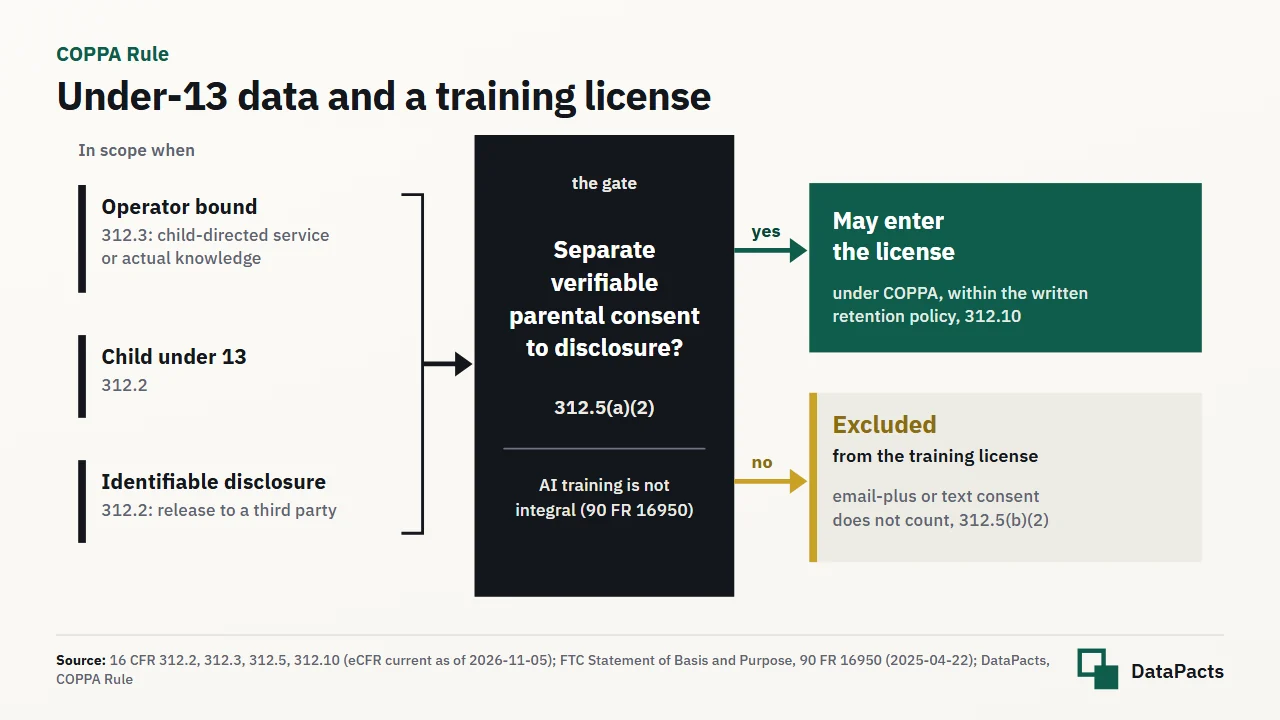
COPPA is a federal statute (15 U.S.C. 6501 to 6506), and the FTC's rule implements it. This page sets out the rule's place in AI training data licensing: who is bound, what counts as a child's personal information, consent, dates, what a seller excludes and enforcement.
The text is the Federal Register text of 2025-04-22 and the eCFR text current as of November 5, 2026, checked on November 9 and 10, 2026.
The figures and citations on this page are dated and sourced as described on the page on how we source, date and check every figure.
Five COPPA Provisions That Decide Whether Children's Data Can Be Licensed
Five provisions of COPPA and its rule decide whether children's personal information can enter a training dataset, and the table gives each one's citation, effect on a license and status as of 2026-11-05, checked 2026-11-10.
| Provision | Citation | Effect on a training data license | Status | Source |
|---|---|---|---|---|
| Scope and age | 16 CFR 312.3; 312.2 "child", "operator" | binds operators of child-directed services and operators with actual knowledge; child = under 13 | in force | ecfr.gov 312.2, 312.3 |
| Personal information and disclosure | 16 CFR 312.2 | photos, video or audio with a child's image or voice, biometrics and persistent identifiers count; disclose = release in identifiable form | in force | ecfr.gov 312.2 |
| Separate consent for third-party disclosure | 16 CFR 312.5(a)(2); 90 FR 16950 | disclosure to train AI is not integral and needs separate verifiable parental consent | in force; compliance 2026-04-22 | federalregister.gov; ecfr.gov 312.5 |
| Retention | 16 CFR 312.10 | no indefinite retention; written retention policy with deletion timeframe | in force; compliance 2026-04-22 | ecfr.gov 312.10 |
| Enforcement | 15 U.S.C. 6502(c), 6505(a); 16 CFR 1.98(d) | FTC enforces; rule violation; USD 53,088 per knowing violation as of 2026-11-05 | in force | govinfo.gov; ecfr.gov 1.98 |
The sections below follow the table's order.
Who COPPA Binds: Operators of Child-Directed Services and Operators With Actual Knowledge
The COPPA Rule binds an operator of a website or online service directed to children and any operator with actual knowledge that it collects or maintains personal information from a child (16 CFR 312.3), and a child is an individual under the age of 13 (312.2).
An operator is a person who operates a website or online service and collects or maintains personal information from or about its users, or on whose behalf it is collected (312.2).
For a seller, the question is whether the records were collected online from children by an operator, not whether the seller is a children's brand.
Data from a general-audience service can be covered where the operator had actual knowledge that a user was a child. The rule's tests for a service "directed to children" and for mixed audiences are not described here.
What Counts as a Child's Personal Information Under 16 CFR 312.2
Personal information under 312.2 means individually identifiable information about an individual collected online, and the list reaches far beyond names and email addresses. The definition includes:
- a first and last name, a home or other physical address, online contact information, and a screen name that functions as online contact information;
- a telephone number and a government-issued identifier;
- a persistent identifier, such as a customer number held in a cookie, an IP address or a device serial number;
- a photograph, video or audio file that contains a child's image or voice;
- geolocation information sufficient to identify street name and name of a city or town;
- a biometric identifier, such as a fingerprint, voiceprint, gait pattern, facial template or faceprint;
- information about the child or parents that the operator collects and combines with any of these.
Image, voice and app-log datasets are the usual carriers, and the page on selling voice recordings to AI covers voice datasets and likeness rights.
Separate Verifiable Parental Consent for Disclosure to Third Parties
An operator must let a parent consent to the collection and use of a child's personal information without consenting to its disclosure to third parties, unless the disclosure is integral to the service, and must obtain separate verifiable parental consent to any such disclosure (16 CFR 312.5(a)(2)).
Consent is needed before any collection, use or disclosure, including a material change to practices a parent consented to earlier (312.5(a)(1)).
"Disclose" means releasing the child's information in identifiable form for any purpose, except to a person who supports the internal operations of the service (312.2). Delivering identifiable records to an AI developer is therefore a disclosure. Whether de-identified or aggregated data leaves the rule is not described here.
The FTC Statement That Training AI Is Not Integral to the Service (90 FR 16950)
In the Statement of Basis and Purpose for the 2025 amendments, the FTC states that disclosing a child's personal information to third parties to train or otherwise develop artificial intelligence technologies is not integral to the website or online service and requires separate consent under 312.5(a)(2) (90 FR 16950).
The same passage names disclosures for monetary or other consideration and for advertising, so a paid training license meets two of the named cases. The statement explains the rule and is dated 2025-04-22. Consent given for using the service does not cover the license.
Consent Methods in 312.5(b) and the Email-Plus Limit
A consent method must be reasonably calculated, in light of available technology, to ensure that the person consenting is the child's parent (312.5(b)(1)). The methods listed in 312.5(b)(2) include:
- a consent form signed by the parent and returned by postal mail, fax or electronic scan;
- a payment card or online payment system transaction, with notice to the account holder;
- a toll-free call or video conference with trained personnel;
- a government-issued identification checked against databases and then deleted;
- knowledge-based authentication questions;
- a photo identification matched to the parent's face, then deleted.
The email-plus method in 312.5(b)(2)(viii) and the text-message method in (ix) are available only to an operator that does not disclose children's personal information, so an operator planning a license cannot rely on either.
Effective Date, Compliance Date and the Retention Limit in 312.10
The 2025 amendments (90 FR 16918) took effect on June 23, 2025, and operators had to comply by April 22, 2026, except for 312.11(d)(1), (d)(4) and (g), which concern safe harbor programs. Both dates are in force as of 2026-11-10.
Section 312.10 bars indefinite retention, limits retention to what is reasonably necessary for the purpose of collection, and requires a written retention policy stating purposes, business need and a deletion timeframe, published in the online notice. A dataset kept beyond that policy, or assembled for a new purpose, is a problem before any consent question.
What a Seller Holding Under-13 Data Must Exclude From a Training Dataset
A seller bound by COPPA keeps out of a training license every record of a child under 13 for which it lacks separate verifiable parental consent to disclosure, and the checklist follows the rule's own terms as of 2026-11-05. Data barred for other reasons, such as contracts or other statutes, is covered under what company data cannot be licensed for AI training.
- Accounts on a child-directed service, or flagged by actual knowledge as under 13, without separate disclosure consent (312.3; 312.5(a)(2)).
- Photos, video or audio containing a child's image or voice (312.2).
- Biometric identifiers, including voiceprints and faceprints (312.2).
- Persistent identifiers and geolocation tied to those accounts (312.2).
- Records kept past the written retention policy (312.10).
- Consents obtained by email-plus or text message (312.5(b)(2)(viii), (ix)).
Removing these records, or not licensing them, is the seller's decision, and how to remove identifiers is not described here.
Age Rules in Buyers' Own Terms
Buyers set their own age limits, and some set them above COPPA's 13. The table compares each buyer's stated terms, ordered alphabetically, as of 2026-11-10. They are dated claims, not a legal standard, and none is a rating of the buyer.
| Buyer | Program | Age rule (buyer's own terms) | Checked | Source |
|---|---|---|---|---|
| Human Archive | Human Archive contributor app | adults; minors may not be the primary subject (privacy policy effective 2026-07-30) | 2026-11-09 | humanarchive.ai/privacy.html |
| Kled | Kled data contributor app | minimum age 18; 16 and 17 only if a parent or guardian accepts the terms | 2026-11-09, re-read 2026-11-10 | kled.ai/terms-of-service |
| micro1 | Company Data Partnerships, Data License Master Terms s.5.7 | data of children under 18, or any higher age required by applicable law, excluded unless the Order Form allows it, among other categories | 2026-11-10 (terms updated 2026-11-08) | micro1.ai/legal/data-license-master-terms |
Each buyer's rule applies to its own program and can change, so the dates matter.
FTC Enforcement of the COPPA Rule and the Civil Penalty Route
The Federal Trade Commission enforces COPPA under the FTC Act (15 U.S.C. 6505(a)), and a violation of the COPPA Rule is treated as a violation of a rule defining an unfair or deceptive act or practice (6502(c)).
The FTC's maximum civil penalty for a knowing violation of such a rule is USD 53,088 per violation (16 CFR 1.98(d), January 2025 adjustment, kept for 2026 by the FTC notice of 2026-09-15).
This is a statutory maximum, not a fine any company has paid. No enforcement case, settlement or state attorney general action is named here.
Section 5 deception, privacy policy changes and model deletion orders sit with the FTC rules on AI training data.
Benefits, Risks, Downsides and Alternatives for a COPPA-Bound Seller, Including Not Licensing
COPPA does not ban licensing data for AI training, but children's personal information enters a license only with separate verifiable parental consent, and excluding it or not licensing at all are valid choices.
Benefits
- Excluding under-13 records keeps the rest of the dataset outside COPPA's disclosure rule (312.5(a)(2)).
- Buyers that exclude minors by default reduce the screening dispute (micro1 s.5.7, checked 2026-11-10).
- A documented retention policy answers diligence questions (312.10).
Risks
- A disclosure without separate consent is a rule violation enforced by the FTC (6502(c), 6505(a)).
- As of 2026-11-05, the civil penalty applies per violation, up to USD 53,088 for a knowing one (16 CFR 1.98(d)).
- Identifiers can sit hidden in images, audio or logs (312.2).
Downsides
- Separate consent must be collected with a listed method, not email-plus or text message (312.5(b)(2)).
- Records past the retention policy cannot be kept for a later license (312.10).
- Buyer age limits above 13 remove more records than COPPA requires.
Alternatives
- License only records of users 13 or older that meet the buyer's own age rule.
- Obtain separate consent for a defined subset.
- License a dataset without children's records.
- Not licensing at all: see the alternatives to selling data to AI labs, which include not selling.
Beyond COPPA: Other Rules on Children's, Student and Biometric Data
COPPA is one federal layer for children's data. The United States AI training data law page sets it beside HIPAA, the FTC Act, the DOJ rule and state laws, while the pages below cover student records, state bans and consent.
- AI training data law by jurisdiction: children's data rules outside the US.
- Privacy law and AI training data compared: COPPA beside the GDPR and state acts.
- Customer consent and confidentiality clauses: what users and customers agreed to.
- Individuals selling their own data: uploads that show children.
- Illinois BIPA rules: biometric identifiers of any age.
- FERPA and education records: student records held by schools and vendors.
- Maryland MODPA ban: no sale of data of consumers under 18 (in force 2025-10-01).
- Education companies licensing content: edtech and school content.
- Privacy risk to people in licensed data: the ethics of children's data.
How This Page Is Sourced and Dated
Every rule here cites the Federal Register text of April 22, 2025, the eCFR text of 16 CFR Part 312 or the US Code, with the date it was checked. This page is general information about COPPA, not legal advice for any specific dataset or deal.
Frequently Asked Questions
Does COPPA allow children's data to be used for AI training?
Only with separate verifiable parental consent to the disclosure. The FTC states that disclosure to train AI is not integral to the service (90 FR 16950; 16 CFR 312.5(a)(2)).
What age does COPPA protect?
Children under 13 (16 CFR 312.2). Buyers may set higher limits in their own terms, such as micro1's under 18 (checked 2026-11-10).
When did the amended COPPA Rule take effect?
June 23, 2025. Compliance is required from April 22, 2026, except for three safe harbor provisions in 312.11 (90 FR 16918).
Who enforces COPPA?
The FTC, under 15 U.S.C. 6505(a). A violation counts as a violation of a trade regulation rule (6502(c)).