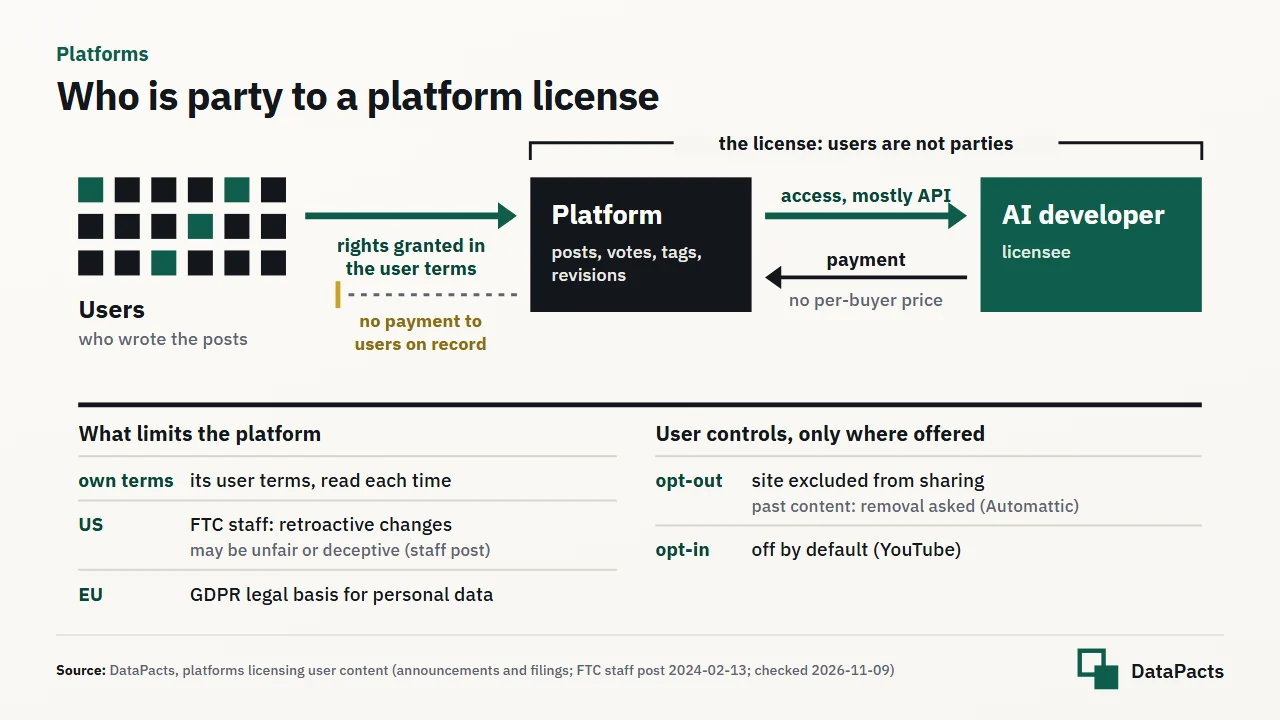
As of 2026-11-10, eight platform licenses are on the public record from the parties' own announcements and filings, none states a per-buyer price, and no announcement or filing on record states a payment to the users who wrote the content.
Reddit's 10-Q filed on 2026-10-30 says that substantially all of its licensing contract value comes from two partners whose agreements are approaching the end of their current terms. Not licensing is a valid outcome. Platform deals are one part of AI training data licensing.
What a Platform Licenses When It Sells Access to User Posts
A platform licenses access to the content its users created on it, plus the structure around it such as votes, tags, revisions and timestamps, and usually delivers it as a continuous feed rather than a one-off file. The announced deals show four kinds of asset:
- Posts and comments, delivered as real-time structured content through the Reddit Data API.
- Questions and answers with tags, comments, votes and revisions, from 150+ Stack Exchange sites.
- Encyclopedic articles, delivered on demand, as snapshots or in realtime.
- Reviews and local business data, as in the Yelp agreement with OpenAI.
Reddit's S-1 describes its arrangements as allowing third parties to "access, search, and analyze data on our platform". The data-type view is forum and community archives as AI training data.
Platform Licenses on Record, Party by Party
Eight platform licenses with AI developers are on the public record from the parties' own announcements and filings, and none states a per-buyer price. The table lists them by date as of 2026-11-10, with the Use column taken from each party's words: T training stated, I "improve model performance" stated, n/s use not stated.
| Date | Platform (legal party) | AI developer | Access and data | Use (party's words) | Value as stated | Source |
|---|---|---|---|---|---|---|
| 2024-01 (disclosed 2024-02-22) | Reddit, Inc. | not named in the S-1 | arrangements to "access, search, and analyze data on our platform" | n/s | USD 203.0 million aggregate contract value, terms two to three years | Reddit, Form S-1 (sec.gov) |
| 2024-02-22 | Reddit, Inc. | Google LLC | Reddit Data API, real-time structured content | T: "display, train on, and otherwise use" (Google) | not disclosed | blog.google |
| 2024-02-27 | Automattic Inc. (WordPress.com, Tumblr) | select AI companies, not named | public posts from sites not opted out | n/s | not disclosed | automattic.com |
| 2024-02-29 | Stack Exchange, Inc. (Stack Overflow) | Google Cloud (Google LLC) | technical knowledge surfaced in the Google Cloud console | n/s | not disclosed | stackoverflow.co |
| 2024-05-06 | Stack Exchange, Inc. (Stack Overflow) | OpenAI | OverflowAPI; attribution in ChatGPT | I: collaborate to improve model performance (Stack Overflow) | not disclosed | stackoverflow.co |
| 2024-05-16 | Reddit, Inc. | OpenAI | Reddit Data API for ChatGPT and new products | n/s | not disclosed | redditinc.com |
| 2026-01-15 | Wikimedia, LLC (Wikimedia Enterprise) | Amazon, Meta, Microsoft, Mistral AI, Perplexity (new partners) | paid Enterprise API: on-demand, snapshot, realtime | n/s | not disclosed; no pricing | enterprise.wikimedia.com |
| 2026-02 (letter dated 2026-02-12) | Yelp Inc. | OpenAI | agreement "recently signed" | n/s | not disclosed | Yelp shareholder letter (sec.gov) |
n/s = use not stated. "Not stated" does not mean training is forbidden.
Paid API Access: Reddit, Stack Overflow and Wikimedia Enterprise
Reddit, Stack Overflow and Wikimedia Enterprise sell API access to their content, and only Google's announcement with Reddit states training in so many words.
Reddit's post of 2024-05-16 says OpenAI accesses the Reddit Data API for ChatGPT and new products, and its Q2 2024 shareholder letter also names Sprinklr as a data licensing partner. Stack Overflow's OpenAI agreement of 2024-05-06 pairs OverflowAPI access with attribution in ChatGPT.
Stack Overflow states, checked 2026-11-09, that 83M+ Q&A are available for licensing, with a free sample of 1,000 Q&A pairs, continuous access for training and fine-tuning, and attribution expected. The legal party is Stack Exchange, Inc. The full record sits on Reddit's AI data licensing deals with Google and OpenAI.
Sharing Public Posts With Unnamed AI Companies: Automattic
Automattic announced on 2024-02-27 that it shares public content from WordPress.com and Tumblr sites with select AI companies, but only from sites that have not opted out. Automattic states that it updates partners about new opt-outs and asks them to remove content from past sources.
Reviews and Local Data: Yelp's Agreement With OpenAI
Yelp told shareholders in a letter dated 2026-02-12 that it had recently signed an agreement with OpenAI, without a signing date or a value.
What Platforms' Filings Say About Licensing Money
Platform filings disclose licensing money only in aggregates and mixed revenue lines, never per buyer. Five items carry the figures:
- Reddit S-1 (2024-02-22): January 2024 arrangements with an aggregate contract value of USD 203.0 million, terms of two to three years, counterparties not named.
- Reddit "Other revenue": content licensing plus products sold directly to users, USD 140.026 million for FY2025 and USD 47.961 million for Q3 2026, so the line is not licensing revenue alone.
- Reddit remaining performance obligations (10-Q, period ended 2026-09-30): USD 62.4 million in contracts with an original expected duration exceeding one year, primarily long-term content licensing.
- Reddit concentration (10-Q filed 2026-10-30): substantially all licensing contract value from two partners whose agreements are approaching the end of their current terms, with no renewal or non-renewal on record as of 2026-11-09.
- Yelp (letter of 2026-02-12): other revenue of USD 74 million in 2025, a line that includes data licensing.
Company-level figures from several filers are compared under AI data licensing revenue in company filings.
How a Platform Can License What Its Users Wrote
A platform licenses user content under the rights its users granted it, within limits set by other terms, consumer-protection law and data-protection law.
The Rights Users Grant and the Limits Other Terms Set
The platform's own terms of service decide whether it holds rights in user posts broad enough to sublicense them to an AI developer, and the user is not asked again for each deal. A rights review reads the current terms of each platform rather than assuming a common rule.
Posts released under an open license follow that license. Creative Commons states, checked 2026-11-09, that its licenses apply only where copyright permission is required, and that under a cautious reading content under a NoDerivatives license is not used as training data.
Other terms can cut the other way. Discord's terms, effective 2025-09-29 and checked 2026-11-09, prohibit "selling, licensing, or otherwise commercializing content or data obtained from the services" in section 9.
Changing Terms to Add AI Licensing: the FTC Staff Position
FTC staff wrote on 2024-02-13 that it may be unfair or deceptive for a company to adopt more permissive data practices through a retroactive or surreptitious change to its terms. The post is a staff blog entry, not a Commission rule.
Reddit disclosed in its S-1/A that it received a letter of non-public inquiry from the FTC on 2024-03-14 about licensing user content to train AI, and no outcome is on the record. Section 5 and privacy policy changes are covered under FTC rules on AI training data.
Personal Data Inside Public Posts
Public posts name and describe people, so in the EU licensing them for training is also a processing of personal data that needs a legal basis. The EDPB adopted Opinion 28/2024 on 2024-12-17 under Article 64(2) GDPR, and it sets two tests:
- Legal basis: legitimate interest is assessed by a three-step test.
- Model anonymity: a model is anonymous only if extraction and query-based retrieval of personal data are insignificant.
The three-step test is explained under legitimate interest for AI training data.
User Backlash, Opt-outs and Opt-ins Around Platform Licensing
Platforms have answered user objections in three ways on the record: an opt-out paired with removal requests for past deliveries, an opt-in that is off by default, and a fund that pays contributors. Automattic's opt-out excludes a site from sharing, and Automattic asks partners to remove content from past sources.
YouTube's third-party training setting is off by default, and the channel owner chooses listed companies or all third parties. YouTube states, checked 2026-11-09, that it is not facilitating payments between third-party companies and creators or other rights holders at this time.
Shutterstock announced its Contributor Fund on 2022-10-25 and states, checked 2026-11-09, that it compensates contributors whose IP was used in developing generative models, with earnings from the OpenAI datasets first issued in Q4 2022. Shutterstock is a stock library, not a community.
No dated protest, deletion or moderator action over a platform license is described here. User-side settings and their limits are set out under opting out of AI training.
Protecting the Licensed Asset: Suits Over Unlicensed Access
A license is worth what the platform can keep others from taking free, and Reddit has sued companies it says accessed its content without one. As of 2026-11-09, Reddit v.
Anthropic is pending in San Francisco County Superior Court (CGC-25-625892) after the federal case 3:25-cv-05643-TLT was remanded on 2026-03-30 (Dkt. 60), over breach of contract and related claims about automated access to train Claude.
Reddit v. SerpApi, Oxylabs, AWMProxy and Perplexity (S.D.N.Y. 1:25-cv-08736-PAE, filed 2025-10-22) concerns DMCA section 1201 and related claims over scraping Reddit content from Google results. The court predominantly denied the motions to dismiss of SerpApi and Perplexity on 2026-07-31 (Dkt. 104), and the Oxylabs motion was undecided as of 2026-11-06.
Reddit's shareholder letter of 2026-10-29 frames its Q4 2026 logged-in-only tests outside the U.S. partly as protecting access to its data corpus. The wider contract and computer-misuse questions are covered under web scraping for AI training.
Benefits, Risks and Downsides of Licensing User Content, and the Options Besides It
Licensing user content can bring multi-year contract revenue, but it rests on rights users granted for other purposes, draws regulator attention, and not licensing is a valid outcome.
Benefits
- Multi-year contract revenue: Reddit's S-1 states terms of two to three years.
- Attribution: Stack Overflow expects it.
- Willing users stay in: Automattic's opt-out.
Risks
- Retroactive terms changes may be unfair or deceptive in the view of FTC staff.
- Reddit disclosed a non-public FTC inquiry, with no outcome on record.
- EU personal-data duties apply to posts that name people.
- Unlicensed access undercuts the licensed asset, as Reddit's two suits show.
Downsides
- Concentration: Reddit's licensing contract value sits with two partners.
- Mixed revenue lines are hard to read.
- User trust is at stake, and no record quantifies it.
Alternatives
- License only content whose authors opted in, as in YouTube's setting.
- License through an API with attribution terms, as Stack Overflow does.
- Block or restrict access, as Reddit's logged-in tests do.
- Not licensing at all, among the alternatives to selling data to AI labs.
Each option changes what the platform can promise a buyer.
Steps From a Terms Review to a Signed Platform Data License
A platform reaches a signed license in six steps, and the first two decide how much of its content it can offer.
- Read the user terms and any open-content license on the posts.
- Decide whether users get an opt-out or an opt-in, and whether it reaches past deliveries.
- Screen for personal data and set the legal basis.
- Decide the use granted, training, display or both, and the attribution terms.
- Collect written terms from more than one AI developer and compare grant, term, exclusivity, deletion and payment basis.
- Announce the change to users before it applies.
Grant, attribution and deletion terms are explained in AI data licensing agreements.
Where Platform Licensing Meets Publishers, Creators and Services Training on Their Own Users
This page covers platforms that license user content to outside AI developers, while a service that trains its own models on its users' data is a different case with its own rules.
That case is covered under services that train on their own users. The intermediaries called content licensing platforms for publishers are a different kind of platform.
Platforms are one entry among every type of seller. The uploader's side is described under creators selling content for AI training, and the closest seller types are stock photo and footage libraries and nonprofits licensing data.
- Edited content: news publishers and media licensing content.
- Where platform deals sit: licensed vs scraped training data.
- Every platform license in the AI data licensing deals tracker.
- Notices and transfers: GDPR and AI training data.
This page is information, not legal advice.
Deal, Case and Buyer Pages Named on This Page
Each deal, case and buyer above has or will have its own page with parties, dates and sources.
- Buyers: Google as a data buyer, OpenAI as a data buyer, Shutterstock data licensing.
- Cases: Reddit v. Anthropic, Reddit v. Perplexity, SerpApi and others.
- Deals: Automattic (Tumblr, WordPress.com) data licensing, Shutterstock's AI licensing deals, Stack Overflow AI licensing deals, Wikimedia Enterprise AI deals, Yelp and OpenAI data licensing agreement.
- Terms: Discord server data and AI licensing.
Frequently Asked Questions
Do platforms pay users when they license their posts to AI companies?
None of the platform licenses on record states a payment to the users who wrote the content. Shutterstock's Contributor Fund is a stock library's model, and YouTube says it does not facilitate payments.
Can users stop a platform from licensing their posts?
Only where the platform offers a control. Automattic excludes sites that opted out and asks partners to remove past content, while YouTube's third-party training setting is off unless the creator turns it on.
Do platform licenses with AI companies cover training?
Some do. Google states it may train on Reddit content and Stack Overflow offers access for training and fine-tuning, while the OpenAI-Reddit, Wikimedia Enterprise and Yelp announcements do not state training.