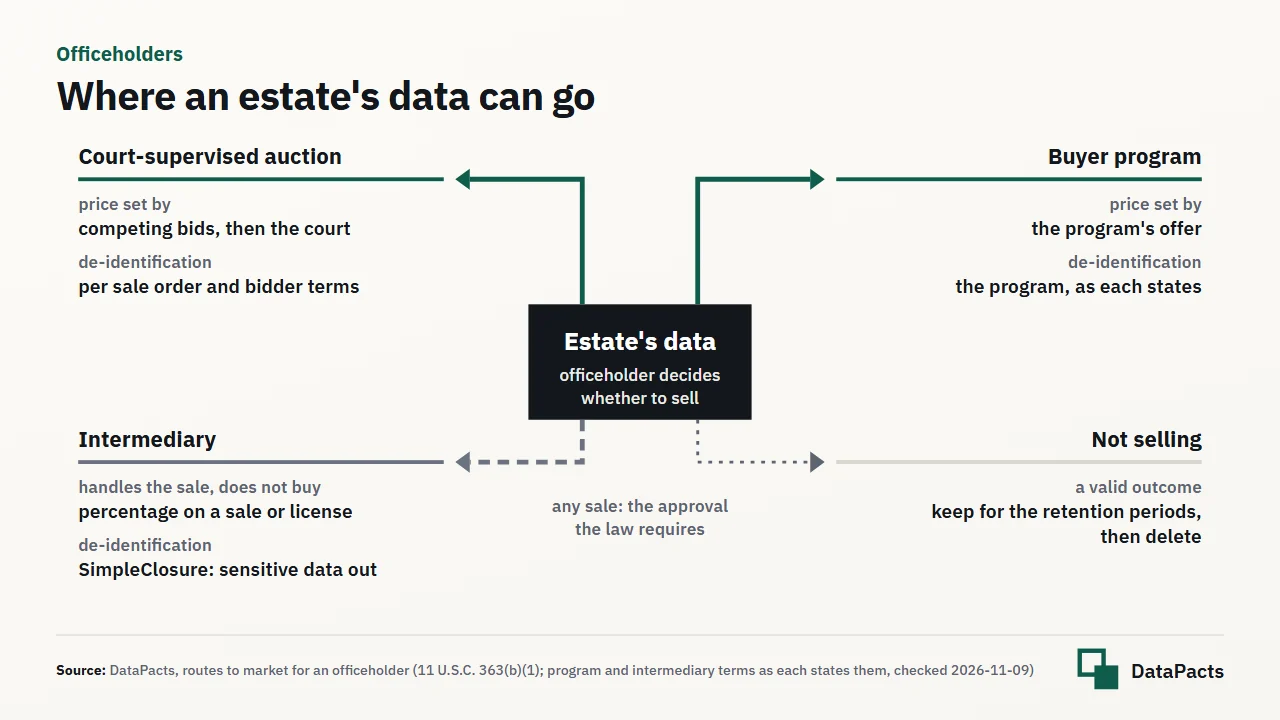
The page covers the mandate, regulator positions, scoping, routes to market, bidder terms, pricing and the option not to sell, as one officeholder route in AI training data licensing. Country procedure sits on the jurisdiction pages.
The statutes, regulator texts and program pages below were checked against their primary sources, under the rules on how we source, date and check every figure.
What an Officeholder's Mandate Means for the Company's Data
The officeholder holds the power to sell the company's property, data included, and in some jurisdictions also a duty to realize it, but each sale passes the approval the insolvency law sets.
In the UK, an administrator may sell company property by public auction or private contract (Insolvency Act 1986 Sch B1 para 60 with Sch 1 para 2; Schedule B1 has applied since 2003-09-15), and a liquidator holds the same power under Sch 4 para 6. In the US, a trustee or debtor in possession may sell outside the ordinary course after notice and a hearing (11 U.S.C. 363(b)(1)).
German law frames realization as a duty. From the opening of proceedings the power of disposal passes to the Insolvenzverwalter (InsO s.80(1)), who must realize the estate without delay after the report meeting unless creditors' resolutions stand in the way (s.159), and who needs creditors' consent for significant acts such as selling the business (s.160).
Austria requires the creditors' committee and the court to approve a sale of the business regardless of value (IO s.117(1)).
In France the juge-commissaire sets prices and conditions (Code de commerce art. L642-19, in the version in force from 2009-02-15 to 2016-11-20). This page states no UK or US duty to realize and no personal liability rule for officeholders, either way.
In a UK administration the administrator acts as the company's agent, so the company stays the data controller (Sch B1 para 69). The controller position of a liquidator, and of officeholders in other jurisdictions, is not stated here. The rules of UK administration and liquidation are set out in full on the UK page.
What Data Protection Regulators Have Said About Personal Data in Insolvency Sales
No regulator in the jurisdictions covered here exempts an insolvent company from data protection law, and the published positions limit what an officeholder may hand to bidders before and after signing. The table lists six published positions, as of 2026-11-09.
| Regulator | Position or action | Date | What it means for an officeholder | Source |
|---|---|---|---|---|
| EDPB (EU) | Guidelines 02/2026 on Anonymisation: anonymity tested by no record isolation, no linkage and no inference, from each relevant entity's perspective; consultation until 2026-10-30 | adopted for consultation 2026-07-07; not final as of 2026-11-09 | de-identified estate data leaves the GDPR only if it meets these criteria | edpb.europa.eu |
| Garante (Italy) | order against Framos Italia s.r.l. in liquidazione: GDPR Arts 5(1)(a), (c), (e), 6, 12, 13, 17 and 29 breached; fine EUR 5,000, taking account of the liquidation | 2026-04-17 | liquidation does not pause GDPR duties | garanteprivacy.it |
| ICO (UK), with other authorities | co-signed the joint letter on the 23andMe bankruptcy published by the Office of the Privacy Commissioner of Canada | 2025-04-28 | regulators follow estate data sales across borders | priv.gc.ca |
| DSK (Germany) | asset-deal resolution: pre-signing transfer of customer, supplier and employee data in principle not permitted without consent; special-category data only with explicit consent; objection period of about 6 weeks | 2024-09-11 | limits data rooms and the transfer itself | datenschutzkonferenz-online.de |
| DSK (Germany) | resolution "Besserer Schutz von Patientendaten bei Schließung von Krankenhäusern" | 2024-05-15 | patient records in closures are a named concern | datenschutzkonferenz-online.de |
| FTC (US) | RadioShack letter recalling the Toysmart conditions: customer data not sold as a standalone asset, buyer in substantially the same line of business, bound by the privacy policy, affirmative consent for material changes | 2015-05-16 | a buyer may inherit the debtor's privacy promises | ftc.gov |
Published regulator positions on personal data in insolvency and asset sales, as of 2026-11-09. Not a complete list; no EDPB or ICO guidance specific to insolvency sales is listed.
In the EU the DSK resolution is the most detailed on asset deals: it covers the pre-signing transfer, a possible legitimate interest for key persons in advanced negotiations, and an objection period of about 6 weeks for customer data.
The Garante fined a company in liquidation, so the status does not pause GDPR duties. The GDPR and AI training data page covers the legal bases.
In the US, personal data collected under a privacy policy in force at the filing may be sold only consistently with it, or after a consumer privacy ombudsman is appointed (11 U.S.C. 332, not later than 7 days before the hearing) and the court approves.
The procedure is set out under US bankruptcy data sales and the consumer privacy ombudsman.
Scoping What the Estate Can Offer: Customer, Employee and Special-Category Data
An officeholder can offer only the data that may lawfully leave the estate, so scoping splits customer records, employee records, special-category data and third-party content before any bidder sees a sample.
The US ombudsman route covers only consumer data under the definition in 11 U.S.C. 101(41A), so employee and business records fall outside it on its face and need their own review. The Garante order concerned a former employee's mailboxes kept active for 6 months after termination.
Special-category customer data, for example health data, moves in an EU asset deal only with informed explicit consent (GDPR Art. 9(2)(a) and Art. 7) in the DSK's reading. The DSK also adopted a resolution on patient data when hospitals close (2024-05-15), cited here by title and date only.
De-identified data leaves the GDPR only if it is anonymous. The EDPB's Guidelines 02/2026, adopted for consultation on 2026-07-07 (consultation until 2026-10-30) and not final as of 2026-11-09, test anonymity by three criteria (no record isolation, no linkage, no inference) from each relevant entity's perspective.
The test and the legal effect are explained under anonymization versus pseudonymization, with the method steps under PII removal and de-identification.
Routes to Market for an Officeholder: Auction, Buyer Program or Intermediary
An officeholder can take estate data to market by a court-supervised auction, by a private contract with a buyer program, or through an intermediary, and each route changes who sets the price and who handles the data. The table compares the three routes, as of 2026-11-09.
| Route | Who sets the price | Who handles de-identification | Example on record | Source |
|---|---|---|---|---|
| Court-supervised auction | competing bids, then court approval (11 U.S.C. 363(b)(1)) | set by the sale order and the bidder's terms | 23andMe: USD 256.0 million initial bid superseded by USD 305.0 million (2025) | govinfo.gov; sec.gov |
| Private contract with a buyer program | the program's offer; approval as the law requires | the program, as each states: Ooak in house, Turing at its cost | Ooak states wind-down deals close with a director, liquidator or administrator signing | ooakdata.com; lazarus.turing.com |
| Intermediary (handles the sale, does not buy) | buyers found by the intermediary; it takes a percentage on a sale or license | SimpleClosure states sensitive employee, compensation, health and personal information is excluded | SimpleClosure AssetHub: license or outright sale | simpleclosure.com |
How an officeholder can take estate data to market, as of 2026-11-09. Program terms are each party's own claim, checked 2026-11-09.
Intermediaries handle the sale for the estate and are not buyers. SimpleClosure states that it takes a percentage only if assets are sold or licensed, and Ooak Data states that its wind-down deals close with a director, liquidator or administrator signing. Fee models and conflicts are compared under selling direct or through a broker.
Checking a Bidder's Terms Before the Estate Signs
Before signing, an officeholder checks who will de-identify the data, how long the bidder keeps raw data, what license it takes and what liability the estate accepts, because buyer programs answer each point differently.
On de-identification, micro1 states that it de-identifies sensitive information itself, Turing and Mercor state that they cover the cost, and Ooak states that it anonymizes in house, each as a claim checked 2026-11-09. A bidder-run or an independent de-identification is the officeholder's choice.
On retention and license, Ooak states that raw data is deleted within 30 days of delivery with written confirmation. micro1's master terms of 2026-11-08 describe a perpetual nonexclusive license, raw-data deletion at the earlier of 120 days after delivery or termination with no duty to retrain, a licensor indemnity and a clawback if the data manifest is materially inaccurate.
Turing states that the license to Turing is exclusive for the first 6 months after signing, during which it may license the same record to more than one lab (Ooak checked 2026-11-09, Turing checked 2026-11-17).
Obligations that outlast a sale matter to an estate that will close. The buyer-side and seller-side checks are set out under due diligence in an AI data deal.
How Estate Data Gets a Price: Bids, Prior License Income and the Book Value Gap
Estate data gets its price from competing bids or a negotiated offer, because an internally built data archive usually carries no book value to start from.
On 2026-08-14 the Spirit Airlines auction produced a successful bid of USD 10,000,000 from Google LLC and an alternate bid of USD 7,500,000 from Mercor.io Corporation (Dkt. 1463); the sale is not approved as of 2026-11-09 and the hearing is set for 2026-11-17 (Dkt. 1779, Bankr. S.D.N.Y. 25-11897 (SHL)).
23andMe shows that bids can be superseded: Regeneron's initial winning bid at the 2025-05-17 auction gave way to TTAM Research Institute's purchase under the sale order of 2025-06-27 (Bankr.
E.D. Mo. 25-40976), the amounts being those in the route table. Its genetic database had earned license income before the case, including a USD 20 million upfront payment for a one-year non-exclusive license (2023-10-30).
Under IAS 38.63 internally generated data archives are not recognized as intangible assets, so the balance sheet gives no figure. This page states no appraisal or valuation requirement for estates. Methods and public price points are on the page about what company data is worth to AI companies.
Taking Estate Data to Market or Not: Benefits, Risks, Downsides and Alternatives
A data sale can add realizations for creditors, but it brings privacy, employee and contract exposure the officeholder must manage, and leaving the data unsold is a valid outcome.
Benefits
- An asset with no book value can still raise money.
- Competing bids set the price.
- Some programs state they take wind-down records signed by an officeholder and carry the de-identification cost.
Risks
- Regulators keep enforcing against companies in liquidation.
- Pre-signing disclosure of customer, supplier or employee data is in principle not permitted without consent in the DSK's reading.
- Regulators can order erasure of a dataset or model built on unlawfully processed data (EDPB Opinion 28/2024, adopted 2024-12-17, para 114).
- Referral fees around US estate sales are restricted: professionals paid from the estate may not share compensation (11 U.S.C. 504), and payment for acting or forbearing to act in a title 11 case can be a crime (18 U.S.C. 152(6)); the terms of referral programs of AI data buyers are compared separately.
Downsides
- Scoping, de-identification and review take time and cost that the estate pays unless a program states it covers them.
- License terms can outlast the estate, such as indemnities and clawbacks.
- Record retention duties continue after a sale; no periods are stated here.
Alternatives
- Not selling: keep the records for their retention periods and then delete them.
- Selling the business without the data, as the proposed Character.AI stalking-horse bid of 2026-10-13 excludes end-user data, training data and models.
- Licensing on revenue share instead of selling, with ownership unchanged, as Turing states for Project Lazarus.
- An out-of-court route such as a Delaware assignment under 10 Del. C. ch. 73A, effective 2026-06-10.
DataPacts takes no position on whether an estate should sell; the decision belongs to the officeholder and, where the law requires, the creditors or the court.
Where the Officeholder's Role Connects to Country Rules and the Seller Path
This page covers the officeholder's role across jurisdictions; the pages below cover each jurisdiction's procedure, the estate tracker, the seller process and the buyers.
- Parent: data assets in insolvency, how estates in every jurisdiction sell
- Germany: German insolvency and data sales, the Insolvenzverwalter's procedure
- Tracker: bankruptcy estates selling data assets
- Employees: employee data in bankruptcy data sales, why the ombudsman does not cover it
- Records: record retention after closing a company, minimum periods
- Outside insolvency: selling data from a shut-down or defunct company
- Programs: company data partnership programs, every one on the site
- Intermediaries: shutdown services that handle data for closing companies
- The general decision: should you sell or license your data
- Buyers: who buys AI training data, every program compared
This page is information, not legal advice.
Frequently Asked Questions
Can a liquidator sell a company's customer data?
Yes, under the power of sale (in the UK Insolvency Act 1986 Sch 4 para 6), but the sale needs the approval the insolvency law requires. Personal data stays subject to data protection law and, in the US, to 11 U.S.C. 363(b)(1).
Does insolvency suspend data protection law?
No. Italy's Garante fined a company in liquidation EUR 5,000 on 2026-04-17 for GDPR breaches, and the German DSK's 2024 resolution on asset deals limits what customer and employee data may pass to bidders.
Who pays for de-identifying estate data?
It depends on the buyer's terms. Turing states it covers de-identification costs, Mercor states it covers anonymization and transfer costs, and micro1 states it de-identifies data itself (checked 2026-11-09); an estate can also appoint its own provider.