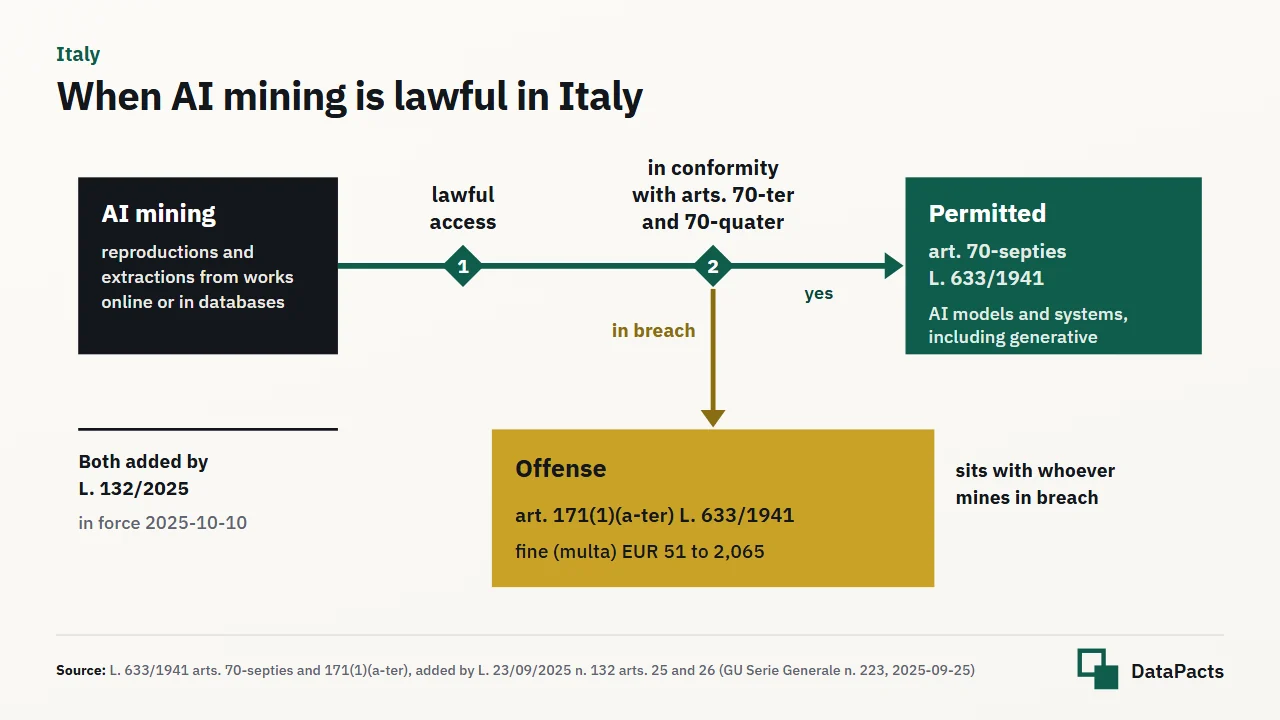
Legge 23 settembre 2025, n. 132 added the mining article and the offence, and both have been in force since 2025-10-10.
This page sets out the instruments, dated changes and open items as of 2026-11-09, for the data holder and for the AI developer.
It is a free-to-read part of the wider reference on AI training data licensing, covers EU rules only where Italy implements or adds to them, and cites Normattiva, the Gazzetta Ufficiale and the Garante's own documents.
What Italian Law Adds to EU Rules Before a Company Licenses Data for Training
Italian law decides five things on top of the EU instruments: when AI mining of protected works is lawful, when it is a crime, what a future decree may add for training data, how the data protection authority has acted on AI, and when staff communications may be used at all.
- Mining: art. 70-septies of the copyright law, in conformity with arts. 70-ter and 70-quater.
- Offence: art. 171(1)(a-ter) of the copyright law.
- Delegation: art. 16 of Law n. 132/2025, decree pending.
- Regulator: Garante decisions from 2023 to 2026.
- Employees: art. 4 of Law n. 300/1970.
The GDPR (Regulation (EU) 2016/679, applies from 2018-05-25) applies directly in Italy. Italian rules on recording calls and meetings and Italian withholding on royalties paid abroad are not recorded on this page.
Italian Instruments and Regulator Decisions That Apply to a Training Data Deal
Ten Italian instruments, regulator acts and record gaps shape a training-data license, and the table gives each citation, its date and whether it is final, pending, guidance or not stated.
Rows with a page of their own link to it once that page is published, and "not stated" means no primary source was verified on 2026-11-09, not that no rule exists.
| Instrument | Citation | Dates | What it decides in a data deal | Final, pending, guidance or not stated | Source |
|---|---|---|---|---|---|
| Legge 23 settembre 2025 n. 132 | L. 23/09/2025 n. 132 (25G00143), GU Serie Generale n. 223 | published 2025-09-25; in force 2025-10-10 | adds the AI mining article and offence; art. 16 delegation; art. 8 health research; art. 20 authorities | final (art. 16 decree pending) | normattiva.it; gazzettaufficiale.it |
| L. 633/1941 art. 70-septies | added by L. 132/2025 art. 25(1)(b) | in force 2025-10-10 | AI mining of lawfully accessed works permitted in conformity with arts. 70-ter and 70-quater | final | normattiva.it |
| L. 633/1941 arts. 70-ter and 70-quater | not stated | not stated | wording, reservation form and research scope not stated on this page | not stated | n/a |
| L. 633/1941 art. 171(1)(a-ter) | added by L. 132/2025 art. 26(3) | in force 2025-10-10 | mining in breach of arts. 70-ter and 70-quater is an offence; multa EUR 51 to 2,065 | final | gazzettaufficiale.it |
| GDPR | Regulation (EU) 2016/679 | applies from 2018-05-25 | legal basis, notices and transfers for personal data in the set | final | eur-lex.europa.eu |
| Garante decisions and guidance | note doc. web 10020334; provv. n. 755/2024; provv. n. 741/2024; order of 2026-04-17 (registro n. 278) | 2023-03-30 to 2026-04-17 | scraping measures; fine with opposition upheld; warning to a seller; liquidation mailbox order | guidance and decisions | garanteprivacy.it |
| Statuto dei lavoratori art. 4 | L. 20 maggio 1970, n. 300, art. 4 | in force | remote-monitoring tools need agreement or authorization; data for employment purposes only, with adequate information | final | normattiva.it |
| US-Italy treaty rates on royalties | IRS Tax Treaty Table 1, Rev. May 2023, income codes 10 and 12 | as of 2026-11-09 | 8% (code 10) and 0% (code 12) US withholding for Italian residents, subject to limitation on benefits | final | irs.gov |
| Italian withholding on royalties paid abroad | not stated | not stated | not stated | not stated | n/a |
| Recording of calls and meetings | not stated | not stated | not stated | not stated | n/a |
How Each Italian Rule Reaches the Seller and the Buyer
The table lists each instrument; the sections below show what each one asks of the data holder and of the AI developer.
Mining for AI Under Art. 70-septies: Conformity With Arts. 70-ter and 70-quater
Art. 70-septies of the copyright law (L. 633/1941), added by art. 25(1)(b) of Legge 23 settembre 2025 n. 132 and in force since 2025-10-10, permits reproductions and extractions from works or materials online or in databases to which the user has lawful access, for text and data mining through AI models and systems, including generative ones, in conformity with arts. 70-ter and 70-quater.
The Gazzetta Ufficiale record is Serie Generale n. 223 of 2025-09-25 (25G00143); 2025-09-25 is the publication date and 2025-10-10 the entry into force.
Italy routes AI mining through the two articles that carry the EU exceptions, so the conditions of those articles decide whether a license is the buyer's route.
Their wording, the form of a reservation and the transposing decree are not stated on this page. The EU rule and its opt-out sit on the page about the EU text and data mining exception.
The Offence in Art. 171(1)(a-ter) and What It Means for a Licensor
Art. 26(3) of the 2025 law added letter a-ter to art. 171(1) of the copyright law, which punishes whoever reproduces or extracts text or data from works or materials online or in databases in violation of arts. 70-ter and 70-quater, also through AI systems.
The base penalty of art. 171 is a fine (multa) of EUR 51 to 2,065 according to the Gazzetta Ufficiale notes of 2025-09-25, while Normattiva's art. 171 page still shows the lire wording.
The offence sits with the person who mines in breach, so a documented reservation plus a license moves the buyer from offence risk into a contract. No prosecution under the new letter is recorded here.
What the 2025 Statute Delegates and Designates: Training-Data Decrees, AgID and ACN
Art. 16 of Law n. 132/2025 delegates the Government to adopt, within 12 months of entry into force, legislative decrees giving an organic discipline of the use of data, algorithms and mathematical methods for training AI systems, without obligations beyond those of the AI Act.
The decrees may set remedies, sanctions and specialised business-court sections. The deadline computes to 2026-10-10, and it is extended by 60 days when the 60-day parliamentary opinion period ends within the last 30 days or later. No adopted decree was found as of 2026-11-09.
Art. 20 designates AgID as the national AI authority and notifying authority under Art. 70 of the AI Act, and ACN as market surveillance authority and single point of contact under art. 20(2).
The Garante's powers stay as they are. Normattiva marks arts. 19 and 24 as amended on 2026-06-26, and the content of that change is not described here.
Health Research Data Under Art. 8: Notice to the Regulator First
Art. 8 of the 2025 law sets a framework for using health data in AI research, and art. 8(5) lets the processing start only 30 days after it is notified to the Garante.
Who qualifies and which data are covered are not stated here. Health data stay special-category data under Art. 9 GDPR, which matters for any set described under medical and clinical data for AI training.
Regulator Decisions a Seller Should Know, 2023 to 2026
The Garante per la protezione dei dati personali has acted on AI training data through guidance, urgent limitations, a fine, a formal warning to a seller and an order on a company in liquidation.
Its information note of 2024-05-20 on web scraping for generative AI (doc. web 10020334) is guidance, not binding, and lists four measures: reserved areas, terms-of-service clauses, traffic monitoring and bot countermeasures.
On 2025-01-30 it ordered an urgent limitation of processing against the two DeepSeek companies and opened an investigation, and the outcome is not stated here.
On 2024-11-27 the Garante issued provvedimento n. 741, a formal warning under Art. 58(2)(a) GDPR to GEDI Gruppo Editoriale S.p.A. over its agreement of 2024-09-24 with OpenAI, citing possible breaches of Arts. 9, 10, 13 and 14 and of Chapter III. The deal value was not disclosed.
The Garante limited ChatGPT's processing on 2023-03-30 and fined OpenAI EUR 15 million in decision n. 755 of 2024-11-02, and the Tribunale di Roma upheld OpenAI's opposition in judgment n. 4153/2026, published 2026-03-18. The case record of the Italian Garante v. OpenAI holds the detail.
Staff Email and Chat: Remote-Monitoring Limits in Law 300/1970
Art. 4 of the Statuto dei lavoratori (L. 20 maggio 1970, n. 300) limits tools that allow remote monitoring of workers, and the data they collect may be used only for purposes connected to the employment relationship.
- Art. 4(1): such tools are allowed only for organizational, production, safety or asset-protection needs, with an RSU or RSA agreement or an authorization of the Ispettorato.
- Art. 4(2): the rule does not apply to tools used to perform the work.
- Art. 4(3): the data are usable for all purposes connected to the employment relationship if the worker received adequate information and d.lgs. 196/2003 is respected, checked 2026-11-09.
On our reading, licensing staff email or chat to an AI developer is not an employment purpose, so art. 4(3) does not cover it; this is an interpretation to confirm with counsel.
On 2026-04-17 the Garante fined a company in liquidation EUR 5,000 for keeping a former employee's two mailboxes active from 2023-06-30 to 2023-12-21, taking the liquidation into account (order registro n. 278). The comparison across countries is on the page about employee data and AI training rules.
Royalty Payments Between Italy and the United States
A US buyer paying a royalty to an Italian-resident seller withholds 0% on copyright royalties (income code 12) and 8% on know-how and other industrial royalties (income code 10) under IRS Table 1, Rev.
May 2023, subject to the treaty's limitation-on-benefits test. Which code a data license falls under depends on the license terms, not on this page. Italian withholding on royalties paid by an Italian buyer abroad is not stated here.
Enacted, Pending and Open: Italian Changes as of November 2026
Eleven dated items changed how Italian law and the Italian regulator treat training data, and the table keeps statutes, decisions, guidance and pending decrees apart.
| Date | Item | Citation or actor | Status as of 2026-11-09 | Source |
|---|---|---|---|---|
| 2026-10-10 | Art. 16 delegation deadline (computed: 12 months from entry into force; 60-day extension rule) | L. 132/2025 art. 16 | no adopted decree found | normattiva.it |
| 2026-06-26 | Arts. 19 and 24 of L. 132/2025 marked amended | Normattiva update | content of the change not described | normattiva.it |
| 2026-04-17 | Order on a company in liquidation: former employee's mailboxes kept active, EUR 5,000 | Garante, registro n. 278 | decided | garanteprivacy.it |
| 2026-03-18 | Judgment n. 4153/2026 published: OpenAI's opposition to decision n. 755 upheld | Tribunale di Roma | opposition upheld; decision temporarily removed by the Garante | garanteprivacy.it |
| 2025-10-10 | L. 132/2025 enters into force, adding art. 70-septies and art. 171(1)(a-ter) | L. 23/09/2025 n. 132 | in force | normattiva.it |
| 2025-09-25 | L. 132/2025 published | GU Serie Generale n. 223 | published | gazzettaufficiale.it |
| 2025-01-30 | Urgent limitation against the DeepSeek companies | Garante | limitation ordered, investigation opened; outcome not stated | garanteprivacy.it |
| 2024-11-27 | Formal warning to GEDI over its archive deal with OpenAI | Garante provv. n. 741, Art. 58(2)(a) GDPR | warning issued | garanteprivacy.it |
| 2024-11-02 | Decision n. 755: EUR 15 million fine on OpenAI, 6-month information campaign | Garante; Art. 166(7) Privacy Code | opposition upheld 2026-03-18 | garanteprivacy.it |
| 2024-05-20 | Information note on web scraping for generative AI | Garante, doc. web 10020334 | guidance, not binding | garanteprivacy.it |
| 2023-03-30 | Urgent temporary limitation of ChatGPT processing | Garante, registro n. 112, Art. 58(2)(f) GDPR | ordered | garanteprivacy.it |
A limitation or a warning is not a fine. The Garante's notice states that the opposition against decision n. 755 was upheld; whether the decision was set aside in whole or in part, or appealed, is not stated, and the art. 16 decree remains pending.
Benefits, Risks, Downsides and Alternatives of Licensing Data Under Italian Law, Including Not Selling
Italian law lets a company license data it holds the rights to, and the mining article plus its offence give a license real value, but the Garante's practice, the employee rule and a pending decree add conditions, and not licensing remains a valid choice.
Benefits
- Lawful access plus conformity with arts. 70-ter and 70-quater is the test, so a license gives the buyer certainty.
- Mining in breach is an offence, which supports a license price.
- A 0% US treaty rate applies to copyright royalties paid to Italian residents.
Risks
- The Garante issued a formal warning to a seller over an archive deal.
- The Garante fined a company in liquidation over mailboxes left active.
- Special-category data in the set bring Art. 9 GDPR duties.
Downsides
- An art. 4(1) agreement or authorization and the notices take time before any income.
- A decree under art. 16 may change the training-data rules.
Alternatives
- License only content without personal data.
- Keep the data and document a reservation.
- License de-identified data.
- Not selling or licensing at all, among the alternatives to selling data to AI labs.
Beyond the Italian Layer: EU Instruments, Neighboring Member States and the Sale
Italian law stops at the EU layer above it and at the contract; the pages below cover the EU instruments, the other member states and the sale itself.
- European Union rules for AI training data, the parent and the EU layer above Italian law.
- AI training data law by jurisdiction, every jurisdiction compared.
- GDPR and AI training data, legal basis and notices.
- transferring training data to US buyers under Chapter V.
- EU AI Act Article 53, what the AI Act asks of model providers.
- copyright and AI training across jurisdictions, how copyright exceptions compare.
- machine-readable TDM reservations, how to express a reservation.
- web scraping for AI training, scraping law beyond Italy.
- call and meeting recording consent rules compared.
- selling data to AI companies from outside the US, including the GEDI warning.
- France rules for licensing data.
- Germany rules for licensing data.
- Spain rules for licensing data.
- Ireland rules for licensing data, where the Garante sent its OpenAI file.
- sell or license company data to AI companies, the steps of a sale.
How This Page Is Sourced and Dated
Every rule here cites Normattiva, the Gazzetta Ufficiale, the Garante's own documents or the IRS treaty table, with the date it was checked.
The rules for dating and checking are set out in the method for sourcing and dating every figure. This page is general information about Italian law, not legal advice for any specific deal.
Frequently Asked Questions
Does Italian law allow AI training on copyrighted works?
Yes, in conformity with arts. 70-ter and 70-quater. Art. 70-septies permits mining of lawfully accessed works for AI, and mining in breach is an offence under art. 171(1)(a-ter).
When did Italy's AI law enter into force?
On 2025-10-10. Legge 132/2025 was published in the Gazzetta Ufficiale on 2025-09-25, which is not its date of entry into force.
Is the Garante's EUR 15 million fine on OpenAI still in force?
The Tribunale di Roma upheld OpenAI's opposition to it. Judgment n. 4153/2026, published 2026-03-18, concerns decision n. 755 of 2024-11-02, which the Garante temporarily removed.
Can an Italian company license its employees' emails for AI training?
Art. 4(3) of the Statuto covers employment purposes only, with adequate information. On our reading licensing is not covered, and the GDPR applies as well.